

|
시장보고서
상품코드
2038738
트럭 시장 : 시장 비즈니스 기회, 성장요인, 업계 동향 분석 및 예측(2026-2035년)Trucks Market Opportunity, Growth Drivers, Industry Trend Analysis, and Forecast 2026 - 2035 |
||||||

세계의 트럭 시장은 2025년에 4,009억 달러로 평가되었고, CAGR 7.3%로 성장할 전망이며, 2035년까지 7,926억 달러에 이를 것으로 추정되고 있습니다.
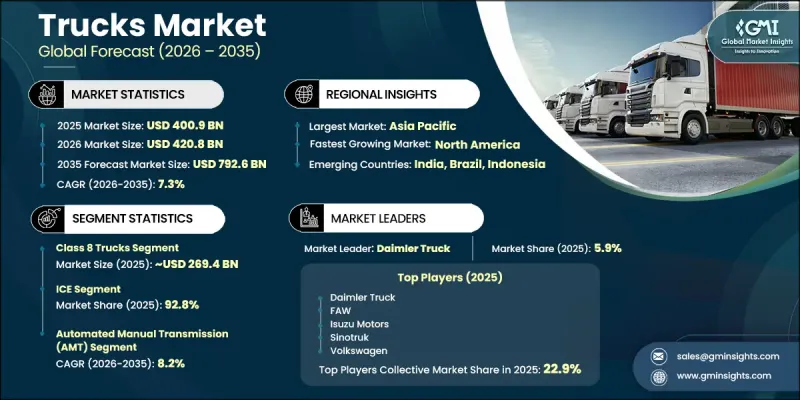
시장의 성장은 화물 수요의 변동과 밀접한 관련이 있으며, 그 수요는 여전히 지역 전체의 경제 동향에 크게 영향을 받고 있습니다. 물류 네트워크의 확대와 운송 효율성에 대한 강조가 업계의 트렌드를 더욱 형성하고 있습니다. 정부 주도의 물류 인프라 강화 노력은 특히 급성장하는 경제권에서 시장 발전을 뒷받침하는 데 있어 점점 더 중요한 역할을 하고 있습니다. 도로망에 대한 공공 투자 증가, 규제 개선 및 공급망 효율화 프로그램은 화물 운송 서비스에 대한 수요 증가에 기여하고 있으며, 이는 중대형 트럭에 대한 안정적인 수요를 견인하고 있습니다. 국내 화물 운송은 여전히 도로 운송이 주류를 이루고 있으며, 이는 트럭을 기반으로 한 물류 시스템의 중요성을 뒷받침하고 있습니다. 동시에 전동화 추세, 차량 시스템의 자동화, 건설 부문의 성장, 택배 서비스의 급속한 확장이 업계의 구조적 변화를 주도하고 있습니다. 이러한 요인들이 복합적으로 작용하여 전 세계 트럭 운송 생태계 전반에 걸쳐 차량 설계, 운영 모델 및 차량 보유 자금 조달 구조를 재구성하고 있습니다.
| 시장 범위 | |
|---|---|
| 개시 연도 | 2025년 |
| 예측 기간 | 2026-2035년 |
| 개시 연도 시장 규모 | 4,009억 달러 |
| 예측 시장 규모 | 7,926억 달러 |
| CAGR | 7.3% |
2025년 8등급 트럭 부문은 67.2%의 점유율을 차지했으며 2,694억 달러의 수익을 창출했습니다. 이 부문은 첨단 기술이 차량 시스템에 광범위하게 통합됨에 따라 큰 변화를 겪고 있습니다. 커넥티드 플릿 솔루션, 자동화 지원, 디지털 모니터링 도구 등의 기능을 통해 운영 효율성, 안전성, 비용 관리를 향상시키고 있습니다. 운송업체들은 생산성을 높이고 물류 성능을 최적화하기 위해 차세대 차량에 대한 투자를 점점 더 많이 늘리고 있습니다.
내연기관 부문은 2025년 92.8%의 점유율을 차지했으며, 시장 규모는 3,719억 달러에 달했습니다. 이러한 압도적인 점유율은 특히 장거리 운송과 중량물 운송에서 뛰어난 성능을 바탕으로 하고 있습니다. 잘 구축된 연료 보급 인프라, 높은 토크 출력, 입증된 신뢰성 등의 기술적 장점으로 인해 전 세계 상업용 운송 사업에서 가장 선호되는 선택이 되고 있습니다.
미국의 트럭 시장은 2025년 823억 달러 규모로 평가되었고, 2026-2035년 연평균 7.9% 성장할 것으로 예측됩니다. 이 나라의 잘 정비된 물류 생태계와 장거리 노선에서 도로 화물 운송에 대한 높은 의존도가 주요 성장 요인으로 작용하고 있습니다. 배출가스 저감에 초점을 맞춘 규제 기준은 기술의 단계적 전환을 촉진하고 있지만, 인프라 구축 상황과 운영 효율성 요구 사항으로 인해 디젤 차량이 여전히 주류를 차지하고 있습니다.
자주 묻는 질문
목차
제1장 조사 방법
제2장 주요 요약
제3장 업계 인사이트
제4장 경쟁 구도
제5장 시장 추산 및 예측 : 클래스별(2022-2035년)
제6장 시장 추산 및 예측 : 추진 방식 및 연료별(2022-2035년)
제7장 시장 추산 및 예측 : 변속기별(2022-2035년)
제8장 시장 추산 및 예측 : 자율주행 레벨별(2022-2035년)
제9장 시장 추산 및 예측 : 용도별(2022-2035년)
제10장 시장 추산 및 예측 : 지역별(2022-2035년)
제11장 기업 개요
AJY 26.06.11The Global Trucks Market was valued at USD 400.9 billion in 2025 and is estimated to grow at a CAGR of 7.3% to reach USD 792.6 billion by 2035.
Market growth is linked to fluctuations in freight demand, which remain highly sensitive to overall economic performance across regions. Expansion of logistics networks and rising emphasis on transportation efficiency are further shaping industry dynamics. Government-led initiatives that strengthen logistics infrastructure are playing an increasingly important role in supporting market development, particularly in rapidly expanding economies. Increased public investment in road networks, regulatory improvements, and supply chain efficiency programs is contributing to higher demand for freight transportation services, which in turn is driving consistent requirements for medium and heavy-duty trucks. Road transport continues to dominate domestic cargo movement, reinforcing the importance of truck-based logistics systems. At the same time, structural changes in the industry are being driven by electrification trends, automation in vehicle systems, construction sector growth, and the rapid expansion of parcel delivery services. These factors collectively are reshaping vehicle design, operational models, and fleet financing structures across the global trucking ecosystem.
| Market Scope | |
|---|---|
| Start Year | 2025 |
| Forecast Year | 2026-2035 |
| Start Value | $400.9 Billion |
| Forecast Value | $792.6 Billion |
| CAGR | 7.3% |
The Class 8 trucks segment accounted for a 67.2% share in 2025, generating revenue of USD 269.4 billion. This segment is undergoing significant transformation as advanced technologies become more widely integrated into vehicle systems. Features such as connected fleet solutions, automation support, and digital monitoring tools are improving operational efficiency, safety, and cost management. Fleet operators are increasingly investing in next-generation vehicles to enhance productivity and optimize logistics performance.
The internal combustion engine segment held a 92.8% share in 2025, valued at USD 371.9 billion. This dominance is supported by its strong performance capabilities, particularly for long-distance and heavy-load applications. The technology benefits from established refueling infrastructure, high torque output, and proven reliability, making it the preferred choice across commercial transportation operations worldwide.
U.S. Trucks Market was valued at USD 82.3 billion in 2025 and is expected to grow at a CAGR of 7.9% between 2026 and 2035. The country's well-developed logistics ecosystem and heavy dependence on road freight transportation across long-distance routes are key growth drivers. Regulatory standards focused on reducing emissions are encouraging gradual technological transitions, while diesel-powered vehicles continue to dominate due to infrastructure readiness and operational efficiency requirements.
Key companies operating in the Global Trucks Market include Volvo, Daimler Truck, PACCAR, Isuzu Motors, Dongfeng Motor, FAW Group, Foton Motor, Sinotruk, Volkswagen, and Shaanxi Auto. Companies in the Global Trucks Market are strengthening their market position through continuous investment in advanced vehicle technologies, including electrification, connectivity, and automation systems. Manufacturers are focusing on improving fuel efficiency, safety features, and overall vehicle performance to meet evolving regulatory and customer requirements. Strategic collaborations with logistics providers and technology firms are helping accelerate innovation and expand service capabilities. Expansion of production facilities and localization strategies are being adopted to enhance supply chain efficiency and reduce operational costs. Companies are also offering flexible financing solutions and customized fleet packages to attract commercial buyers.
Table of Contents
Chapter 1 Methodology
- 1.1 Research approach
- 1.2 Quality Commitments
- 1.2.1 GMI AI policy & data integrity commitment
- 1.3 Research Trail & Confidence Scoring
- 1.3.1 Research Trail Components
- 1.3.2 Scoring Components
- 1.4 Data Collection
- 1.5 Data mining sources
- 1.5.1 Paid sources
- 1.6 Base estimates and calculations
- 1.6.1 Base year calculation for any one approach
- 1.7 Forecast
- 1.7.1 Quantified market impact analysis
- 1.8 Research transparency addendum
- 1.8.1 Source attribution framework
- 1.8.2 Quality assurance metrics
- 1.8.3 Our commitment to trust
Chapter 2 Executive Summary
- 2.1 Industry 360° synopsis
- 2.2 Key market trends
- 2.2.1 Regional
- 2.2.2 Class
- 2.2.3 Propulsion/Fuel
- 2.2.4 Transmission
- 2.2.5 Autonomy Level
- 2.2.6 Application
- 2.3 TAM analysis, 2026-2035
- 2.4 CXO perspectives: Strategic imperatives
Chapter 3 Industry Insights
- 3.1 Industry ecosystem analysis
- 3.1.1 Supplier landscape
- 3.1.2 Profit margin analysis
- 3.1.3 Cost structure
- 3.1.4 Value addition at each stage
- 3.1.5 Factor affecting the value chain
- 3.1.6 Disruptions
- 3.2 Industry Impact forces
- 3.2.1 Growth drivers
- 3.2.1.1 Rising e-commerce & last-mile delivery demand
- 3.2.1.2 Stringent emission regulations driving clean fuel adoption
- 3.2.1.3 Infrastructure development & construction activity growth
- 3.2.1.4 Government incentives for electric & alternative fuel trucks
- 3.2.2 Industry pitfalls & challenges
- 3.2.2.1 High initial cost of electric & autonomous trucks
- 3.2.2.2 Limited charging/refueling infrastructure for alternative fuels
- 3.2.3 Market opportunities
- 3.2.3.1 Autonomous trucking technology advancements
- 3.2.3.2 Hydrogen fuel cell truck development
- 3.2.3.3 Emerging market urbanization & logistics expansions
- 3.2.1 Growth drivers
- 3.3 Technology trends & innovation ecosystem
- 3.3.1 Current technologies
- 3.3.1.1 Electric Powertrains
- 3.3.1.2 Advanced Driver Assistance Systems (ADAS)
- 3.3.1.3 Connected IoT Platforms
- 3.3.2 Emerging technologies
- 3.3.2.1 Autonomous Trucks
- 3.3.2.2 Hydrogen Fuel Cells
- 3.3.2.3 Platooning Technology
- 3.3.2.4 Smart Fleet Analytics with AI
- 3.3.1 Current technologies
- 3.4 Growth potential analysis
- 3.5 Pricing Analysis (Driven by Primary Research)
- 3.5.1 Historical Price Trend Analysis
- 3.5.2 Pricing Strategy by Player Type (Premium / Value / Cost-plus)
- 3.6 Regulatory landscape
- 3.6.1 North America
- 3.6.1.1 US - National Highway Traffic Safety Administration
- 3.6.1.2 Canada - Transport Canada
- 3.6.2 Europe
- 3.6.2.1 EU - European Commission
- 3.6.2.2 UK - Department for Transport (DfT)
- 3.6.3 Asia Pacific
- 3.6.3.1 India - Ministry of Road Transport and Highways
- 3.6.3.2 China - Ministry of Industry and Information Technology (MIIT)
- 3.6.4 Latin America
- 3.6.4.1 Brazil - National Traffic Department (DENATRAN / SENATRAN)
- 3.6.4.2 Argentina - National Road Safety Agency (ANSV)
- 3.6.5 Middle East & Africa
- 3.6.5.1 Saudi Arabia - Saudi Standards Metrology and Quality Organization
- 3.6.5.2 UAE - Federal Authority for Land and Maritime Transport
- 3.6.1 North America
- 3.7 Porter's analysis
- 3.8 PESTEL analysis
- 3.9 Patent analysis (Driven by Primary Research)
- 3.10 Trade Data Analysis (Driven by Paid Database)
- 3.10.1 Import/Export Volume & Value Trends
- 3.10.2 Key Trade Corridors & Tariff Impact
- 3.11 Capacity & Production Landscape (Driven by Primary Research)
- 3.11.1 Installed Capacity by Region & Key Producer
- 3.11.2 Capacity Utilization Rates & Expansion Pipelines
- 3.12 Cost breakdown analysis
- 3.13 EV Charging Infrastructure Readiness
- 3.13.1 EV charging network deployment by region
- 3.13.2 Charging standards & interoperability (CCS, CHAdeMO, MCS)
- 3.13.3 Infrastructure investment requirements & funding models
- 3.13.4 Grid capacity & energy management challenges
- 3.14 Impact of AI & Generative AI on the Market
- 3.14.1 AI-driven disruption of existing business models
- 3.14.2 GenAI use cases & adoption roadmap by segment
- 3.14.3 Risks, limitations & regulatory considerations
- 3.15 Forecast assumptions & scenario analysis (Driven by Primary Research)
- 3.15.1 Base Case - key macro & industry variables driving CAGR
- 3.15.2 Optimistic Scenarios - Favorable macro and industry tailwinds
- 3.15.3 Pessimistic Scenario - Macroeconomic slowdown or industry headwinds
Chapter 4 Competitive Landscape, 2025
- 4.1 Introduction
- 4.2 Company market share analysis
- 4.2.1 North America
- 4.2.2 Europe
- 4.2.3 Asia Pacific
- 4.2.4 LATAM
- 4.2.5 MEA
- 4.3 Competitive analysis of major market players
- 4.4 Competitive positioning matrix
- 4.5 Key developments
- 4.5.1 Mergers & acquisitions
- 4.5.2 Partnerships & collaborations
- 4.5.3 New product launches
- 4.5.4 Expansion plans and funding
- 4.6 Company tier benchmarking
- 4.6.1 Tier classification criteria & qualifying thresholds
- 4.6.2 Tier positioning matrix by revenue, geography & innovation
Chapter 5 Market Estimates & Forecast, By Class, 2022 - 2035 ($Bn, Units)
- 5.1 Key trends
- 5.2 Class 3
- 5.3 Class 4
- 5.4 Class 5
- 5.5 Class 6
- 5.6 Class 7
- 5.7 Class 8
Chapter 6 Market Estimates & Forecast, By Propulsion/Fuel, 2022 - 2035 ($Bn, Units)
- 6.1 Key trends
- 6.2 Internal Combustion Engine (ICE)
- 6.2.1 Diesel
- 6.2.2 Gasoline
- 6.2.3 Natural Gas
- 6.3 Battery Electric Vehicle (BEV)
- 6.4 Hybrid Electric Vehicle (HEV)
- 6.5 Fuel Cell Electric Vehicle (FCEV)
Chapter 7 Market Estimates & Forecast, By Transmission, 2022 - 2035 ($Bn, Units)
- 7.1 Key trends
- 7.2 Manual Transmission
- 7.3 Automatic Transmission
- 7.4 Automated Manual Transmission (AMT)
Chapter 8 Market Estimates & Forecast, By Autonomy Level, 2022 - 2035 ($Bn, Units)
- 8.1 Key trends
- 8.2 Level 0
- 8.3 Level 1
- 8.4 Level 2
- 8.5 Level 3
- 8.6 Level 4
- 8.7 Level 5
Chapter 9 Market Estimates & Forecast, By Application, 2022 - 2035 ($Bn, Units)
- 9.1 Key trends
- 9.2 Logistics & transportation
- 9.3 Construction & infrastructure
- 9.4 Retail & e-commerce
- 9.5 Agriculture & Forestry
- 9.6 Mining
- 9.7 Others
Chapter 10 Market Estimates & Forecast, By Region, 2022 - 2035 ($Bn, Units)
- 10.1 Key trends
- 10.2 North America
- 10.2.1 US
- 10.2.2 Canada
- 10.3 Europe
- 10.3.1 Germany
- 10.3.2 UK
- 10.3.3 France
- 10.3.4 Italy
- 10.3.5 Spain
- 10.3.6 Russia
- 10.3.7 Switzerland
- 10.3.8 Netherlands
- 10.3.9 Poland
- 10.4 Asia Pacific
- 10.4.1 China
- 10.4.2 India
- 10.4.3 Japan
- 10.4.4 South Korea
- 10.4.5 Australia
- 10.4.6 Indonesia
- 10.4.7 Malaysia
- 10.4.8 Vietnam
- 10.4.9 Philippines
- 10.5 Latin America
- 10.5.1 Brazil
- 10.5.2 Mexico
- 10.5.3 Argentina
- 10.5.4 Chile
- 10.6 MEA
- 10.6.1 South Africa
- 10.6.2 Saudi Arabia
- 10.6.3 UAE
Chapter 11 Company Profiles
- 11.1 Global players
- 11.1.1 Daimler Truck
- 11.1.2 Volvo Group
- 11.1.3 PACCAR
- 11.1.4 Isuzu Motors
- 11.1.5 Toyota Group
- 11.1.6 Dongfeng Motor
- 11.1.7 Tata Motors Commercial Vehicles
- 11.1.8 Volkswagen
- 11.1.9 Ford Motor
- 11.1.10 FAW Group
- 11.2 Regional players
- 11.2.1 Sinotruk
- 11.2.2 Hyundai Motors
- 11.2.3 Ashok Leyland
- 11.2.4 BYD Auto
- 11.2.5 Mahindra and Mahindra
- 11.2.6 SAIC Motor
- 11.2.7 Eicher
- 11.3 Emerging players
- 11.3.1 Hyliion
- 11.3.2 Foton Motor
- 11.3.3 JAC Motors


