|
시장보고서
상품코드
2038744
바닐린산 시장 : 시장 비즈니스 기회, 성장요인, 업계 동향 분석 및 예측(2026-2035년)Vanillic Acid Market Opportunity, Growth Drivers, Industry Trend Analysis, and Forecast 2026 - 2035 |
||||||

세계의 바닐린산 시장은 2025년에 212억 달러로 평가되었고, 2035년까지 연평균 복합 성장률(CAGR) 1.5%로 성장할 전망이며, 247억 달러에 이를 것으로 추정되고 있습니다.
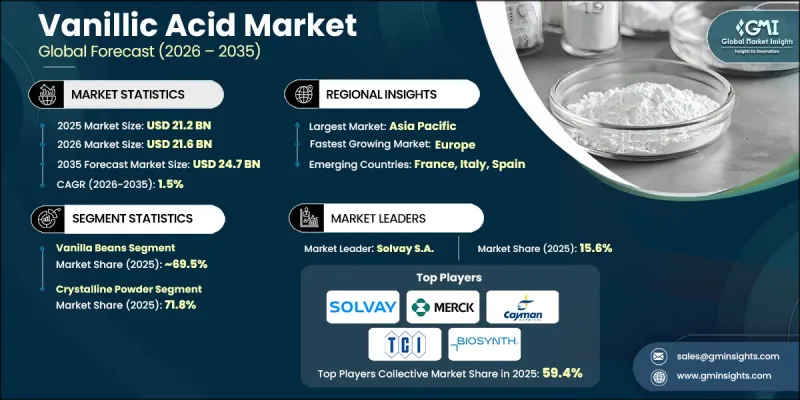
시장 확대는 향료 및 향료 제제의 주요 중간체로서 바닐린산의 사용 증가와 함께 식음료, 퍼스널케어, 제약 분야에서 바닐린산의 중요성이 증가하고 있는 것에 기인합니다. 천연 유래의 향과 기능성으로 인해 맛과 향의 화합물을 만드는데 중요한 성분으로 사용되고 있습니다. 의약품 분야에서 바닐린산은 항균 및 항산화 작용을 가지고 있어 의약품 제제화 및 치료용 제품 개발을 지원하는 물질로 그 중요성이 커지고 있습니다. 천연 유래, 클린 라벨, 지속 가능한 원료에 대한 소비자 선호도가 높아지면서 업계 전반 수요가 더욱 증가하고 있습니다. 지속적인 연구개발을 통해 새로운 용도의 가능성과 제품 개선이 이루어지고 있습니다. 그러나 천연 원료, 특히 바닐라 유래 원료의 제한된 가용성은 여전히 주요 제약 요인으로 작용하고 있으며, 기후 변화, 작물 질병, 지정학적 불안정성으로 인한 공급망 혼란은 생산 안정성에 영향을 미치고 있습니다. 이러한 도전에도 불구하고, 신흥 지역, 특히 아시아태평양의 산업 활동 확대는 향후 시장 발전을 위한 강력한 성장 잠재력을 창출하고 있습니다.
| 시장 범위 | |
|---|---|
| 개시 연도 | 2025년 |
| 예측 기간 | 2026-2035년 |
| 개시 연도 시장 규모 | 212억 달러 |
| 예측 시장 규모 | 247억 달러 |
| CAGR | 1.5% |
바닐라빈 부문은 2025년 69.5%의 점유율을 차지했으며, 2035년까지 연평균 복합 성장률(CAGR) 1.4%를 나타낼 것으로 예측됩니다. 이 콩은 바닐린산 생산의 주요 전구체인 바닐린의 주요 천연 공급원 역할을 합니다. 향료 및 향료 제조에 광범위하게 사용되어 다양한 소비재에서 달콤하고, 크림 같고, 향기로운 맛프로파일을 개발할 수 있도록 돕습니다. 각 업계에서는 베이커리 제품, 제과류, 음료, 향료의 배합을 개선하기 위해 바닐라빈 추출물에 크게 의존하고 있습니다. 또한, 클린 라벨과 친환경 생산 방식에 대한 요구가 높아지면서 과일에서 추출한 천연 성분의 사용도 주목받고 있습니다.
2025년에는 결정성 분말 부문이 71.8%의 점유율을 차지했습니다. 이 형태는 의약품, 화장품, 식품용도에서 우수한 안정성, 취급의 용이성, 정확한 정량화가 가능하여 널리 선호되고 있습니다. 긴 저장 기간과 다양한 용매에 대한 높은 용해도는 산업용 배합에서 실용성을 더욱 높여줍니다. 제조업체들은 높은 순도 기준과 일관된 제품 품질을 우선시하기 때문에 결정성 분말을 계속 선호하고 있으며, 이는 규제 요건을 준수하는 데 기여하고 시장에서 지속적으로 우위를 점하고 있습니다.
북미의 바닐린산 시장은 46억 달러로 평가되었고, 2026-2035년 연평균 1.2%의 성장률을 보일 것으로 예측됩니다. 이 지역의 성장은 식품, 의약품, 화장품 산업 전반에 걸쳐 천연 및 클린 라벨 원료에 대한 소비자 수요 증가에 힘입어 성장세를 보이고 있습니다. 소비자의 건강에 대한 인식이 높아지고 이를 뒷받침하는 규제 프레임워크가 결합되어 바닐린산 기반 제품의 혁신을 촉진하고 그 용도 분야가 확대되고 있습니다.
자주 묻는 질문
목차
제1장 조사 방법 및 범위
제2장 주요 요약
제3장 업계 인사이트
제4장 경쟁 구도
제5장 시장 추산 및 예측 : 소스별(2022-2035년)
제6장 시장 추산 및 예측 : 형태별(2022-2035년)
제7장 시장 추산 및 예측 : 순도별(2022-2035년)
제8장 시장 추산 및 예측 : 용도별(2022-2035년)
제9장 시장 추산 및 예측 : 지역별(2022-2035년)
제10장 기업 개요
AJY 26.06.11The Global Vanillic Acid Market was valued at USD 21.2 billion in 2025 and is estimated to grow at a CAGR of 1.5% to reach USD 24.7 billion by 2035.
Market expansion is being supported by the rising use of vanillic acid as a key intermediate in flavoring and fragrance formulations, as well as its increasing relevance across food and beverage, personal care, and pharmaceutical applications. Its naturally derived aroma profile and functional properties make it an important ingredient in creating taste and scent compounds. In the pharmaceutical sector, vanillic acid is gaining importance due to its antibacterial and antioxidant characteristics, which support drug formulation and therapeutic product development. Growing consumer inclination toward natural, clean-label, and sustainably sourced ingredients is further driving demand across industries. Continuous research and development efforts are enabling new application possibilities and product enhancements. However, the limited availability of natural raw materials, particularly vanilla-derived sources, remains a key constraint, with supply chain disruptions caused by climate variations, crop diseases, and geopolitical instability affecting production consistency. Despite these challenges, expanding industrial activity in emerging regions, especially across Asia-Pacific, is creating strong growth potential for future market development.
| Market Scope | |
|---|---|
| Start Year | 2025 |
| Forecast Year | 2026-2035 |
| Start Value | $21.2 Billion |
| Forecast Value | $24.7 Billion |
| CAGR | 1.5% |
The vanilla beans segment held a 69.5% share in 2025 and is expected to grow at a CAGR of 1.4% through 2035. These beans serve as a primary natural source of vanillin, which is a key precursor in the production of vanillic acid. Their widespread use in flavor and fragrance manufacturing supports the development of sweet, creamy, and aromatic profiles across multiple consumer products. Industries rely heavily on vanilla bean extracts to enhance formulations in bakery goods, confectionery items, beverages, and fragrances. The use of naturally derived ingredients from fruit sources is also gaining attention as it aligns with the growing demand for clean-label and environmentally responsible production practices.
The crystalline powder segment accounted for 71.8% share in 2025. This form is widely preferred due to its superior stability, ease of handling, and accurate dosing capabilities across pharmaceutical, cosmetic, and food applications. Its long shelf life and strong solubility in various solvents further enhance its usability in industrial formulations. Manufacturers continue to favor crystalline powder as they prioritize high purity standards and consistent product quality, which helps maintain compliance with regulatory requirements and supports its continued dominance in the market.
North America Vanillic Acid Market was valued at USD 4.6 billion and is projected to grow at a CAGR of 1.2% between 2026 and 2035. Regional growth is being driven by increasing consumer demand for natural and clean-label ingredients across the food, pharmaceutical, and cosmetic industries. Rising health awareness among consumers, along with supportive regulatory frameworks, is encouraging innovation and expanding application areas for vanillic acid-based products.
Key companies operating in the Global Vanillic Acid Market include Merck, Cayman Chemical, Solvay S.A., Biosynth, Tokyo Chemical Industry, CDH Fine Chemical, Sinoway Industrial Co., Ltd., Henan Fengda Chemical, Fluorochem Ltd., Toronto Research Chemical, Simson Pharma Limited, and Shanghai Aladdin Bio-Chem Technology. Companies in the Vanillic Acid Market are strengthening their competitive position through expansion of production capabilities, investment in research and development, and diversification of application areas. Many manufacturers are focusing on improving synthesis processes to enhance product purity, yield, and cost efficiency. Strategic collaborations with research institutions and end-use industries are enabling faster development of innovative formulations. Firms are also expanding their global distribution networks to strengthen supply chain reliability and improve market reach. Increasing focus on sustainable sourcing and environmentally friendly production methods is helping companies align with evolving regulatory and consumer expectations.
Table of Contents
Chapter 1 Methodology & Scope
- 1.1 Market scope and definition
- 1.2 Research design
- 1.2.1 Research approach
- 1.2.2 Data collection methods
- 1.3 Data mining sources
- 1.3.1 Global
- 1.3.2 Regional/Country
- 1.4 Base estimates and calculations
- 1.4.1 Base year calculation
- 1.4.2 Key trends for market estimation
- 1.5 Primary research and validation
- 1.5.1 Primary sources
- 1.6 Forecast model
- 1.7 Research assumptions and limitations
Chapter 2 Executive Summary
- 2.1 Industry 360° synopsis
- 2.2 Key market trends
- 2.2.1 Regional
- 2.2.2 Source
- 2.2.3 Form
- 2.2.4 Purity
- 2.2.5 Application
- 2.3 TAM Analysis, 2026-2035
- 2.4 CXO perspectives: Strategic imperatives
Chapter 3 Industry Insights
- 3.1 Industry ecosystem analysis
- 3.1.1 Supplier landscape
- 3.1.2 Profit margin
- 3.1.3 Value addition at each stage
- 3.1.4 Factor affecting the value chain
- 3.1.5 Disruptions
- 3.2 Industry impact forces
- 3.2.1 Growth drivers
- 3.2.1.1 Increasing demand for clean label & natural ingredients
- 3.2.1.2 Consumer preference shift toward natural products
- 3.2.1.3 Regulatory support for clean label certifications
- 3.2.2 Industry pitfalls and challenges
- 3.2.2.1 High production costs & feedstock volatility
- 3.2.2.2 Limited availability of raw materials
- 3.2.3 Market opportunities
- 3.2.3.1 Innovations in microbial fermentation
- 3.2.3.2 Growing demand for functional & clean-beauty products
- 3.2.1 Growth drivers
- 3.3 Growth potential analysis
- 3.4 Regulatory landscape
- 3.4.1 North America
- 3.4.2 Europe
- 3.4.3 Asia Pacific
- 3.4.4 Latin America
- 3.4.5 Middle East & Africa
- 3.5 Porter's analysis
- 3.6 PESTEL analysis
- 3.7 Price trends
- 3.7.1 By region
- 3.7.2 By purity
- 3.8 Future market trends
- 3.9 Technology and innovation landscape
- 3.9.1 Current technological trends
- 3.9.2 Emerging technologies
- 3.10 Patent Landscape
- 3.11 Trade statistics (HS code)
- 3.11.1 Major importing countries
- 3.11.2 Major exporting countries
- 3.12 Sustainability and environmental aspects
- 3.12.1 Sustainable practices
- 3.12.2 Waste reduction strategies
- 3.12.3 Energy efficiency in production
- 3.12.4 Eco-friendly initiatives
- 3.13 Carbon footprint consideration
Chapter 4 Competitive Landscape, 2025
- 4.1 Introduction
- 4.2 Company market share analysis
- 4.2.1 By region
- 4.2.1.1 North America
- 4.2.1.2 Europe
- 4.2.1.3 Asia Pacific
- 4.2.1.4 LATAM
- 4.2.1.5 MEA
- 4.2.1 By region
- 4.3 Competitive analysis of major market players
- 4.4 Competitive positioning matrix
- 4.5 Key developments
- 4.5.1 Mergers & acquisitions
- 4.5.2 Partnerships & collaborations
- 4.5.3 New Product Launches
- 4.5.4 Expansion Plans
Chapter 5 Market Estimates and Forecast, By Source, 2022-2035 (USD Billion) (Kilo Tons)
- 5.1 Key trends
- 5.2 Vanilla beans
- 5.3 Fruits
- 5.4 Vegetables
- 5.5 Others
Chapter 6 Market Estimates and Forecast, By Form, 2022-2035 (USD Billion) (Kilo Tons)
- 6.1 Key trends
- 6.2 Crystalline powder
- 6.3 Liquid
Chapter 7 Market Estimates and Forecast, By Purity, 2022-2035 (USD Billion) (Kilo Tons)
- 7.1 Key trends
- 7.2 98%
- 7.3 99%
- 7.4 Below 98%
Chapter 8 Market Estimates and Forecast, By Application, 2022-2035 (USD Billion) (Kilo Tons)
- 8.1 Key trends
- 8.2 Flavor and fragrance
- 8.2.1 Natural flavoring agents
- 8.2.2 Fragrance compounds & perfumery
- 8.2.3 Food & beverage flavoring
- 8.3 Pharmaceutical
- 8.3.1 Pharmaceutical intermediates & api synthesis
- 8.3.2 Active ingredient formulations
- 8.3.3 Drug discovery applications
- 8.4 Cosmetic
- 8.4.1 Skincare products (anti-aging, serums)
- 8.4.2 Personal care formulations
- 8.4.3 Clean beauty products
- 8.5 Other
Chapter 9 Market Estimates and Forecast, By Region, 2022-2035 (USD Billion) (Kilo Tons)
- 9.1 Key trends
- 9.2 North America
- 9.2.1 U.S.
- 9.2.2 Canada
- 9.3 Europe
- 9.3.1 Germany
- 9.3.2 UK
- 9.3.3 France
- 9.3.4 Spain
- 9.3.5 Italy
- 9.3.6 Rest of Europe
- 9.4 Asia Pacific
- 9.4.1 China
- 9.4.2 India
- 9.4.3 Japan
- 9.4.4 Australia
- 9.4.5 South Korea
- 9.4.6 Rest of Asia Pacific
- 9.5 Latin America
- 9.5.1 Brazil
- 9.5.2 Mexico
- 9.5.3 Argentina
- 9.5.4 Rest of Latin America
- 9.6 Middle East and Africa
- 9.6.1 Saudi Arabia
- 9.6.2 South Africa
- 9.6.3 UAE
- 9.6.4 Rest of Middle East and Africa
Chapter 10 Company Profiles
- 10.1 Biosynth
- 10.2 Cayman Chemical
- 10.3 CDH Fine Chemical
- 10.4 Fluorochem Ltd.
- 10.5 Henan Fengda Chemical
- 10.6 Merck
- 10.7 Shanghai Aladdin Bio-Chem Technology
- 10.8 Simson Pharma Limited
- 10.9 Sinoway Industrial Co., Ltd.
- 10.10 Solvay S.A.
- 10.11 Tokyo Chemical Industry
- 10.12 Toronto Research Chemicals