

|
시장보고서
상품코드
2038783
비즈니스 제트 시장 : 시장 기회, 성장요인, 업계 동향 분석 및 예측(2026-2035년)Business Jets Market Opportunity, Growth Drivers, Industry Trend Analysis, and Forecast 2026 - 2035 |
||||||

세계의 비즈니스 제트 시장은 2025년에 270억 달러로 평가되었고, CAGR 8.3%로 성장할 전망이며, 2035년까지 605억 달러에 이를 것으로 추정되고 있습니다.
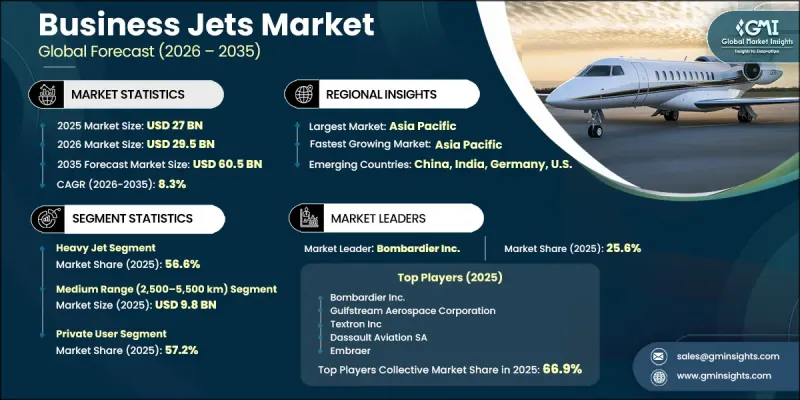
시장 확대는 기업 경영진의 효율적이고 유연한 항공 모빌리티 솔루션에 대한 수요 증가와 더불어 전 세계 부유층 증가와 맞춤형 항공 서비스에 대한 선호도 증가에 힘입어 성장세를 보이고 있습니다. 또한, 특히 민간항공편 취항이 제한되어 있는 오지나 서비스 취약 지역으로의 사업 활동 확대도 수요를 강화하고 있습니다. 또한, 공유 및 온디맨드 이용 등 유연한 소유 모델의 확산으로 개인 항공 이용이 더욱 친숙해지고 있습니다. 연비 효율성, 기내 편의성, 운항 성능 향상 등 항공기 기술의 지속적인 개선은 신규 구매 및 장비의 현대화를 더욱 촉진하고 있습니다. 기업들이 생산성과 출장의 최적화를 중시하는 가운데, 비즈니스 항공은 상업용 항공 여행에 대한 신뢰할 수 있는 대안으로 계속 인기를 얻고 있으며, 전 세계 시장에서의 지속적인 성장을 뒷받침하고 있습니다.
| 시장 범위 | |
|---|---|
| 개시 연도 | 2025년 |
| 예측 기간 | 2026-2035년 |
| 개시 연도 시장 규모 | 270억 달러 |
| 예측 시장 규모 | 605억 달러 |
| CAGR | 8.3% |
민간 항공의 제약이 증가하고 승객 수가 증가함에 따라 개인 제트기 이용으로 전환이 진행되고 있습니다. 최신 항공기는 항속거리 연장, 순항 속도 향상, 연비 효율 개선으로 설계되어 보다 효율적인 장거리 이동을 가능하게 합니다. 이러한 발전은 항공사가 노후화된 항공기를 최신 기종으로 교체하는 교체 주기를 촉진하고 있습니다. 또한, 지속가능성에 대한 고려가 점점 더 중요해지고 있으며, 운항 사업자들은 진화하는 규제 프레임워크에 맞추어 환경 친화적인 접근 방식을 채택하고 있습니다. 이러한 전환은 연비 효율을 높이고 대체 항공 연료에 대응할 수 있도록 설계된 차세대 항공기에 대한 수요를 가속화하고 있습니다.
초경량 제트기(VLJ) 카테고리는 2026-2035년 연평균 복합 성장률(CAGR) 16.5%를 나타낼 것으로 예측됩니다. 경제적인 단거리 개인 여행 솔루션에 대한 관심이 높아지면서 이 부문의 성장에 기여하고 있습니다. 이 항공기는 지역 간 연결, 엔트리급 민간 항공 및 운영자 주도의 이용에 널리 활용되고 있습니다. 상대적으로 낮은 구매 비용과 운영 비용, 그리고 전세 서비스 제공업체에 의한 채택 증가가 수요 증가를 뒷받침하고 있습니다.
2,500-5,500km의 항속거리를 커버하는 중거리 부문은 2025년 98억 달러 시장 규모를 기록했습니다. 이 부문은 지역 내 이동과 장거리 이동 모두에 대응할 수 있다는 점에서 우위를 유지하고 있습니다. 이 항공기는 운영 비용, 항속거리, 기내 편의성 사이에서 효과적인 균형을 제공하여 기업 운영자 및 전세 서비스 제공업체들 사이에서 선호되는 선택이 되고 있습니다. 높은 가동률과 폭넓은 도입 기종으로 이 부문의 선도적 지위는 계속 강화되고 있습니다.
2025년 북미의 비즈니스 제트 시장은 50.6%의 점유율을 차지했습니다. 이 지역의 성장은 잘 구축된 비즈니스 항공 생태계, 높은 기업 집중도, 그리고 많은 부유층에 의해 뒷받침되고 있습니다. 공항과 지원시설의 촘촘한 네트워크를 포함한 탄탄한 인프라가 시장 수요를 더욱 부추기고 있습니다. 유리한 규제 환경과 안정적인 기체 교체 주기로 인해 개인 및 법인 사용자 모두 비즈니스 제트기 도입이 꾸준히 증가하고 있습니다.
자주 묻는 질문
목차
제1장 조사 방법 및 범위
제2장 주요 요약
제3장 업계 인사이트
제4장 경쟁 구도
제5장 시장 추산 및 예측 : 사이즈별(2022-2035년)
제6장 시장 추산 및 예측 : 항속 거리별(2022-2035년)
제7장 시장 추산 및 예측 : 최종 사용자별(2022-2035년)
제8장 시장 추산 및 예측 : 지역별(2022-2035년)
제9장 기업 개요
AJY 26.06.11The Global Business Jets Market was valued at USD 27 billion in 2025 and is estimated to grow at a CAGR of 8.3% to reach USD 60.5 billion by 2035.
Market expansion is fueled by the rising demand for efficient and flexible air mobility solutions among corporate executives, along with increasing global affluence and a growing preference for customized aviation services. The expansion of business activities into remote and underserved regions is also strengthening demand, particularly where commercial airline connectivity remains limited. Additionally, the growing popularity of flexible ownership models, including shared and on-demand access, is making private aviation more accessible. Continuous improvements in aircraft technology, including enhanced fuel efficiency, cabin comfort, and operational performance, are further encouraging new purchases and fleet modernization. As organizations place greater emphasis on productivity and travel optimization, business aviation continues to gain traction as a reliable alternative to commercial travel, supporting sustained growth across global markets.
| Market Scope | |
|---|---|
| Start Year | 2025 |
| Forecast Year | 2026-2035 |
| Start Value | $27 Billion |
| Forecast Value | $60.5 Billion |
| CAGR | 8.3% |
Rising constraints within commercial aviation and increasing passenger volumes are prompting a shift toward private jet usage. Modern aircraft are being designed with extended flight ranges, improved cruising speeds, and enhanced fuel economy, enabling long-distance travel with greater efficiency. These advancements are driving replacement cycles as operators upgrade aging fleets with more advanced models. Sustainability considerations have also become increasingly important, with operators adopting environmentally responsible practices and aligning with evolving regulatory frameworks. This transition is accelerating demand for next-generation aircraft designed to support improved fuel efficiency and compatibility with alternative aviation fuels.
The very light jet category is projected to witness a CAGR of 16.5% during 2026-2035. Growing interest in economical and short-distance private travel solutions is contributing to segment growth. These aircraft are widely utilized for regional connectivity, entry-level private aviation, and operator-driven usage. Their relatively lower purchase and operational costs, combined with increasing adoption among charter service providers, continue to support demand growth.
The medium-range segment, covering distances between 2,500 and 5,500 km segment generated USD 9.8 billion in 2025. This segment maintains its dominance due to its ability to cater to both regional and longer-distance travel needs. These aircraft offer an effective balance between operating costs, travel range, and onboard comfort, making them a preferred choice among corporate operators and charter service providers. High utilization rates and an extensive installed fleet base continue to reinforce this segment's leading position.
North America Business Jets Market accounted for 50.6% share in 2025. The region's growth is supported by a well-established business aviation ecosystem, a high concentration of corporate entities, and a significant population of high-net-worth individuals. Strong infrastructure, including a dense network of airports and support facilities, further strengthens market demand. Favorable regulatory conditions and consistent fleet replacement cycles continue to drive steady adoption of business jets across both private and corporate users.
Key companies operating in the Global Business Jets Market include Bombardier Inc., Airbus, Boeing, Dassault Aviation SA, Embraer, Gulfstream Aerospace Corporation, Textron Inc., Cirrus Aircraft, Pilatus Aircraft Ltd, Piper Aircraft, Honda Aircraft Company, Cessna Aircraft Company, Daher, Eclipse Aerospace, and Piaggio Aerospace. Companies in the Business Jets Market are focusing on product innovation, strategic partnerships, and fleet modernization to strengthen their competitive positioning. Manufacturers are investing heavily in research and development to introduce fuel-efficient aircraft with advanced avionics, improved aerodynamics, and enhanced cabin experiences. Expanding service networks, including maintenance, repair, and overhaul capabilities, is also a key priority to ensure customer retention. Firms are increasingly adopting sustainable aviation solutions and aligning product portfolios with environmental standards.
Table of Contents
Chapter 1 Methodology and Scope
- 1.1 Market scope and definition
- 1.2 Research design
- 1.2.1 Research approach
- 1.2.2 Data collection methods
- 1.3 Data mining sources
- 1.3.1 Global
- 1.3.2 Regional/Country
- 1.4 Base estimates and calculations
- 1.4.1 Base year calculation
- 1.4.2 Key trends for market estimation
- 1.5 Primary research and validation
- 1.5.1 Primary sources
- 1.6 Forecast model
- 1.7 Research assumptions and limitations
Chapter 2 Executive Summary
- 2.1 Industry 360° synopsis, 2022 - 2035
- 2.2 Key market trends
- 2.2.1 Size trends
- 2.2.2 Range trends
- 2.2.3 End user trends
- 2.2.4 Regional trends
- 2.3 TAM Analysis, 2026-2035
- 2.4 CXO perspectives: Strategic imperatives
Chapter 3 Industry Insights
- 3.1 Industry ecosystem analysis
- 3.1.1 Supplier Landscape
- 3.1.2 Profit Margin
- 3.1.3 Cost structure
- 3.1.4 Value addition at each stage
- 3.1.5 Factor affecting the value chain
- 3.1.6 Disruptions
- 3.2 Industry impact forces
- 3.2.1 Growth drivers
- 3.2.1.1 Rising demand for time-efficient and flexible travel
- 3.2.1.2 Expansion of high-net-worth individuals (HNWIs) and ultra-HNWIs
- 3.2.1.3 Growth of business travel to emerging and secondary markets
- 3.2.1.4 Increasing adoption of charter, fractional ownership, and jet cards
- 3.2.1.5 Technological advancements and fleet modernization
- 3.2.2 Industry pitfalls and challenges
- 3.2.2.1 High acquisition and operating costs of business jets
- 3.2.2.2 Regulatory complexity and infrastructure constraints
- 3.2.3 Market opportunities
- 3.2.3.1 Expansion of sustainable aviation fuel (SAF) availability and incentives
- 3.2.3.2 Rising use of business jets for government, defense, and special mission applications
- 3.2.1 Growth drivers
- 3.3 Growth potential analysis
- 3.4 Regulatory landscape
- 3.4.1 North America
- 3.4.2 Europe
- 3.4.3 Asia Pacific
- 3.4.4 Latin America
- 3.4.5 Middle East & Africa
- 3.5 Porter's analysis
- 3.6 PESTEL analysis
- 3.7 Technology and Innovation landscape
- 3.7.1 Current technological trends
- 3.7.2 Emerging technologies
- 3.8 Price trends
- 3.8.1 By region
- 3.8.2 By product
- 3.9 Pricing Strategies
- 3.10 Emerging Business Models
- 3.11 Compliance Requirements
- 3.12 Patent and IP analysis
Chapter 4 Competitive Landscape, 2025
- 4.1 Introduction
- 4.2 Company market share analysis
- 4.2.1 By region
- 4.2.1.1 North America
- 4.2.1.2 Europe
- 4.2.1.3 Asia Pacific
- 4.2.1.4 Latin America
- 4.2.1.5 Middle East & Africa
- 4.2.2 Market concentration analysis
- 4.2.1 By region
- 4.3 Competitive benchmarking of key players
- 4.3.1 Financial performance comparison
- 4.3.1.1 Revenue
- 4.3.1.2 Profit margin
- 4.3.1.3 R&D
- 4.3.2 Product portfolio comparison
- 4.3.2.1 Product range breadth
- 4.3.2.2 Technology
- 4.3.2.3 Innovation
- 4.3.3 Geographic presence comparison
- 4.3.3.1 Global footprint analysis
- 4.3.3.2 Service network coverage
- 4.3.3.3 Market penetration by region
- 4.3.4 Competitive positioning matrix
- 4.3.4.1 Leaders
- 4.3.4.2 Challengers
- 4.3.4.3 Followers
- 4.3.4.4 Niche players
- 4.3.5 Strategic outlook matrix
- 4.3.1 Financial performance comparison
- 4.4 Key developments
- 4.4.1 Mergers and acquisitions
- 4.4.2 Partnerships and collaborations
- 4.4.3 Technological advancements
- 4.4.4 Expansion and investment strategies
- 4.4.5 Digital transformation initiatives
- 4.5 Emerging/ startup competitors landscape
Chapter 5 Market Estimates and Forecast, By Size, 2022 - 2035 (USD Million)
- 5.1 Key trends
- 5.2 Very-light jet
- 5.3 Light jet
- 5.4 Medium jet
- 5.5 Heavy jet
Chapter 6 Market Estimates and Forecast, By Range, 2022 - 2035 (USD Million)
- 6.1 Key trends
- 6.2 Short range (<2,500 km)
- 6.3 Medium range (2,500-5,500 km)
- 6.4 Long range (>5,500 km)
Chapter 7 Market Estimates and Forecast, By End User, 2022 - 2035 (USD Million)
- 7.1 Key trends
- 7.2 Private user
- 7.3 Operator
Chapter 8 Market Estimates and Forecast, By Region, 2022 - 2035 (USD Million)
- 8.1 Key trends
- 8.2 North America
- 8.2.1 U.S.
- 8.2.2 Canada
- 8.3 Europe
- 8.3.1 Germany
- 8.3.2 UK
- 8.3.3 France
- 8.3.4 Spain
- 8.3.5 Italy
- 8.3.6 Russia
- 8.4 Asia Pacific
- 8.4.1 China
- 8.4.2 India
- 8.4.3 Japan
- 8.4.4 Australia
- 8.4.5 South Korea
- 8.5 Latin America
- 8.5.1 Brazil
- 8.5.2 Mexico
- 8.5.3 Argentina
- 8.6 Middle East and Africa
- 8.6.1 South Africa
- 8.6.2 Saudi Arabia
- 8.6.3 UAE
Chapter 9 Company Profiles
- 9.1 Global Key Players
- 9.1.1 Bombardier Inc.
- 9.1.2 Gulfstream Aerospace Corporation
- 9.1.3 Textron Inc
- 9.1.4 Dassault Aviation SA
- 9.1.5 Embraer
- 9.2 Regional key players
- 9.2.1 North America
- 9.2.1.1 Piper Aircraft, Inc.
- 9.2.1.2 Boeing
- 9.2.1.3 Cessna Aircraft Company
- 9.2.2 Asia Pacific
- 9.2.2.1 Honda Aircraft Company, LLC
- 9.2.3 Europe
- 9.2.3.1 Piaggio Aerospace
- 9.2.3.2 Pilatus Aircraft Ltd
- 9.2.3.3 Daher
- 9.2.3.4 Airbus
- 9.2.1 North America
- 9.3 Niche Players/Disruptors
- 9.3.1 Eclipse Aerospace, Inc.
- 9.3.2 Cirrus Aircraft


