

|
시장보고서
상품코드
2100732
미국의 비즈니스 제트기 시장 : 점유율 분석, 업계 동향 및 통계, 성장 예측(2026-2031년)US Business Jet - Market Share Analysis, Industry Trends & Statistics, Growth Forecasts (2026 - 2031) |
||||||
 Mordor Intelligence
Mordor Intelligence에 의하면, 미국 비즈니스 제트기 시장 규모는 2025년에 155억 달러로 평가되었고 2026년 156억 9,000만 달러에서 2031년까지 166억 6,000만 달러에 이를 것으로 예측되며, 예측 기간(2026-2031년) CAGR은 1.21%를 나타낼 전망입니다.
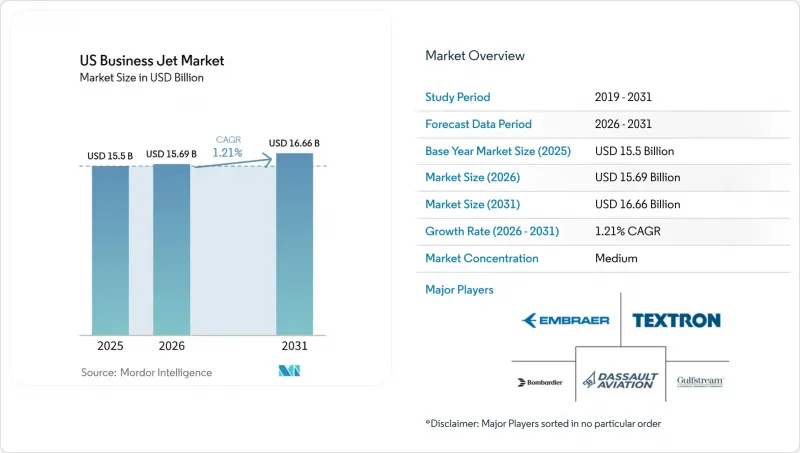
본 보고서는 기체 유형(대형 제트기, 중형 제트기, 소형/초소형 제트기), 최종 사용자(개인 소유자, 기업·법인, 전세/에어택시 사업자, 훈련·교육 기관, 정부 및 특수 임무 사업자), 소유 형태(신규 기체 구매, 중고 기체 구매, 기타)별로 분류되어 있습니다. 시장 전망은 금액(달러) 기준으로 제시되어 있습니다.
미국 비즈니스 제트기 시장 동향 및 인사이트
부유층 인구 증가가 프리미엄 수요를 견인
나이트프랭크의 ‘2024년 부자 보고서’에 따르면, 자산이 3,000만 달러를 초과하는 미국의 초부유층 인구는 7.0% 이상 증가했으며, 그 대부분은 캘리포니아주와 텍사스주에 집중되어 있습니다. 이러한 자산 확대에 따라 동서 해안 간을 정기적으로 연결할 뿐만 아니라 유럽으로도 직항할 수 있는 대형 객실 항공기에 대한 수요가 높아지고 있습니다. 이를 통해 경영진은 복잡한 여정을 계획하더라도 급유를 위한 착륙 횟수를 최소화할 수 있게 됩니다. 넓은 객실 공간, 저소음성, 맞춤형 인테리어와 같은 장점 덕분에 걸프스트림 G700이나 봄바르디아 7500과 같은 플래그십 모델은 운영 예산이 빠듯한 상황에서도 구매 목록의 최상위에 자리 잡고 있습니다. 각 제조업체는 세제 혜택이 종료되기 전에 잠재 고객을 확보하기 위해 객실 맞춤화, 항속 거리 연장, 지상과 기내 간 연결성 향상을 우선적으로 추진하고 있습니다. 초고액 자산가(UHNWIs)는 항공기를 비즈니스 도구나 라이프스타일 자산으로 활용하는 경우가 많으며, 이들의 구매 속도는 광범위한 경제 변동의 영향을 비교적 덜 받기 때문에 미국 비즈니스 제트기 시장의 안정적인 기반을 뒷받침하고 있습니다.
기업 출장의 유연성이 조달 전략을 재구축
포춘 500대 기업에 따르면, 2024년 개인용 항공기 이용률은 팬데믹 이전 수준보다 23% 증가했습니다. 이는 연구개발(R&D) 거점 간에 팀을 신속하게 이동시켜야 하는 제약 회사나 기술 기업들에 의해 주도된 것입니다. 경영진은 포인트-투-포인트 제트기 이용을 단순한 사치품이 아닌 핵심 인프라로 간주하며, 이사회 차원의 자본 배분에 관한 논의 체계를 재구성하고 있습니다. 주문형 일정 조정, 기내 위생 프로토콜의 철저한 이행, 상업 항공편 운항 차질 회피와 같은 이점들은 전반적인 비용 상승에도 불구하고 소유, 전세, 또는 공유 계약의 정당성을 뒷받침하는 요인이 되고 있습니다. 조달 팀은 지역 내 항속 거리와 낮은 변동 비용을 모두 충족하는 중형기를 점점 더 선호하는 한편, 대륙 횡단 임무를 위해 최소 1대의 대형 기체를 유지하고 있습니다. 이러한 기능적 세분화로 인해 사업자들은 혼합 기단을 유지하거나, 다양한 임무 세트에 적합한 수송 능력을 확보할 수 있는 프랙셔널 제공업체와 제휴하도록 유도되고 있습니다. 디지털 비행 스케줄링 도구는 기업의 출장 관리 시스템과 연동되어 데이터 기반의 ROI 분석을 강화함으로써, 기업 물류 계획에서 비즈니스 항공의 추가적인 제도화를 촉진하고 있습니다.
소유 비용의 급등이 시장 진입 장벽을 높이고 있습니다.
중형 제트기의 연간 총 소유 비용은 연료 가격 변동, 보험료 인상, 임금 인플레이션이 겹치면서 2024년에는 320만 달러에 달하고,, 2019년 대비 18% 급증했습니다. 최근 사고 동향에 따른 인수 기준의 엄격화로 인해 보험료는 연간 25% 상승하여 중소기업의 진입 장벽이 높아지고 있습니다. 뉴욕과 로스앤젤레스의 대형 기내 공간 항공기 격납고 임대료는 현재월1만 5,000달러를 초과하고 있습니다. 또한, 항공사들이 동일한 인력 풀을 활용하고 있기 때문에 파트 135 조종사의 급여는 12% 상승했습니다. 규모의 경제를 실현할 수 없는 단일 기체 소유자는 고정비 상승을 감당하거나, 분할 소유나 전세와 같은 대안으로 전환하는 것 중 하나를 선택할 수밖에 없습니다. 이러한 비용 동향으로 인해 첫 구매를 고려하는 계층 시장 규모가 축소되어, 미국 비즈니스 제트기 시장의 성장이 억제되고 있습니다.
부문 분석
2025년, 대형 제트기는 미국 비즈니스 제트기 시장 점유율의 78.92%를 차지했습니다. 이는 7,000해리를 넘는 항속 거리, 기립이 가능한 넓은 객실, 견실한 재판매 가치에 힘입은 것으로, 그 결과 일관된 잔존 가치 유지 곡선을 보여주고 있습니다. 대형 기체를 통해 국가 간 직항편이 가능해짐에 따라, 기업의 일정 담당자는 노선을 통합하고 포지셔닝 비행을 최소화할 수 있습니다. 이러한 항속 거리 외에도 50사이클마다 이루어지는 짧은 정비 주기와, 강화된 웰니스 프로토콜을 충족하는 첨단 환경 제어 시스템도 갖추고 있습니다.
한편, 중형 기종은 2031년까지 해당 부문에서 가장 빠른 연평균 성장률(CAGR) 2.11%를 나타낼 것으로 전망됩니다. 이는 ‘사이테이션 롱기튜드’나 ‘엠브라에르 프레토르 600’과 같은 기종이 대형 객실 항공기에 비해 시간당 비용을 20-30% 낮게 유지하면서도 대륙 간을 연결하는 역할을 수행하고 있기 때문입니다. 6피트를 넘는 객실 높이, 평평한 바닥, 디지털 비행 갑판은 과거의 ‘실내가 비좁다’거나 ‘항공전자 장비 기능이 제한적이다’는 인식을 뒤집고 있습니다. 전세 중개업체에게 중형 제트기는 3-4시간 비행 거리에서 가격과 쾌적성의 최적의 균형을 실현하는 경우가 많아, 고객에 대한 매력을 높이고 있습니다. 그 결과 발생하는 이중적인 수요 패턴이 꾸준한 가치 성장을 뒷받침하며, 이 부문에서 미국 비즈니스 제트기 시장의 전반적인 리스크 프로파일 균형을 유지하고 있습니다.
기타 혜택
- 엑셀 형식 시장 예측(ME) 시트
- 3개월간의 애널리스트 지원
자주 묻는 질문
목차
제1장 서론
제2장 조사 방법
제3장 주요 요약
제4장 시장 구도
제5장 시장 규모와 성장 예측
제6장 경쟁 구도
제7장 시장 기회와 향후 전망
JHS 26.08.11According to Mordor Intelligence, the US business jet market size was valued at USD 15.50 billion in 2025 and estimated to grow from USD 15.69 billion in 2026 to reach USD 16.66 billion by 2031, at a CAGR of 1.21% during the forecast period (2026-2031).
This report is Segmented by Body Type (Large Jet, Mid-Size Jet, and Light/Very-Light Jet), End User (Individual Owners, Business and Corporate Entities, Charter/Air-Taxi Operators, Training and Academic Institutions, and Government and Special-Mission Operators), and Ownership Model (New Aircraft Purchase, Pre-Owned Purchase, and More). The Market Forecasts are Provided in Terms of Value (USD).
US Business Jet Market Trends and Insights
Growth in High-Net-Worth Individual Population Drives Premium Demand
Knight Frank's 2024 Wealth Report measured a more than 7.0% rise in US ultra-high-net-worth individuals- those with assets above USD 30 million-with marked concentration in California and Texas. This wealth expansion fortifies demand for large-cabin aircraft that routinely link the coasts and reach Europe nonstop, allowing executives to pair complex itineraries with minimal fuel stops. Cabin volume advantages, low ambient noise, and bespoke interiors position flagship models such as the Gulfstream G700 and Bombardier Global 7500 at the apex of purchasing lists, even as operating budgets tighten. Manufacturers prioritize cabin personalization, range extensions, and enhanced ground-to-air connectivity to convert prospective clients before tax incentives sunset. UHNWIs often deploy aircraft as business tools and lifestyle assets; their purchasing cadence remains relatively insulated from broader economic swings, supporting baseline stability in the US business jet market.
Corporate Travel Flexibility Reshapes Procurement Strategies
Fortune 500 companies reported 23% higher private aviation usage in 2024 than pre-pandemic levels, driven by pharmaceutical and technology firms that must move teams swiftly among R&D centers. Management treats point-to-point jet access as critical infrastructure rather than a discretionary luxury, reframing board-level capital allocation debates. On-demand scheduling, guaranteed cabin hygiene protocols, and the avoidance of commercial disruptions help justify ownership, charter, or share commitments despite general cost inflation. Procurement teams increasingly favor mid-size platforms that blend regional range with lower variable costs, while retaining at least one large-cabin aircraft for transcontinental missions. This functional segmentation prompts operators to maintain mixed fleets or partner with fractional providers that can ensure appropriate lift across various mission sets. Digital flight-scheduling tools integrate with corporate travel-management systems to reinforce data-driven ROI analyses, further institutionalizing business aviation within enterprise logistics planning.
Escalating Ownership Costs Pressure Market Accessibility
Total annual ownership expense for a mid-size jet climbed to USD 3.2 million in 2024, an 18% surge from 2019 as fuel volatility, insurance hikes, and wage inflation converge. Insurance premiums increased by 25% annually amid tighter underwriting linked to recent incident trends, thereby elevating barriers for smaller corporations. Hangar leases in New York and Los Angeles now exceed USD 15,000 per month for large-cabin airframes, while Part 135 pilot salaries have risen 12% as airlines have tapped the same labor pool. Without economies of scale, single-aircraft owners must either absorb higher fixed costs or migrate to fractional or charter solutions. These cost dynamics narrow the addressable market for first-time buyers and curb growth in the US business jet market.
Other drivers and restraints analyzed in the detailed report include:
- Advanced Aircraft Technologies Command Premium Pricing
- Tax Depreciation Benefits Accelerate Acquisition Timelines
- Supply Chain Constraints Extend Delivery Timelines
For complete list of drivers and restraints, kindly check the Table Of Contents.
Segment Analysis
Large jets accounted for 78.92% of the US business jet market share in 2025, driven by their 7,000-plus nautical-mile range, full-stand-up cabins, and robust resale values, resulting in consistent residual-value retention curves. Heavy airframes enable nonstop links among countries, allowing corporate schedulers to consolidate routes and minimize positioning legs. This endurance is paired with low 50-cycle maintenance intervals and advanced environmental control systems that meet heightened wellness protocols.
Mid-size aircraft nonetheless deliver the segment's fastest 2.11% CAGR through 2031, as platforms such as the Citation Longitude and Embraer Praetor 600 bridge transcontinental gaps at 20-30% lower hourly costs than large-cabin peers. Cabin heights above 6 ft, flat floors, and digital flight decks refute earlier perceptions of cramped interiors or limited avionics capability. For charter brokers, mid-size jets often hit optimal price-comfort equilibria in the 3-4-hour stage length, broadening client appeal. The resulting dual-tier demand pattern underpins steady value growth, balancing the overall risk profile of the US business jet market within this segmentation.
Complete Report Scope:
- By Body Type
- Large Jet
- Mid-Size Jet
- Light/Very-Light Jet
- By End User
- Individual Owners
- Business and Corporate Entities
- Charter/Air-Taxi Operators
- Training and Academic Institutions
- Government and Special-Mission Operators
- By Ownership Model
- New Aircraft Purchase
- Pre-Owned Purchase
- Fractional Ownership
- Jet Cards/Membership
List of Companies Covered in this Report:
- Airbus SE
- The Boeing Company
- Bombardier Inc.
- Embraer S.A.
- Textron Inc.
- Honda Aircraft Company (Honda Motor Co., Ltd.)
- Gulfstream Aerospace Corporation (General Dynamics Corporation)
- Dassault Aviation SA
- Cirrus Design Corporation
- Pilatus Aircraft Ltd.
Additional Benefits:
- The market estimate (ME) sheet in Excel format
- 3 months of analyst support
TABLE OF CONTENTS
1 INTRODUCTION
- 1.1 Study Assumptions and Market Definition
- 1.2 Scope of the Study
2 RESEARCH METHODOLOGY
3 EXECUTIVE SUMMARY
4 MARKET LANDSCAPE
- 4.1 Market Overview
- 4.2 Market Drivers
- 4.2.1 Growth in HNWI and UHNWI population
- 4.2.2 Rising corporate demand for flexible and time-sensitive air travel
- 4.2.3 Launch of new aircraft models with SAF readiness and advanced cabin technologies
- 4.2.4 Tax benefits from 100% bonus depreciation under the Build Back Better Act
- 4.2.5 Increasing adoption of fractional ownership programs to maximize fleet utilization
- 4.2.6 Growing focus on sustainability-linked procurement by publicly traded companies
- 4.3 Market Restraints
- 4.3.1 High capital and operational costs associated with business jet ownership
- 4.3.2 Persistent supply chain disruptions and skilled labor shortages in aviation
- 4.3.3 Rising regulatory scrutiny and public activism against private jet usage
- 4.3.4 Financial instability and liquidity risks among charter operators
- 4.4 Value Chain Analysis
- 4.5 Regulatory Landscape
- 4.6 Technological Outlook
- 4.7 Porter's Five Forces Analysis
- 4.7.1 Threat of New Entrants
- 4.7.2 Bargaining Power of Buyers
- 4.7.3 Bargaining Power of Suppliers
- 4.7.4 Threat of Substitutes
- 4.7.5 Intensity of Competitive Rivalry
5 MARKET SIZE AND GROWTH FORECASTS (VALUE)
- 5.1 By Body Type
- 5.1.1 Large Jet
- 5.1.2 Mid-Size Jet
- 5.1.3 Light/Very-Light Jet
- 5.2 By End User
- 5.2.1 Individual Owners
- 5.2.2 Business and Corporate Entities
- 5.2.3 Charter/Air-Taxi Operators
- 5.2.4 Training and Academic Institutions
- 5.2.5 Government and Special-Mission Operators
- 5.3 By Ownership Model
- 5.3.1 New Aircraft Purchase
- 5.3.2 Pre-Owned Purchase
- 5.3.3 Fractional Ownership
- 5.3.4 Jet Cards/Membership
6 COMPETITIVE LANDSCAPE
- 6.1 Market Concentration
- 6.2 Strategic Moves
- 6.3 Market Share Analysis
- 6.4 Company Profiles (includes Global level Overview, Market level overview, Core Segments, Financials as available, Strategic Information, Market Rank/Share for key companies, Products and Services, and Recent Developments)
- 6.4.1 Airbus SE
- 6.4.2 The Boeing Company
- 6.4.3 Bombardier Inc.
- 6.4.4 Embraer S.A.
- 6.4.5 Textron Inc.
- 6.4.6 Honda Aircraft Company (Honda Motor Co., Ltd.)
- 6.4.7 Gulfstream Aerospace Corporation (General Dynamics Corporation)
- 6.4.8 Dassault Aviation SA
- 6.4.9 Cirrus Design Corporation
- 6.4.10 Pilatus Aircraft Ltd.
7 MARKET OPPORTUNITIES AND FUTURE OUTLOOK
- 7.1 White-space and Unmet-need Assessment


