

|
시장보고서
상품코드
2038797
합성생물학 시장 : 시장 비즈니스 기회, 성장요인, 업계 동향 분석 및 예측(2026-2035년)Synthetic Biology Market Opportunity, Growth Drivers, Industry Trend Analysis, and Forecast 2026 - 2035 |
||||||

세계의 합성생물학 시장은 2025년에 256억 달러로 평가되었고, CAGR 17.5%로 성장할 전망이며, 2035년까지 1,281억 달러에 이를 것으로 추정되고 있습니다.
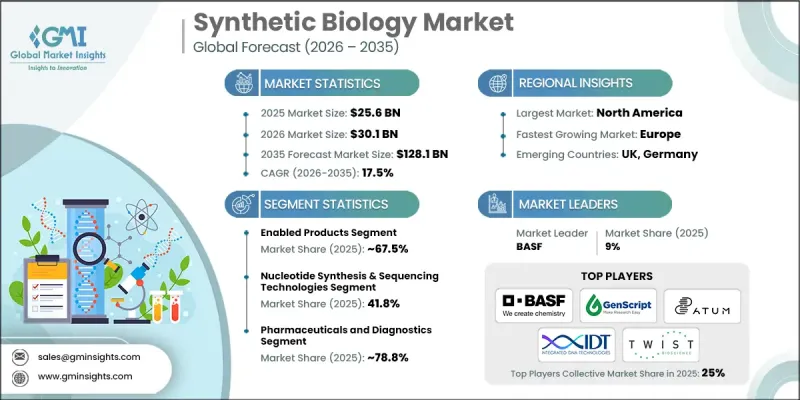
합성생물학이 공학 원리와 생물학적 시스템을 통합하여 새로운 생물학적 구성 요소, 장치 및 시스템을 설계하고 구축함에 따라 시장은 강력한 모멘텀을 보이고 있습니다. 이 분야는 기존의 유전공학적인 방법에서 세포의 거동을 정밀하고 프로그램 가능한 형태로 제어할 수 있는 첨단 플랫폼으로 크게 발전했습니다. 이러한 변화는 DNA 시퀀싱 및 합성 기술, 계산 생물학 도구의 급속한 발전, 생물학적 시스템 설계에 대한 깊은 지식에 의해 가속화되고 있습니다. 이 생태계는 올리고뉴클레오티드, 효소, 숙주생물 등의 기초 투입물, 합성유전자, 형질전환세포, DNA 라이브러리 등의 주요 결과물, 그리고 의약품, 산업용 화학물질, 바이오연료, 생체재료에 이르는 다운스트림 용도 분야에 이르기까지 다양합니다. 유전자 편집 기술, 특히 CRISPR 기반 플랫폼의 채택 확대는 헬스케어, 농업, 산업 바이오테크놀러지 분야에서의 적용 범위를 더욱 넓혀 전체 시장의 성장을 뒷받침하고 있습니다.
| 시장 범위 | |
|---|---|
| 개시 연도 | 2025년 |
| 예측 기간 | 2026-2035년 |
| 개시 연도 시장 규모 | 256억 달러 |
| 예측 시장 규모 | 1,281억 달러 |
| CAGR | 17.5% |
2025년에는 '실용화 제품' 부문이 시장 점유율의 67.5%를 차지했으며, 2035년까지 연평균 복합 성장률(CAGR) 17.4%로 성장할 것으로 전망됩니다. 이 부문은 설계된 생체 분자, 산업용 효소, 바이오 화학물질, 지속 가능한 연료, 첨단 소재, 농업용 생물학적 제제, 치료 솔루션 등 상업적으로 개발 가능한 결과물을 포함하고 있기 때문에 시장을 주도하고 있습니다. 견조한 수익 창출은 산업 분야에서의 직접적인 상업화 및 여러 최종 사용 분야에 걸친 광범위한 통합에 의해 뒷받침되고 있습니다.
제약 및 진단 부문은 2025년 78.8%의 점유율을 차지했으며, 2035년까지 연평균 17.2%의 성장률을 보일 것으로 전망됩니다. 이 부문은 신약 개발, 백신 개발, 유전자 및 세포 치료 연구, 분자진단의 설계 생물 시스템에 의해 주도되는 가장 확립된 용도 분야로 남아 있습니다. 합성생물학은 높은 정확도와 재현성, 맞춤형 의료 솔루션을 가능하게 하고, 첨단 치료 및 진단 플랫폼의 개발을 가속화하고 있습니다.
북미의 합성생물학 시장은 2025년 39.6%의 점유율을 차지했습니다. 이 지역은 첨단 연구 인프라, 생명공학 혁신 기술의 조기 도입, 그리고 학술 기관, 스타트업, 대형 생명공학 기업 및 제약회사를 포함한 고도로 발달된 생태계를 통해 지속적인 기술 발전과 상용화를 지원하며 탄탄한 입지를 유지하고 있습니다.
자주 묻는 질문
목차
제1장 조사 방법 및 범위
제2장 주요 요약
제3장 업계 인사이트
제4장 경쟁 구도
제5장 시장 추산 및 예측 : 제품 유형별(2022-2035년)
제6장 시장 추산 및 예측 : 기술별(2022-2035년)
제7장 시장 추산 및 예측 : 용도별(2022-2035년)
제8장 시장 추산 및 예측 : 지역별(2022-2035년)
제9장 기업 개요
AJY 26.06.11The Global Synthetic Biology Market was valued at USD 25.6 billion in 2025 and is estimated to grow at a CAGR of 17.5% to reach USD 128.1 billion by 2035.
The market is witnessing strong momentum as synthetic biology integrates engineering principles with biological systems to design and construct novel biological components, devices, and systems. The field has evolved significantly from traditional genetic engineering approaches toward advanced platforms that enable precise and programmable control of cellular behavior. This transformation has been accelerated by rapid advancements in DNA sequencing and synthesis technologies, computational biology tools, and deeper insights into biological system design. The ecosystem spans enabling inputs such as oligonucleotides, enzymes, and chassis organisms, core outputs including synthetic genes, engineered cells, and DNA libraries, and downstream applications across pharmaceuticals, industrial chemicals, biofuels, and biomaterials. Increasing adoption of genome editing technologies, particularly CRISPR-based platforms, is further expanding applications across healthcare, agriculture, and industrial biotechnology, supporting broad-based market growth.
| Market Scope | |
|---|---|
| Start Year | 2025 |
| Forecast Year | 2026-2035 |
| Start Value | $25.6 Billion |
| Forecast Value | $128.1 Billion |
| CAGR | 17.5% |
The enabled products segment accounted for 67.5% share in 2025 and is expected to grow at a CAGR of 17.4% through 2035. This segment leads the market as it includes commercially deployable outputs such as engineered biomolecules, industrial enzymes, bio-based chemicals, sustainable fuels, advanced materials, agricultural biologicals, and therapeutic solutions. Strong revenue generation is supported by direct industrial commercialization and widespread integration across multiple end-use sectors.
The pharmaceuticals and diagnostics segment held a 78.8% share in 2025 and is projected to grow at a CAGR of 17.2% through 2035. It remains the most established application area, driven by engineered biological systems in drug discovery, vaccine development, gene and cell therapy research, and molecular diagnostics. Synthetic biology enables highly precise, reproducible, and customizable medical solutions, accelerating the development of advanced therapeutic and diagnostic platforms.
North America Synthetic Biology Market accounted for 39.6% share in 2025. The region maintains a strong position due to advanced research infrastructure, early adoption of biotechnology innovations, and a highly developed ecosystem that includes academic institutions, startups, and large biotechnology and pharmaceutical companies, supporting continuous technological advancement and commercialization.
Major players operating in the Global Synthetic Biology Industry include Twist Bioscience, GenScript, Integrated DNA Technologies, Thermo Fisher Scientific, Novozymes, BASF, Royal DSM, Amyris, Gevo Inc, and Bristol-Myers Squibb. Companies in the Synthetic Biology Market are prioritizing heavy investment in advanced genome engineering platforms, including CRISPR-based technologies and automated DNA synthesis systems, to improve precision and scalability. They are strengthening R&D capabilities through collaborations with academic institutions and biotechnology startups to accelerate innovation pipelines. Expansion into high-growth application areas such as therapeutics, sustainable chemicals, and industrial bioproducts is also a key focus to diversify revenue streams. Firms are increasingly adopting integrated platform strategies that combine software, automation, and biological design tools to reduce development timelines. Strategic partnerships and licensing agreements are being used to access proprietary technologies and expand global reach. In addition, companies are investing in scalable biomanufacturing infrastructure to support commercialization, while also focusing on regulatory compliance and quality assurance to ensure safe and efficient market adoption.
Table of Contents
Chapter 1 Methodology & Scope
- 1.1 Market scope and definition
- 1.2 Research design
- 1.2.1 Research approach
- 1.2.2 Data collection methods
- 1.3 Data mining sources
- 1.3.1 Global
- 1.3.2 Regional/Country
- 1.4 Base estimates and calculations
- 1.4.1 Base year calculation
- 1.4.2 Key trends for market estimation
- 1.5 Primary research and validation
- 1.5.1 Primary sources
- 1.6 Forecast model
- 1.7 Research assumptions and limitations
Chapter 2 Executive Summary
- 2.1 Industry 360° synopsis
- 2.2 Key market trends
- 2.2.1 Regional
- 2.2.2 Product Type
- 2.2.3 Technology
- 2.2.4 Application
- 2.3 TAM Analysis, 2026-2035
- 2.4 CXO perspectives: Strategic imperatives
- 2.4.1 Executive decision points
- 2.4.2 Critical success factors
- 2.5 Future Outlook and Strategic Recommendations
Chapter 3 Industry Insights
- 3.1 Industry ecosystem analysis
- 3.1.1 Supplier landscape
- 3.1.2 Profit margin
- 3.1.3 Value addition at each stage
- 3.1.4 Factor affecting the value chain
- 3.1.5 Disruptions
- 3.2 Industry impact forces
- 3.2.1 Growth drivers
- 3.2.1.1 Increasing adoption of CRISPR and genome editing technologies for precise genetic modifications
- 3.2.1.2 Growing integration of artificial intelligence and bioinformatics tools
- 3.2.1.3 Rising demand for sustainable and eco-friendly bioproducts across industries
- 3.2.2 Industry pitfalls and challenges
- 3.2.2.1 Rising prevalence of chronic diseases and personalized medicine approaches
- 3.2.2.2 High capital requirements for scale-up
- 3.2.3 Market opportunities
- 3.2.3.1 Innovative solutions in healthcare, agriculture, and sustainable biomanufacturing to address global challenges
- 3.2.3.2 Personalized medicine & cell therapy expansion
- 3.2.1 Growth drivers
- 3.3 Growth potential analysis
- 3.4 Regulatory landscape
- 3.4.1 North America
- 3.4.2 Europe
- 3.4.3 Asia Pacific
- 3.4.4 Latin America
- 3.4.5 Middle East & Africa
- 3.5 Porter's analysis
- 3.6 PESTEL analysis
- 3.7 Price trends
- 3.7.1 By region
- 3.7.2 By Product type
- 3.8 Future market trends
- 3.9 Technology and Innovation landscape
- 3.9.1 Current technological trends
- 3.9.2 Emerging technologies
- 3.10 Patent Landscape
- 3.11 Trade statistics (HS code)
- 3.11.1 Major importing countries
- 3.11.2 Major exporting countries
- 3.12 Sustainability and environmental aspects
- 3.12.1 Sustainable practices
- 3.12.2 Waste reduction strategies
- 3.12.3 Energy efficiency in production
- 3.12.4 Eco-friendly initiatives
- 3.13 Carbon footprint consideration
Chapter 4 Competitive Landscape, 2025
- 4.1 Introduction
- 4.2 Company market share analysis
- 4.2.1 By region
- 4.2.1.1 North America
- 4.2.1.2 Europe
- 4.2.1.3 Asia Pacific
- 4.2.1.4 LATAM
- 4.2.1.5 MEA
- 4.2.1 By region
- 4.3 Company matrix analysis
- 4.4 Competitive analysis of major market players
- 4.5 Competitive positioning matrix
- 4.6 Key developments
- 4.6.1 Mergers & acquisitions
- 4.6.2 Partnerships & collaborations
- 4.6.3 New Product Launches
- 4.6.4 Expansion Plans
Chapter 5 Market Estimates and Forecast, By Product Type, 2022-2035 (USD Million)
- 5.1 Key trends
- 5.2 Core Products
- 5.2.1 Synthetic Nucleic Acids
- 5.2.2 Genetic Parts & Vectors
- 5.2.3 Others
- 5.3 Enabling Products
- 5.3.1 Gene Synthesis & Sequencing Platforms
- 5.3.2 Genetic Engineering Kits & Reagents
- 5.3.3 Others
- 5.4 Enabled Products
- 5.4.1 Therapeutic Biologics & Cell Therapies
- 5.4.2 Bio-Based Chemicals & Materials
- 5.4.3 Others
Chapter 6 Market Estimates and Forecast, By Technology, 2022-2035 (USD Million)
- 6.1 Key trends
- 6.2 Nucleotide Synthesis & Sequencing Technologies
- 6.3 Genetic Engineering Technologies
- 6.4 Bioinformatics & Computational Biology
- 6.5 Microfluidics & Miniaturization
- 6.6 Others
Chapter 7 Market Estimates and Forecast, By Application, 2022-2035 (USD Million)
- 7.1 Key trends
- 7.2 Pharmaceuticals and diagnostics
- 7.3 Industrial Chemicals & Materials
- 7.4 Agriculture & Food Production
- 7.5 Energy & Biofuels
- 7.6 Others
Chapter 8 Market Estimates and Forecast, By Region, 2022-2035 (USD Million)
- 8.1 Key trends
- 8.2 North America
- 8.2.1 U.S.
- 8.2.2 Canada
- 8.3 Europe
- 8.3.1 Germany
- 8.3.2 UK
- 8.3.3 France
- 8.3.4 Spain
- 8.3.5 Italy
- 8.3.6 Rest of Europe
- 8.4 Asia Pacific
- 8.4.1 China
- 8.4.2 India
- 8.4.3 Japan
- 8.4.4 Australia
- 8.4.5 South Korea
- 8.4.6 Rest of Asia Pacific
- 8.5 Latin America
- 8.5.1 Brazil
- 8.5.2 Mexico
- 8.5.3 Argentina
- 8.5.4 Rest of Latin America
- 8.6 Middle East and Africa
- 8.6.1 Saudi Arabia
- 8.6.2 South Africa
- 8.6.3 UAE
- 8.6.4 Rest of Middle East and Africa
Chapter 9 Company Profiles
- 9.1 Novozymes
- 9.2 BASF
- 9.3 GenScript
- 9.4 ATUM
- 9.5 Integrated DNA Technologies
- 9.6 Twist Bioscience
- 9.7 Biomax Informatics
- 9.8 Pareto Biotechnologies
- 9.9 Blue Heron
- 9.10 TeselaGen Syntax
- 9.11 Thermo Fisher Scientific
- 9.12 Gevo Inc
- 9.13 Royal DSM
- 9.14 Bristol-Myers Squibb
- 9.15 Amyris


