
|
시장보고서
상품코드
2122020
합성생물학 : 시장 점유율 분석, 업계 동향과 통계, 성장 예측(2026-2031년)Synthetic Biology - Market Share Analysis, Industry Trends & Statistics, Growth Forecasts (2026 - 2031) |
||||||
 Mordor Intelligence
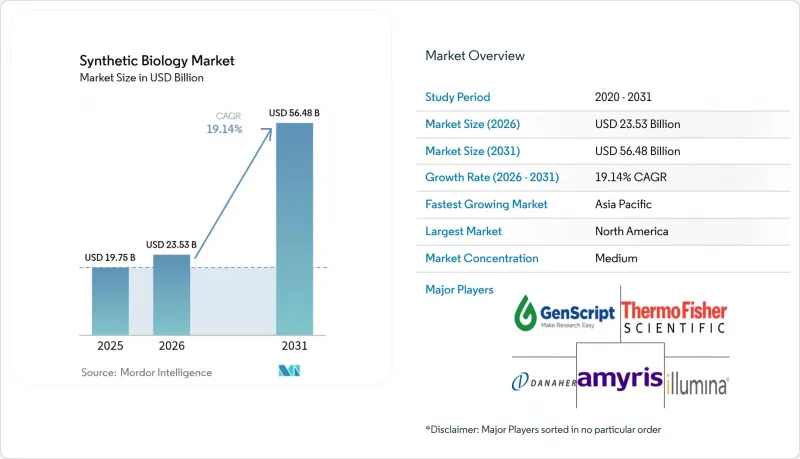
Mordor Intelligence에 따르면 합성생물학 시장 규모는 2025년에 197억 5,000만 달러로 평가되며, 2026년 235억 3,000만 달러에서 2031년까지 564억 8,000만 달러에 달할 것으로 예측되고 있으며, 예측 기간(2026-2031년)에 CAGR은 19.14%에 달할 전망입니다.
이 보고서는 제품별(핵심 제품, 기반 제품, 응용 제품), 용도별(헬스케어, 화학(바이오연료 포함), 식품·농업, 기타 용도(바이오보안, 에너지, 환경)), 그리고 지역별(북미, 유럽, 아시아태평양, 중동 및 아프리카, 남미)로 분류되어 있습니다.
글로벌 합성생물학 시장 동향 및 인사이트
정부 및 벤처 캐피털(VC)을 통한 자금 조달의 급증
대규모 공공 프로그램을 통해 바이오 제조 확장을 지원하는 자금 풀이 확대되고 있습니다. 미국은 2040년까지 국내 화학 물질 수요의 30%를 바이오 기반 생산으로 충당하는 것을 목표로 150억 달러 규모의 ‘국가 생명공학 구상 법(National Biotechnology Initiative Act)’을 제정했습니다. 중국은 2024년에 바이오 제조 인프라에 41억 7,000만 달러를 투자하겠다고 약속하며, 기술 주권을 우선시하는 자세를 보이고 있습니다. ‘호라이즌 유럽’의 SYNBEE 프로젝트는 25개국에 걸친 스타트업을 육성하고 있으며, SynBioBeta에 따르면 벤처 자금 조달은 팬데믹 이전 수준을 계속해서 상회하고 있습니다. 이러한 공공 자본과 민간 자본의 융합으로 인해 실험실에서 파일럿 플랜트에 이르는 ‘죽음의 계곡’이 단축되고, 시장 전체에서 제품 출시까지의 기간이 단축되고 있습니다.
유전자 합성 비용 곡선의 하락
효소를 이용한 DNA 합성 기술 덕분에 수 킬로베이스 규모의 구축체를 몇 주가 아닌 불과 며칠 만에 생성할 수 있게 되었습니다. Ansa Biotechnologies사의 플랫폼은 현재 1,000 bp를 초과하는 서열을 합성할 수 있으며, 2025년까지 10,000 bp의 합성 능력을 목표로 하고 있습니다. Evonetix사의 반도체 기반 칩은 기존의 포스포라미다이트 화학법에 비해 10배 빠른 속도로 유전자 길이의 단편을 제조합니다. Kilobaser사와 Telesis Bio사의 벤치탑형 합성 장치는 소규모 연구실에서도 쉽게 활용할 수 있습니다. 이러한 혁신으로 인해 대사 공학 및 단백질 최적화 프로젝트의 반복 비용이 절감되어, 합성 생물학 시장 전반의 수요가 더욱 높아지고 있습니다.
이중 용도 생물학적 위협 규제로 인한 제약
정책 입안자들에 의한 유전 물질 스크리닝 규제가 강화됨에 따라 규정 준수 부담이 증가하고 있습니다. SecureDNA사는 고객의 기밀성을 유지하면서도 30염기쌍을 초과하는 모든 주문에 대해 병원체 데이터베이스와 대조 작업을 수행하고 있으며, 이로 인해 비용과 처리 시간이 추가되고 있습니다. 중국의 생물안전 체계는 유전자 변형 미생물에 대해 엄격한 감독을 부과하는 한편, 혁신 지원도 목표로 하고 있습니다. 유럽에서는 생명공학법 시행이 2026년 3분기까지 연기되면서 불확실성이 장기화되고 있습니다. 프론티어스(Frontiers)의 조사에 따르면 AI를 활용한 바이오 자동화가 법 정비 속도를 앞지를 가능성이 있으며, 새로운 거버넌스 모델이 필요할 것이라고 경고하고 있습니다. 합성생물학 시장의 중소규모 기업은 이러한 규제 체제에 대응하기 위한 자원이 부족한 경우가 많아, 제품 출시 지연으로 이어지고 있습니다.
부문 분석
핵심 제품은 DNA/RNA 합성 장치와 유전자 편집 키트가 실험실 워크플로우에 필수적인 인프라를 형성하고 있으며, 2025년 매출의 47.92%를 차지했습니다. Evonetix사의 칩형 합성 장치는 하드웨어 혁신을 구현하여 합성 시간을 10분의 1로 단축하고, 소모품에 대한 지속적인 수요를 지원하고 있습니다. 핵심 제품의 합성생물학 시장 규모는 정확도와 처리량의 지속적인 향상에 힘입어 꾸준히 성장할 것으로 예상됩니다.
올리고뉴클레오티드, 클로닝 벡터, 무세포 시스템 등을 포괄하는 ‘이네이블링 제품’은 2031년까지 연평균 성장률(CAGR) 19.91%로 성장할 것으로 예측되며, 이는 제품 카테고리 중 가장 높은 성장률입니다. Twist Bioscience가 AI 안전 컨소시엄에 참여하고 있다는 사실은 안전한 DNA 조달이 전략적으로 얼마나 중요한지를 여실히 보여줍니다. 최초의 합성 효모 게놈과 프로그래밍 가능한 무세포 단백질 공장은 복잡성에 대한 요구가 높아지고 있음을 반영하며, 이로 인해 합성생물학 시장 전체의 소모품 수요가 증가하고 있습니다.
유전체 공학은 CRISPR-Cas9의 광범위한 채택과 TIGR과 같은 새로운 대체 기술의 부상으로 인해 2025년 합성생물학 시장 점유율의 33.21%를 차지했습니다. CASGEVY와 같은 상용화의 이정표는 치료제를 통한 수입원 확립을 지원하고 있습니다. 규제상의 선례가 산업 및 농업 분야의 유전체 편집 노력을 지원하고 있으며, 이로 인해 이 기술 부문의 주도적 지위가 공고해지고 있습니다.
바이오정보학 및 CAD 툴은 연평균 성장률(CAGR) 19.56%로 확대되며, 경험적 시행착오에서 알고리즘 주도형 엔지니어링으로의 변혁을 가져오고 있습니다. 'Researchers'지는 히트 물질 발굴까지의 기간을 단축하는 CodonTransformer의 다종 최적화 프레임워크에 대해 해설하고 있습니다. AI 모델의 규모가 확대됨에 따라 구독형 소프트웨어의 매출은 시약 판매액보다 더 빠르게 증가할 것으로 예상되며, 이는 밸류체인내 각 참여자 간의 합성생물학 시장 규모 분포를 재편하게 될 것입니다.
지역별 분석
2025년, 북미는 매출 점유율의 43.12%를 차지했습니다. 150억 달러 규모의 연방 정부 바이오 제조 투자가 생산 능력 확충을 지원하는 한편, 벤처 캐피털과 확립된 연구개발 클러스터가 스타트업 설립을 촉진하고 있습니다. Ginkgo Bioworks의 플랫폼 제휴와 서모피셔 사이언티픽(Thermo Fisher Scientific)의 400억-500억 달러 규모의 M&A 자금은 업계 재편과 규모의 경제에 따른 우위를 보여주고 있습니다. 그러나 미국 기업은 바이오정보학 분야의 인력 부족과 연방법 및 주법이 중복되는 규제에 대응해야 하는 부담과 같은 과제에 직면해 있으며, 이러한 요인들이 해당 지역의 합성생물학 시장 성장에 영향을 미칠 가능성이 있습니다.
아시아태평양은 연평균 성장률(CAGR) 21.7%로 가장 빠르게 성장하고 있는 지역입니다. 중국은 2024년 41억 7,000만 달러의 투자와 2025년에 예정된 추가 자금 배분을 바탕으로, 영향력 있는 생명공학 분야의 논문 및 특허에서 유럽을 추월했습니다. 상하이의 생명공학 허브는 해당 지역에 집적된 제조 인프라와 보조금 프로그램을 활용하여 상용화를 가속화하고 있습니다. 가격 경쟁력이 있는 생산 능력을 바탕으로 이 지역은 주요 수출 거점으로서의 입지를 확고히 하며, 세계 합성생물학 시장에서 영향력을 강화하고 있습니다.
유럽에서는 견고한 지속가능성 정책과 규제 집행의 불균형이 공존하고 있습니다. ‘Circular Bio-Based Europe’ 구상은 16만 5,000명의 직원을 보유한 15개 바이오 정유소에 22억 달러를 투자하고 있습니다. ‘호라이즌 유럽(Horizon Europe)’의 SYNBEE 프로그램은 25개국에 걸쳐 창업자 지원을 확대하고 있습니다. 그러나 EU 생명공학법의 제정 지연은 불확실성을 장기화시켜 프로젝트 자금 조달을 둔화시킬 가능성이 있습니다. 인셈프라(Insempra)와 같은 기업은 자본 시장이 신중한 상황임에도 불구하고 화장품용 바이오 유래 성분의 생산 확대를 위해 2,000만 달러를 조달했습니다. 장벽이 있기는 하지만, 유럽의 순환 경제 이념은 합성생물학 시장에서 장기적인 중요성을 확고히 하고 있습니다.
기타 혜택:
- 엑셀 형식의 시장 예측(ME) 시트
- 3개월간의 애널리스트 지원
자주 묻는 질문
목차
제1장 서론
제2장 조사 방법
제3장 개요
제4장 시장 구도
제5장 시장 규모와 성장 예측
제6장 경쟁 구도
제7장 시장 기회와 향후 전망
KSA 26.09.04According to Mordor Intelligence, the synthetic biology market size was valued at USD 19.75 billion in 2025 and estimated to grow from USD 23.53 billion in 2026 to reach USD 56.48 billion by 2031, at a CAGR of 19.14% during the forecast period (2026-2031).
This report is Segmented by Product (Core Products, Enabling Products, and Enabled Products), Application (Healthcare, Chemicals (Including Biofuels), Food and Agriculture, and Other Applications (Biosecurity, Energy, and Environment)), and Geography (North America, Europe, Asia-Pacific, Middle East and Africa, and South America).
Global Synthetic Biology Market Trends and Insights
Government & VC Funding Surge
Large-scale public programs are deepening the capital pool that supports biomanufacturing build-outs. The United States enacted a USD 15 billion National Biotechnology Initiative Act to meet 30% of domestic chemical demand through bio-based production by 2040 . China committed USD 4.17 billion in 2024 for biomanufacturing infrastructure, signaling technology sovereignty priorities. Horizon Europe's SYNBEE project nurtures start-ups across 25 nations, while venture funding has remained above pre-pandemic levels according to SynBioBeta. This confluence of public and private capital shortens the "valley of death" from lab bench to pilot plant, accelerating time-to-market across the market.
Falling Cost Curve for Gene Synthesis
Enzymatic DNA synthesis now delivers multi-kilobase constructs in days instead of weeks. Ansa Biotechnologies' platform synthesizes sequences exceeding 1,000 bp today and targets 10,000 bp capability by 2025 . Evonetix's semiconductor-based chips fabricate gene-length fragments 10 times faster than traditional phosphoramidite chemistry. Benchtop synthesizers from Kilobaser and Telesis Bio further democratize access for smaller labs. These innovations cut iteration costs for metabolic-engineering and protein-optimization projects, reinforcing demand across the synthetic biology market.
Dual-Use Bio-Threat Regulation Drag
Compliance burdens grow as policymakers tighten genetic-material screening. SecureDNA screens every order over 30 bp against pathogen databases while preserving customer confidentiality, adding cost and processing time. China's biosafety framework imposes strict oversight of engineered microbes yet aims to support innovation. Europe postponed its Biotech Act until Q3 2026, prolonging uncertainty. Frontiers research warns that AI-enabled bio-automation may outpace legislative cycles, requiring new governance models. Smaller firms in the synthetic biology market often lack the regulatory-affairs bandwidth to navigate these regimes, slowing product launches.
Other drivers and restraints analyzed in the detailed report include:
- AI-Driven Protein Design Adoption
- Breakthroughs in Gene-Editing Platforms Expanding Addressable Applications
- Corporate Net-Zero Mandates Driving Demand for Bio-Based Chemicals, Fuels, and Materials
- Talent Bottleneck in Bio-Informatics Engineers
For complete list of drivers and restraints, kindly check the Table Of Contents.
Segment Analysis
Core Products accounted for 47.92% of 2025 revenue as DNA/RNA synthesizers and gene-editing kits formed the indispensable infrastructure of laboratory workflows. Evonetix's chip-based synthesizer exemplifies hardware innovation, cutting synthesis times by a factor of 10 and anchoring recurring consumables demand. The synthetic biology market size for Core Products is expected to grow steadily, supported by continuous upgrades to accuracy and throughput.
Enabling Products-encompassing oligonucleotides, cloning vectors, and cell-free systems-are forecast to grow at a 19.91% CAGR through 2031, the fastest among product classes. Twist Bioscience's participation in AI safety consortia underscores the strategic importance of secure DNA sourcing. The first synthetic yeast genome and programmable cell-free protein factories reflect rising complexity needs, which magnify consumables volume across the synthetic biology market.
Genome Engineering held 33.21% of synthetic biology market share in 2025, buoyed by widespread CRISPR-Cas9 adoption and emergent alternatives like TIGR. Commercialization milestones such as CASGEVY validate therapeutic revenue pools. Regulatory precedents are encouraging industrial and agricultural genome-editing initiatives, reinforcing leadership of this technology segment.
Bioinformatics & CAD Tools will expand at a 19.56% CAGR, transforming empirical tinkering into algorithmically guided engineering. Researchers describes CodonTransformer's multi-species optimization framework that shortens path-to-hit timelines . As AI models scale, subscription software revenues are set to rise faster than reagent sales, reshaping the synthetic biology market size distribution among value-chain players.
Complete Report Scope:
- By Product
- Core Products
- DNA/RNA Synthesizers
- Gene Editing Kits & Enzymes
- Enabling Products
- Oligonucleotides
- Cloning Vectors
- Enabled Products
- Cell-Free Systems
- Engineered Micro-organisms
- Core Products
- By Technology
- Genome Engineering
- DNA/RNA Synthesis
- Bioinformatics & CAD Tools
- Bioprocessing & Automation
- By Application
- Healthcare
- Drug Discovery
- Gene & Cell Therapy
- Chemicals & Biofuels
- Specialty Chemicals
- Advanced Biofuels
- Food & Agriculture
- Alternative Proteins
- Crop Trait Engineering
- Other (Bio-security, Environment, Data Storage)
- Healthcare
- By End-User
- Industrial Biotech Companies
- Pharma & Biopharma
- Academic & Research Institutes
- Defense & Government Labs
- By Geography
- North America
- United States
- Canada
- Mexico
- Europe
- Germany
- United Kingdom
- France
- Italy
- Spain
- Rest of Europe
- Asia-Pacific
- China
- Japan
- India
- South Korea
- Australia
- Rest of Asia-Pacific
- Middle East
- GCC
- Rest of Middle East
- South America
- Brazil
- Argentina
- Rest of South America
- North America
Geography Analysis
North America held 43.12% revenue share in 2025. The USD 15 billion federal biomanufacturing commitment anchors capacity build-outs, while venture capital and established R&D clusters sustain start-up formation. Ginkgo Bioworks' platform partnerships and Thermo Fisher Scientific's USD 40-50 billion M&A war chest illustrate consolidation and scale advantages. Nevertheless, U.S. firms face talent bottlenecks in bio-informatics and the compliance load of overlapping federal and state rules, factors that could modulate synthetic biology market growth in the region.
Asia-Pacific is the fastest-expanding region at 21.7% CAGR. China has overtaken Europe in high-impact biotech papers and patents, supported by USD 4.17 billion in 2024 investments and further allocations slated for 2025. Shanghai's biotech hub leverages co-located manufacturing infrastructure and subsidy programs to accelerate commercialization. Price-competitive production capabilities position the region as a leading export platform, reinforcing its influence on the global synthetic biology market.
Europe combines robust sustainability policy with fragmented regulatory execution. The Circular Bio-Based Europe initiative directs USD 2.2 billion toward 15 biorefineries employing 165,000 workers. Horizon Europe's SYNBEE extends entrepreneur support to 25 nations. Delays in the EU Biotech Act, however, prolong uncertainty and may slow project financing. Companies like Insempra have raised USD 20 million to scale bio-based ingredients for cosmetics even amid cautious capital markets. Despite hurdles, Europe's circular-economy ethos secures long-term relevance within the synthetic biology market.
- Thermo Fisher Scientific
- Danaher (IDT & Cytiva)
- Illumina
- Genscript
- Twist Bioscience
- Amyris
- Gingko Bioworks
- Precigen
- Novozymes
- DSM-Firmenich
- Zymergen
- Synthetic Genomics (Viridos)
- New England Biolabs
- Inscripta
- Benchling
- Oxford Nanopore
- Evonetix
- Prokarium
- Arzeda
- Deep Genomics
Additional Benefits:
- The market estimate (ME) sheet in Excel format
- 3 months of analyst support
TABLE OF CONTENTS
1 Introduction
- 1.1 Study Assumptions & Market Definition
- 1.2 Scope of the Study
2 Research Methodology
3 Executive Summary
4 Market Landscape
- 4.1 Market Overview
- 4.2 Market Drivers
- 4.2.1 Government & VC funding surge
- 4.2.2 Falling cost curve for gene synthesis
- 4.2.3 AI-driven protein design adoption
- 4.2.4 Strategic moves by agriculture and food majors to secure engineered proteins and next-gen crops for supply-chain resilience
- 4.2.5 Breakthroughs in gene-editing platforms expanding addressable applications
- 4.2.6 Corporate net-zero mandates driving demand for bio-based chemicals, fuels, and materials
- 4.3 Market Restraints
- 4.3.1 Dual-use bio-threat regulation drag
- 4.3.2 Talent bottleneck in bio-informatics engineers
- 4.3.3 Limited DNA data-storage standards
- 4.3.4 Societal and ethical concerns over GMO adoption,
- 4.4 Value / Supply-Chain Analysis
- 4.5 Regulatory Landscape
- 4.6 Technological Outlook
- 4.7 Porter's Five Forces Analysis
- 4.7.1 Threat of New Entrants
- 4.7.2 Bargaining Power of Buyers
- 4.7.3 Bargaining Power of Suppliers
- 4.7.4 Threat of Substitutes
- 4.7.5 Competitive Rivalry
5 Market Size & Growth Forecasts (Value / USD)
- 5.1 By Product
- 5.1.1 Core Products
- 5.1.1.1 DNA/RNA Synthesizers
- 5.1.1.2 Gene Editing Kits & Enzymes
- 5.1.2 Enabling Products
- 5.1.2.1 Oligonucleotides
- 5.1.2.2 Cloning Vectors
- 5.1.3 Enabled Products
- 5.1.3.1 Cell-Free Systems
- 5.1.3.2 Engineered Micro-organisms
- 5.1.1 Core Products
- 5.2 By Technology
- 5.2.1 Genome Engineering
- 5.2.2 DNA/RNA Synthesis
- 5.2.3 Bioinformatics & CAD Tools
- 5.2.4 Bioprocessing & Automation
- 5.3 By Application
- 5.3.1 Healthcare
- 5.3.1.1 Drug Discovery
- 5.3.1.2 Gene & Cell Therapy
- 5.3.2 Chemicals & Biofuels
- 5.3.2.1 Specialty Chemicals
- 5.3.2.2 Advanced Biofuels
- 5.3.3 Food & Agriculture
- 5.3.3.1 Alternative Proteins
- 5.3.3.2 Crop Trait Engineering
- 5.3.4 Other (Bio-security, Environment, Data Storage)
- 5.3.1 Healthcare
- 5.4 By End-User
- 5.4.1 Industrial Biotech Companies
- 5.4.2 Pharma & Biopharma
- 5.4.3 Academic & Research Institutes
- 5.4.4 Defense & Government Labs
- 5.5 By Geography
- 5.5.1 North America
- 5.5.1.1 United States
- 5.5.1.2 Canada
- 5.5.1.3 Mexico
- 5.5.2 Europe
- 5.5.2.1 Germany
- 5.5.2.2 United Kingdom
- 5.5.2.3 France
- 5.5.2.4 Italy
- 5.5.2.5 Spain
- 5.5.2.6 Rest of Europe
- 5.5.3 Asia-Pacific
- 5.5.3.1 China
- 5.5.3.2 Japan
- 5.5.3.3 India
- 5.5.3.4 South Korea
- 5.5.3.5 Australia
- 5.5.3.6 Rest of Asia-Pacific
- 5.5.4 Middle East
- 5.5.4.1 GCC
- 5.5.4.3 Rest of Middle East
- 5.5.5 South America
- 5.5.5.1 Brazil
- 5.5.5.2 Argentina
- 5.5.5.3 Rest of South America
- 5.5.1 North America
6 Competitive Landscape
- 6.1 Market Concentration
- 6.2 Market Share Analysis
- 6.3 Company Profiles (includes Global level Overview, Market level overview, Core Segments, Financials, Strategic Information, Market Rank/Share, Products & Services, Recent Developments)
- 6.3.1 Thermo Fisher Scientific
- 6.3.2 Danaher (IDT & Cytiva)
- 6.3.3 Illumina
- 6.3.4 GenScript
- 6.3.5 Twist Bioscience
- 6.3.6 Amyris
- 6.3.7 Gingko Bioworks
- 6.3.8 Precigen
- 6.3.9 Novozymes
- 6.3.10 DSM-Firmenich
- 6.3.11 Zymergen
- 6.3.12 Synthetic Genomics (Viridos)
- 6.3.13 New England Biolabs
- 6.3.14 Inscripta
- 6.3.15 Benchling
- 6.3.16 Oxford Nanopore
- 6.3.17 Evonetix
- 6.3.18 Prokarium
- 6.3.19 Arzeda
- 6.3.20 Deep Genomics
7 Market Opportunities & Future Outlook
- 7.1 White-space & Unmet-Need Assessment