|
시장보고서
상품코드
2045703
와인, 스카치 및 위스키 통 시장 : 시장 기회, 성장요인, 업계 동향 분석 및 예측(2026-2035년)Wine, Scotch, and Whiskey Barrels Market Opportunity, Growth Drivers, Industry Trend Analysis, and Forecast 2026 - 2035 |
||||||

세계의 와인, 스카치 및 위스키 통시장은 2025년에 22억 달러로 평가되었고, CAGR 3%로 성장할 전망이며, 2035년까지 30억 달러에 이를 것으로 추정되고 있습니다.
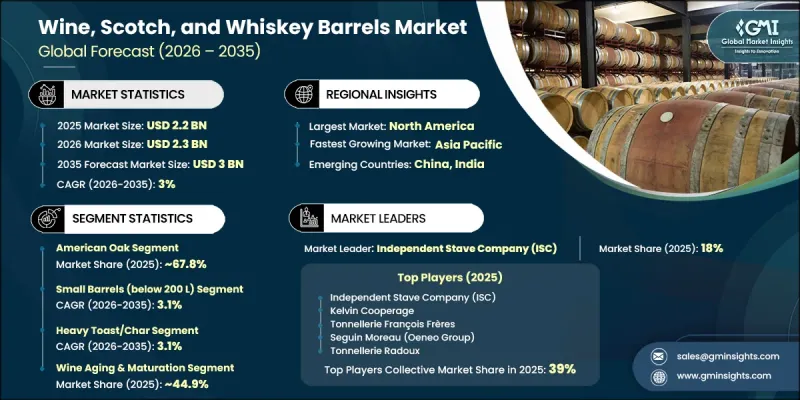
프리미엄 알코올 음료에 대한 수요 증가, 수제 음료 생산의 급속한 확대, 세련된 풍미를 지닌 숙성된 증류주와 와인에 대한 소비자의 선호도 변화로 인해 시장은 꾸준히 성장하고 있습니다. 지속가능성은 업계 전반에 걸쳐 최우선 순위가 되고 있으며, 통 제조업체들은 환경 친화적인 조달 및 생산 방식을 채택할 것을 촉구하고 있습니다. 각 기업들은 환경에 미치는 영향을 최소화하고 업무 효율성을 높이기 위해 지속 가능한 임업 관행, 통 재사용 프로그램, 재생 솔루션에 대한 투자를 늘리고 있습니다. 대체 목재의 사용 확대는 숙성 용도 전반에서 풍미 혁신과 제품 차별화를 위한 새로운 기회를 창출하고 있습니다. 아메리칸 오크는 저렴한 가격과 강력한 향미 부여 능력으로 업계를 지배하고 있지만, 프렌치 오크는 정교한 숙성 특성으로 프리미엄 시장에서의 지위를 유지하고 있습니다. 동유럽산 오크도 성능과 비용의 균형 잡힌 선택으로 받아들여지고 있습니다. 작은 통은 숙성을 촉진하고 풍미의 농도를 높이기 때문에 공예품 생산자들 사이에서 큰 수요가 있습니다. 한편, 중간 크기의 통은 전통적인 숙성 용도로 여전히 널리 선호되고 있습니다. 와인 숙성은 전 세계 와인 소비량 증가에 힘입어 가장 큰 용도 점유율을 차지하고 있습니다. 한편, 위스키와 버번 생산은 오크통 사용에 대한 규제 요건으로 인해 위스키와 버번 생산에 대한 수요가 계속 증가하고 있습니다. 증류소가 여전히 주요 최종 사용자 범주로 남아 있지만, 부티크 및 공예품 생산자가 시장에서 빠르게 성장하는 부문으로 부상하고 있습니다.
| 시장 범위 | |
|---|---|
| 개시 연도 | 2025년 |
| 예측 기간 | 2026-2035 |
| 개시 연도 시장 규모 | 22억 달러 |
| 예측 시장 규모 | 30억 달러 |
| CAGR | 3% |
아메리칸 오크 부문은 2025년 67.8%의 점유율을 차지한 것으로 평가되었으며, 2035년까지 연평균 복합 성장률(CAGR) 3.1%를 나타낼 것으로 예측됩니다. 아메리칸 오크는 비용 효율성이 뛰어나고 다양한 숙성 용도에 선호되는 강력한 풍미 특성을 제공하기 때문에 이 부문이 계속해서 선두를 유지하고 있습니다. 내구성, 접근성, 그리고 다양한 알코올 음료와의 궁합이 좋기 때문에 생산자들 사이에서 널리 채택되고 있습니다.
200리터 미만의 소형 통은 2025년 57.1%의 점유율을 차지했으며, 2026-2035년 연평균 복합 성장률(CAGR) 3.1%를 나타낼 것으로 예측됩니다. 이 통은 숙성 주기를 단축할 수 있을 뿐만 아니라 숙성 과정에서 더 풍부한 풍미를 끌어낼 수 있어 수제 음료 제조업체들 사이에서 큰 인기를 끌고 있습니다. 대형 통에 비해 비용은 높지만 단기간에 고유한 풍미 프로파일을 만들 수 있기 때문에 생산자들은 프리미엄 음료 및 특수 음료 생산에 있어 소형 포맷을 계속 선호하고 있습니다.
북미의 와인, 스카치 및 위스키 통 시장은 2026-2035년 연평균 복합 성장률(CAGR) 2.7%를 나타낼 것으로 예측됩니다. 지역별 성장세는 특히 미국 전역의 위스키와 버번의 견조한 생산량에 힘입은 바 있습니다. 버번 생산에 새로운 통을 사용하도록 의무화한 규정으로 인해 지역 전체에서 통에 대한 안정적인 수요가 지속적으로 창출되고 있습니다. 크래프트 증류소의 사업 확장, 프리미엄 음료의 소비 증가, 기술적으로 진보된 통 제조 방법의 채택 확대는 북미 전역 시장 성장을 더욱 촉진하고 있습니다.
자주 묻는 질문
목차
제1장 조사 방법과 범위
제2장 주요 요약
제3장 업계 인사이트
제4장 경쟁 구도
제5장 시장 추산 및 예측 : 소재 유형별(2022-2035년)
제6장 시장 추산 및 예측 : 팰릿 사이즈별(2022-2035년)
제7장 시장 추산 및 예측 : 토스트 레벨별(2022-2035년)
제8장 시장 추산 및 예측 : 용도별(2022-2035년)
제9장 시장 추산 및 예측 : 최종 용도별(2022-2035년)
제10장 시장 추산 및 예측 : 유통 채널별(2022-2035년)
제11장 시장 추산 및 예측 : 지역별(2022-2035년)
제12장 기업 개요
AJY 26.06.09The Global Wine, Scotch, And Whiskey Barrels Market was valued at USD 2.2 billion in 2025 and is estimated to grow at a CAGR of 3% to reach USD 3 billion by 2035.
The market continues to expand steadily due to rising demand for premium alcoholic beverages, the rapid growth of craft beverage production, and changing consumer preferences for aged spirits and wines with refined flavor profiles. Sustainability is becoming a major priority across the industry, encouraging barrel manufacturers to adopt environmentally responsible sourcing and production methods. Companies are increasingly investing in sustainable forestry practices, barrel reuse programs, and refurbishment solutions to minimize environmental impact while improving operational efficiency. The growing use of alternative wood materials is also creating new opportunities for flavor innovation and product differentiation across aging applications. American oak continues to dominate the industry because of its affordability and strong flavor contribution, while French oak maintains a premium market position due to its refined aging characteristics. Eastern European oak is also gaining acceptance as a balanced option between performance and cost. Small barrels are witnessing strong demand among craft producers because they accelerate maturation and enhance flavor intensity, while medium-sized barrels continue to remain widely preferred for traditional aging applications. Wine maturation accounts for the largest application share, supported by growing global wine consumption, while whiskey and bourbon production continue to generate strong demand due to regulatory requirements surrounding oak barrel usage. Distilleries remain the leading end-user category, with boutique and craft producers emerging as a rapidly expanding segment within the market.
| Market Scope | |
|---|---|
| Start Year | 2025 |
| Forecast Year | 2026-2035 |
| Start Value | $2.2 Billion |
| Forecast Value | $3 Billion |
| CAGR | 3% |
The American oak segment accounted for 67.8% share in 2025 and is expected to grow at a CAGR of 3.1% through 2035. The segment continues to lead because American oak offers a cost-effective solution while delivering strong flavor characteristics preferred across various aging applications. Its durability, availability, and compatibility with different alcoholic beverages continue to support widespread adoption among producers.
The small barrels with capacities below 200 liters held a share of 57.1% in 2025 and is projected to grow at a CAGR of 3.1% from 2026 to 2035. These barrels are gaining significant popularity among craft beverage manufacturers because they allow faster maturation cycles and produce richer flavor extraction during the aging process. Despite higher costs compared to larger barrels, producers continue to favor smaller formats for premium and specialty beverage production due to their ability to create distinct flavor profiles within shorter timeframes.
North America Wine, Scotch, And Whiskey Barrels Market is anticipated to grow at a CAGR of 2.7% during 2026-2035. Regional growth is supported by strong production volumes of whiskey and bourbon, particularly across the United States. Regulations requiring the use of new oak barrels in bourbon production continue to drive consistent demand for barrels throughout the region. Expanding craft distillery operations, rising premium beverage consumption, and increasing adoption of technologically advanced barrel manufacturing practices are further contributing to market growth across North America.
Major companies operating in the Global Wine, Scotch, and Whiskey Barrels Market include Independent Stave Company (ISC), Kelvin Cooperage, Tonnellerie Francois Freres, Seguin Moreau (Oeneo Group), Tonnellerie Radoux, Tonnellerie Taransaud, Tonnellerie Demptos, Nadalie (Tonnellerie Nadalie), Speyside Cooperage, and Cooperages 1912/Heinrich. Companies operating in the wine, scotch, and whiskey barrels market are focusing on sustainable sourcing practices, product innovation, and strategic partnerships to strengthen their competitive position. Manufacturers are expanding investments in responsible forestry programs and barrel recycling initiatives to meet growing sustainability expectations across the beverage industry. Many producers are also developing customized barrel solutions with unique toasting techniques and alternative wood options to create differentiated flavor profiles for premium alcoholic beverages. Capacity expansion and modernization of cooperage facilities are helping companies improve production efficiency and maintain supply consistency.
Table of Contents
Chapter 1 Methodology & Scope
- 1.1 Research approach
- 1.2 Quality Commitments
- 1.2.1 GMI AI policy & data integrity commitment
- 1.2.1.1 Source consistency protocol
- 1.2.1 GMI AI policy & data integrity commitment
- 1.3 Research Trail & Confidence Scoring
- 1.3.1 Research Trail Components
- 1.3.2 Scoring Components
- 1.4 Data Collection
- 1.4.1 Partial list of primary sources
- 1.5 Data mining sources
- 1.5.1 Paid sources
- 1.5.1.1 Sources, by region
- 1.5.1 Paid sources
- 1.6 Base estimates and calculations
- 1.6.1 Base year calculation for any one approach
- 1.7 Forecast model
- 1.7.1 Quantified market impact analysis
- 1.7.1.1 Mathematical impact of growth parameters on forecast
- 1.7.1 Quantified market impact analysis
- 1.8 Research transparency addendum
- 1.8.1 Source attribution framework
- 1.8.2 Quality assurance metrics
- 1.8.3 Our commitment to trust
Chapter 2 Executive Summary
- 2.1 Industry 360° synopsis
- 2.2 Key market trends
- 2.2.1 Regional
- 2.2.2 Material Type
- 2.2.3 Barrel Size
- 2.2.4 Toast Level
- 2.2.5 Application
- 2.2.6 End-Use
- 2.2.7 Distribution Channel
- 2.3 TAM Analysis, 2025-2034
- 2.4 CXO perspectives: Strategic imperatives
Chapter 3 Industry Insights
- 3.1 Industry ecosystem analysis
- 3.1.1 Supplier landscape
- 3.1.2 Profit margin
- 3.1.3 Value addition at each stage
- 3.1.4 Factor affecting the value chain
- 3.1.5 Disruptions
- 3.2 Industry impact forces
- 3.2.1 Growth drivers
- 3.2.2 Industry pitfalls and challenges
- 3.2.3 Market opportunities
- 3.3 Growth potential analysis
- 3.4 Regulatory landscape
- 3.4.1 North America
- 3.4.2 Europe
- 3.4.3 Asia Pacific
- 3.4.4 Latin America
- 3.4.5 Middle East & Africa
- 3.5 Porter's analysis
- 3.6 PESTEL analysis
- 3.7 Price trends
- 3.7.1 By region
- 3.7.2 By material
- 3.8 Future market trends
- 3.9 Technology and Innovation landscape
- 3.9.1 Current technological trends
- 3.9.2 Emerging technologies
- 3.10 Patent Landscape
- 3.11 Trade statistics (HS code)
- 3.11.1 Major importing countries
- 3.11.2 Major exporting countries
- 3.12 Sustainability and environmental aspects
- 3.12.1 Sustainable practices
- 3.12.2 Waste reduction strategies
- 3.12.3 Energy efficiency in production
- 3.12.4 Eco-friendly initiatives
Chapter 4 Competitive Landscape, 2025
- 4.1 Introduction
- 4.2 Company market share analysis
- 4.2.1 By region
- 4.2.1.1 North America
- 4.2.1.2 Europe
- 4.2.1.3 Asia Pacific
- 4.2.1.4 LATAM
- 4.2.1.5 MEA
- 4.2.1 By region
- 4.3 Company matrix analysis
- 4.4 Competitive analysis of major market players
- 4.5 Competitive positioning matrix
- 4.6 Key developments
- 4.6.1 Mergers & acquisitions
- 4.6.2 Partnerships & collaborations
- 4.6.3 New Product Launches
- 4.6.4 Expansion Plans
Chapter 5 Market Estimates and Forecast, By Material Type, 2022-2035 (USD Million) (Unit)
- 5.1 Key trends
- 5.2 American Oak
- 5.3 French Oak
- 5.4 Eastern European Oak
- 5.5 Other Wood Types
Chapter 6 Market Estimates and Forecast, By Barrel Size, 2022-2035 (USD Million) (Unit)
- 6.1 Key trends
- 6.2 Small Barrels (Below 200L)
- 6.3 Medium Barrels (200-300L)
- 6.4 Large Barrels (Above 300L)
Chapter 7 Market Estimates and Forecast, By Toast Level, 2022-2035 (USD Million) (Unit)
- 7.1 Key trends
- 7.2 Heavy Toast/Char
- 7.3 Medium Toast
- 7.4 Light Toast
- 7.5 Untoasted/Raw Oak
Chapter 8 Market Estimates and Forecast, By Application, 2022-2035 (USD Million) (Unit)
- 8.1 Key trends
- 8.2 Wine Aging & Maturation
- 8.3 Whiskey/Bourbon Aging
- 8.4 Scotch Whiskey Maturation
- 8.5 Other Spirits
Chapter 9 Market Estimates and Forecast, By End Use, 2022-2035 (USD Million) (Unit)
- 9.1 Key trends
- 9.2 Distilleries
- 9.3 Wineries & Vineyards
- 9.4 Craft/Boutique Producers
- 9.5 Breweries
- 9.6 Retail & Home Consumers
Chapter 10 Market Estimates and Forecast, By Distribution Channel, 2022-2035 (USD Million) (Unit)
- 10.1 Key trends
- 10.2 Direct Sales (B2B)
- 10.3 Distributors & Wholesalers
- 10.4 Cooperage Specialists & Agents
- 10.5 Online Retail (B2C)
Chapter 11 Market Estimates and Forecast, By Region, 2022-2035 (USD Million) (Unit)
- 11.1 Key trends
- 11.2 North America
- 11.2.1 U.S.
- 11.2.2 Canada
- 11.3 Europe
- 11.3.1 Germany
- 11.3.2 UK
- 11.3.3 France
- 11.3.4 Spain
- 11.3.5 Italy
- 11.3.6 Rest of Europe
- 11.4 Asia Pacific
- 11.4.1 China
- 11.4.2 India
- 11.4.3 Japan
- 11.4.4 Australia
- 11.4.5 South Korea
- 11.4.6 Rest of Asia Pacific
- 11.5 Latin America
- 11.5.1 Brazil
- 11.5.2 Mexico
- 11.5.3 Argentina
- 11.5.4 Rest of Latin America
- 11.6 Middle East and Africa
- 11.6.1 Saudi Arabia
- 11.6.2 South Africa
- 11.6.3 UAE
- 11.6.4 Rest of Middle East and Africa
Chapter 12 Company Profiles
- 12.1 Independent Stave Company (ISC)
- 12.2 Kelvin Cooperage
- 12.3 Tonnellerie Francois Freres
- 12.4 Seguin Moreau (Oeneo Group)
- 12.5 Tonnellerie Radoux
- 12.6 Tonnellerie Taransaud
- 12.7 Tonnellerie Demptos
- 12.8 Nadalie (Tonnellerie Nadalie)
- 12.9 Speyside Cooperage
- 12.10 Cooperages 1912/Heinrich