|
시장보고서
상품코드
2045742
중앙 PV 인버터 시장 : 시장 비즈니스 기회, 성장요인, 업계 동향 분석 및 예측(2026-2035년)Central PV Inverter Market Opportunity, Growth Drivers, Industry Trend Analysis, and Forecast 2026 - 2035 |
||||||

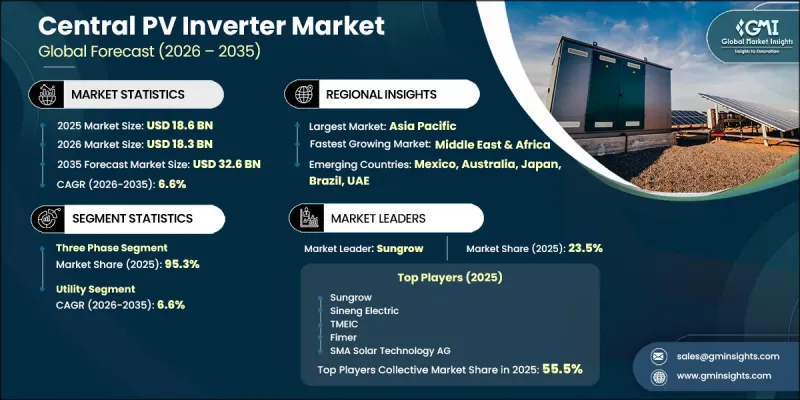
세계의 중앙 PV 인버터 시장은 2025년에 186억 달러로 평가되었고, CAGR 6.6%로 성장할 전망이며, 2035년까지 326억 달러에 이를 것으로 예측됩니다.
이 시장은 대용량 중앙 집중식 전력 변환 시스템을 필요로 하는 유틸리티 규모의 태양광 발전 설비와 대규모 상업용 태양광 발전 프로젝트의 급속한 확장에 영향을 받고 있습니다. 효율적인 에너지 변환 및 전력망 인프라와의 원활한 통합에 대한 수요가 증가함에 따라 집중형 태양광 인버터 기술의 도입이 가속화되고 있습니다. 태양광 모듈의 지속적인 효율 향상, 첨단 제조 기술, 재정적 인센티브 및 세제 혜택과 같은 지원 정책 프레임워크는 전 세계 태양광 시장의 성장을 더욱 촉진하고 있습니다. 시스템 성능을 향상시키면서 태양광 발전 비용을 절감하는 것에 대한 관심이 높아짐에 따라 대규모 프로젝트에서 대용량 인버터 시스템 도입이 촉진되고 있습니다. 제조업체들은 비용 최적화 및 운영 효율성을 지원하고, 확장성, 계통 호환성이 뛰어나며, 유지보수가 적은 인버터 솔루션 개발에 점점 더 많은 노력을 기울이고 있습니다. 탄소중립 및 재생에너지 도입에 대한 전 세계적인 노력 증가도 대규모 태양광 발전 프로젝트에 대한 투자를 촉진하고 있습니다. 중앙 PV 인버터는 메가와트 규모의 설치에서 규모의 경제, 시스템 통합 비용 절감, 효율성 향상 등의 이점을 지속적으로 누리고 있으며, 장기적인 태양광 발전 개발에서 선호되는 선택이 되고 있습니다.
| 시장 범위 | |
|---|---|
| 개시 연도 | 2025년 |
| 예측 기간 | 2026-2035년 |
| 개시 연도 시장 규모 | 186억 달러 |
| 예측 시장 규모 | 326억 달러 |
| CAGR | 6.6% |
삼상 부문은 95.3%의 점유율을 차지하고 있으며, 2035년까지 연평균 복합 성장률(CAGR) 6.6%를 나타낼 것으로 예측됩니다. 대규모 태양광 발전 프로젝트 및 상업용 태양광 발전 프로젝트에서 삼상 전력 시스템 도입이 확대되면서 중앙 인버터 솔루션에 대한 수요가 크게 증가하고 있습니다. 이러한 시스템은 더 높은 전력 용량을 수용하고, 전압의 안정성을 유지하며, 부하의 균형을 유지할 수 있기 때문에 널리 선호되고 있습니다. 대규모 태양광 발전 설비와의 호환성과 효율적인 계통연계 능력으로 인해 전 세계 태양광 인프라 프로젝트에서 채택이 더욱 확대되고 있습니다.
유틸리티 부문은 2025년 65.9%의 점유율을 차지했으며, 2026-2035년 연평균 6.6%의 성장률을 보일 것으로 전망됩니다. 대규모 태양광 발전시설의 확대에 따라 고출력에 대응하고 효율적인 계통연계를 보장할 수 있는 중앙 PV 인버터에 대한 수요가 견조하게 증가하고 있습니다. 이러한 시스템은 메가와트급 에너지 생산 관리, 전압 조정 최적화, 무효전력 제어를 지원하는 데 매우 효과적이며, 송전망에 연결된 대규모 실용적인 규모의 태양광 발전소에 이상적인 솔루션입니다.
미국의 중앙 PV 인버터 시장은 98.1%의 점유율을 차지하고 있으며, 2035년까지 15억 달러에 달할 것으로 예측됩니다. 미국 시장의 성장은 유틸리티 규모의 태양광 발전 프로젝트 도입 확대와 계통연계형 재생에너지 시스템에 대한 수요 증가에 의해 주도되고 있습니다. 대규모 태양광 발전 설비는 효율적인 전력 변환, 강화된 계통 지원 기능, 엄격한 계통 연계 요건 준수를 위해 중앙 집중식 인버터 기술에 대한 의존도가 높아지고 있습니다. 이러한 요소들이 시스템 신뢰도 향상과 미국 전역의 대규모 재생에너지 계통연계에 기여하고 있습니다.
자주 묻는 질문
목차
제1장 조사 방법 및 범위
제2장 주요 요약
제3장 산업 인사이트
제4장 경쟁 구도
제5장 시장 규모 및 예측 : 상별(2022-2035년)
제6장 시장 규모 및 예측 : 공칭 출력전압별(2022-2035년)
제7장 시장 규모 및 예측 : 공칭 출력별(2022-2035년)
제8장 시장 규모 및 예측 : 용도별(2022-2035년)
제9장 시장 규모 및 예측 : 지역별(2022-2035년)
제10장 기업 개요
AJY 26.06.15The Global Central PV Inverter Market was valued at USD 18.6 billion in 2025 and is estimated to grow at a CAGR of 6.6% to reach USD 32.6 billion by 2035.
The market is influenced by the rapid expansion of utility-scale solar installations and large commercial solar projects that require high-capacity centralized power conversion systems. Increasing demand for efficient energy conversion and seamless integration with grid infrastructure is accelerating the adoption of central PV inverter technologies. Continuous improvements in solar module efficiency, advanced manufacturing techniques, and supportive policy frameworks such as financial incentives and tax benefits are further strengthening market growth across global regions. Growing emphasis on reducing the cost of solar energy generation while improving system performance is encouraging the deployment of high-capacity inverter systems in large-scale projects. Manufacturers are increasingly focusing on developing scalable, grid-compatible, and low-maintenance inverter solutions that support cost optimization and operational efficiency. Rising global commitments toward carbon neutrality and renewable energy adoption are also driving investments in large solar power projects. Central PV inverters continue to benefit from economies of scale, lower system integration costs, and improved efficiency in megawatt-scale installations, making them a preferred choice for long-term solar energy developments.
| Market Scope | |
|---|---|
| Start Year | 2025 |
| Forecast Year | 2026-2035 |
| Start Value | $18.6 Billion |
| Forecast Value | $32.6 Billion |
| CAGR | 6.6% |
The three-phase segment held a 95.3% share and is expected to grow at a CAGR of 6.6% through 2035. Increasing deployment of three-phase electrical systems in utility-scale and commercial solar projects is significantly boosting demand for central inverter solutions. These systems are widely preferred due to their ability to support higher power capacities, maintain voltage stability, and ensure balanced load distribution. Their compatibility with large-scale solar installations and efficient grid integration capabilities continues to strengthen their adoption across global solar infrastructure projects.
The utility segment accounted for 65.9% share in 2025 and is projected to grow at a CAGR of 6.6% between 2026 and 2035. Expansion of large-scale solar power generation facilities is driving strong demand for central PV inverters due to their ability to handle high power outputs and ensure efficient grid synchronization. These systems are highly effective in managing megawatt-level energy production, optimizing voltage regulation, and supporting reactive power control, making them ideal for extensive utility-scale solar power plants connected to transmission networks.
United States Central PV Inverter Market held a 98.1% share and is projected to reach USD 1.5 billion by 2035. Growth in the U.S. market is being driven by increasing deployment of utility-scale solar projects and rising demand for grid-connected renewable energy systems. Large solar installations are increasingly relying on centralized inverter technologies for efficient power conversion, enhanced grid support functions, and compliance with strict interconnection requirements. These factors are contributing to improved system reliability and large-scale renewable energy integration across the country.
Key companies operating in the Global Central PV Inverter Market include ABB, Delta Electronics, Inc., Eaton, Fimer SpA, Fronius International, GE Vernova, Ingeteam Power Technology, Jema Energy, KEHUA Tech, LS Electric, Medha, Power Electronics, Siemens, Sineng Electric, SMA Solar Technology AG, Statcon Energiaa, Sungrow, TBEA, TMEIC, and Yaskawa Solectria Solar. Companies operating in the central PV inverter market are adopting several strategic initiatives to strengthen their competitive position and expand global reach. Leading players are increasing investments in research and development to enhance inverter efficiency, improve grid compatibility, and support higher power handling capabilities. Manufacturers are also focusing on developing modular and scalable inverter systems that can be easily integrated into large solar projects. Strategic collaborations with solar developers, utilities, and EPC contractors are helping companies expand their project portfolios and improve market penetration. In addition, firms are strengthening manufacturing capacity and supply chain networks to meet rising global demand for utility-scale solar installations. Digital monitoring systems, predictive maintenance technologies, and smart grid integration features are also being incorporated to improve operational performance and system reliability across large-scale solar energy projects.
Table of Contents
Chapter 1 Methodology & Scope
- 1.1 Research design
- 1.2 Quality commitment
- 1.2.1 GMI AI policy & data integrity commitment
- 1.2.1.1 Source consistency protocol
- 1.2.1 GMI AI policy & data integrity commitment
- 1.3 Research Trail & Confidence Scoring
- 1.3.1 Research Trail Components
- 1.3.2 Scoring Components
- 1.4 Data Collection
- 1.4.1 Partial list of primary sources
- 1.5 Data mining sources
- 1.5.1 Paid sources
- 1.5.1.1 Sources, by region
- 1.5.1 Paid sources
- 1.6 Base estimates and calculations
- 1.6.1 Base year calculation for any one approach
- 1.7 Forecast model
- 1.8 Research transparency addendum
- 1.8.1 Source attribution framework
- 1.8.2 Quality assurance metrics
- 1.8.3 Our commitment to trust
- 1.9 Market definitions
Chapter 2 Executive Summary
- 2.1 Industry synopsis, 2022 - 2035
- 2.2 Business trends
- 2.3 Phase trends
- 2.4 Nominal Output Voltage trends
- 2.5 Nominal Output Power trends
- 2.6 Application trends
- 2.7 Regional trends
Chapter 3 Industry Insights
- 3.1 Industry ecosystem
- 3.1.1 Raw material availability & sourcing analysis
- 3.1.2 Manufacturing capacity assessment
- 3.1.3 Supply chain resilience & risk factors
- 3.1.4 Distribution network analysis
- 3.2 Regulatory landscape
- 3.3 Industry impact forces
- 3.3.1 Growth drivers
- 3.3.2 Industry pitfalls & challenges
- 3.4 Growth potential analysis
- 3.5 Porter's analysis
- 3.5.1 Bargaining power of suppliers
- 3.5.2 Bargaining power of buyers
- 3.5.3 Threat of new entrants
- 3.5.4 Threat of substitutes
- 3.6 PESTEL analysis
- 3.6.1 Political factors
- 3.6.2 Economic factors
- 3.6.3 Social factors
- 3.6.4 Technological factors
- 3.6.5 Legal factors
- 3.6.6 Environmental factors
- 3.7 Cost structure analysis of central PV inverter market
- 3.8 Price trend analysis (Driven by Primary Research)
- 3.8.1 Historical price trend analysis (Driven by Primary Research)
- 3.8.2 Central PV inverter pricing by phase (USD/MW) (Driven by Primary Research)
- 3.9 Trade data analysis (Driven by Primary Research)
- 3.9.1 Import/export value trends (Driven by Primary Research)
- 3.9.2 Key trade corridors & tariff impact (Driven by Primary Research)
- 3.10 Production capacity & utilization (Driven by Primary Research)
- 3.10.1 Production capacity by region (Driven by Primary Research)
- 3.10.2 Utilization rates and expansion pipeline (Driven by Primary Research)
- 3.11 Impact of AI & generative AI on the market [SOLUTION CORE]
- 3.11.1 Predictive maintenance & fault detection
- 3.11.2 Grid Optimization & Load Forecasting
- 3.11.3 Digital twin simulation & testing
- 3.11.4 Risks, limitations & regulatory considerations
- 3.12 Emerging opportunities & trends
- 3.12.1 Digitalization & IoT integration
- 3.12.2 Emerging market penetration
- 3.13 Overall investment scenario and future outlook
Chapter 4 Competitive landscape, 2026
- 4.1 Introduction
- 4.2 Company market share analysis, by region, 2025
- 4.2.1 North America
- 4.2.2 Europe
- 4.2.3 Asia Pacific
- 4.2.4 Latin America
- 4.2.5 Middle East & Africa
- 4.3 Strategic dashboard
- 4.4 Strategic initiatives
- 4.5 Company benchmarking
- 4.6 Innovation & technology landscape
Chapter 5 Market Size and Forecast, By Phase, 2022 - 2035 (USD Billion & MW)
- 5.1 Key trends
- 5.2 Single Phase
- 5.3 Three Phase
Chapter 6 Market Size and Forecast, By Nominal Output Voltage, 2022 - 2035 (USD Billion & MW)
- 6.1 Key trends
- 6.2 230 - 400 V
- 6.3 401 - 600 V
Chapter 7 Market Size and Forecast, By Nominal Output Power, 2022 - 2035 (USD Billion & MW)
- 7.1 Key trends
- 7.2 <110 kW
- 7.3 >110 kW
Chapter 8 Market Size and Forecast, By Application, 2022 - 2035 (USD Billion & MW)
- 8.1 Key trends
- 8.2 Commercial
- 8.3 Industrial
- 8.4 Utility
Chapter 9 Market Size and Forecast, By Region, 2022 - 2035 (USD Billion & MW)
- 9.1 Key trends
- 9.2 North America
- 9.2.1 U.S.
- 9.2.2 Canada
- 9.3 Europe
- 9.3.1 Germany
- 9.3.2 Italy
- 9.3.3 Poland
- 9.3.4 Netherlands
- 9.3.5 Austria
- 9.3.6 UK
- 9.3.7 France
- 9.4 Asia Pacific
- 9.4.1 China
- 9.4.2 Australia
- 9.4.3 India
- 9.4.4 Japan
- 9.4.5 South Korea
- 9.5 Middle East & Africa
- 9.5.1 Israel
- 9.5.2 Saudi Arabia
- 9.5.3 UAE
- 9.5.4 South Africa
- 9.6 Latin America
- 9.6.1 Brazil
- 9.6.2 Mexico
- 9.6.3 Chile
Chapter 10 Company Profiles
- 10.1 ABB
- 10.2 Delta Electronics, Inc.
- 10.3 Eaton
- 10.4 Fimer SpA
- 10.5 Fronius International
- 10.6 GE Vernova
- 10.7 Ingeteam Power Technology
- 10.8 Jema Energy
- 10.9 KEHUA Tech
- 10.10 LS Electric
- 10.11 Medha
- 10.12 Power Electronics
- 10.13 Siemens
- 10.14 Sineng Electric
- 10.15 SMA Solar Technology AG
- 10.16 Statcon Energiaa
- 10.17 Sungrow
- 10.18 TBEA
- 10.19 TMEIC
- 10.20 Yaskawa Solectria Solar