|
시장보고서
상품코드
2049179
태양광발전용 인버터 시장 규모, 점유율, 동향 및 예측 : 기술별, 전압별, 용도별, 지역별(2026-2034년)Solar PV Inverter Market Size, Share, Trends and Forecast by Technology, Voltage, Application, and Region, 2026-2034 |
||||||

세계의 태양광발전용 인버터 시장 규모는 2025년에 90억 달러로 평가되었습니다. 향후 IMARC Group은 2026년부터 2034년까지 CAGR 4.01%를 기록하며 2034년까지 시장 규모가 130억 달러에 달할 것으로 예측하고 있습니다. 정부의 노력과 정책 시행, 태양광 인버터 비용 하락, 세계 에너지 수요 증가, 빠른 기술 발전 등이 시장을 이끄는 주요 요인으로 작용하고 있습니다.
태양광발전(PV) 인버터는 태양광 패널에서 생성된 직류(DC)를 교류(AC)로 변환하는 태양광발전 시스템의 중요한 구성요소입니다. 여기에는 파워 트랜지스터, 변압기 및 복잡한 소프트웨어 제어와 같은 주요 구성요소가 포함됩니다. 태양광발전용 인버터는 주택, 상업용 건물, 농업, 운송, 도시계획, 우주기술, 원격지 전력 시스템, 계통지원, 환경보전 활동 등 다양한 분야에서 활용되고 있습니다. 이를 통해 태양에너지의 실용화가 가능해져 에너지 자립을 촉진하고, 재생에너지원을 제공하며, 고정가격매입제도(FIT)를 통한 수입 기회를 창출하고, 탄소발자국을 줄일 수 있습니다.
효율성과 신뢰성의 지속적인 향상, 열 관리의 개선, 태양광 인버터의 용량 확대로 이어지는 최근의 기술 발전이 시장 성장을 견인하고 있습니다. 이와 더불어 계통연계 기능과 고도의 모니터링 기능을 갖추고 시스템의 최적 운영 및 유지보수를 보장하는 스마트 인버터의 도입도 시장 성장을 촉진하는 요인으로 작용하고 있습니다. 또한, 일반 시민들의 환경의식이 높아지면서 태양광발전과 같은 재생에너지로의 전환을 촉진하고 있으며, 이는 시장 성장에 기여하고 있습니다. 여기에 일조량이 부족할 때를 대비해 잉여 전력을 저장할 수 있는 에너지 저장 시스템의 등장과 보급도 시장 성장에 긍정적인 영향을 미치고 있습니다. 이 외에도 교통 부문의 급속한 전기화, 광범위한 연구개발(R&D) 활동, 농촌 지역의 전기화에 대한 수요 증가 등이 시장 성장을 견인할 것으로 예상됩니다.
태양광발전용 인버터 시장 동향 및 촉진요인
정부의 노력과 정책 시행
정부의 노력과 정책은 시장 성장을 촉진하는 데 매우 중요한 역할을 하고 있습니다. 세계 각국 정부는 기후변화의 위협과 태양광발전과 같은 청정하고 재생 가능한 에너지원으로 전환할 필요성을 인식하고 있습니다. 이러한 전환을 촉진하기 위해 정부는 고정가격매입제도(FIT), 세액공제, 직접 보조금 등 일련의 지원책을 도입하여 주택 소유자나 기업이 태양광 패널을 설치하는 데 있어 경제적 부담을 경감시켜주고 있습니다. 이와 더불어, 많은 국가에서 적극적인 재생에너지 목표와 이를 뒷받침할 수 있는 법률을 제정하여 태양광 인버터에 대한 수요를 더욱 촉진하고 있습니다. 이러한 정책은 태양광발전 설비의 초기 비용을 절감할 뿐만 아니라, 장기적인 경제성 또한 높여주고 있습니다. 이러한 정부의 단호한 조치는 재생에너지에 대한 확고한 의지를 보여줌으로써 소비자와 투자자에게 신뢰감을 주고 시장 성장을 견인하고 있습니다.
제품 비용의 급격한 하락
태양광발전용 인버터의 원가 하락도 시장 성장의 중요한 촉진요인 중 하나입니다. 기술의 발전에 따라 제조 공정의 효율성이 향상되어 원자재 및 부품의 비용 절감에 기여하고 있습니다. 제조 자동화의 발전은 인건비 절감과 인적 오류의 최소화로 이어져 제품의 신뢰성을 높이고 있습니다. 또한, 수요 증가에 따른 생산 규모의 확대는 규모의 경제를 가져와 태양광발전용 인버터의 단가를 낮추고 있습니다. 또한, 전기요금을 절감하고자 하는 일반 가정부터 지속가능성 목표를 달성하고자 하는 기업까지 다양한 소비자층에게 태양광발전이 점점 더 저렴해지고 있습니다. 비용의 하락은 태양광발전 시스템의 보급을 촉진하고 있으며, 이는 태양광발전용 인버터의 수요 확대로 이어지고 있습니다.
세계 에너지 수요 증가
급속한 산업화와 도시화에 따라 전 세계적으로 에너지 수요가 급증하고 있습니다. 기존의 에너지원은 유한하고 환경에 악영향을 미치기 때문에 지속가능한 대체 에너지를 찾는 것이 필수적입니다. 태양광발전용 인버터에 의해 실현되는 태양광발전은 실행 가능한 솔루션을 제공합니다. 태양광발전은 풍부하고 재생 가능한 자원인 태양의 힘을 이용하여 전력을 생산합니다. 운송, 난방, 냉방 등의 분야에서 전 세계가 전기화로 전환함에 따라 전력 수요는 비약적으로 증가할 것으로 예상됩니다. PV 인버터를 이용한 태양광발전 시스템은 이러한 증가하는 수요를 지속가능한 형태로 충족시킬 수 있습니다. 주거용 지붕에서 상업용 건물, 대규모 태양광발전소까지 태양광 에너지의 활용은 모든 분야에서 확대되고 있습니다. 따라서 전 세계 에너지 수요의 증가는 태양광 인버터 시장의 성장을 이끄는 주요 요인으로 작용하고 있습니다.
목차
제1장 서문
제2장 조사 범위와 조사 방법
제3장 주요 요약
제4장 소개
제5장 세계의 태양광발전용 인버터 시장
제6장 시장 내역 : 기술별
제7장 시장 내역 : 전압별
제8장 시장 내역 : 용도별
제9장 시장 내역 : 지역별
제10장 SWOT 분석
제11장 밸류체인 분석
제12장 Porter's Five Forces 분석
제13장 가격 분석
제14장 태양광발전용 인버터 제조 공정
제15장 경쟁 구도
KSM 26.06.09The global solar PV inverter market size was valued at USD 9.0 Billion in 2025. Looking forward, IMARC Group estimates the market to reach USD 13.0 Billion by 2034, exhibiting a CAGR of 4.01% during 2026-2034.The implementation of government initiatives and policies, declining costs of solar PV inverters, increasing energy demand across the globe, and rapid technological advancements are some of the major factors propelling the market.
A solar photovoltaic (PV) inverter is a vital component of solar energy systems, transforming direct current produced by solar panels into alternating current (AC). It comprises key components, such as power transistors, transformers, and complex software controls. Solar PV inverter finds applications across diverse fields, including residential housing, commercial buildings, agricultural operations, transportation, urban planning, space technology, remote power systems, grid support, and environmental conservation initiatives. It enables the practical utilization of solar energy, promotes energy independence, provides a renewable energy source, offers potential income through feed-in tariffs, and reduces carbon footprints.
The recent technological advancements, which continuously refine efficiency and reliability, improve thermal management, and increase the capacity of solar PV inverters, are propelling the market growth. Along with this, the introduction of smart inverters, which provide grid support features and advanced monitoring capabilities, ensuring optimal system operation and maintenance, is acting as another growth-inducing factor. Furthermore, escalating environmental awareness among the masses is propelling the shift towards renewable energy sources, such as solar power, which is contributing to the market growth. Apart from this, the advent and growth of energy storage systems, which can store excess solar power for use when sunlight is not available, is positively influencing the market growth. Other factors, including rapid electrification of the transportation sector, extensive research and development (R&D) activities, and increasing demand for electrification of rural areas, are anticipated to drive the market growth.
Solar PV Inverter Market Trends/Drivers
The implementation of government initiatives and policies
Government initiatives and policies are instrumental in fostering the market growth. Governments across the globe have recognized the imminent threat owing to climate change and the need to transition towards clean, renewable energy sources, such as solar power. To incentivize this transition, they have introduced an array of support mechanisms, such as feed-in tariffs, tax credits, and direct subsidies, which reduces the financial burden on homeowners and businesses for installing solar panels. Along with this, numerous countries have also enacted aggressive renewable energy targets backed by supportive legislation, which is further driving the demand for solar PV inverters. These policies not only lower the upfront costs of solar installations but also enhance their economic viability over the long term. Such decisive actions from governments signal a robust commitment to renewable energy, thereby instilling confidence among consumers and investors and driving the market growth.
The rapid decline in product costs
The declining cost of solar PV inverters is another significant driver of market growth. As technology advances, the efficiencies of manufacturing processes improve, contributing to a reduction in the cost of raw materials and components. The rise of automation in manufacturing has also reduced labor costs and minimized human error, enhancing product reliability. Furthermore, the expanding scale of production due to increasing demand leads to economies of scale, which reduces the per-unit cost of solar PV inverters. Moreover, solar energy is now becoming increasingly affordable for a wide array of consumers, from homeowners wanting to offset their electricity bills to businesses aiming to achieve sustainability goals. Lower costs are driving the widespread adoption of solar power systems and, by extension, the demand for solar PV inverters.
The increasing energy demand across the globe
The energy demand across the globe is surging due to rapid industrialization and urbanization activities. Traditional energy sources are limited and environmentally damaging, making it essential to find sustainable alternatives. Solar power, facilitated by solar PV inverters, provides a viable solution. Solar energy harnesses the sun's power, an abundant and renewable resource, to generate electricity. With the global shift towards electrification in sectors such as transport, heating, and cooling, the demand for electricity is set to grow exponentially. Solar power systems using PV inverters can meet this increased demand in a sustainable manner. From residential rooftops to commercial installations and utility-scale solar farms, the application of solar energy is expanding across the board. Thus, rising global energy demand is a key driver propelling the growth of the solar PV inverter market.
Solar PV Inverter Industry Segmentation
This report provides an analysis of the key trends in each segment of the global solar PV inverter market report, along with forecasts at the global and regional levels from 2026-2034. The report has categorized the market based on technology, voltage and application.
Breakup by Technology
- Central Inverters
- String Inverters
- Microinverters
- Others
String inverters dominate the market
String inverters are currently dominating the market as they have been the standard in the solar industry for many years, and their long-standing presence in the market has led to wide acceptance and trust in their technology. Furthermore, they offer a significant cost advantage over other types of inverters, such as microinverters and power optimizers. String inverters also have lower upfront costs, making them an attractive option for cost-conscious consumers. Apart from this, string inverters are incredibly efficient for larger, unshaded installations. They perform exceptionally well in conditions where solar panels receive uniform sunlight, making them a preferred choice for large residential, commercial, or utility-scale installations. Additionally, the recent development of multi-string inverters, which provide more flexibility and efficiency, is contributing to the market growth.
Breakup by Voltage
- < 1,000 V
- 1,000 - 1,499 V
- 1,500 V
> 1500 V dominates the market
The >1500V segment is dominating the market as it allows more solar modules to be connected in series in a string, reducing the number of strings needed. This reduction leads to fewer combiner boxes, fewer cables, and fewer connections, thereby resulting in significant balance of system (BOS) cost savings. Furthermore, it results in a lower current for the same power output, which reduces resistive losses in the system, leading to an overall increase in system efficiency. Additionally, the recent technological advancements in components, such as inverters, transformers, and switchgears, have made it safer and more reliable to operate at these higher voltages, such as > 15000. Moreover, the implementation of favorable regulations and grid codes in many regions supports the adoption of higher voltage levels, further driving the trend towards >1500V systems.
Breakup by Application
- Utility Scale
- Residential Scale
- Small Commercial Scale
- Large Commercial Scale
- Industrial Scale
Utility scale dominate the market
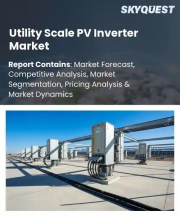
Utility-scale solar projects are dominating the market as they outsize residential and commercial installations in terms of power generation capacity. Given their large scale, even a single utility-scale project can require hundreds or even thousands of inverters, thereby driving up demand in the inverter market. Furthermore, many countries are aggressively expanding their renewable energy capacity to meet climate goals by establishing utility-scale solar farms, which is further boosting the market growth. Apart from this, utility-scale projects offer economies of scale, as the per-unit cost of components, including solar PV inverters, decreases significantly with the scale of the project. This cost advantage makes utility-scale projects more financially attractive, thereby driving their prevalence. Moreover, recent advancements in technology have resulted in more efficient and reliable solar PV inverters that can handle the high power output of utility-scale projects.
Breakup by Region
- Asia Pacific
- Europe
- North America
- Middle East and Africa
- Latin America
Asia Pacific exhibits a clear dominance in the market, accounting for the largest solar PV inverter market share
The report has also provided a comprehensive analysis of all the major regional markets, which includes Asia Pacific, Europe, North America, Middle East and Africa, and Latin America. According to the report, Asia Pacific represented the largest market segment. According to the report, Asia Pacific represented the largest market.
The Asia Pacific region is dominating the solar PV inverter market due to the implementation of ambitious renewable energy targets and supportive government policies, driving large-scale installations of solar power systems. Furthermore, the region has a substantial and growing demand for electricity due to rapid industrialization, urbanization, and population growth. Solar power, facilitated by solar PV inverters, is viewed as a sustainable solution to meet this escalating energy demand. Additionally, the Asia Pacific region has a significant need for rural electrification. Countries with remote areas lacking grid infrastructure are turning towards solar power as a practical solution for electrification, thereby driving the demand for solar PV inverters. Moreover, the region's abundant sunshine provides excellent conditions for solar power generation, making solar energy a naturally preferred choice.
Competitive Landscape
The key market players are significantly heavily in research and development (R&D) to introduce innovative products that offer higher efficiency, reliability, and better integration with energy storage systems. They are also developing smart inverters equipped with advanced features, such as predictive maintenance, remote monitoring and control, and grid support functions. Furthermore, companies are entering partnerships and collaborations with other industry players, research institutions, and technology firms to leverage shared resources and expertise. Additionally, they are pursuing mergers and acquisitions (M&A) strategies to increase their market share, expand their product portfolios, and strengthen their technological capabilities. Moreover, many leading companies are expanding their manufacturing capacities by setting up new production facilities or enhancing existing ones to meet the rising demand for solar PV inverters.
The report has provided a comprehensive analysis of the competitive landscape in the market. Detailed profiles of all major companies have also been provided. Some of the key players in the market include:
- ABB Ltd
- Schneider Electric SE
- Siemens AG
- Mitsubishi Electric Corporation
- Omron Corporation
- General Electric Company
- SMA Solar Technology AG
- Delta Energy Systems Inc.
- Enphase Energy Inc.
- SolarEdge Technologies Inc.
- Huawei Technologies Co. Ltd
- Kstar New Energy Co. Ltd
- Sineng Electric Co. Ltd
- Sungrow Power Supply Co Ltd
- Tabuchi Electric Co. Ltd
- TBEA Sunoasis Co. Ltd
- Toshiba Corporation
Key Questions Answered in This Report
1. How big is the global solar PV inverter market?
2. What is the expected growth rate of the global solar PV inverter market during 2026-2034?
3. What are the key factors driving the global solar PV inverter market?
4. What has been the impact of COVID-19 on the global solar PV inverter market?
5. What is the breakup of the global solar PV inverter market based on the technology?
6. What is the breakup of the global solar PV inverter market based on the voltage?
7. What is the breakup of the global solar PV inverter market based on the application?
8. What are the key regions in the global solar PV inverter market?
9. Who are the key players/companies in the global solar PV inverter market?
Table of Contents
1 Preface
2 Scope and Methodology
- 2.1 Objectives of the Study
- 2.2 Stakeholders
- 2.3 Data Sources
- 2.3.1 Primary Sources
- 2.3.2 Secondary Sources
- 2.4 Market Estimation
- 2.4.1 Bottom-Up Approach
- 2.4.2 Top-Down Approach
- 2.5 Forecasting Methodology
3 Executive Summary
4 Introduction
- 4.1 Overview
- 4.2 Key Industry Trends
5 Global Solar PV Inverter Market
- 5.1 Market Overview
- 5.2 Market Performance
- 5.3 Impact of COVID-19
- 5.4 Market Breakup by Technology
- 5.5 Market Breakup by Voltage
- 5.6 Market Breakup by Application
- 5.7 Market Breakup by Region
- 5.8 Market Forecast
6 Market Breakup by Technology
- 6.1 Central Inverters
- 6.1.1 Market Trends
- 6.1.2 Market Forecast
- 6.2 String Inverters
- 6.2.1 Market Trends
- 6.2.2 Market Forecast
- 6.3 Microinverters
- 6.3.1 Market Trends
- 6.3.2 Market Forecast
- 6.4 Others
- 6.4.1 Market Trends
- 6.4.2 Market Forecast
7 Market Breakup by Voltage
- 7.1 < 1,000 V
- 7.1.1 Market Trends
- 7.1.2 Market Forecast
- 7.2 1,000 - 1,499 V
- 7.2.1 Market Trends
- 7.2.2 Market Forecast
- 7.3 > 1,500 V
- 7.3.1 Market Trends
- 7.3.2 Market Forecast
8 Market Breakup by Application
- 8.1 Utility Scale
- 8.1.1 Market Trends
- 8.1.2 Market Forecast
- 8.2 Residential Scale
- 8.2.1 Market Trends
- 8.2.2 Market Forecast
- 8.3 Small Commercial Scale
- 8.3.1 Market Trends
- 8.3.2 Market Forecast
- 8.4 Large Commercial Scale
- 8.4.1 Market Trends
- 8.4.2 Market Forecast
- 8.5 Industrial Scale
- 8.5.1 Market Trends
- 8.5.2 Market Forecast
9 Market Breakup by Region
- 9.1 Asia Pacific
- 9.1.1 Market Trends
- 9.1.2 Market Forecast
- 9.2 Europe
- 9.2.1 Market Trends
- 9.2.2 Market Forecast
- 9.3 North America
- 9.3.1 Market Trends
- 9.3.2 Market Forecast
- 9.4 Middle East and Africa
- 9.4.1 Market Trends
- 9.4.2 Market Forecast
- 9.5 Latin America
- 9.5.1 Market Trends
- 9.5.2 Market Forecast
10 Global Solar PV Inverter Industry: SWOT Analysis
- 10.1 Overview
- 10.2 Strengths
- 10.3 Weaknesses
- 10.4 Opportunities
- 10.5 Threats
11 Global Solar PV Inverter Industry: Value Chain Analysis
- 11.1 Overview
- 11.2 Research and Development
- 11.3 Raw Material Procurement
- 11.4 Manufacturing
- 11.5 Marketing
- 11.6 Distribution
- 11.7 End-Use
12 Global Solar PV Inverter Industry: Porters Five Forces Analysis
- 12.1 Overview
- 12.2 Bargaining Power of Buyers
- 12.3 Bargaining Power of Suppliers
- 12.4 Degree of Competition
- 12.5 Threat of New Entrants
- 12.6 Threat of Substitutes
13 Global Solar PV Inverter Industry: Price Analysis
- 13.1 Price Indicators
- 13.2 Price Structure
- 13.3 Margin Analysis
14 Solar PV Inverter Manufacturing Process
- 14.1 Product Overview
- 14.2 Raw Material Requirements
- 14.3 Manufacturing Process
- 14.4 Key Success and Risk Factors
15 Competitive Landscape
- 15.1 Market Structure
- 15.2 Key Players
- 15.3 Profiles of Key Players
- 15.3.1 ABB Ltd
- 15.3.2 Schneider Electric SE
- 15.3.3 Siemens AG
- 15.3.4 Mitsubishi Electric Corporation
- 15.3.5 Omron Corporation
- 15.3.6 General Electric Company
- 15.3.7 SMA Solar Technology AG
- 15.3.8 Delta Energy Systems Inc.
- 15.3.9 Enphase Energy Inc.
- 15.3.10 SolarEdge Technologies Inc.
- 15.3.11 Huawei Technologies Co. Ltd
- 15.3.12 Kstar New Energy Co. Ltd
- 15.3.13 Sineng Electric Co. Ltd
- 15.3.14 Sungrow Power Supply Co Ltd
- 15.3.15 Tabuchi Electric Co. Ltd
- 15.3.16 TBEA Sunoasis Co. Ltd
- 15.3.17 Toshiba Corporation