|
시장보고서
상품코드
2045808
펌프 시장 : 시장 기회, 성장요인, 업계 동향 분석 및 예측(2026-2035년)Pump Market Opportunity, Growth Drivers, Industry Trend Analysis, and Forecast 2026 - 2035 |
||||||

세계의 펌프 시장은 2025년에 576억 달러로 평가되었고, 2035년까지 연평균 복합 성장률(CAGR) 4.9%로 성장할 전망이며, 925억 달러에 이를 것으로 추정되고 있습니다.
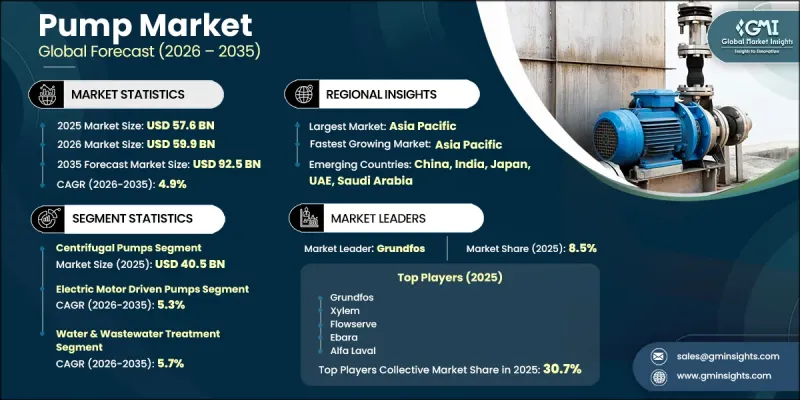
산업계와 정부가 물의 지속가능성과 자원 관리 개선에 집중하면서 상하수도 인프라에 대한 투자 증가가 시장 성장에 크게 기여하고 있습니다. 펌프는 물 분배, 하수 처리, 해수 담수화 및 산업용 유체 관리와 관련된 응용 분야에서 계속해서 중요한 역할을 하고 있습니다. 개발도상국의 급속한 도시화와 가속화된 산업 확장은 다양한 산업 분야에서 첨단 펌프 시스템에 대한 수요를 더욱 증가시키고 있습니다. 석유 및 가스, 화학, 발전, 제조 등의 분야는 유체 이송, 냉각, 가열, 프로세스 작동에 있어 펌프에 크게 의존하고 있습니다. 또한, 산업 현대화, 에너지 효율 시스템, 인프라 개발에 대한 투자 확대는 장기적인 시장 확대를 뒷받침하고 있습니다. 지속 가능한 기술과 에너지 절약을 촉진하는 규제 조치도 운영 효율이 개선된 고성능 펌프 시스템의 도입을 촉진하고 있습니다. 스마트팜프 시스템, 자동화 및 예지보전 솔루션의 기술 발전은 전 세계 산업 및 지자체에서 제품 채택을 더욱 촉진하고 있습니다.
| 시장 범위 | |
|---|---|
| 개시 연도 | 2025년 |
| 예측 기간 | 2026-2035년 |
| 개시 시점 시장 규모 | 576억 달러 |
| 예측 시장 규모 | 925억 달러 |
| CAGR | 4.9% |
펌프 산업은 기업들이 유체 관리 업무 전반의 효율성, 신뢰성 및 지속가능성 향상에 점점 더 집중함에 따라 꾸준히 변화하고 있습니다. 물 부족과 환경 보호에 대한 우려가 높아지면서 공공 기관과 민간 기업 모두 고급 수처리 인프라에 대한 막대한 투자를 진행하고 있으며, 이는 펌프 시스템에 대한 지속적인 수요를 창출하고 있습니다. 동시에 신흥 경제국의 산업화 발전은 에너지, 제조 및 화학 처리 시설에서 펌프의 도입을 계속 촉진하고 있습니다. 국내 제조 역량을 강화하고 수입 의존도를 낮추기 위한 정부의 투자 증가도 시장 확대에 기여하고 있습니다. 또한, 에너지 절약형 모터 기술과 디지털 모니터링 시스템의 지속적인 발전으로 사업자는 에너지 소비와 유지보수 비용을 줄이면서 운영 성능을 최적화할 수 있게 되었습니다.
원심 펌프 부문은 2025년 405억 달러 시장 규모를 기록했으며, 2035년까지 연평균 5.2%의 성장률을 보일 것으로 예측됩니다. 상하수도 처리, 석유 및 가스, 화학 처리 등의 산업에서 견조한 수요가 세계 원심 펌프의 성장을 뒷받침하고 있습니다. 산업 인프라의 확대와 대규모 물 관리 시스템 도입 증가가 채택을 촉진하는 주요 요인으로 작용하고 있습니다. 또한, 에너지 절약형 펌프 기술의 발전과 신흥 경제국의 산업 발전은 이 부문의 확장을 더욱 가속화하고 있습니다.
전기 펌프 부문은 2025년 75.2%의 점유율을 차지했으며, 2026-2035년 연평균 5.3%의 성장률을 보일 것으로 전망됩니다. 산업화와 도시 개발의 발전으로 신뢰성, 에너지 효율성, 운영 유연성을 갖춘 전기 펌프에 대한 수요가 꾸준히 증가하고 있습니다. 이 시스템은 수처리, 석유 및 가스, 화학, 산업 공정 등 효율적인 유체 처리 솔루션이 운영 성능 유지에 필수적인 산업 분야에서 널리 사용되고 있습니다.
미국의 펌프 시장은 2025년 77%의 점유율을 차지했으며, 97억 달러 시장 규모를 기록했습니다. 이 나라 시장 성장은 활발한 산업 활동과 확대되는 인프라 개발 이니셔티브에 의해 뒷받침되고 있습니다. 제조업이 발달한 지역에서는 자동차, 화학, 식품 가공 분야가 산업용 펌프에 대한 수요를 지속적으로 견인하고 있습니다. 또한, 에너지 인프라 및 물 관리 시스템에 대한 투자가 증가함에 따라 여러 최종 사용 산업에서 첨단 펌프 기술의 채택이 증가하고 있습니다.
자주 묻는 질문
목차
제1장 조사 방법 및 범위
제2장 주요 요약
제3장 산업 인사이트
제4장 경쟁 구도
제5장 시장 추정 및 예측 : 펌프 유형별(2022-2035년)
제6장 시장 추정 및 예측 : 동력원별(2022-2035년)
제7장 시장 추정 및 예측 : 최종 사용자 산업별(2022-2035년)
제8장 시장 추정 및 예측 : 유통 채널별(2022-2035년)
제9장 시장 추정 및 예측 : 지역별(2022-2035년)
제10장 기업 개요
AJY 26.06.15The Global Pump Market was valued at USD 57.6 billion in 2025 and is estimated to grow at a CAGR of 4.9% to reach USD 92.5 billion by 2035.
Rising investments in water and wastewater treatment infrastructure are significantly contributing to market growth as industries and governments focus on improving water sustainability and resource management. Pumps continue to play a vital role in applications involving water distribution, sewage handling, desalination, and industrial fluid management. Rapid urbanization and accelerating industrial expansion across developing economies are further increasing demand for advanced pumping systems across multiple industries. Sectors including oil and gas, chemicals, power generation, and manufacturing rely heavily on pumps for fluid transfer, cooling, heating, and process operations. In addition, growing investments in industrial modernization, energy-efficient systems, and infrastructure development are supporting long-term market expansion. Regulatory initiatives promoting sustainable technologies and energy conservation are also encouraging the adoption of high-performance pump systems with improved operational efficiency. Technological advancements in smart pumping systems, automation, and predictive maintenance solutions are further enhancing product adoption across industrial and municipal applications worldwide.
| Market Scope | |
|---|---|
| Start Year | 2025 |
| Forecast Year | 2026-2035 |
| Start Value | $57.6 Billion |
| Forecast Value | $92.5 Billion |
| CAGR | 4.9% |
The pump industry is witnessing a steady transformation as companies increasingly focus on improving efficiency, reliability, and sustainability across fluid management operations. Growing concerns related to water scarcity and environmental protection are encouraging both public and private organizations to invest heavily in advanced water treatment infrastructure, creating sustained demand for pumping systems. At the same time, industrialization across emerging economies continues to support the adoption of pumps in energy, manufacturing, and chemical processing facilities. Rising government investments aimed at strengthening domestic manufacturing capabilities and reducing import dependence are also contributing to market expansion. Additionally, ongoing advancements in energy-efficient motor technologies and digital monitoring systems are helping operators optimize operational performance while reducing energy consumption and maintenance costs.
The centrifugal pumps segment generated USD 40.5 billion in 2025 and is expected to witness a CAGR of 5.2% throughout 2035. Strong demand from industries such as water and wastewater treatment, oil and gas, and chemical processing continues to support the growth of centrifugal pumps globally. Expanding industrial infrastructure and increasing deployment of large-scale water management systems are major factors driving adoption. In addition, advancements in energy-efficient pump technologies and rising industrial development across emerging economies are further accelerating segment expansion.
The electric motor-driven pumps segment held 75.2% share in 2025 and is projected to grow at a CAGR of 5.3% from 2026 to 2035. Increasing industrialization and urban development are supporting a strong demand for electric motor-driven pumps due to their reliability, energy efficiency, and operational flexibility. These systems are widely utilized across industries, including water treatment, oil and gas, chemicals, and industrial processing, where efficient fluid handling solutions are essential for maintaining operational performance.
United States Pump Market accounted for 77% share, generating USD 9.7 billion in 2025. Market growth across the country is supported by strong industrial activity and expanding infrastructure development initiatives. Manufacturing-intensive regions continue to drive demand for industrial pumps across automotive, chemical, and food processing sectors. In addition, increasing investments in energy infrastructure and water management systems are contributing to higher adoption of advanced pump technologies across multiple end-use industries.
Major companies operating in the Global Pump Industry include Alfa Laval, Ebara, Flowserve, Grundfos, IDEX, Ingersoll Rand, KSB Group, Kirloskar Brothers, Pentair, Sulzer, Torishima Pump, Weir, Wilo, Xylem, Caprari, Leo Group, Patterson Pump, Ruhrpumpen, Sundyne, Tapflo, and Verder. Companies operating in the pump market are focusing on technological innovation, energy efficiency, and strategic expansion initiatives to strengthen their competitive position and increase market share. Leading manufacturers are investing heavily in research and development to introduce smart pumping systems equipped with digital monitoring, automation, and predictive maintenance capabilities. Many players are also prioritizing the development of energy-efficient products to comply with evolving environmental regulations and sustainability goals. Strategic partnerships, acquisitions, and regional expansions are helping companies strengthen distribution networks and improve customer reach across industrial and municipal sectors. In addition, businesses are enhancing aftermarket services, maintenance support, and customized fluid management solutions to build long-term customer relationships.
Table of Contents
Chapter 1 Methodology and scope
- 1.1 Research approach
- 1.2 Quality Commitments
- 1.2.1 GMI AI policy & data integrity commitment
- 1.2.1.1 Source consistency protocol
- 1.2.1 GMI AI policy & data integrity commitment
- 1.3 Research Trail & Confidence Scoring
- 1.3.1 Research Trail Components
- 1.3.2 Scoring Components
- 1.4 Data Collection
- 1.4.1 Partial list of primary sources
- 1.5 Data mining sources
- 1.5.1 Paid sources
- 1.5.1.1 Sources, by region
- 1.5.1 Paid sources
- 1.6 Base estimates and calculations
- 1.6.1 Base year calculation for any one approach
- 1.7 Forecast model
- 1.7.1 Quantified market impact analysis
- 1.7.1.1 Mathematical impact of growth parameters on forecast
- 1.7.1 Quantified market impact analysis
- 1.8 Research transparency addendum
- 1.8.1 Source attribution framework
- 1.8.2 Quality assurance metrics
- 1.8.3 Our commitment to trust
Chapter 2 Executive summary
- 2.1 Industry 360° synopsis
- 2.2 Key market trends
- 2.2.1 Regional
- 2.2.2 Pump type
- 2.2.3 Power source
- 2.2.4 End use industry
- 2.2.5 Distribution channel
Chapter 3 Industry insights
- 3.1 Industry ecosystem analysis
- 3.1.1 OEM integrators and system providers
- 3.1.2 Manufacturers
- 3.1.3 Value addition at each stage
- 3.1.4 Factor affecting the value chain
- 3.2 Industry impact forces
- 3.2.1 Growth drivers
- 3.2.2 Industry pitfalls & challenges
- 3.2.3 Market opportunities
- 3.3 Supply chain analysis
- 3.3.1 Critical component sourcing (motors, seals, control systems)
- 3.3.2 Manufacturing and assembly locations
- 3.3.3 Lead times for engineered specialty pumps
- 3.3.4 Supply chain risks and dependencies
- 3.3.5 Reshoring trends in North America and Europe
- 3.4 Growth potential analysis
- 3.5 Pricing analysis, 2025 (driven by primary research)
- 3.5.1 Historical price trend analysis
- 3.5.2 Pricing strategy by player type
- 3.6 Regulatory landscape
- 3.6.1 Global Regulatory Framework Overview
- 3.6.2 North America Regulatory Environment
- 3.6.2.1 FDA requirements for medical and pharmaceutical pumps
- 3.6.2.2 EPA emissions and energy efficiency standards
- 3.6.2.3 ASME Boiler & Pressure Vessel Code compliance
- 3.6.2.4 UL and CSA certification requirements
- 3.6.3 Europe Regulatory Environment
- 3.6.3.1 EU Medical Device Regulation (MDR 2017/745)
- 3.6.3.2 ATEX directives for explosive atmospheres
- 3.6.3.3 Machinery Directive 2006/42/EC
- 3.6.3.4 CE marking and compliance pathways
- 3.6.4 Emerging Regulatory Trends
- 3.6.4.1 Energy efficiency mandates (EU Ecodesign, US DOE standards)
- 3.6.4.2 Data center sustainability regulations
- 3.7 Porter's analysis
- 3.8 PESTEL analysis
- 3.9 Technological and innovation landscape
- 3.9.1 Current technological trends
- 3.9.2 Emerging technologies
- 3.10 Future market trends
- 3.11 Trade data analysis (driven by paid data base) (HS Code: 8413)
- 3.11.1 Import/export volume & value trends
- 3.11.2 Key trade corridors & tariff impact
- 3.11.3 Trade flow by technology type & product category
- 3.12 Impact of AI & generative ai on the market
- 3.12.1 AI-driven disruption of existing business models
- 3.12.2 GenAI use cases & adoption roadmap by segment
- 3.12.3 Risks, limitations & regulatory considerations
- 3.13 Distribution infrastructure & channel penetration landscape (driven by primary research)
- 3.13.1 Channel coverage by region & format (modern vs. traditional trade)
- 3.13.2 Last-mile infrastructure gaps & emerging channel shifts
Chapter 4 Competitive landscape, 2025
- 4.1 Introduction
- 4.2 Company market share analysis
- 4.2.1 North America
- 4.2.2 Europe
- 4.2.3 Asia Pacific
- 4.2.4 Latin America
- 4.2.5 MEA
- 4.3 Company matrix analysis
- 4.4 Competitive analysis of major market players
- 4.5 Competitive positioning matrix
- 4.6 Key developments
- 4.6.1 Mergers & acquisitions
- 4.6.2 Partnerships & collaborations
- 4.6.3 New product launches
- 4.6.4 Expansion plans
Chapter 5 Market Estimates & Forecast, By Pump Type, 2022 - 2035 ($Billion, Thousand Units)
- 5.1 Key trends
- 5.2 Centrifugal pumps
- 5.2.1 Single-stage centrifugal pumps
- 5.2.2 Multi-stage centrifugal pumps
- 5.2.3 Split case pumps
- 5.2.4 Others (sealless centrifugal pumps etc.)
- 5.3 Positive displacement pumps
- 5.3.1 Rotary positive displacement pumps
- 5.3.1.1 Gear pumps
- 5.3.1.2 Screw pumps
- 5.3.1.3 Vane pumps
- 5.3.1.4 Lobe pumps
- 5.3.1.5 Others (progressive cavity pumps etc.)
- 5.3.2 Reciprocating positive displacement pumps
- 5.3.2.1 Piston pumps
- 5.3.2.2 Plunger pumps
- 5.3.2.3 Others (diaphragm pumps etc.)
- 5.3.1 Rotary positive displacement pumps
- 5.4 Specialty pump
- 5.4.1 Vacuum pumps
- 5.4.1.1 Dry vacuum pumps
- 5.4.1.2 Liquid ring vacuum pumps
- 5.4.1.3 Others (rotary vane vacuum pumps etc.)
- 5.4.2 Cryogenic pumps
- 5.4.3 Peristaltic pumps
- 5.4.4 Regenerative turbine pumps
- 5.4.5 Others (jet pumps etc.)
- 5.4.1 Vacuum pumps
Chapter 6 Market Estimates & Forecast, By Power Source, 2022 - 2035 ($Billion, Thousand Units)
- 6.1 Key trends
- 6.2 Electric motor driven pumps
- 6.3 Engine driven pumps
- 6.3.1 Diesel engine driven
- 6.3.2 Natural gas engine driven
- 6.4 Pneumatic & hydraulic driven pumps
- 6.5 Others (solar powered pumps etc.)
Chapter 7 Market Estimates & Forecast, By End User Industry, 2022 - 2035 ($Billion, Thousand Units)
- 7.1 Key trends
- 7.2 Data centers
- 7.3 Semiconductor manufacturing
- 7.4 HVAC (temperature control sector)
- 7.5 Medical & healthcare
- 7.6 Food & beverages
- 7.7 Oil & gas
- 7.8 Water & wastewater treatment
- 7.9 Others (power generation etc.)
Chapter 8 Market Estimates & Forecast, By Distribution Channel, 2022 - 2035 ($Billion, Thousand Units)
- 8.1 Key trends
- 8.2 Direct sales
- 8.3 Indirect sales
Chapter 9 Market Estimates & Forecast, By Region, 2022 - 2035 ($Billion, Thousand Units)
- 9.1 Key trends
- 9.2 North America
- 9.2.1 U.S.
- 9.2.2 Canada
- 9.3 Europe
- 9.3.1 Germany
- 9.3.2 UK
- 9.3.3 France
- 9.3.4 Spain
- 9.3.5 Italy
- 9.3.6 Netherlands
- 9.4 Asia Pacific
- 9.4.1 China
- 9.4.2 Japan
- 9.4.3 India
- 9.4.4 Australia
- 9.4.5 South Korea
- 9.5 Latin America
- 9.5.1 Brazil
- 9.5.2 Mexico
- 9.5.3 Argentina
- 9.6 MEA
- 9.6.1 South Africa
- 9.6.2 Saudi Arabia
- 9.6.3 UAE
Chapter 10 Company Profiles
- 10.1 Global Key Players
- 10.1.1 Alfa Laval
- 10.1.2 Ebara
- 10.1.3 Flowserve
- 10.1.4 Grundfos
- 10.1.5 IDEX
- 10.1.6 Ingersoll Rand
- 10.1.7 KSB Group
- 10.2 Regional Players
- 10.2.1 Kirloskar Brothers
- 10.2.2 Pentair
- 10.2.3 Sulzer
- 10.2.4 Torishima Pump
- 10.2.5 Weir
- 10.2.6 Wilo
- 10.2.7 Xylem
- 10.3 Emerging/Niche Specialists
- 10.3.1 Caprari
- 10.3.2 Leo Group
- 10.3.3 Patterson Pump
- 10.3.4 Ruhrpumpen
- 10.3.5 Sundyne
- 10.3.6 Tapflo
- 10.3.7 Verder