

|
시장보고서
상품코드
2045836
복원유 시장 : 기회, 성장 촉진요인, 업계 동향 분석 및 예측(2026-2035년)Reconstituted Milk Market Opportunity, Growth Drivers, Industry Trend Analysis, and Forecast 2026 - 2035 |
||||||

세계의 복원유 시장은 2025년에 2,520억 달러로 평가되었고 CAGR 3.7%를 나타내 2035년까지 3,678억 달러에 이를 것으로 추정되고 있습니다.
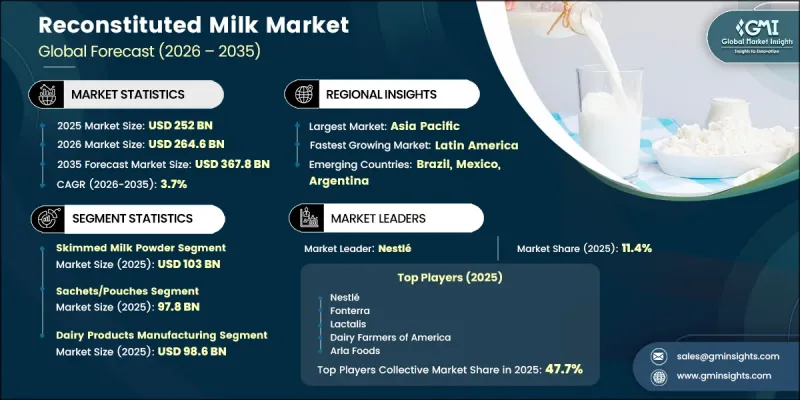
복원유는 분유와 안전한 식수를 혼합하여 제조되며, 원하는 지방 성분에 따라 탈지분유, 전분유 또는 부분 탈지분유를 사용하여 제조할 수 있습니다. 이 제품은 음료로 널리 소비되는 것 외에도 요구르트, 냉동 디저트, 베이커리 제품, 과자류 등 유제품 베이스 응용 분야에도 널리 사용되고 있습니다. 시장 확대는 인프라 제약, 공급망 혼란 또는 기후 변화로 인해 원유에 대한 접근성이 불안정한 지역에서 상온 보관이 가능한 유제품 솔루션에 대한 수요가 증가함에 따라 뒷받침되고 있습니다. 복원유는 보관의 유연성과 운송 효율을 향상시키기 때문에 도시 및 외딴 지역의 사람들에게 중요한 솔루션이 되고 있습니다. 또한, 식량 안보에 대한 우려가 높아지고 비용 효율적인 유제품에 대한 수요가 증가함에 따라 전 세계 상업용 식품 가공 사업 및 기관 공급망에서 그 채택이 더욱 확대되고 있습니다.
| 시장 범위 | |
|---|---|
| 시작 연도 | 2025년 |
| 예측 기간 | 2026-2035년 |
| 시작 연도 시장 규모 | 2,520억 달러 |
| 예측 금액 | 3,678억 달러 |
| CAGR | 3.7% |
탈지분유 부문은 2025년 1,030억 달러를 차지했습니다. 각 제조업체들이 다양한 영양 요구 사항과 지방 함량 요구에 맞는 맞춤형 복원유 배합 개발에 집중하면서 탈지분유와 전지방 분유에 대한 수요는 지속적으로 증가하고 있습니다. 일반 가정, 상업용 급식 및 산업용 식품 생산에서 이러한 원료의 사용 확대가 이 부문의 성장을 뒷받침하고 있습니다. 제조업체들은 변화하는 소비자 및 가공업계의 요구에 부응하기 위해 제품의 균일성, 영양 균형 및 배합의 유연성을 점점 더 중요하게 여기고 있습니다.
2025년, 파우치 및 봉지 부문은 978억 달러 시장 규모를 기록하여 복원유 시장의 주요 포장 카테고리로 자리매김했습니다. 저렴한 가격, 취급의 용이성, 효율적인 분량 관리 기능으로 인해 소포장 포장에 대한 수요가 증가하고 있습니다. 연포장 형태는 가격에 민감한 시장과 대량 판매를 하는 소매 환경에서 광범위한 유통을 지원합니다. 한편, 병 포장은 편의성, 재사용성, 보관 관리의 간소화로 인해 조직화된 소매 및 외식 산업 분야에서 강력한 수요를 유지하고 있습니다. 휴대성과 포장 효율성에 대한 관심이 높아지면서 여러 소비자 부문에 걸친 시장 수요가 더욱 강화되고 있습니다.
북미의 복원유 시장은 2025년 383억 달러에서 2035년까지 581억 달러로 확대될 것으로 예측됩니다. 이 지역 수요는 식품 제조, 재고 관리 시스템 및 장기 보관 용도의 복원유 사용 확대에 의해 뒷받침되고 있습니다. 이 제품은 예측 가능한 유제품 공급, 운송 효율성 및 장기 보존성이 사업 지속을 위해 필수적인 상황에서 그중요성이 더욱 커지고 있습니다. 가공식품 제조업체와 기관투자자들 수요 증가도 이 지역 시장 확대에 기여하고 있습니다.
자주 묻는 질문
목차
제1장 조사 방법과 범위
제2장 주요 요약
제3장 업계 인사이트
제4장 경쟁 구도
제5장 시장 추산 및 예측 : 유형별(2022-2035년)
제6장 시장 추산 및 예측 : 포장별(2022-2035년)
제7장 시장 추산 및 예측 : 용도별(2022-2035년)
제8장 시장 추산 및 예측 : 유통 채널별(2022-2035년)
제9장 시장 추산 및 예측 : 지역별(2022-2035년)
제10장 기업 개요
KTH 26.06.10The Global Reconstituted Milk Market was valued at USD 252 billion in 2025 and is estimated to grow at a CAGR of 3.7% to reach USD 367.8 billion by 2035.
Reconstituted milk is produced by blending milk powder with safe drinking water and can be formulated using skimmed milk powder, whole milk powder, or partially skimmed milk powder, depending on the desired fat composition. The product is widely consumed as a beverage and is also extensively utilized in dairy-based applications, including yogurt, frozen desserts, bakery products, and confectionery formulations. Market expansion is being supported by the growing need for shelf-stable dairy solutions in regions where access to fresh milk remains inconsistent due to infrastructure limitations, supply chain disruptions, or fluctuating climatic conditions. Reconstituted milk offers improved storage flexibility and transportation efficiency, making it an important solution for both urban and remote populations. In addition, increasing food security concerns and rising demand for cost-effective dairy products are encouraging broader adoption across commercial food processing operations and institutional supply chains worldwide.
| Market Scope | |
|---|---|
| Start Year | 2025 |
| Forecast Year | 2026-2035 |
| Start Value | $252 Billion |
| Forecast Value | $367.8 Billion |
| CAGR | 3.7% |
The skimmed milk powder segment accounted for USD 103 billion in 2025. Demand for skimmed milk powder and whole milk powder continues to rise as manufacturers focus on creating customized reconstituted milk formulations tailored to varying nutritional and fat-content requirements. The growing use of these ingredients across households, institutional catering, and industrial food production is supporting segment expansion. Manufacturers are increasingly emphasizing product consistency, nutritional balance, and formulation flexibility to meet evolving consumer and processing demands.
The sachets and pouches segment generated USD 97.8 billion in 2025, making it the leading packaging category in the reconstituted milk market. Demand for sachet-based packaging is increasing due to affordability, ease of handling, and efficient portion control capabilities. Flexible packaging formats also support wider distribution across price-sensitive markets and high-volume retail environments. At the same time, bottle packaging continues to maintain strong demand within organized retail and foodservice sectors because of convenience, reusability, and simplified storage management. The growing emphasis on portability and packaging efficiency is further strengthening market demand across multiple consumer segments.
North America Reconstituted Milk Market is expected to rise from USD 38.3 billion in 2025 to USD 58.1 billion by 2035. Demand across the region is being supported by the increasing use of reconstituted milk in food manufacturing, inventory management systems, and long-term storage applications. The product is gaining importance in situations where a predictable dairy supply, transportation efficiency, and extended shelf life are critical for operational continuity. Rising demand from processed food manufacturers and institutional buyers is also contributing to regional market expansion.
Major companies operating in the Global Reconstituted Milk Market include Nestle, Kraft Heinz, Lactalis, Fonterra, Dairy Farmers of America, Arla Foods, Yili Group, Saputo, China Modern Dairy, DMK Group, Schreiber Foods, Mengniu Dairy, Meiji Holdings, and Sodiaal. Companies operating in the reconstituted milk market are focusing on expanding production capabilities and strengthening supply chain efficiency to meet rising global demand. Leading manufacturers are investing in advanced milk powder processing technologies to improve product quality, nutritional consistency, and shelf stability. Many companies are also diversifying packaging formats to address varying consumer preferences and improve convenience across retail and institutional channels. Strategic collaborations with distributors, retailers, and foodservice providers are helping businesses expand market reach and strengthen brand visibility. Sustainability initiatives, including energy-efficient production and waste reduction practices, are becoming increasingly important as companies align with environmental goals. In addition, firms are enhancing product portfolios with fortified and customized dairy formulations to cater to evolving nutritional requirements.
Table of Contents
Chapter 1 Methodology & Scope
- 1.1 Market scope and definition
- 1.2 Research design
- 1.2.1 Research approach
- 1.2.2 Data collection methods
- 1.3 Data mining sources
- 1.3.1 Global
- 1.3.2 Regional/Country
- 1.4 Base estimates and calculations
- 1.4.1 Base year calculation
- 1.4.2 Key trends for market estimation
- 1.5 Primary research and validation
- 1.5.1 Primary sources
- 1.6 Forecast model
- 1.7 Research assumptions and limitations
Chapter 2 Executive Summary
- 2.1 Industry 360° synopsis
- 2.2 Key market trends
- 2.2.1 Type
- 2.2.2 Packaging
- 2.2.3 Application by end use
- 2.2.4 Distribution Channel
- 2.2.5 Regional
- 2.3 TAM Analysis, 2026-2035
- 2.4 CXO perspectives: Strategic imperatives
- 2.5 Future outlook and strategic recommendations
Chapter 3 Industry Insights
- 3.1 Industry ecosystem analysis
- 3.1.1 Supplier landscape
- 3.1.2 Profit margin
- 3.1.3 Value addition at each stage
- 3.1.4 Factor affecting the value chain
- 3.1.5 Disruptions
- 3.2 Industry impact forces
- 3.2.1 Growth drivers
- 3.2.1.1 Increased shelf-life compared to fresh milk
- 3.2.1.2 Expanding urban populations with limited refrigeration
- 3.2.1.3 Stable supply for food processing industries
- 3.2.2 Industry pitfalls and challenges
- 3.2.2.1 Rising demand in remote and rural regions
- 3.2.2.2 Growing use in bakery and confectionery products
- 3.2.3 Market opportunities
- 3.2.3.1 Consumer preference for fresh milk alternatives
- 3.2.3.2 Quality perception issues in some regional markets
- 3.2.3.3 Dependence on milk powder price fluctuations
- 3.2.1 Growth drivers
- 3.3 Growth potential analysis
- 3.4 Regulatory landscape
- 3.4.1 North America
- 3.4.2 Europe
- 3.4.3 Asia Pacific
- 3.4.4 Latin America
- 3.4.5 Middle East & Africa
- 3.5 Porter's analysis
- 3.6 PESTEL analysis
- 3.7 Technology and innovation landscape
- 3.7.1 Current technological trends
- 3.7.2 Emerging technologies
- 3.8 Price trends
- 3.8.1 By region
- 3.8.2 By type
- 3.9 Future market trends
- 3.10 Patent landscape
- 3.11 Trade statistics (HS code)
- 3.11.1 Major importing countries
- 3.11.2 Major exporting countries
- 3.12 Sustainability and environmental aspects
- 3.12.1 Sustainable practices
- 3.12.2 Waste reduction strategies
- 3.12.3 Energy efficiency in production
- 3.12.4 Eco-friendly initiatives
- 3.13 Carbon footprint consideration
Chapter 4 Competitive Landscape, 2025
- 4.1 Introduction
- 4.2 Company market share analysis
- 4.2.1 By region
- 4.2.1.1 North America
- 4.2.1.2 Europe
- 4.2.1.3 Asia Pacific
- 4.2.1.4 LATAM
- 4.2.1.5 MEA
- 4.2.1 By region
- 4.3 Company matrix analysis
- 4.4 Competitive analysis of major market players
- 4.5 Competitive positioning matrix
- 4.6 Key developments
- 4.6.1 Mergers & acquisitions
- 4.6.2 Partnerships & collaborations
- 4.6.3 New product launches
- 4.6.4 Expansion plans
Chapter 5 Market Estimates and Forecast, By Type, 2022-2035 (USD Million) (Kilo Tons)
- 5.1 Key trends
- 5.2 Skimmed milk powder
- 5.3 Whole milk powder
- 5.4 Anhydrous milk fat
- 5.5 Others
Chapter 6 Market Estimates and Forecast, By Packaging, 2022-2035 (USD Million) (Kilo Tons)
- 6.1 Key trends
- 6.2 Sachets/Pouches
- 6.3 Bottles
- 6.4 Cartons
- 6.5 Others
Chapter 7 Market Estimates and Forecast, By Application, 2022-2035 (USD Million) (Kilo Tons)
- 7.1 Key trends
- 7.2 Dairy products manufacturing
- 7.2.1 Cheese manufacturing
- 7.2.2 Yogurt manufacturing
- 7.2.3 Ice cream & frozen desserts
- 7.2.4 Butter & cream production
- 7.2.5 UHT & reconstituted drinking milk
- 7.2.6 Other dairy products
- 7.3 Food & beverage
- 7.3.1 Bakery & confectionery
- 7.3.2 Processed foods & ready meals
- 7.3.3 Sauces, dressings & condiments
- 7.3.4 Beverages (non-dairy)
- 7.3.5 Snacks & savory products
- 7.3.6 Other
- 7.4 Dietary & nutritional supplements
- 7.4.1 Protein supplements & powders
- 7.4.2 Meal replacement products
- 7.4.3 Sports nutrition
- 7.4.4 Clinical nutrition
- 7.4.5 Other
- 7.5 Cosmetics & personal care
- 7.5.1 Skincare products
- 7.5.2 Haircare products
- 7.5.3 Bath & body products
- 7.5.4 Cosmetic formulations
- 7.5.5 Other
- 7.6 Infant formula
- 7.6.1 Standard infant formula
- 7.6.2 Specialty & hypoallergenic formulations
- 7.6.3 Follow-on & growing-up milk
- 7.6.4 Other
- 7.7 Other
Chapter 8 Market Estimates and Forecast, By Distribution channel, 2022-2035 (USD Million) (Kilo Tons)
- 8.1 Key trends
- 8.2 B2B (business-to-business)
- 8.2.1 Food & beverage manufacturing
- 8.2.2 Hospitality & foodservice
- 8.2.3 Industrial/institutional
- 8.2.4 Others
- 8.3 B2C (business-to-consumer)
- 8.3.1 Hypermarkets & supermarkets
- 8.3.2 Online/e-commerce
- 8.3.3 Wholesale stores
- 8.3.4 Convenience stores
- 8.3.5 Others
Chapter 9 Market Estimates and Forecast, By Region, 2022-2035 (USD Million) (Kilo Tons)
- 9.1 Key trends
- 9.2 North America
- 9.2.1 U.S.
- 9.2.2 Canada
- 9.3 Europe
- 9.3.1 Germany
- 9.3.2 UK
- 9.3.3 France
- 9.3.4 Spain
- 9.3.5 Italy
- 9.3.6 Rest of Europe
- 9.4 Asia Pacific
- 9.4.1 China
- 9.4.2 India
- 9.4.3 Japan
- 9.4.4 Australia
- 9.4.5 South Korea
- 9.4.6 Rest of Asia Pacific
- 9.5 Latin America
- 9.5.1 Brazil
- 9.5.2 Mexico
- 9.5.3 Argentina
- 9.5.4 Rest of Latin America
- 9.6 Middle East and Africa
- 9.6.1 Saudi Arabia
- 9.6.2 South Africa
- 9.6.3 UAE
- 9.6.4 Rest of Middle East and Africa
Chapter 10 Company Profiles
- 10.1 Nestle
- 10.2 Kraft Heinz
- 10.3 Lactalis
- 10.4 Fonterra
- 10.5 Dairy Farmers of America
- 10.6 Arla Foods
- 10.7 Yili Group
- 10.8 Saputo
- 10.9 China Modern Dairy
- 10.10 DMK Group
- 10.11 Schreiber Foods
- 10.12 Mengniu Dairy
- 10.13 Meiji Holdings
- 10.14 Sodiaal


