|
시장보고서
상품코드
2045877
소포 분류 시스템 시장 : 시장 비즈니스 기회, 성장요인, 업계 동향 분석 및 예측(2026-2035년)Parcel Sorting System Market Opportunity, Growth Drivers, Industry Trend Analysis, and Forecast 2026 - 2035 |
||||||

세계의 소포 분류 시스템 시장은 2025년에 37억 달러로 평가되었고, CAGR 8.4%로 성장할 전망이며, 2035년까지 83억 달러에 이를 것으로 추정되고 있습니다.
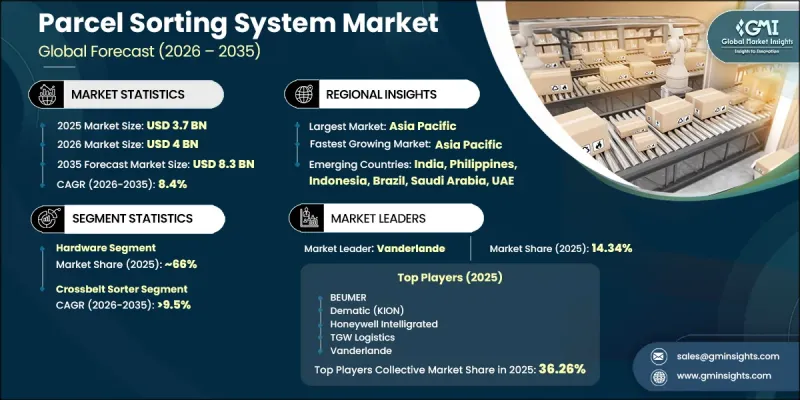
전자상거래의 확대, 옴니채널 소매 전략, 국경 간 배송 증가는 전 세계 물류 업무의 방식을 계속 변화시키고 있으며, 시장은 급속한 변화를 겪고 있습니다. 기존의 수작업에 의한 분류 프로세스는 점점 더 많은 양의 소포를 더 높은 정확도와 속도로 처리할 수 있도록 설계된 자동화, 지능형, 확장성이 높은 시스템으로 대체되고 있습니다. 현대의 물류센터와 풀필먼트 허브는 복잡한 배송 네트워크를 관리하고 주문의 신속한 이행에 대한 소비자의 높은 기대치를 충족시키기 위해 첨단 분류 기술에 대한 의존도가 높아지고 있습니다. 배송의 신속성과 업무 효율성 향상에 대한 요구가 높아지면서 물류 네트워크 전반에 걸쳐 자동화 도입이 크게 증가하고 있습니다. 당일배송, 익일배송에 대한 기대가 일반화되면서 물류 사업자들은 대량의 화물과 다양한 유형의 소포를 효율적으로 처리할 수 있는 대용량 분류 시스템에 대한 투자를 진행하고 있습니다. 자동화를 통해 수작업에 대한 의존도를 낮추고, 업무상 실수를 최소화하며, 분류의 전반적인 정확성과 일관성을 향상시킬 수 있습니다. 이러한 전환은 높은 처리 능력과 업무의 정확성이 필수적인 대규모 물류 시설에서 특히 중요합니다. 동시에 인력 부족과 인건비 상승도 자동화 솔루션으로의 전환을 가속화하고 있습니다. 소포 분류 시스템은 사람의 개입을 줄이면서 연속적이고 중단 없는 운영을 가능하게 하며, 수요가 급증하는 시기에도 기업이 비용을 최적화하고 생산성을 향상시킬 수 있도록 돕습니다.
| 시장 범위 | |
|---|---|
| 개시 연도 | 2025년 |
| 예측 기간 | 2026-2035년 |
| 개시 연도 시장 규모 | 37억 달러 |
| 예측 시장 규모 | 83억 달러 |
| CAGR | 8.4% |
하드웨어 부문은 2025년 66%의 점유율을 차지했으며, 2035년까지 연평균 복합 성장률(CAGR) 8.2%로 성장할 것으로 전망됩니다. 이 부문이 시장을 주도하는 이유는 컨베이어, 스캐너, 분류 장치, 자동 이송 시스템 등의 물리적 인프라가 소포의 효율적인 이동을 실현하는 데 필수적인 역할을 하기 때문입니다. 이러한 구성 요소는 분류 시설 운영의 핵심이며 처리 속도, 정확도 및 처리 능력에 직접적인 영향을 미칩니다. 소포 처리량이 증가함에 따라 물류 사업자들은 지속적인 운영을 지원하고 다양한 유형의 소포를 처리할 수 있는 견고하고 고성능의 하드웨어 솔루션에 점점 더 많은 관심을 기울이고 있습니다.
크로스 벨트 분류기 부문은 2025년 35.3%의 점유율을 차지했으며, 2026-2035년 연평균 복합 성장률(CAGR) 9.5%를 나타낼 것으로 예측됩니다. 이 부문은 빠른 처리 능력과 대량의 소포를 관리할 때 높은 정확도로 인해 시장을 독점하고 있습니다. 크로스 벨트 시스템은 컨베이어 벨트가 장착된 개별적으로 제어되는 운반 장치를 이용하여 소포를 지정된 출구로 효율적으로 유도합니다. 다양한 크기와 형태의 소포를 처리할 수 있어 속도와 정확성이 중요한 대규모 물류센터 및 EC 풀필먼트 업무에 매우 적합합니다.
2025년 중국의 소포 분류 시스템 시장은 42.2%의 점유율을 차지했으며, 6억 5,830만 달러 시장 규모를 기록했습니다. 이 나라 시장 성장은 디지털 커머스의 급속한 성장과 방대한 온라인 소비자층에 의해 강력하게 뒷받침되고 있습니다. 많은 거래량과 빈번한 판촉 활동으로 인해 방대한 소포의 흐름이 발생하고 있으며, 물류 네트워크 전반에 걸쳐 고도의 자동 분류 인프라에 대한 수요가 증가하고 있습니다. 진화하는 물류 생태계에서 증가하는 배송 수요에 대응하기 위해 빠르고 확장성이 높은 시스템이 지속적으로 우선순위를 차지하고 있습니다.
자주 묻는 질문
목차
제1장 조사 방법
제2장 주요 요약
제3장 산업 인사이트
제4장 경쟁 구도
제5장 시장 추정 및 예측 : 컴포넌트별(2022-2035년)
제6장 시장 추정 및 예측 : 유형별(2022-2035년)
제7장 시장 추정 및 예측 : 최종 용도별(2022-2035년)
제8장 시장 추정 및 예측 : 지역별(2022-2035년)
제9장 기업 개요
AJY 26.06.15The Global Parcel Sorting System Market was valued at USD 3.7 billion in 2025 and is estimated to grow at a CAGR of 8.4% to reach USD 8.3 billion by 2035.
The market is undergoing rapid transformation as e-commerce expansion, omnichannel retail strategies, and increasing cross-border shipments continue to reshape global logistics operations. Traditional manual sorting processes are being replaced by automated, intelligent, and highly scalable systems designed to handle growing parcel volumes with greater accuracy and speed. Modern distribution centers and fulfillment hubs are increasingly dependent on advanced sortation technologies to manage complex delivery networks and meet rising consumer expectations for faster order fulfillment. Rising demand for faster deliveries and improved operational efficiency is significantly driving automation adoption across logistics networks. As same-day and next-day delivery expectations become more common, logistics providers are investing in high-capacity sorting systems capable of processing large volumes and varied parcel types efficiently. Automation reduces dependency on manual handling, minimizes operational errors, and improves overall sorting accuracy and consistency. This transition is especially important in large-scale logistics facilities where high throughput and operational precision are essential. At the same time, labor shortages and rising workforce costs are accelerating the shift toward automated solutions. Parcel sorting systems enable continuous, uninterrupted operations with reduced human intervention, helping companies optimize costs and improve productivity during peak demand cycles.
| Market Scope | |
|---|---|
| Start Year | 2025 |
| Forecast Year | 2026-2035 |
| Start Value | $3.7 Billion |
| Forecast Value | $8.3 Billion |
| CAGR | 8.4% |
The hardware segment accounted for 66% share in 2025 and is projected to grow at a CAGR of 8.2% through 2035. This segment leads the market due to the essential role of physical infrastructure such as conveyors, scanners, sorting units, and automated handling systems in enabling efficient parcel movement. These components form the core operational foundation of sorting facilities and directly influence processing speed, accuracy, and throughput capacity. With rising parcel volumes, logistics operators are increasingly prioritizing robust, high-performance hardware solutions that can support continuous operations and handle diverse package categories.
The crossbelt sorter segment held a 35.3% share in 2025 and is expected to grow at a CAGR of 9.5% from 2026 to 2035. This segment dominates due to its high-speed handling capabilities and strong accuracy in managing large parcel volumes. Crossbelt systems utilize individually controlled carriers equipped with conveyor belts that direct parcels efficiently to designated outlets. Their ability to handle mixed parcel sizes and shapes makes them highly suitable for large distribution centers and e-commerce fulfillment operations where speed and precision are critical.
China Parcel Sorting System Market held a 42.2% share in 2025, generating USD 658.3 million. Market growth in the country is strongly supported by the rapid expansion of digital commerce and a large base of online consumers. High transaction volumes and frequent promotional activities are generating substantial parcel flows, which is increasing demand for advanced automated sorting infrastructure across logistics networks. The country's evolving logistics ecosystem continues to prioritize high-speed, scalable systems to support growing delivery requirements.
Key companies operating in the Global Parcel Sorting System Industry include Vanderlande, Siemens Logistics, TGW Logistics, Murata Machinery, KNAPP, Interroll, Honeywell Intelligrated, Dematic (KION), Daifuku, and BEUMER. Companies in the parcel sorting system market are focusing on expanding automation capabilities by integrating robotics, AI-based tracking, and intelligent control software to improve sorting accuracy and operational efficiency. They are investing heavily in research and development to design high-speed, energy-efficient, and modular systems that can scale with fluctuating parcel volumes. Strategic partnerships with e-commerce platforms, logistics providers, and warehouse operators are helping firms expand deployment opportunities globally. Manufacturers are also prioritizing predictive maintenance technologies and IoT-enabled monitoring to reduce downtime and enhance system reliability. Expansion into emerging logistics hubs and customization of solutions for regional distribution requirements are further strengthening market positioning.
Table of Contents
Chapter 1 Methodology
- 1.1 Research approach
- 1.2 Quality Commitments
- 1.2.1 GMI AI policy & data integrity commitment
- 1.2.1.1 Source consistency protocol
- 1.2.1 GMI AI policy & data integrity commitment
- 1.3 Research Trail & Confidence Scoring
- 1.3.1 Research Trail Components
- 1.3.2 Scoring Components
- 1.4 Data Collection
- 1.4.1 Partial list of primary sources
- 1.5 Data mining sources
- 1.5.1 Paid sources
- 1.5.1.1 Sources, by region
- 1.5.1 Paid sources
- 1.6 Base estimates and calculations
- 1.6.1 Base year calculation
- 1.7 Forecast Model
- 1.7.1 Quantified market impact analysis
- 1.7.1.1 Mathematical impact of growth parameters on forecast
- 1.7.1 Quantified market impact analysis
- 1.8 Research transparency addendum
- 1.8.1 Source attribution framework
- 1.8.2 Quality assurance metrics
- 1.8.3 Our commitment to trust
Chapter 2 Executive Summary
- 2.1 Industry 360° synopsis, 2022 - 2035
- 2.2 Key market trends
- 2.2.1 Regional
- 2.2.2 Component
- 2.2.3 Type
- 2.2.4 End Use
- 2.3 TAM Analysis, 2026-2035
- 2.4 CXO perspectives: Strategic imperatives
Chapter 3 Industry Insights
- 3.1 Industry ecosystem analysis
- 3.1.1 Supplier landscape
- 3.1.2 Profit margin analysis
- 3.1.3 Cost structure
- 3.1.4 Value addition at each stage
- 3.1.5 Factor affecting the value chain
- 3.1.6 Disruptions
- 3.2 Industry impact forces
- 3.2.1 Growth drivers
- 3.2.1.1 E-commerce growth and last-mile delivery demands
- 3.2.1.2 Rising labor costs and workforce optimization needs
- 3.2.1.3 Automation and ai integration in logistics operations
- 3.2.1.4 Sustainability requirements and environmental regulations
- 3.2.2 Industry pitfalls & challenges
- 3.2.2.1 High initial capital investment and ROI considerations
- 3.2.2.2 High implementation and maintenance costs
- 3.2.3 Market opportunities
- 3.2.3.1 E-commerce driving advanced sorting needs
- 3.2.3.2 Growing need for flexible systems to sort varied parcel sizes
- 3.2.1 Growth drivers
- 3.3 Growth potential analysis
- 3.4 Technology and Innovation landscape
- 3.4.1 Current technological trends
- 3.4.2 Emerging technologies
- 3.5 Pricing Analysis (Driven by Primary Research)
- 3.5.1 Historical Price Trend Analysis
- 3.5.2 Pricing Strategy by Player Type (Premium / Value / Cost-plus)
- 3.6 Regulatory landscape
- 3.6.1 North America
- 3.6.2 Europe
- 3.6.3 Asia Pacific
- 3.6.4 Latin America
- 3.6.5 Middle East & Africa
- 3.7 Porter's analysis
- 3.8 PESTEL analysis
- 3.9 Trade Data Analysis (Based on Paid Database)
- 3.9.1 Import/Export Volume & Value Trends
- 3.9.2 Key Trade Corridors & Tariff Impact
- 3.10 Impact of AI & Generative AI on the Market (Driven by Primary Research)
- 3.10.1 AI-Driven Disruption of Existing Business Models
- 3.10.2 GenAI Use Cases & Adoption Roadmap by Segment
- 3.10.3 Risks, Limitations & Regulatory Considerations
- 3.11 Capacity & Production Landscape (Driven by Primary Research)
- 3.11.1 Production Capacity by Region & Key Producer
- 3.11.2 Capacity Utilization Rates & Expansion Pipelines
- 3.12 Patent Landscape (Driven by Primary Research)
- 3.13 Sustainability and environmental aspects
- 3.13.1 Sustainable practices
- 3.13.2 Waste reduction strategies
- 3.13.3 Energy efficiency in production
- 3.13.4 Eco-friendly initiatives
- 3.13.5 Carbon footprint considerations
- 3.14 Forecast assumptions & scenario analysis (Driven by Primary Research)
- 3.14.1 Base Case - key macro & industry variables driving CAGR
- 3.14.2 Optimistic Scenarios - Favorable Macro and Industry Tailwinds
- 3.14.3 Pessimistic Scenario - Macroeconomic slowdown or industry headwinds
Chapter 4 Competitive Landscape, 2025
- 4.1 Introduction
- 4.2 Company market share analysis
- 4.2.1 North America
- 4.2.2 Europe
- 4.2.3 Asia Pacific
- 4.2.4 Latin America
- 4.2.5 MEA
- 4.3 Competitive analysis of major market players
- 4.4 Competitive positioning matrix
- 4.5 Key developments
- 4.5.1 Mergers & acquisitions
- 4.5.2 Partnerships & collaborations
- 4.5.3 New Product Launches
- 4.5.4 Expansion Plans and funding
- 4.6 Company Tier Benchmarking
- 4.6.1 Tier Classification Criteria & Qualifying Thresholds
- 4.6.2 Tier Positioning Matrix by Revenue, Geography & Innovation
Chapter 5 Market Estimates & Forecast, By Component, 2022 - 2035 ($Bn)
- 5.1 Key trends
- 5.2 Hardware
- 5.3 Software
- 5.4 Services
Chapter 6 Market Estimates & Forecast, By Type, 2022 - 2035 ($Bn)
- 6.1 Key trends
- 6.2 Push tray sorters
- 6.3 Tilt-tray sorter
- 6.4 Crossbelt sorter
- 6.5 Shoe sorter
- 6.6 Others
Chapter 7 Market Estimates & Forecast, By End Use, 2022 - 2035 ($Bn)
- 7.1 Key trends
- 7.2 Transportation & Logistics
- 7.3 Retail & E-commerce
- 7.4 Food & Beverage
- 7.5 Pharmaceutical
- 7.6 Others
Chapter 8 Market Estimates & Forecast, By Region, 2022 - 2035 ($Bn)
- 8.1 Key trends
- 8.2 North America
- 8.2.1 US
- 8.2.2 Canada
- 8.3 Europe
- 8.3.1 Germany
- 8.3.2 UK
- 8.3.3 France
- 8.3.4 Italy
- 8.3.5 Spain
- 8.3.6 Russia
- 8.3.7 Netherlands
- 8.3.8 Belgium
- 8.4 Asia Pacific
- 8.4.1 China
- 8.4.2 India
- 8.4.3 Japan
- 8.4.4 Australia
- 8.4.5 South Korea
- 8.4.6 Philippines
- 8.4.7 Indonesia
- 8.5 Latin America
- 8.5.1 Brazil
- 8.5.2 Mexico
- 8.5.3 Argentina
- 8.6 MEA
- 8.6.1 South Africa
- 8.6.2 Saudi Arabia
- 8.6.3 UAE
Chapter 9 Company Profiles
- 9.1 Global Players
- 9.1.1 Beumer Group
- 9.1.2 Daifuku
- 9.1.3 Dematic (Kion Group)
- 9.1.4 Honeywell Intelligrated
- 9.1.5 Interroll
- 9.1.6 Siemens Logistics
- 9.1.7 SSI Schaefer
- 9.1.8 Swisslog (Kuka Group)
- 9.1.9 TGW Logistics Group
- 9.1.10 Vanderlande
- 9.2 Regional Players
- 9.2.1 Bastian Solutions
- 9.2.2 Bowe Bell + Howell
- 9.2.3 Eurosort
- 9.2.4 Fives Group
- 9.2.5 KNAPP AG
- 9.2.6 Korber Supply Chain
- 9.2.7 Murata Machinery
- 9.2.8 Okura Yusoki
- 9.2.9 Solystic
- 9.2.10 ULMA Handling Systems
- 9.3 Emerging players
- 9.3.1 Geek+ (Geek Plus)
- 9.3.2 GreyOrange
- 9.3.3 HAI Robotics
- 9.3.4 Locus Robotics
- 9.3.5 Quicktron