|
시장보고서
상품코드
2061313
정수 시장 기회, 성장요인, 업계 동향 분석 및 예측(2026-2035년)Water Filtration Market Opportunity, Growth Drivers, Industry Trend Analysis, and Forecast 2026 - 2035 |
||||||

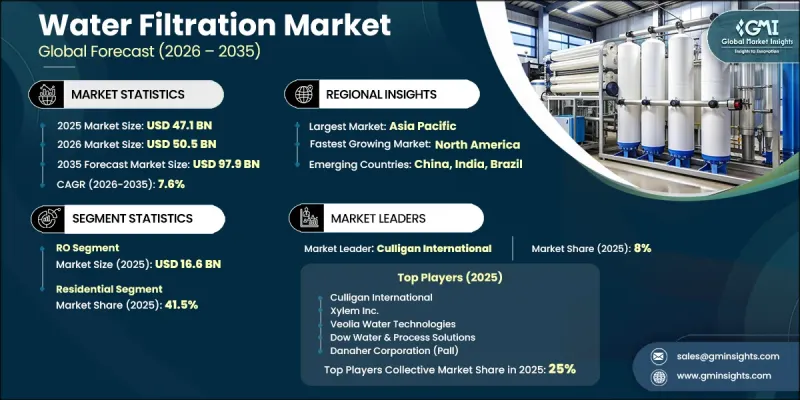
세계의 정수 시장은 2025년에 471억 달러로 평가되고 CAGR 7.6%로 성장하며, 2035년까지 979억 달러에 달할 것으로 예측됩니다.
소비자들이 일상생활에서 깨끗하고 안전한 물을 이용할 수 있는 것을 점점 더 중요하게 여기게 됨에 따라 정수 산업은 계속해서 성장하고 있습니다. 수질에 대한 인식이 높아짐에 따라 주택, 상업, 산업 각 부문의 구매 행태에 큰 영향을 미치고 있습니다. 물의 순도, 불쾌한 맛이나 냄새, 오염 물질의 존재에 대한 우려로 인해 소비자들은 장기적인 건강과 편의성을 위해 신뢰할 수 있는 여과 솔루션에 대한 투자를 확대하고 있습니다. 또한 노후화된 상수도 인프라와 불균일한 수처리 기준에 대한 우려가 커지면서 시장이 활성화되고 있으며, 이에 따라 가정과 직장에서의 정수 시스템 수요가 증가하고 있습니다. 각 업계에서는 더욱 까다로워진 소비자의 기대에 부응하면서도 업무 효율을 유지하고, 기계를 보호하며, 제품 품질을 향상시키기 위해 첨단 정수 설비를 도입하고 있습니다. 또한 라이프스타일의 변화에 따라 현대 생활 공간에 적합하고, 콤팩트하며 사용하기 편리하고, 유지 관리가 간편한 정수 시스템에 대한 관심이 높아지고 있습니다. 지속가능성에 대한 동향 또한 시장 성장을 더욱 지원하고 있습니다. 소비자들은 일회용 페트병에 대한 의존도를 줄이고, 친환경적인 소비 습관을 지원하는 여과 시스템을 점점 더 선호하고 있기 때문입니다.
| 시장 범위 | |
|---|---|
| 시작연도 | 2025년 |
| 예측 기간 | 2026-2035년 |
| 개시 금액 | 471억 달러 |
| 예측액 | 979억 달러 |
| CAGR | 7.6% |
2025년, RO 부문 시장 규모는 166억 달러에 달했습니다. 역삼투(RO) 시스템은 수질 개선에 매우 효과적인 해결책으로 널리 인정받고 있으며, 소비자들의 지지를 계속해서 얻고 있습니다. 소비자들은 단일 시스템으로 물과 관련된 여러 가지 우려 사항을 해결할 수 있다는 점에서 RO 기술을 높이 평가하고 있으며, 음용수의 청결성과 안전성에 대한 신뢰를 높이고 있습니다. 이러한 시스템은 수질이 불안정하거나 불확실한 지역에서 특히 선호됩니다. 정수 성능과 장기적인 신뢰성에 대한 소비자들의 높은 신뢰가 가정용 및 일상용 RO 기반 여과 제품의 꾸준한 보급을 지원하고 있습니다.
2025년에는 주택 부문이 시장 점유율의 41.5%를 차지했습니다. 소비자들이 일상적인 음용 및 조리를 위해 깨끗한 물을 직접 사용하는 것을 우선시하고 있으므로 가정에서의 수요는 여전히 시장 확대의 주요 원동력으로 작용하고 있습니다. 수질, 인프라 현황 및 잠재적인 오염 문제에 대한 우려가 커짐에 따라 점점 더 많은 가정이 자택에 정수 시스템을 설치하고 있습니다. 주택 사용자들은 편의성, 유지보수의 용이성, 그리고 신뢰할 수 있는 성능을 모두 갖춘 솔루션을 점점 더 많이 찾고 있습니다. 맞춤형 수처리 시스템에 대한 선호도가 높아짐에 따라 세계 시장에서 주거용 부문의 입지가 더욱 공고해지고 있습니다.
미국 정수기 시장은 2025년에 73.7%의 점유율을 차지하며 72억 달러의 시장 규모를 기록했습니다. 이 지역 시장은 소비자들의 수질에 대한 인식과 사용지형 정수 시스템에 대한 선호도가 높아지는 추세에 큰 영향을 받고 있습니다. 많은 주택 및 상업 시설 이용자들은 인프라의 노후화와 물의 안전성에 대한 우려로 인해 정수 제품을 일상생활에 없어서는 안 될 것으로 여기고 있습니다. 또한 지속가능한 생활 방식에 대한 관심이 높아지면서 수요가 지원되고 있으며, 정수 시스템은 병입 음료수 소비를 대체할 실용적인 대안으로 여겨지고 있습니다. 기업이 진화하는 품질 기대치와 환경 우선 순위에 부응하는 편리하고 신뢰할 수 있는 수처리 솔루션을 추구하는 가운데, 상업 시설 역시 제품 수요에 계속해서 크게 기여하고 있습니다.
자주 묻는 질문
목차
제1장 조사 방법
제2장 개요
제3장 업계 인사이트
제4장 경쟁 구도
제5장 시장 추산·예측 : 기술별, 2022-2035년
제6장 시장 추산·예측 : 용도별, 2022-2035년
제7장 시장 추산·예측 : 지역별, 2022-2035년
제8장 기업 개요
KSA 26.06.23The Global Water Filtration Market was valued at USD 47.1 billion in 2025 and is estimated to grow at a CAGR of 7.6% to reach USD 97.9 billion by 2035.
The water filtration industry continues to expand as consumers place greater importance on access to clean and safe water for everyday use. Growing awareness regarding water quality has significantly influenced purchasing behavior across residential, commercial, and industrial sectors. Concerns associated with water purity, unpleasant taste, odor, and the presence of contaminants are encouraging consumers to invest in reliable filtration solutions for long-term health and convenience. The market is also benefiting from increasing concerns surrounding aging water infrastructure and inconsistent treatment standards, which have strengthened demand for filtration systems in homes and workplaces. Industries are adopting advanced filtration equipment to maintain operational efficiency, protect machinery, and improve product quality while meeting stricter consumer expectations. In addition, changing lifestyles are driving interest in compact, user-friendly, and low-maintenance filtration systems suitable for modern living spaces. Sustainability trends are further supporting market growth, as consumers increasingly prefer filtration systems that help reduce dependence on single-use plastic bottles and support environmentally responsible consumption habits.
| Market Scope | |
|---|---|
| Start Year | 2025 |
| Forecast Year | 2026-2035 |
| Start Value | $47.1 Billion |
| Forecast Value | $97.9 Billion |
| CAGR | 7.6% |
In 2025, the RO segment generated USD 16.6 billion. Reverse osmosis systems continue to gain strong consumer acceptance because they are widely perceived as highly effective solutions for improving water quality. Consumers value RO technology for its ability to address multiple water-related concerns through a single system, increasing confidence in the cleanliness and safety of drinking water. These systems are particularly preferred in regions where water quality remains uncertain or inconsistent. High consumer trust in purification performance and long-term reliability continues to support strong adoption of RO-based filtration products for household and everyday use.
The residential segment accounted for 41.5% share in 2025. Household demand remains a major driver of market expansion as consumers prioritize direct access to clean water for daily consumption and food preparation. Growing concerns regarding water quality, infrastructure conditions, and potential contamination issues have encouraged more families to install filtration systems within their homes. Residential users are increasingly seeking solutions that offer convenience, ease of maintenance, and dependable performance. The rising preference for personalized water treatment systems continues to strengthen the position of the residential segment across the global market.
U.S. Water Filtration Market held a 73.7% share, generating USD 7.2 billion in 2025. The regional market is strongly influenced by consumer awareness regarding water quality and the increasing preference for point-of-use filtration systems. Many residential and commercial users consider filtration products an essential part of everyday life due to concerns related to aging infrastructure and water safety. Demand is also supported by growing interest in sustainable living practices, with filtration systems viewed as a practical alternative to bottled water consumption. Commercial establishments continue to contribute significantly to product demand as businesses seek convenient and reliable water treatment solutions that align with evolving quality expectations and environmental priorities.
Major companies operating in the Global Water Filtration Market include Pentair PLC, A.O. Smith Corporation, Danaher Corporation, Veolia Water Technologies, 3M Purification Inc., Culligan International, Xylem Inc., Coway Co., Ltd., Kent RO Systems Ltd., Brita GmbH, Eureka Forbes Limited, Whirlpool Corporation, Panasonic Corporation, LG Electronics, Kinetico, BWT, Toray Industries, Dow Water & Process Solutions, HaloSource Inc., LifeStraw (Vestergaard), and Sawyer Products. Companies operating in the water filtration market are adopting multiple strategies to strengthen their market position and expand customer reach. Leading manufacturers are investing heavily in product innovation to develop advanced filtration technologies that improve purification efficiency, convenience, and energy savings. Businesses are also focusing on compact and aesthetically designed systems that align with modern residential and commercial requirements. Expansion of online distribution channels and direct-to-consumer sales platforms has become a major priority for improving accessibility and customer engagement. Many companies are strengthening partnerships with distributors, retailers, and service providers to expand regional presence and improve after-sales support.
Table of Contents
Chapter 1 Methodology
- 1.1 Research approach
- 1.2 Quality Commitments
- 1.2.1 GMI AI policy & data integrity commitment
- 1.2.1.1 Source consistency protocol
- 1.2.1 GMI AI policy & data integrity commitment
- 1.3 Research Trail & Confidence Scoring
- 1.3.1 Research Trail Components
- 1.3.2 Scoring Components
- 1.4 Data Collection
- 1.4.1 Partial list of primary sources
- 1.5 Data mining sources
- 1.5.1 Paid sources
- 1.5.1.1 Sources, by region
- 1.5.1 Paid sources
- 1.6 Base estimates and calculations
- 1.6.1 Base year calculation for any one approach
- 1.7 Forecast model
- 1.7.1 Quantified market impact analysis
- 1.7.1.1 Mathematical impact of growth parameters on forecast
- 1.7.1 Quantified market impact analysis
- 1.8 Research transparency addendum
- 1.8.1 Source attribution framework
- 1.8.2 Quality assurance metrics
- 1.8.3 Our commitment to trust
Chapter 2 Executive Summary
- 2.1 Industry snapshot
- 2.2 Business trends
- 2.3 Technology trends
- 2.4 Application trends
- 2.5 Regional trends
Chapter 3 Industry Insights
- 3.1 Industry ecosystem and value chain analysis with seven subsections
- 3.1.1 Raw material suppliers
- 3.1.2 Component manufacturers
- 3.1.3 System integrators and OEM manufacturers
- 3.1.4 Distribution channels
- 3.1.5 End-user segments
- 3.1.6 After-sales service and maintenance providers
- 3.1.7 Value addition and margin distribution across the value chain
- 3.2 Industry impact forces
- 3.2.1 Drivers
- 3.2.2 Restraint/Challenges
- 3.2.3 Opportunities
- 3.3 Growth Potential
- 3.4 Technology and innovation landscape
- 3.4.1 Emerging filtration technologies and innovations
- 3.4.2 Smart water monitoring and IoT integration
- 3.4.3 Nanotechnology and advanced membrane development
- 3.4.4 Sustainable and energy-efficient solutions
- 3.4.5 Technology adoption lifecycle by end-use segment
- 3.5 Regulatory framework
- 3.5.1 Drinking water quality standards by
- 3.5.2 Product certification requirements
- 3.5.3 Environmental regulations
- 3.5.4 Import and export regulations and trade compliance requirements
- 3.5.5 Labeling and consumer safety requirements
- 3.6 Pricing analysis (driven by primary research)
- 3.6.1 Historical price trend analysis (driven by primary research)
- 3.6.2 Pricing strategy by player type
- 3.7 Porter’s Analysis
- 3.8 PESTEL Analysis
- 3.9 Trade data analysis (driven by paid database) (HS Code: 84212100)
- 3.9.1 Import and export volume and value trends driven by primary research
- 3.9.2 Key trade corridors and tariff impact driven by primary research
- 3.10 Impact of AI and generative AI on the market
- 3.10.1 AI-driven disruption of existing business models
- 3.10.2 Generative AI use cases and adoption roadmap by segment
- 3.10.3 Risks, limitations, and regulatory considerations
Chapter 4 Competitive Landscape, 2025
- 4.1 Competitive Landscape
- 4.2 Company market share analysis, 2024
- 4.3 Strategic Initiative
- 4.4 Company benchmarking
Chapter 5 Market Estimates and Forecast, By Technology, 2022 - 2035 ($ Billion)
- 5.1 Key trends
- 5.2 Reverse Osmosis (RO)
- 5.3 Ion Exchange/Water Softeners
- 5.3.1 Salt-Based Ion Exchange
- 5.3.2 Salt-Free Water Conditioners
- 5.4 Activated Carbon Filtration
- 5.4.1 Granular Activated Carbon (GAC)
- 5.4.2 Carbon Block Filters
- 5.5 Ultraviolet (UV) Disinfection
- 5.5.1 Low-Pressure UV Systems
- 5.5.2 Medium-Pressure UV Systems
- 5.6 Ultrafiltration (UF)
- 5.6.1 Inside-Out UF
- 5.6.2 Outside-In UF
- 5.7 Microfiltration
- 5.8 Nanofiltration
- 5.9 Sediment/Mechanical Filters
- 5.10 Gravity Filters
- 5.11 Others
Chapter 6 Market Estimates and Forecast, By Application, 2022 - 2035 ($ Billion)
- 6.1 Key trends
- 6.2 Residential
- 6.3 Commercial
- 6.3.1 Foodservice & Hospitality
- 6.3.2 Healthcare Facilities
- 6.3.3 Office & Institutional
- 6.3.4 Others
- 6.4 Industrial
- 6.4.1 Food & Beverage Processing
- 6.4.2 Pharmaceuticals & Biotechnology
- 6.4.3 Power & Energy
- 6.4.4 Chemical & Petrochemical
- 6.4.5 Electronics & Semiconductor
- 6.4.6 Others
- 6.5 Municipal/Utility
Chapter 7 Market Estimates and Forecast, By Region, 2022 - 2035 ($ Billion)
- 7.1 Key trends
- 7.2 North America
- 7.2.1 US
- 7.2.2 Canada
- 7.3 Europe
- 7.3.1 Germany
- 7.3.2 UK
- 7.3.3 France
- 7.3.4 Italy
- 7.3.5 Spain
- 7.3.6 Netherlands
- 7.4 Asia Pacific
- 7.4.1 China
- 7.4.2 India
- 7.4.3 Japan
- 7.4.4 Australia
- 7.4.5 South Korea
- 7.5 Latin America
- 7.5.1 Brazil
- 7.5.2 Mexico
- 7.5.3 Argentina
- 7.6 Middle East and Africa
- 7.6.1 South Africa
- 7.6.2 Saudi Arabia
- 7.6.3 UAE
Chapter 8 Company Profiles
- 8.1 Global Players
- 8.1.1 Pentair PLC
- 8.1.2 A.O. Smith Corporation
- 8.1.3 Danaher Corporation
- 8.1.4 Veolia Water Technologies
- 8.1.5 3M Purification Inc.
- 8.1.6 Culligan International
- 8.1.7 Xylem Inc.
- 8.2 Regional Champions
- 8.2.1 Coway Co., Ltd.
- 8.2.2 Kent RO Systems Ltd.
- 8.2.3 Brita GmbH
- 8.2.4 Eureka Forbes Limited
- 8.2.5 Whirlpool Corporation
- 8.2.6 Panasonic Corporation
- 8.2.7 LG Electronics
- 8.2.8 Kinetico
- 8.2.9 BWT
- 8.3 Niche/Specialist Players
- 8.3.1 Toray Industries
- 8.3.2 Dow Water & Process Solutions
- 8.3.3 HaloSource Inc.
- 8.3.4 LifeStraw (Vestergaard)
- 8.3.5 Sawyer Products