
|
시장보고서
상품코드
2061322
승용차 플릿 유지보수 및 서비스 시장 기회, 성장 촉진요인, 산업 동향 분석 및 예측(2026-2035년)Passenger Vehicle Fleet Maintenance and Services Market Opportunity, Growth Drivers, Industry Trend Analysis, and Forecast 2026 - 2035 |
||||||

세계의 승용차 플릿 유지보수 및 서비스 시장은 2025년에 1,950억 달러로 평가되었으며, CAGR 5.6%로 성장하여 2035년까지 3,435억 달러에 달할 것으로 추정됩니다.
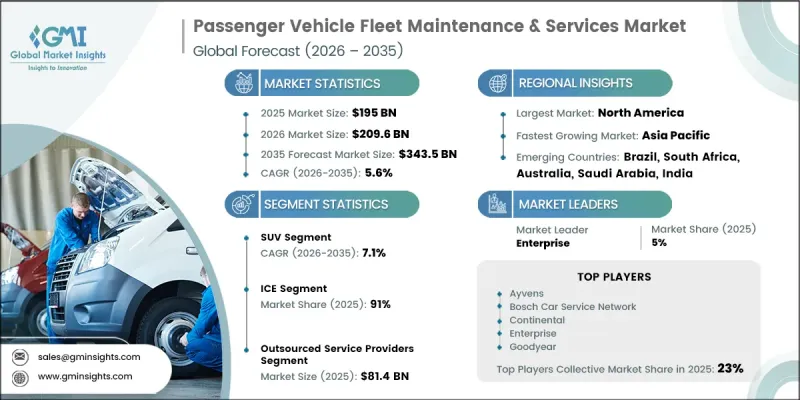
플릿 사업자들이 차량 가동률 극대화, 비용 효율성 향상, 규제 준수 확보에 점점 더 주력함에 따라, 이 시장은 기술 주도적이고 소프트웨어를 활용한 생태계로 빠르게 진화하고 있습니다. 기존의 정기 점검에 기반한 정비 방식은 텔레매틱스, IoT 대응 센서, AI를 활용한 진단 기술에 힘입어 예측 정비 및 상태 기반 유지보수 시스템으로 점차 대체되고 있습니다. 이러한 전환은 차량 가동 중단이 업무 성과나 수익성에 큰 영향을 미칠 수 있는 물류, 공공 서비스, 배송 분야의 차량 함대에서 특히 두드러집니다. 또한, 업계에서는 텔레매틱스 기능 및 통합형 차량 관리 서비스 플랫폼의 강화를 목적으로 한 시장 통합과 전략적 인수가 가속화되고 있습니다. AI를 활용한 안전 기술과 실시간 차량 관리 도구의 도입이 확대됨에 따라, 운전자의 행동 분석, 업무 가시화, 사고 예방이 강화되고 있습니다. 지능형 블랙박스, 예측 경보, 비디오 텔레매틱스 등의 첨단 시스템은 사업자가 위험을 줄이고, 보험료를 절감하며, 규정 준수 관리를 개선하는 데 도움이 되고 있습니다. 그 결과, 차량 유지보수 서비스는 유지보수 업무, 수리, 클레임 관리, 차량 분석을 통일된 체계 아래 통합하는, 완벽하게 연결된 디지털 생태계의 일부로서 점점 더 중요한 위치를 차지하고 있습니다.
| 시장 범위 | |
|---|---|
| 시작 연도 | 2025년 |
| 예측 기간 | 2026-2035년 |
| 초기 시장 규모 | 1,950억 달러 |
| 예측액 | 3,435억 달러 |
| CAGR | 5.6% |
SUV 부문은 2025년에 37%의 시장 점유율을 차지했으며, 2026년부터 2035년까지 연평균 성장률(CAGR) 7.1%로 성장할 것으로 전망됩니다. 이 부문의 성장은 주로 기업용 차량, 차량 공유 서비스 및 프리미엄 모빌리티 사업 분야에서 SUV 이용이 확대됨에 따라 주도되고 있습니다. 대형 차량의 정비 과정이 점점 더 복잡해지는 가운데, 가동 중단 시간을 줄이고 운영상의 편의성을 높이는 것을 목표로 하는, 유연하고 기동성이 뛰어난 유지보수 솔루션에 대한 수요가 증가하고 있습니다. 모바일 정비 모델은 서비스의 접근성과 효율성을 향상시키는 능력 덕분에 도시 지역의 차량 관리 전략에서 그 중요성이 점점 더 커지고 있습니다.
내연기관(ICE) 부문은 2025년에 91%의 점유율을 차지했으며, 2035년까지 연평균 성장률(CAGR) 4.6%로 성장할 것으로 전망됩니다. 가솔린 및 디젤 차량을 기반으로 한 승용차 및 상업용 운송 부문의 전 세계 보유 대수가 많기 때문에 내연기관 차량은 여전히 강력한 시장 지위를 유지하고 있습니다. 서비스 제공업체들은 고객 유지율과 운영 효율성을 높이기 위해 통합된 유지보수 생태계에 대한 투자를 강화하고, 서비스 편의성을 확대하며, 편의성을 중시하는 유지보수 솔루션 도입을 추진하고 있습니다.
미국 승용차 차량 관리 서비스 시장은 2025년에 822억 달러 규모에 달했습니다. 이 지역은 광범위한 차량 운영, 확립된 제3자 정비 네트워크, 첨단 차량 관리 시스템, 그리고 서비스 제공업체의 견실한 수익성을 뒷받침하는 유리한 가격 체계에 힘입어, 세계에서 가장 선진적이고 성숙한 시장 중 하나로 자리매김하고 있습니다.
자주 묻는 질문
목차
제1장 조사 방법과 범위
제2장 주요 요약
제3장 업계 인사이트
제4장 경쟁 구도
제5장 시장 추정 및 예측 : 차량별, 2022-2035년
제6장 시장 추정 및 예측 : 서비스별, 2022-2035년
제7장 시장 추정 및 예측 : 플릿 소유 형태별, 2022-2035년
제8장 시장 추정 및 예측 : 추진력별, 2022-2035년
제9장 시장 추정 및 예측 : 서비스 제공별, 2022-2035년
제10장 시장 추정 및 예측 : 지역별, 2022-2035년
제11장 기업 개요
KSM 26.06.22The Global Passenger Vehicle Fleet Maintenance & Services Market was valued at USD 195 billion in 2025 and is estimated to grow at a CAGR of 5.6% to reach USD 343.5 billion by 2035.
The market is rapidly evolving into a technology-driven and software-enabled ecosystem as fleet operators increasingly focus on maximizing vehicle uptime, improving cost efficiency, and ensuring regulatory compliance. Traditional scheduled servicing approaches are gradually being replaced by predictive and condition-based maintenance systems supported by telematics, IoT-enabled sensors, and AI-powered diagnostic technologies. This transition is particularly prominent across logistics, utility, and delivery fleets where vehicle downtime can significantly impact operational performance and profitability. The industry is also witnessing accelerated market consolidation and strategic acquisitions aimed at strengthening telematics capabilities and integrated fleet service platforms. Increasing adoption of AI-enabled safety technologies and real-time fleet monitoring tools is enhancing driver behavior analysis, operational visibility, and accident prevention. Advanced systems such as intelligent dash cameras, predictive alerts, and video telematics are helping operators reduce risks, lower insurance costs, and improve compliance management. As a result, fleet maintenance services are increasingly becoming part of a fully connected digital ecosystem that combines maintenance operations, repairs, claims management, and fleet analytics within a unified framework.
| Market Scope | |
|---|---|
| Start Year | 2025 |
| Forecast Year | 2026-2035 |
| Start Value | $195 Billion |
| Forecast Value | $343.5 Billion |
| CAGR | 5.6% |
The SUV segment accounted for 37% share in 2025 and is expected to grow at a CAGR of 7.1% from 2026 to 2035. Growth in this segment is primarily driven by the rising use of SUVs across corporate fleets, ride-hailing services, and premium mobility operations. The increasing complexity associated with servicing larger vehicles is generating higher demand for flexible and mobile maintenance solutions designed to reduce downtime and improve operational convenience. Mobile servicing models are becoming increasingly important in urban fleet management strategies due to their ability to enhance service accessibility and efficiency.
The ICE segment held a 91% share in 2025 and is forecast to grow at a CAGR of 4.6% through 2035. Internal combustion engine vehicles continue to maintain a strong market position due to the large global volume of gasoline and diesel-powered fleets operating across passenger and commercial transportation sectors. Service providers are increasingly focusing on integrated maintenance ecosystems, expanding service accessibility, and introducing convenience-driven maintenance solutions to improve customer retention and operational effectiveness.
United States Passenger Vehicle Fleet Maintenance & Services Market generated USD 82.2 billion in 2025. The region represents one of the most advanced and mature markets globally, supported by extensive fleet operations, established third-party maintenance networks, sophisticated fleet management systems, and favorable pricing structures that support strong profitability for service providers.
Major companies operating in the Global Passenger Vehicle Fleet Maintenance & Services Industry include Ayvens, Bosch Car Service Network, Bridgestone, Continental, Dana Incorporated, DENSO, Element Fleet Management, Enterprise, Goodyear, and Holman. Companies operating in the passenger vehicle fleet maintenance & services market are implementing several strategic initiatives to strengthen their competitive position and expand market presence. A major focus area involves investing in advanced telematics platforms, AI-powered diagnostics, and predictive maintenance technologies to improve operational efficiency and reduce vehicle downtime. Service providers are also expanding mobile maintenance capabilities and on-site servicing models to enhance customer convenience and improve response times. Strategic mergers, acquisitions, and partnerships are helping companies strengthen digital fleet management capabilities and broaden service portfolios. In addition, organizations are integrating real-time monitoring systems, safety analytics, and connected vehicle technologies to deliver comprehensive fleet solutions.
Table of Contents
Chapter 1 Methodology & Scope
- 1.1 Research approach
- 1.2 Quality Commitments
- 1.2.1 GMI AI policy & data integrity commitment
- 1.2.1.1 Source consistency protocol
- 1.2.1 GMI AI policy & data integrity commitment
- 1.3 Research Trail & Confidence Scoring
- 1.3.1 Research Trail Components
- 1.3.2 Scoring Components
- 1.4 Data Collection
- 1.4.1 Partial list of primary sources
- 1.5 Data mining sources
- 1.5.1 Paid sources
- 1.5.1.1 Sources, by region
- 1.5.1 Paid sources
- 1.6 Base estimates and calculations
- 1.6.1 Base year calculation
- 1.7 Forecast model
- 1.7.1 Quantified market impact analysis
- 1.7.1.1 Mathematical impact of growth parameters on forecast
- 1.7.1 Quantified market impact analysis
- 1.8 Research transparency addendum
- 1.8.1 Source attribution framework
- 1.8.2 Quality assurance metrics
- 1.8.3 Our commitment to trust
Chapter 2 Executive Summary
- 2.1 Industry 360° synopsis
- 2.2 Key market trends
- 2.2.1 Vehicle
- 2.2.2 Service
- 2.2.3 Fleet Ownership
- 2.2.4 Propulsion
- 2.2.5 Service Delivery
- 2.3 TAM Analysis, 2026-2035
- 2.4 CXO perspectives: Strategic imperatives
Chapter 3 Industry Insights
- 3.1 Industry ecosystem analysis
- 3.1.1 Supplier landscape
- 3.1.1.1 Raw material suppliers
- 3.1.1.2 Component suppliers
- 3.1.1.3 Manufacturers
- 3.1.1.4 Service providers
- 3.1.1.5 Distribution channel
- 3.1.1.6 End Use
- 3.1.2 Cost structure
- 3.1.3 Profit margin
- 3.1.4 Value addition at each stage
- 3.1.5 Vertical integration trends
- 3.1.6 Disruptors
- 3.1.1 Supplier landscape
- 3.2 Impact forces
- 3.2.1 Growth drivers
- 3.2.1.1 Rising commercial-use passenger vehicle parc
- 3.2.1.2 Higher vehicle utilization & mileage intensity
- 3.2.1.3 Aging global passenger vehicle fleet
- 3.2.1.4 Growth of outsourcing in fleet maintenance
- 3.2.2 Industry pitfalls & challenges
- 3.2.2.1 High informal servicing in emerging markets
- 3.2.2.2 OEM warranty and bundled service contracts
- 3.2.3 Market opportunities
- 3.2.3.1 Predictive maintenance & telematics adoption
- 3.2.3.2 Growth of mobility service fleets
- 3.2.3.3 Electrification of fleet vehicles
- 3.2.3.4 Mobile and on-demand maintenance services
- 3.2.1 Growth drivers
- 3.3 Growth potential analysis
- 3.4 Pricing Analysis (Driven by Primary Research)
- 3.4.1 Historical Price Trend Analysis
- 3.4.2 Pricing Strategy by Player Type (Premium / Value / Cost-plus)
- 3.5 Regulatory landscape
- 3.5.1 North America
- 3.5.1.1 ACT Regulation
- 3.5.1.2 EPA Phase 3
- 3.5.2 Europe
- 3.5.2.1 CO2 Emission Standards
- 3.5.2.2 Euro 6/Next Generation Standards
- 3.5.3 Asia-Pacific
- 3.5.3.1 Emission Reduction Targets
- 3.5.3.2 China-6 Standard
- 3.5.4 Latin America
- 3.5.4.1 Brazil Proconve P8
- 3.5.4.2 Mexico EPA-Aligned Standards
- 3.5.5 MEA
- 3.5.5.1 Saudi Vision 2030 Green Initiatives
- 3.5.5.2 South Africa EV Tax Rebates
- 3.5.1 North America
- 3.6 Technology and Innovation landscape
- 3.6.1 Current technologies
- 3.6.2 Emerging technologies
- 3.7 Porter’s analysis
- 3.8 PESTEL analysis
- 3.9 Patent analysis (Driven by Primary Research)
- 3.10 Capacity & production landscape (Driven by Primary Research)
- 3.10.1 Installed capacity by region & key producer
- 3.10.2 Capacity utilization rates & expansion pipelines
- 3.11 Trade data analysis (Driven by Paid Research)
- 3.11.1 Intra Trade Flows - Volume & Value Trends
- 3.11.2 Import/Export Corridor Analysis
- 3.12 Impact of AI & generative AI on the market
- 3.12.1 AI-Driven Disruption of Existing Business Models
- 3.12.2 Automated design optimization
- 3.12.3 Supply chain AI for demand forecasting
- 3.12.4 GenAI use cases & adoption roadmap by segment
- 3.12.5 Risks, Limitations & Regulatory Considerations
- 3.13 Forecast assumptions & scenario analysis (Driven by Primary Research)
- 3.13.1 Base Case - key macro & industry variables driving CAGR
- 3.13.2 Optimistic Scenarios - Favorable Macro and Industry Tailwinds
- 3.13.3 Pessimistic Scenario - Macroeconomic slowdown or industry headwinds
- 3.14 Sustainability and environmental aspects
- 3.14.1 Sustainable practices
- 3.14.2 Waste reduction strategies
- 3.14.3 Energy efficiency in production
- 3.14.4 Eco-friendly Initiatives
- 3.14.5 Carbon footprint considerations
Chapter 4 Competitive Landscape, 2025
- 4.1 Introduction
- 4.2 Company market share analysis
- 4.2.1 North America
- 4.2.2 Europe
- 4.2.3 Asia-Pacific
- 4.2.4 Latin America
- 4.2.5 Middle East & Africa
- 4.3 Competitive positioning matrix
- 4.4 Key developments
- 4.4.1 Mergers & acquisitions
- 4.4.2 Partnerships & collaborations
- 4.4.3 New product launches
- 4.4.4 Expansion plans and funding
- 4.5 Company tier benchmarking
- 4.5.1 Tier classification criteria & qualifying thresholds
- 4.5.2 Tier positioning matrix by revenue, geography & innovation
Chapter 5 Market Estimates & Forecast, By Vehicle, 2022 - 2035 ($Mn)
- 5.1 Key trends
- 5.2 SUV
- 5.3 Sedan
- 5.4 Hatchback
- 5.5 Others
Chapter 6 Market Estimates & Forecast, By Service, 2022 - 2035 ($Mn)
- 6.1 Key trends
- 6.2 Preventive Maintenance
- 6.3 Telematics-driven Diagnostics
- 6.4 Body-shop Collision Repairs
- 6.5 Emergency/Corrective Repairs
- 6.6 Tires, Brakes, Batteries & Lubricants
- 6.7 Others
Chapter 7 Market Estimates & Forecast, By Fleet Ownership, 2022 - 2035 ($Mn)
- 7.1 Key trends
- 7.2 Private Corporate Fleets
- 7.3 Government Fleets
- 7.4 Rental and Leasing Companies
- 7.5 Mobility Service Providers
- 7.6 Others
Chapter 8 Market Estimates & Forecast, By Propulsion, 2022 - 2035 ($Mn)
- 8.1 Key trends
- 8.2 ICE
- 8.3 Electric
- 8.4 Hybrid
Chapter 9 Market Estimates & Forecast, By Service Delivery, 2022 - 2035 ($Mn)
- 9.1 Key trends
- 9.2 In-House/Captive Workshops
- 9.3 Outsourced Service Providers
- 9.4 Mobile/On-Site Services
- 9.5 Hybrid Models
Chapter 10 Market Estimates & Forecast, By Region, 2022 - 2035 ($Mn)
- 10.1 North America
- 10.1.1 US
- 10.1.2 Canada
- 10.2 Europe
- 10.2.1 UK
- 10.2.2 Germany
- 10.2.3 France
- 10.2.4 Italy
- 10.2.5 Spain
- 10.2.6 Belgium
- 10.2.7 Netherlands
- 10.2.8 Sweden
- 10.2.9 Russia
- 10.3 Asia Pacific
- 10.3.1 China
- 10.3.2 India
- 10.3.3 Japan
- 10.3.4 Australia
- 10.3.5 Singapore
- 10.3.6 South Korea
- 10.3.7 Vietnam
- 10.3.8 Indonesia
- 10.3.9 Thailand
- 10.4 Latin America
- 10.4.1 Brazil
- 10.4.2 Mexico
- 10.4.3 Argentina
- 10.5 MEA
- 10.5.1 South Africa
- 10.5.2 Saudi Arabia
- 10.5.3 UAE
- 10.5.4 Turkey
Chapter 11 Company Profiles
- 11.1 Global players
- 11.1.1 ARI (Holman Fleet Management)
- 11.1.2 Bosch Car Service
- 11.1.3 Bridgestone
- 11.1.4 Continental
- 11.1.5 Dana Incorporated
- 11.1.6 DENSO
- 11.1.7 Element Fleet Management
- 11.1.8 Enterprise Holdings
- 11.1.9 LeasePlan
- 11.1.10 The Goodyear Tire & Rubber Company
- 11.1.11 Wheels, Inc.
- 11.1.12 ZF Friedrichshafen AG
- 11.2 Regional players
- 11.2.1 Castrol Auto Service
- 11.2.2 Eurorepar Car Service
- 11.2.3 Firestone Complete Auto Care
- 11.2.4 Inchcape
- 11.2.5 Midas
- 11.2.6 Pep Boys
- 11.3 Emerging players
- 11.3.1 Tmall Car Maintenance
- 11.3.2 Tuhu Car Maintenance