
|
시장보고서
상품코드
2061342
클라우드 연동형 배터리 관리 시스템(BMS) 최적화 소프트웨어 시장 기회, 성장요인, 업계 동향 분석 및 예측(2026-2035년)Cloud-Linked Battery Management System (BMS) Optimization Software Market Opportunity, Growth Drivers, Industry Trend Analysis, and Forecast 2026 - 2035 |
||||||

세계의 클라우드 연동형 배터리 관리 시스템(BMS) 최적화 소프트웨어 시장은 2025년에 5억 7,120만 달러로 평가되며, 20.6%의 CAGR로 확대하며, 2035년에는 41억 달러에 달할 것으로 추정되고 있습니다.
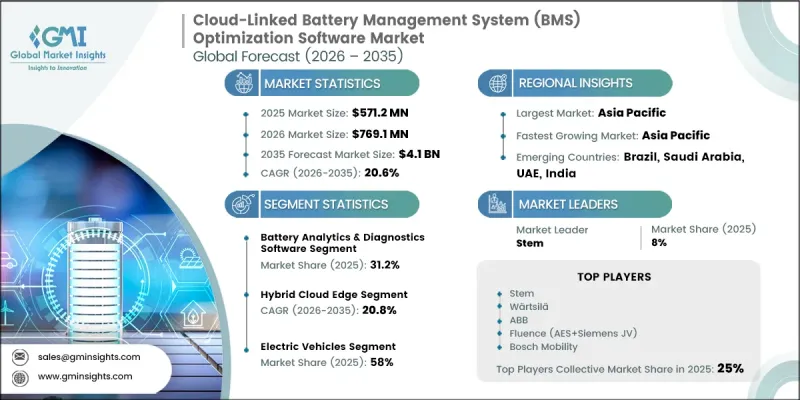
이 시장은 전기자동차와 배터리 에너지 저장 시스템의 급속한 보급에 힘입어, 전 세계 배터리 생태계의 복잡성과 규모가 확대됨에 따라 강력한 성장을 달성하고 있습니다. 모빌리티 및 전력망 분야에서 배터리 자산이 증가함에 따라 성능의 안정성과 안전성을 확보하기 위해서는 지속적인 모니터링, 예측 최적화 및 수명 주기 관리가 필수적입니다. 배터리 성능 저하 및 예기치 못한 가동 중단으로 인한 비용 증가는 지능형 클라우드 기반 최적화 플랫폼으로의 전환을 더욱 가속화하고 있습니다. 또한 배터리 교체는 전기 이동 수단과 고정형 에너지 저장 장치 모두에서 수명 주기 전반에 걸쳐 가장 많은 비용이 드는 요소 중 하나로 남아 있으며, 효율 최적화는 매우 중요한 우선 과제가 되고 있습니다. 클라우드 컴퓨팅과 첨단 분석 기술의 통합을 통해 배터리 동작에 대한 실시간 인사이트를 확보할 수 있게 되었으며, 이를 통해 차량 운영사, 전력사, 제조사의 의사결정이 개선되고 있습니다. 에너지 전환, 전기화, 송전망 현대화에 대한 관심이 높아지고 있는 점도 도입을 지원하고 있으며, 한편 규제 체계는 배터리 밸류체인 전반에 걸친 투명성과 디지털 추적성 향상을 촉진하고 있으며, 이러한 요소들이 시너지를 발휘하며 2035년까지 지속가능한 시장 성장을 지원하고 있습니다.
| 시장 범위 | |
|---|---|
| 시작연도 | 2025년 |
| 예측 기간 | 2026-2035년 |
| 개시 금액 | 5억 7,120만 달러 |
| 예측액 | 41억 달러 |
| CAGR | 20.6% |
배터리 분석·진단 소프트웨어 부문은 31.2%의 시장 점유율을 차지하고 있으며, 2026-2035년 연평균 성장률(CAGR) 18.7%로 성장할 것으로 전망됩니다. 이 부문은 충전 상태(SOC), 배터리 상태(SOH), 전압 수준, 온도 변동 및 기타 작동 매개변수와 같은 중요한 성능 지표를 지속적으로 평가하도록 설계되었습니다. 전기자동차 및 에너지 저장 시스템에서 이상 현상 파악, 잠재적 고장 예측, 그리고 배터리의 전반적인 신뢰성, 안전성 및 수명 주기 효율 향상에 중요한 역할을 하고 있습니다.
하이브리드 클라우드 엣지 부문은 2025년에 47.9%의 시장 점유율을 차지하며, 2026-2035년 연평균 성장률(CAGR) 20.8%로 성장할 것으로 전망됩니다. 이 아키텍처에서는 엣지 디바이스와 중앙 집중형 클라우드 플랫폼 간에 계산 처리의 역할을 분담합니다. 시간적 제약이 있는 배터리 제어, 모니터링 및 안전 기능은 에지 측에서 로컬로 처리되는 반면, 장기적인 분석, 인공지능 학습 및 최적화 워크로드는 클라우드에서 처리됩니다. 이 분산형 프레임워크를 통해 대규모 전기자동차(EV) 차량군 및 에너지 저장 시스템을 위한 확장 가능한 데이터 처리 능력을 유지하면서, 낮은 지연 시간의 응답성을 확보할 수 있습니다.
미국의 클라우드 연동형 BMS 최적화 소프트웨어 시장은 2025년에 1억 4,180만 달러에 달하며, 2026-2035년 연평균 성장률(CAGR) 21.3%로 성장할 것으로 전망됩니다. 해당 국가에서는 연방 정부의 인센티브와 송전망 현대화 계획에 힘입어, 유틸리티급 배터리 에너지 저장 시스템의 도입이 급속히 확대되고 있습니다. 설치된 에너지 저장 용량이 지속적으로 확대되는 가운데, 사업자들은 배터리의 상태를 모니터링하고, 에너지 공급 전략을 최적화하며, 지역적으로 분산된 에너지 저장 네트워크 전반에 걸쳐 자산 활용도를 높이기 위해 클라우드 기반 BMS 플랫폼 도입을 점점 더 확대하고 있습니다.
자주 묻는 질문
목차
제1장 조사 방법
제2장 개요
제3장 업계 인사이트
제4장 경쟁 구도
제5장 시장 추산·예측 : 소프트웨어 모듈별, 2022-2035년
제6장 시장 추산·예측 : 배포 모드별, 2022-2035년
제7장 시장 추산·예측 : 최종 사용별, 2022-2035년
제8장 시장 추산·예측 : 배터리 유형별, 2022-2035년
제9장 시장 추산·예측 : 지역별, 2022-2035년
제10장 기업 개요
KSA 26.06.23The Global Cloud-Linked Battery Management System (BMS) Optimization Software Market was valued at USD 571.2 million in 2025 and is estimated to grow at a CAGR of 20.6% to reach USD 4.1 billion in 2035.
The market is experiencing strong expansion driven by the rapid penetration of electric vehicles and battery energy storage systems, which is increasing the complexity and scale of battery ecosystems worldwide. As battery assets multiply across mobility and grid applications, continuous monitoring, predictive optimization, and lifecycle management have become essential to ensure performance stability and safety. Rising costs associated with battery degradation and unplanned downtime are further accelerating the shift toward intelligent cloud-enabled optimization platforms. In addition, battery replacement remains one of the most expensive lifecycle components in both electric mobility and stationary storage, making efficiency optimization a critical priority. The integration of cloud computing with advanced analytics is enabling real-time insights into battery behavior, improving decision-making across fleet operators, utilities, and manufacturers. Growing emphasis on energy transition, electrification, and grid modernization is also reinforcing adoption, while regulatory frameworks are pushing greater transparency and digital traceability across the battery value chain, collectively supporting sustained market growth through 2035.
| Market Scope | |
|---|---|
| Start Year | 2025 |
| Forecast Year | 2026-2035 |
| Start Value | $571.2 Million |
| Forecast Value | $4.1 Billion |
| CAGR | 20.6% |
The Battery Analytics & Diagnostics Software segment held a 31.2% share and is projected to grow at a CAGR of 18.7% from 2026 to 2035. This segment is designed to continuously evaluate critical performance indicators such as state of charge, state of health, voltage levels, temperature variations, and other operational parameters. It plays a vital role in identifying anomalies, predicting potential failures, and improving overall battery reliability, safety, and lifecycle efficiency across electric vehicles and energy storage deployments.
The Hybrid Cloud-edge segment held a 47.9% share in 2025 and is expected to grow at a CAGR of 20.8% from 2026 to 2035. This architecture divides computing responsibilities between edge devices and centralized cloud platforms. Time-sensitive battery control, monitoring, and safety functions are processed locally at the edge, while long-term analytics, artificial intelligence training, and optimization workloads are handled in the cloud. This distributed framework ensures low-latency responsiveness while maintaining scalable data processing capabilities for large-scale EV fleets and energy storage systems.
United States Cloud-Linked BMS Optimization Software Market reached USD 141.8 million in 2025 and is projected to grow at a CAGR of 21.3% from 2026 to 2035. The country is witnessing rapid expansion of utility-scale battery energy storage deployments supported by federal incentives and grid modernization initiatives. As installed storage capacity continues to grow, operators are increasingly adopting cloud-based BMS platforms to track battery health, optimize energy dispatch strategies, and enhance asset utilization across geographically distributed storage networks.
Major companies operating in the Global Cloud-Linked Battery Management System (BMS) Optimization Software Industry include ABB, ACCURE Battery Intelligence, Bosch Mobility, Elysia, Zitara (Fortescue), Fluence (AES + Siemens joint venture), Qnovo, Stem, TWAICE, Voltaiq, and Wartsila. Companies operating in the cloud-linked BMS optimization software market are focusing on strengthening their competitive position through continuous innovation in AI-driven battery analytics and predictive maintenance capabilities. They are investing heavily in cloud-edge hybrid architectures to improve scalability, latency control, and real-time monitoring accuracy across distributed energy systems. Strategic collaborations with EV manufacturers, battery producers, and utility providers are being prioritized to expand ecosystem integration and ensure broader deployment of software platforms. Many players are also enhancing interoperability features to support diverse battery chemistries and hardware systems, improving flexibility across applications. In addition, firms are leveraging subscription-based software models and platform-as-a-service offerings to generate recurring revenue streams while increasing customer retention. Expansion into large-scale energy storage and electric mobility sectors is further reinforcing market penetration.
Table of Contents
Chapter 1 Methodology
- 1.1 Research approach
- 1.2 Quality Commitments
- 1.2.1 GMI AI policy & data integrity commitment
- 1.2.1.1 Source consistency protocol
- 1.2.1 GMI AI policy & data integrity commitment
- 1.3 Research Trail & Confidence Scoring
- 1.3.1 Research Trail Components
- 1.3.2 Scoring Components
- 1.4 Data Collection
- 1.4.1 Partial list of primary sources
- 1.5 Data mining sources
- 1.5.1 Paid sources
- 1.5.1.1 Sources, by region
- 1.5.1 Paid sources
- 1.6 Base estimates and calculations
- 1.6.1 Base year calculation
- 1.7 Forecast model
- 1.7.1 Quantified market impact analysis
- 1.7.1.1 Mathematical impact of growth parameters on forecast
- 1.7.1 Quantified market impact analysis
- 1.8 Research transparency addendum
- 1.8.1 Source attribution framework
- 1.8.2 Quality assurance metrics
- 1.8.3 Our commitment to trust
Chapter 2 Executive Summary
- 2.1 Industry 360° synopsis
- 2.2 Key market trends
- 2.2.1 Regional
- 2.2.2 Software module
- 2.2.3 Deployment mode
- 2.2.4 End use
- 2.2.5 Battery type
- 2.3 TAM analysis, 2026-2035
- 2.4 CXO perspectives: Strategic imperatives
Chapter 3 Industry Insights
- 3.1 Industry ecosystem analysis
- 3.1.1 Supplier landscape
- 3.1.2 Profit margin
- 3.1.3 Cost structure
- 3.1.4 Value addition at each stage
- 3.1.5 Factor affecting the value chain
- 3.1.6 Disruptions
- 3.2 Industry impact forces
- 3.2.1 Growth drivers
- 3.2.1.1 EV & BESS expansion
- 3.2.1.2 Battery degradation costs
- 3.2.1.3 EU battery compliance mandate
- 3.2.1.4 Software-defined BMS shift
- 3.2.2 Industry pitfalls and challenges
- 3.2.2.1 Cloud cybersecurity risks
- 3.2.2.2 Real-time latency limits
- 3.2.3 Market opportunities
- 3.2.3.1 BMS-as-a-service models
- 3.2.3.2 Second-life battery markets
- 3.2.3.3 Telecom fleet optimization
- 3.2.3.4 Data center battery intelligence
- 3.2.1 Growth drivers
- 3.3 Growth potential analysis
- 3.4 Technology and innovation landscape
- 3.4.1 Current technological trends
- 3.4.1.1 AI/ML Algorithms for SOC, SOH & RUL Estimation
- 3.4.1.2 Physics-Based & Electrochemical Model Integration
- 3.4.2 Emerging technologies
- 3.4.2.1 Digital Twin Architectures for Cloud-Linked BMS
- 3.4.2.2 OTA Update & Software-Defined BMS Evolution
- 3.4.1 Current technological trends
- 3.5 Pricing Analysis (Driven by primary research)
- 3.5.1 Historical Price Trend Analysis
- 3.5.2 Pricing Strategy by Player Type (Premium / Value / Cost-plus)
- 3.6 Cost breakdown analysis
- 3.7 Regulatory landscape
- 3.7.1 North America
- 3.7.1.1 North American Electric Reliability Corporation
- 3.7.1.2 Federal Energy Regulatory Commission
- 3.7.2 Europe
- 3.7.2.1 European Commission
- 3.7.2.2 European Union Agency for Cybersecurity
- 3.7.3 Asia Pacific
- 3.7.3.1 Ministry of Industry and Information Technology
- 3.7.3.2 Ministry of Economy Trade and Industry
- 3.7.4 Latin America
- 3.7.4.1 National Electric Energy Agency
- 3.7.4.2 National Energy Commission
- 3.7.5 Middle East & Africa
- 3.7.5.1 Dubai Electricity and Water Authority
- 3.7.5.2 Saudi Energy Efficiency Center
- 3.7.1 North America
- 3.8 Porter's analysis
- 3.9 PESTEL analysis
- 3.10 Patent analysis (Driven by primary research)
- 3.11 Impact of AI & Generative AI on the Market
- 3.11.1 AI-driven disruption of existing business models
- 3.11.2 Gen AI use cases & adoption roadmap by segment
- 3.11.3 Risks, limitations & regulatory considerations
- 3.12 Sustainability and environmental aspects
- 3.12.1 Sustainable practices
- 3.12.2 Waste reduction strategies
- 3.12.3 Energy efficiency in production
- 3.12.4 Eco-friendly initiatives
- 3.12.5 Carbon footprint considerations
- 3.13 Forecast assumptions & scenario analysis (Driven by primary research)
- 3.13.1 Base Case - key macro & industry variables driving CAGR
- 3.13.2 Optimistic Scenarios - Favorable macro and industry tailwinds
- 3.13.3 Pessimistic Scenario - Macroeconomic slowdown or industry headwinds
Chapter 4 Competitive Landscape, 2025
- 4.1 Introduction
- 4.2 Company market share analysis
- 4.2.1 North America
- 4.2.2 Europe
- 4.2.3 Asia Pacific
- 4.2.4 LATAM
- 4.2.5 MEA
- 4.3 Competitive analysis of major market players
- 4.4 Competitive positioning matrix
- 4.5 Key developments
- 4.5.1 Mergers & acquisitions
- 4.5.2 Partnerships & collaborations
- 4.5.3 New product launches
- 4.5.4 Expansion plans and funding
- 4.6 4.6 Company tier benchmarking
- 4.6.1 Tier classification criteria & qualifying thresholds
- 4.6.2 Tier positioning matrix by revenue, geography & innovation
Chapter 5 Market Estimates & Forecast, By Software Module, 2022 - 2035 ($Mn)
- 5.1 Key trends
- 5.2 Battery analytics & diagnostics software
- 5.3 Predictive maintenance & fault detection software
- 5.4 Battery performance optimization software
- 5.5 Digital twin & simulation software
- 5.6 OTA update & configuration management software
- 5.7 Battery lifecycle & second-life management software
Chapter 6 Market Estimates & Forecast, By Deployment Mode, 2022 - 2035 ($Mn)
- 6.1 Key trends
- 6.2 Pure Cloud
- 6.3 Hybrid Cloud-Edge
- 6.4 End-Edge-Cloud
Chapter 7 Market Estimates & Forecast, By End Use, 2022 - 2035 ($Mn)
- 7.1 Key trends
- 7.2 Electric Vehicles (EV)
- 7.3 Battery Energy Storage Systems (BESS)
- 7.4 Industrial & Commercial
- 7.5 Telecom & Data Centers
- 7.6 Others
Chapter 8 Market Estimates & Forecast, By Battery Type, 2022 - 2035 ($Mn)
- 8.1 Key trends
- 8.2 Lithium-Ion (Li-ion) batteries
- 8.3 Solid-state batteries
- 8.4 Lead-acid batteries
- 8.5 Nickel-based batteries
- 8.6 Others
Chapter 9 Market Estimates & Forecast, By Region, 2022 - 2035 ($Mn)
- 9.1 Key trends
- 9.2 North America
- 9.2.1 U.S.
- 9.2.2 Canada
- 9.3 Europe
- 9.3.1 Germany
- 9.3.2 UK
- 9.3.3 France
- 9.3.4 Italy
- 9.3.5 Spain
- 9.3.6 Russia
- 9.3.7 Netherlands
- 9.3.8 Norway
- 9.3.9 Sweden
- 9.3.10 Austria
- 9.4 Asia Pacific
- 9.4.1 China
- 9.4.2 India
- 9.4.3 Japan
- 9.4.4 South Korea
- 9.4.5 Australia
- 9.4.6 Vietnam
- 9.4.7 Indonesia
- 9.4.8 Singapore
- 9.4.9 Malaysia
- 9.4.10 Philippines
- 9.5 Latin America
- 9.5.1 Brazil
- 9.5.2 Mexico
- 9.5.3 Argentina
- 9.5.4 Colombia
- 9.6 MEA
- 9.6.1 South Africa
- 9.6.2 Saudi Arabia
- 9.6.3 UAE
Chapter 10 Company Profiles
- 10.1 Global players
- 10.1.1 ABB
- 10.1.2 ACCURE Battery Intelligence
- 10.1.3 Bosch Mobility
- 10.1.4 Fluence (AES+Siemens JV)
- 10.1.5 Qnovo
- 10.1.6 Stem
- 10.1.7 TWAICE
- 10.1.8 Voltaiq
- 10.1.9 Wartsila
- 10.2 Regional players
- 10.2.1 Brill Power
- 10.2.2 Dukosi
- 10.2.3 Eatron Technologies
- 10.2.4 Electra Vehicles (Electra Brain)
- 10.2.5 Elysia + Zitara (Fortescue)
- 10.2.6 Modo Energy
- 10.2.7 Peaxy
- 10.2.8 PowerUp Technology
- 10.3 Emerging players
- 10.3.1 About:Energy
- 10.3.2 BattGenie
- 10.3.3 Cognivity AI