

|
시장보고서
상품코드
2061404
종자 코팅재 시장 기회, 성장요인, 업계 동향 분석 및 예측(2026-2035년)Seed Coating Material Market Opportunity, Growth Drivers, Industry Trend Analysis, and Forecast 2026 - 2035 |
||||||

세계의 종자 코팅재 시장은 2025년에 20억 달러로 평가되고 CAGR 7.3%로 성장하며, 2035년까지 41억 달러에 달할 것으로 예측됩니다.
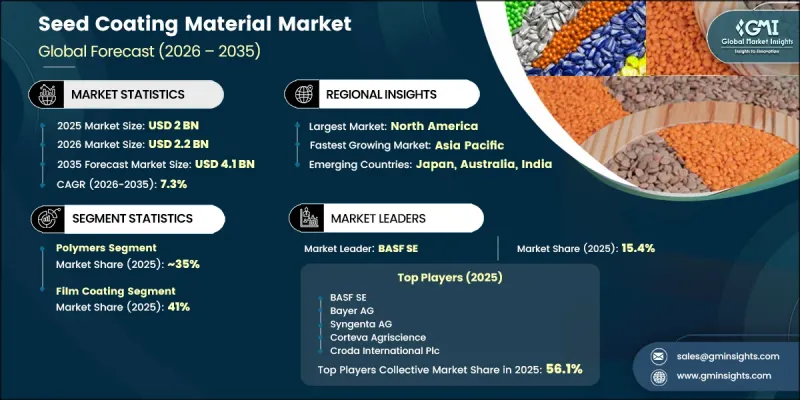
현대 농업에서 발아율 향상, 모종 생육 개선, 그리고 작물의 종합적인 생산성 극대화를 도모하기 위해 종자의 품질이 점점 더 중요시되면서, 관련 시장은 성장세를 보이고 있습니다. 농가 및 농업 이해관계자들의 투자 확대는 종자의 성능 향상을 통해 수익성을 높일 필요성에 의해 주도되고 있습니다. 종자 코팅재는 종자를 보호하는 동시에, 가혹한 환경 조건을 견딜 수 있는 고수확 품종의 생산을 가능하게 하는 데 있으며, 매우 중요한 역할을 하고 있습니다. 작물 다양화 추세와 단일 작물 재배에서 점차 전환되고 있는 점이 시장의 확산을 더욱 지원하고 있습니다. 농가는 위험을 줄이고, 토양 건강을 개선하며, 다양한 식품에 대한 소비자의 높아지는 수요에 부응하기 위해 다각적인 재배에 점점 더 주력하고 있습니다. 종자 코팅 솔루션은 곡물, 잡곡, 지방종자, 두류, 과일, 채소 등 광범위한 작물 범주에 걸쳐 맞춤형 솔루션을 제공하여 안정적인 농업 생산성을 보장합니다. 그러나 업계는 여전히 원자재 가격 변동이나 최종사용자의 첨단 코팅 기술에 대한 인지도 부족과 같은 과제에 직면해 있습니다.
| 시장 범위 | |
|---|---|
| 시작연도 | 2025년 |
| 예측 기간 | 2026-2035년 |
| 개시 금액 | 20억 달러 |
| 예측액 | 41억 달러 |
| CAGR | 7.3% |
폴리머 계열 소재 부문은 2025년에 35%의 시장 점유율을 차지하며, 2035년까지 연평균 성장률(CAGR) 8.5%로 성장할 것으로 전망됩니다. 이러한 재료들은 뛰어난 내구성과 폭넓은 활용성, 그리고 종자 주위에 보호층을 형성하는 능력 덕분에 널리 선호되고 있습니다. 이러한 요소들은 종자의 취급성을 개선하고, 수분 함량을 유지하며, 유효 성분의 서방형 방출을 가능하게 하는 데 도움이 됩니다. 종자 코팅 생태계의 다른 주요 구성 요소로는 코팅의 안정성을 유지하는 바인더, 종자 식별에 사용되는 착색제, 그리고 식물의 성장과 발육을 돕는 미네랄 및 미량영양소가 포함됩니다. 또한 종자용 윤활유는 파종 작업 중 취급 편의성을 높이는 역할도 합니다.
2025년 기준으로, 필름 코팅 분야는 41%의 시장 점유율을 차지했습니다. 이 기술은 종자 주위에 균일하고 얇은 보호층을 형성하여 취급 효율을 높일 뿐만 아니라, 영양소와 작물 보호제의 정밀한 시비를 가능하게 합니다. 다양한 환경 조건에서 종자의 성능과 적응성을 높이는 그 효과 덕분에, 가장 널리 채택되고 있는 코팅 방법으로서의 입지를 확고히 하고 있습니다. 피복이나 펠릿화 같은 다른 기술과 비교했을 때, 필름 코팅은 그 정밀도와 비용 효율성, 그리고 다양한 농업 용도에서 일관된 종자 품질을 유지할 수 있다는 점에서 선호되고 있습니다.
북미의 종자 코팅재료 시장은 5억 9,500만 달러로 평가되며, 2026-2035년 연평균 성장률(CAGR) 6.3%로 성장할 것으로 예상됩니다. 이 지역의 성장은 첨단인 농업 기술의 도입과 농업 분야의 엄격한 규제 체계 도입에 힘입어 이루어지고 있습니다. 고수확 작물 생산에 대한 수요가 증가하는 데 더해, 지속가능한 농업 관행으로의 전환이 특히 곡물 및 지방종자 재배 분야에서 종자 코팅 솔루션의 소비 확대를 주도하고 있습니다. 종자 보호 강화와 발아 효율 개선에 초점을 맞춘 혁신에 힘입어 시장은 꾸준히 성장하고 있습니다.
자주 묻는 질문
목차
제1장 조사 방법과 범위
제2장 개요
제3장 업계 인사이트
제4장 경쟁 구도
제5장 시장 추산·예측 : 성분별, 2022-2035년
제6장 시장 추산·예측 : 코팅 유형별, 2022-2035년
제7장 시장 추산·예측 : 작물 유형별, 2022-2035년
제8장 시장 추산·예측 : 지역별, 2022-2035년
제9장 기업 개요
KSA 26.06.24The Global Seed Coating Material Market was valued at USD 2 billion in 2025 and is estimated to grow at a CAGR of 7.3% to reach USD 4.1 billion by 2035.
The market is gaining momentum as modern agriculture increasingly prioritizes seed quality to enhance germination rates, improve seedling development, and maximize overall crop productivity. Rising investments by farmers and agricultural stakeholders are driven by the need to achieve higher profitability through improved seed performance. Seed coating materials play a critical role in protecting seeds while enabling the production of high-yield varieties capable of withstanding harsh environmental conditions. Growing crop diversification trends, alongside the gradual shift away from monocropping practices, are further strengthening market adoption. Farmers are increasingly focusing on diversified cultivation to reduce risks, improve soil health, and meet rising consumer demand for varied food products. Seed coating solutions also support customization across a wide range of crop categories, including cereals, grains, oilseeds, pulses, fruits, and vegetables, ensuring consistent agricultural performance. However, the industry continues to face challenges related to fluctuating raw material prices and limited awareness of advanced coating technologies among end users.
| Market Scope | |
|---|---|
| Start Year | 2025 |
| Forecast Year | 2026-2035 |
| Start Value | $2 Billion |
| Forecast Value | $4.1 Billion |
| CAGR | 7.3% |
The polymer-based materials segment held a 35% share in 2025 and is projected to grow at a CAGR of 8.5% through 2035. These materials are widely preferred due to their strong durability, versatile properties, and ability to form a protective layer around seeds. They assist in improving seed handling, maintaining moisture levels, and enabling controlled release of active ingredients. Other key components in the seed coating ecosystem include binders that maintain coating stability, colorants used for seed identification, and minerals and micronutrients that support plant growth and development. Seed lubricants also contribute to smoother handling during planting operations.
The film coating segment held a share of 41% in 2025. This technique creates a uniform, thin protective layer around seeds, improving handling efficiency and enabling precise application of nutrients and crop protection agents. Its effectiveness in enhancing seed performance and adaptability under varying environmental conditions has positioned it as the most widely adopted coating method. Compared to alternative techniques such as encrusting and pelleting, film coating is preferred for its precision, cost efficiency, and ability to maintain consistent seed quality across diverse agricultural applications.
North America Seed Coating Material Market was valued at USD 595 million and is expected to grow at a CAGR of 6.3% from 2026 to 2035. Growth in the region is supported by the adoption of advanced agricultural technologies and the implementation of strict regulatory frameworks in the farming sector. Increasing demand for high-yield crop production, along with the shift toward sustainable farming practices, is driving higher consumption of seed coating solutions, particularly in cereal and oilseed cultivation. The market continues to expand steadily, supported by innovations focused on improving seed protection and enhancing germination efficiency.
Key companies operating in the Global Seed Coating Material Market include BASF SE, Bayer AG, Syngenta AG, Corteva Agriscience, Croda International Plc, Clariant AG, Germains Seed Technology, Incotec Group, Precision Laboratories LLC, Michelman Inc., BrettYoung, Chromatech Incorporated, Universal Coating Systems, Mahendra Overseas, Milliken & Company, and Summit Seed Coatings. Companies operating in the seed coating material market are focusing on multiple strategic initiatives to strengthen their competitive position and expand market presence. Industry players are investing in advanced polymer technologies and multifunctional coating formulations that enhance seed protection, germination efficiency, and nutrient delivery. Expansion of research and development activities is enabling the introduction of more effective and environmentally sustainable coating solutions. Companies are also forming strategic partnerships with seed producers and agricultural input suppliers to improve product distribution and market penetration. Strengthening production capabilities and optimizing raw material sourcing are helping firms manage cost fluctuations and improve supply chain resilience. In addition, manufacturers are focusing on region-specific product customization to meet diverse crop requirements and climatic conditions.
Table of Contents
Chapter 1 Methodology & Scope
- 1.1 Market scope and definition
- 1.2 Research design
- 1.2.1 Research approach
- 1.2.2 Data collection methods
- 1.3 Data mining sources
- 1.3.1 Global
- 1.3.2 Regional/Country
- 1.4 Base estimates and calculations
- 1.4.1 Base year calculation
- 1.4.2 Key trends for market estimation
- 1.5 Primary research and validation
- 1.5.1 Primary sources
- 1.6 Forecast model
- 1.7 Research assumptions and limitations
Chapter 2 Executive Summary
- 2.1 Industry 360° synopsis
- 2.2 Key market trends
- 2.2.1 Regional
- 2.2.2 Ingredient
- 2.2.3 Type of Coating
- 2.2.4 Crop Type
- 2.3 TAM Analysis, 2026-2035
- 2.4 CXO perspectives: Strategic imperatives
Chapter 3 Industry Insights
- 3.1 Industry ecosystem analysis
- 3.1.1 Supplier landscape
- 3.1.2 Profit margin
- 3.1.3 Value addition at each stage
- 3.1.4 Factor affecting the value chain
- 3.1.5 Disruptions
- 3.2 Industry impact forces
- 3.2.1 Growth drivers
- 3.2.1.1 Growing global demand for high-quality seeds & enhanced crop yields
- 3.2.1.2 Increasing adoption of precision agriculture technologies
- 3.2.1.3 Rising focus on sustainable & organic farming practices
- 3.2.2 Industry pitfalls and challenges
- 3.2.2.1 High cost of advanced seed coating technologies
- 3.2.2.2 Stringent regulatory approval processes for active ingredients
- 3.2.3 Market opportunities
- 3.2.3.1 Development of bio-based & biodegradable coating materials
- 3.2.3.2 Integration of smart technologies (IOT, sensors) in seed coatings
- 3.2.1 Growth drivers
- 3.3 Growth potential analysis
- 3.4 Regulatory landscape
- 3.4.1 North America
- 3.4.2 Europe
- 3.4.3 Asia Pacific
- 3.4.4 Latin America
- 3.4.5 Middle East & Africa
- 3.5 Porter’s analysis
- 3.6 PESTEL analysis
- 3.7 Price trends
- 3.7.1 By region
- 3.7.2 By ingredient
- 3.8 Future market trends
- 3.9 Technology and innovation landscape
- 3.9.1 Current technological trends
- 3.9.2 Emerging technologies
- 3.10 Patent Landscape
- 3.11 Trade statistics (HS code)
- 3.11.1 Major importing countries
- 3.11.2 Major exporting countries
- 3.12 Sustainability and environmental aspects
- 3.12.1 Sustainable practices
- 3.12.2 Waste reduction strategies
- 3.12.3 Energy efficiency in production
- 3.12.4 Eco-friendly initiatives
- 3.13 Carbon footprint consideration
Chapter 4 Competitive Landscape, 2025
- 4.1 Introduction
- 4.2 Company market share analysis
- 4.2.1 By region
- 4.2.1.1 North America
- 4.2.1.2 Europe
- 4.2.1.3 Asia Pacific
- 4.2.1.4 LATAM
- 4.2.1.5 MEA
- 4.2.1 By region
- 4.3 Competitive analysis of major market players
- 4.4 Competitive positioning matrix
- 4.5 Key developments
- 4.5.1 Mergers & acquisitions
- 4.5.2 Partnerships & collaborations
- 4.5.3 New Product Launches
- 4.5.4 Expansion Plans
Chapter 5 Market Estimates and Forecast, By Ingredient, 2022-2035 (USD Billion) (Kilo Tons)
- 5.1 Key trends
- 5.2 Polymers
- 5.3 Binders
- 5.4 Colorants
- 5.5 Minerals & micronutrients
- 5.6 Seed planting lubricants
- 5.7 Others
Chapter 6 Market Estimates and Forecast, By Type of Coating, 2022-2035 (USD Billion) (Kilo Tons)
- 6.1 Key trends
- 6.2 Film coating
- 6.3 Encrusting
- 6.4 Pelleting
Chapter 7 Market Estimates and Forecast, By Crop Type, 2022-2035 (USD Billion) (Kilo Tons)
- 7.1 Key trends
- 7.2 Cereals & grains
- 7.2.1 Corn
- 7.2.2 Wheat
- 7.2.3 Rice
- 7.2.4 Barley
- 7.2.5 Other cereals
- 7.3 Oilseeds & pulses
- 7.3.1 Soybean
- 7.3.2 Canola / rapeseed
- 7.3.3 Sunflower
- 7.3.4 Cotton
- 7.3.5 Other oilseeds & pulses
- 7.4 Fruits & vegetables
- 7.5 Other crops
Chapter 8 Market Estimates and Forecast, By Region, 2022-2035 (USD Billion) (Kilo Tons)
- 8.1 Key trends
- 8.2 North America
- 8.2.1 U.S.
- 8.2.2 Canada
- 8.3 Europe
- 8.3.1 Germany
- 8.3.2 UK
- 8.3.3 France
- 8.3.4 Spain
- 8.3.5 Italy
- 8.3.6 Rest of Europe
- 8.4 Asia Pacific
- 8.4.1 China
- 8.4.2 India
- 8.4.3 Japan
- 8.4.4 Australia
- 8.4.5 South Korea
- 8.4.6 Rest of Asia Pacific
- 8.5 Latin America
- 8.5.1 Brazil
- 8.5.2 Mexico
- 8.5.3 Argentina
- 8.5.4 Rest of Latin America
- 8.6 Middle East and Africa
- 8.6.1 Saudi Arabia
- 8.6.2 South Africa
- 8.6.3 UAE
- 8.6.4 Rest of Middle East and Africa
Chapter 9 Company Profiles
- 9.1 BASF SE
- 9.2 Bayer AG
- 9.3 Syngenta AG
- 9.4 Corteva Agriscience
- 9.5 Croda International Plc
- 9.6 Clariant AG
- 9.7 Germains Seed Technology
- 9.8 Incotec Group
- 9.9 Precision Laboratories LLC
- 9.10 Michelman Inc.
- 9.11 BrettYoung
- 9.12 Chromatech Incorporated
- 9.13 Universal Coating Systems
- 9.14 Mahendra Overseas
- 9.15 Milliken & Company
- 9.16 Summit Seed Coatings


