

|
시장보고서
상품코드
2061437
액체 질소 시장 기회, 성장요인, 업계 동향 분석 및 예측(2026-2035년)Liquid Nitrogen Market Opportunity, Growth Drivers, Industry Trend Analysis, and Forecast 2026 - 2035 |
||||||

세계의 액체 질소 시장은 2025년에 171억 달러로 평가되고 CAGR 5%로 성장하며, 2035년까지 282억 달러에 달할 것으로 추정되고 있습니다.
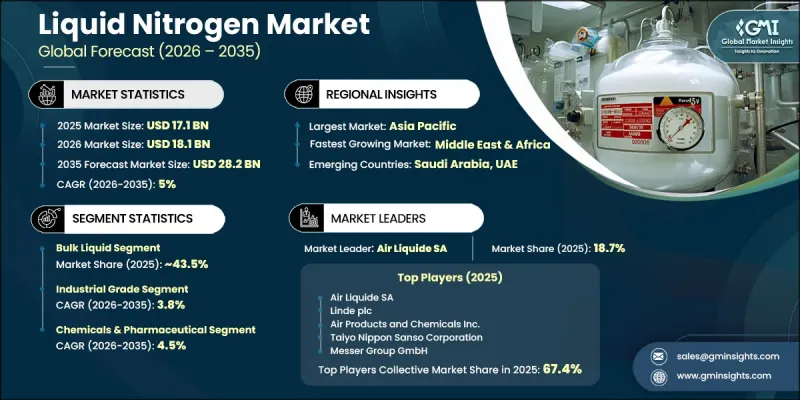
다양한 산업 및 상업 분야에서 액체 질소의 활용이 확대됨에 따라 시장은 강력한 성장세를 보이고 있습니다. 비등점이 -196°C로 매우 낮은 것으로 알려진 액체 질소는 의료, 식품 가공, 전자, 자동차, 야금, 화학, 제조 등 다양한 산업 분야에서 냉각, 동결 및 불활성화제로 널리 이용되고 있습니다. 극저온 기술 및 첨단 보존 기술에 대한 수요가 증가함에 따라 시장 성장에 크게 기여하고 있습니다. 의료 업계에서는 극저온을 유지할 수 있는 특성 덕분에, 동결 보존, 생물 시료 보관, 의약품 제조, 백신 운송 분야에서 액체 질소의 사용이 확대되고 있습니다. 식품 및 음료 업계에서는 액체 질소를 활용한 급속 냉동 기술을 통해 제조업체가 제품의 신선도, 식감, 영양가를 유지하면서 유통기한을 연장할 수 있게 되었습니다. 전자기기 업계에서도 반도체 및 부품 제조 공정에서 오염과 산화를 방지하는 데 도움이 되는 비반응성이라는 특성 덕분에 액체 질소의 소비량은 계속 증가하고 있습니다. 또한 이 제품은 친환경적이고 비용 효율이 뛰어나며 유해한 잔류물을 남기지 않고 급속 냉각이 가능하다는 장점도 시장 성장을 지원하고 있습니다. 산업화의 진전, 기술의 발전, 그리고 대규모 가스 생산 인프라에 대한 투자 확대 역시 전 세계 액체 질소 산업의 장기적인 성장을 지원하고 있습니다.
| 시장 범위 | |
|---|---|
| 시작연도 | 2025년 |
| 예측 기간 | 2026-2035 |
| 개시 금액 | 171억 달러 |
| 예측액 | 282억 달러 |
| CAGR | 5% |
대용량 액체 부문은 2025년에 43.5%의 시장 점유율을 차지하며, 2035년까지 연평균 성장률(CAGR) 4.9%로 성장할 것으로 전망됩니다. 일상 업무에서 끊김 없이 대량의 공급이 필요한 업계 전반에 걸쳐, 벌크 액체 질소에 대한 수요는 계속해서 견고한 양상을 보이고 있습니다. 제조 시설, 금속 가공 공장, 석유 및 가스 사업 및 대규모 식품 가공 시설은 업무 효율성과 안정적인 제품 공급을 실현하는 벌크 액체 질소 시스템에 여전히 크게 의존하고 있습니다. 또한 이 부문은 운송 효율을 높이고 산업 사용자의 운영 비용을 절감하는 집중형 초저온 저장·공급 시스템의 도입 확대로 인한 혜택도 누리고 있습니다. 산업 인프라에 대한 투자 증가와 신흥 국가에서의 생산 활동 확대로 인해, 향후 수년간 벌크 액체 질소의 수요는 더욱 증가할 것으로 예상됩니다.
산업용 부문은 2025년에 60.8%의 시장 점유율을 차지하며, 2026-2035년 연평균 성장률(CAGR) 3.8%로 성장할 것으로 전망됩니다. 산업용 등급의 액체 질소는 제조, 가공, 포장, 냉동, 냉각 공정 등 폭넓은 용도로 사용되고 있으며, 계속해서 시장을 독점하고 있습니다. 산업 분야에서는 온도 제어 및 불활성 분위기 용도에서 신뢰성이 높고 경제적인 솔루션을 제공하기 위해 산업용 등급의 질소가 선호되고 있습니다. 식품 보존 업계에서는 운송 및 보관 중 제품의 품질을 유지하기 위해 이 등급이 널리 사용되고 있으며, 한편 금속 가공 시설에서는 수축 결합, 냉각 및 극저온 처리 용도로 사용되고 있습니다. 자동차 생산, 전자기기 제조 및 산업용 가공 분야의 수요가 증가함에 따라 예측 기간 중 높은 도입 수준이 유지될 것으로 예상됩니다. 또한 산업용 자동화 및 정밀 제조 기술의 지속적인 발전으로 인해 여러 분야에 걸친 산업용 액체 질소의 활용 분야에서 새로운 기회가 창출되고 있습니다.
북미의 액체 질소 시장은 첨단인 제조 기반과 급속한 기술 혁신 덕분에 2025년에는 25%의 시장 점유율을 차지했습니다. 이 지역은 의료, 전자기기, 자동차, 항공우주, 식품 가공 산업 분야의 높은 수요 덕분에 혜택을 보고 있습니다. 반도체 제조 및 생의학 연구에 대한 투자 증가로 인해, 지역 전체에서 고순도 액체 질소 솔루션에 대한 수요가 크게 증가하고 있습니다. 북미의 의료 분야에서도 실험실 용도, 재생의료, 의약품 보관을 위한 극저온 기술의 도입이 확대되고 있습니다. 견고한 산업 인프라, 자동화에 대한 관심 증가, 그리고 첨단 냉각 시스템의 활용 확대가 해당 지역의 시장 성장을 더욱 지원하고 있습니다. 또한 확고한 입지를 갖춘 가스 공급업체들의 존재와 연구개발 활동에 대한 지속적인 투자가 북미 액체 질소 시장의 경쟁 구도를 더욱 치열하게 만들고 있습니다.
자주 묻는 질문
목차
제1장 조사 방법과 범위
제2장 개요
제3장 업계 인사이트
제4장 경쟁 구도
제5장 시장 추산·예측 : 운송별, 2022-2035년
제6장 시장 추산·예측 : 등급별, 2022-2035년
제7장 시장 추산·예측 : 최종 사용별, 2022-2035년
제8장 시장 추산·예측 : 지역별, 2022-2035년
제9장 기업 개요
KSA 26.06.24The Global Liquid Nitrogen Market was valued at USD 17.1 billion in 2025 and is estimated to grow at a CAGR of 5% to reach USD 28.2 billion by 2035.
The market is witnessing strong momentum due to the growing use of liquid nitrogen across a broad range of industrial and commercial applications. Liquid nitrogen, recognized for its extremely low boiling point of -196°C, is widely utilized as a cooling, freezing, and inerting agent in industries such as healthcare, food processing, electronics, automotive, metallurgy, chemicals, and manufacturing. Rising demand for cryogenic technologies and advanced preservation techniques is significantly contributing to market growth. In the healthcare industry, liquid nitrogen is increasingly adopted for cryopreservation, biological sample storage, pharmaceutical processing, and vaccine transportation due to its ability to maintain ultra-low temperatures. In the food and beverage sector, rapid freezing technologies supported by liquid nitrogen are helping manufacturers maintain product freshness, texture, and nutritional quality while extending shelf life. The electronics industry also continues to increase consumption of liquid nitrogen because of its non-reactive characteristics, which help prevent contamination and oxidation during semiconductor and component manufacturing processes. The market is further benefiting from the product's environmentally safe profile, cost efficiency, and ability to deliver rapid cooling without leaving harmful residues. Growing industrialization, technological advancements, and rising investments in large-scale gas production infrastructure are also supporting the long-term expansion of the liquid nitrogen industry worldwide.
| Market Scope | |
|---|---|
| Start Year | 2025 |
| Forecast Year | 2026-2035 |
| Start Value | $17.1 Billion |
| Forecast Value | $28.2 Billion |
| CAGR | 5% |
The bulk liquid segment accounted for 43.5% share in 2025 and is anticipated to grow at a CAGR of 4.9% through 2035. Demand for bulk liquid nitrogen remains strong across industries that require an uninterrupted and high-volume supply for daily operations. Manufacturing facilities, metal processing plants, oil and gas operations, and large food processing units continue to rely heavily on bulk liquid nitrogen systems because they offer operational efficiency and consistent product availability. The segment is also benefiting from the growing installation of centralized cryogenic storage and distribution systems that improve transportation efficiency and reduce operating costs for industrial users. Increasing investments in industrial infrastructure and expanding production activities in emerging economies are expected to further strengthen demand for bulk liquid nitrogen over the coming years.
The industrial-grade segment held a share of 60.8% in 2025 and is forecast to grow at a CAGR of 3.8% from 2026 to 2035. Industrial-grade liquid nitrogen continues to dominate the market due to its widespread application across manufacturing, fabrication, packaging, freezing, and cooling processes. Industries prefer industrial-grade nitrogen because it provides a reliable and economical solution for temperature control and inert atmosphere applications. The food preservation industry extensively utilizes this grade to maintain product quality during transportation and storage, while metal fabrication facilities use it for shrink fitting, cooling, and cryogenic treatment applications. Rising demand from automotive production, electronics manufacturing, and industrial processing operations is expected to maintain strong adoption levels throughout the forecast period. Additionally, ongoing improvements in industrial automation and precision manufacturing technologies are creating new opportunities for industrial-grade liquid nitrogen applications across multiple sectors.
North America Liquid Nitrogen Market held a 25% share in 2025 owing to its advanced manufacturing base and rapid technological innovation. The region benefits from high demand across healthcare, electronics, automotive, aerospace, and food processing industries. Increasing investments in semiconductor manufacturing and biomedical research are driving substantial demand for high-purity liquid nitrogen solutions throughout the region. The healthcare sector in North America also continues to adopt cryogenic technologies for laboratory applications, regenerative medicine, and pharmaceutical storage. Strong industrial infrastructure, growing focus on automation, and increasing use of advanced cooling systems are further supporting regional market growth. In addition, the presence of well-established gas suppliers and continuous investments in research and development activities are strengthening the competitive landscape of the North American liquid nitrogen market.
Key companies operating in the Global Liquid Nitrogen Market include Linde plc, Air Liquide SA, Air Products and Chemicals Inc., Nippon Sanso Corporation, Messer Group GmbH, Iwatani Corporation, Southern Industrial Gas Berhad, Gulf Cryo Holding CJSC, Emirates Industrial Gas Company LLC, and NexAir LLC. Companies active in the liquid nitrogen market are increasingly focusing on production expansion, strategic partnerships, and technological advancements to strengthen their market presence and improve competitive positioning. Leading manufacturers are investing in advanced cryogenic infrastructure, large-scale air separation plants, and efficient distribution networks to ensure uninterrupted supply across industrial and healthcare sectors. Businesses are also prioritizing research and development initiatives aimed at improving storage efficiency, transportation safety, and energy optimization within cryogenic systems. In addition, market participants are expanding geographically through acquisitions, collaborations, and long-term supply agreements to increase customer reach in emerging markets.
Table of Contents
Chapter 1 Methodology & Scope
- 1.1 Market scope and definition
- 1.2 Research design
- 1.2.1 Research approach
- 1.2.2 Data collection methods
- 1.3 Data mining sources
- 1.3.1 Global
- 1.3.2 Regional/Country
- 1.4 Base estimates and calculations
- 1.4.1 Base year calculation
- 1.4.2 Key trends for market estimation
- 1.5 Primary research and validation
- 1.5.1 Primary sources
- 1.6 Forecast model
- 1.7 Research assumptions and limitations
Chapter 2 Executive Summary
- 2.1 Industry 360° synopsis
- 2.2 Key market trends
- 2.2.1 Regional
- 2.2.2 Transportation
- 2.2.3 Grade
- 2.2.4 End use
- 2.3 TAM Analysis, 2026-2035
- 2.4 CXO perspectives: Strategic imperatives
- 2.4.1 Executive decision points
Chapter 3 Industry Insights
- 3.1 Industry ecosystem analysis
- 3.1.1 Supplier landscape
- 3.1.2 Profit margin
- 3.1.3 Value addition at each stage
- 3.1.4 Factor affecting the value chain
- 3.1.5 Disruptions
- 3.2 Industry impact forces
- 3.2.1 Growth drivers
- 3.2.2 Industry pitfalls and challenges
- 3.2.3 Market opportunities
- 3.3 Growth potential analysis
- 3.4 Regulatory landscape
- 3.4.1 North America
- 3.4.2 Europe
- 3.4.3 Asia Pacific
- 3.4.4 Latin America
- 3.4.5 Middle East & Africa
- 3.5 Porter's analysis
- 3.6 PESTEL analysis
- 3.7 Price trends
- 3.7.1 By region
- 3.7.2 By type
- 3.8 Future market trends
- 3.9 Technology and Innovation landscape
- 3.9.1 Current technological trends
- 3.9.2 Emerging technologies
- 3.10 Patent Landscape
- 3.11 Trade statistics (HS code)
- 3.11.1 Major importing countries
- 3.11.2 Major exporting countries
- 3.12 Sustainability and environmental aspects
- 3.12.1 Sustainable practices
- 3.12.2 Waste reduction strategies
- 3.12.3 Energy efficiency in production
- 3.12.4 Eco-friendly initiatives
- 3.13 Carbon footprint consideration
Chapter 4 Competitive Landscape, 2025
- 4.1 Introduction
- 4.2 Company market share analysis
- 4.2.1 By region
- 4.2.1.1 North America
- 4.2.1.2 Europe
- 4.2.1.3 Asia Pacific
- 4.2.1.4 LATAM
- 4.2.1.5 MEA
- 4.2.1 By region
- 4.3 Company matrix analysis
- 4.4 Competitive analysis of major market players
- 4.5 Competitive positioning matrix
- 4.6 Key developments
- 4.6.1 Mergers & acquisitions
- 4.6.2 Partnerships & collaborations
- 4.6.3 New Product Launches
- 4.6.4 Expansion Plans
Chapter 5 Market Estimates and Forecast, By Transportation, 2022-2035 (USD Billion) (Kilo Tons)
- 5.1 Key trends
- 5.2 On-site production
- 5.2.1 Cryogenic on-site plants
- 5.2.2 Pressure swing adsorption (PSA) systems
- 5.2.3 Membrane separation systems
- 5.3 Bulk liquid
- 5.3.1 Large volume tanker delivery
- 5.3.2 Microbulk delivery systems
- 5.4 Packaged
- 5.4.1 Cylinders
- 5.4.2 Dewars
- 5.4.3 Portable containers
Chapter 6 Market Estimates and Forecast, By Grade, 2022-2035 (USD Billion) (Kilo Tons)
- 6.1 Key trends
- 6.2 Industrial grade
- 6.3 High purity (5N)
- 6.4 Ultra-high purity
Chapter 7 Market Estimates and Forecast, By End Use, 2022-2035 (USD Billion) (Kilo Tons)
- 7.1 Key trends
- 7.2 Automotive
- 7.2.1 Tire manufacturing & deflashing
- 7.2.2 Metal shrink fitting
- 7.2.3 Component testing & quality control
- 7.3 Chemicals & pharmaceutical
- 7.3.1 Chemical synthesis & processing
- 7.3.2 Pharmaceutical manufacturing & cryopreservation
- 7.3.3 Biobanking & sample storage
- 7.4 Rubber & plastic
- 7.4.1 Deflashing & deburring
- 7.4.2 Grinding & pulverizing
- 7.4.3 Material property modification
- 7.5 Food & beverages
- 7.5.1 Individual quick freezing (IQF)
- 7.5.2 Food preservation & storage
- 7.5.3 Beverage carbonation & chilling
- 7.5.4 Cold chain logistics
- 7.6 Healthcare
- 7.6.1 Cryotherapy & dermatology
- 7.6.2 Cryosurgery
- 7.6.3 Reproductive medicine & fertility preservation
- 7.6.4 Medical device cooling
- 7.7 Metal fabrication
- 7.7.1 Cryogenic machining
- 7.7.2 Heat treatment & tempering
- 7.7.3 Shrink fitting & assembly
- 7.7.4 Deburring & deflashing
- 7.8 Oil & gas
- 7.8.1 LNG production & processing
- 7.8.2 Enhanced oil recovery
- 7.8.3 Pipeline purging & inerting
- 7.8.4 Wellhead freeze protection
- 7.9 Electronics & semiconductors
- 7.9.1 Photolithography cooling
- 7.9.2 Ion implantation temperature management
- 7.9.3 CMP (chemical mechanical polishing) process control
- 7.9.4 Molecular beam epitaxy (MBE)
- 7.9.5 Vacuum chamber gas condensation
- 7.9.6 Equipment testing & quality control
Chapter 8 Market Estimates and Forecast, By Region, 2022-2035 (USD Billion) (Kilo Tons)
- 8.1 Key trends
- 8.2 North America
- 8.2.1 U.S.
- 8.2.2 Canada
- 8.3 Europe
- 8.3.1 Germany
- 8.3.2 UK
- 8.3.3 France
- 8.3.4 Spain
- 8.3.5 Italy
- 8.3.6 Rest of Europe
- 8.4 Asia Pacific
- 8.4.1 China
- 8.4.2 India
- 8.4.3 Japan
- 8.4.4 Australia
- 8.4.5 South Korea
- 8.4.6 Rest of Asia Pacific
- 8.5 Latin America
- 8.5.1 Brazil
- 8.5.2 Mexico
- 8.5.3 Argentina
- 8.5.4 Rest of Latin America
- 8.6 Middle East and Africa
- 8.6.1 Saudi Arabia
- 8.6.2 South Africa
- 8.6.3 UAE
- 8.6.4 Rest of Middle East and Africa
Chapter 9 Company Profiles
- 9.1 Air Liquide SA
- 9.2 Air Products and Chemicals Inc.
- 9.3 Emirates Industrial Gas Company LLC
- 9.4 Gulf Cryo Holding CJSC
- 9.5 Iwatani Corporation
- 9.6 Linde plc
- 9.7 Messer Group GmbH
- 9.8 NexAir LLC
- 9.9 Southern Industrial Gas Berhad
- 9.10 Nippon Sanso Corporation


