|
시장보고서
상품코드
2061442
차량 도난 방지 시스템 시장 기회, 성장요인, 업계 동향 분석 및 예측(2026-2035년)Vehicle Anti-Theft System Market Opportunity, Growth Drivers, Industry Trend Analysis, and Forecast 2026 - 2035 |
||||||

세계의 차량 도난 방지 시스템 시장은 2025년에 167억 달러로 평가되고 CAGR 8.4%로 성장하며, 2035년까지 367억 달러에 달할 것으로 추정되고 있습니다.
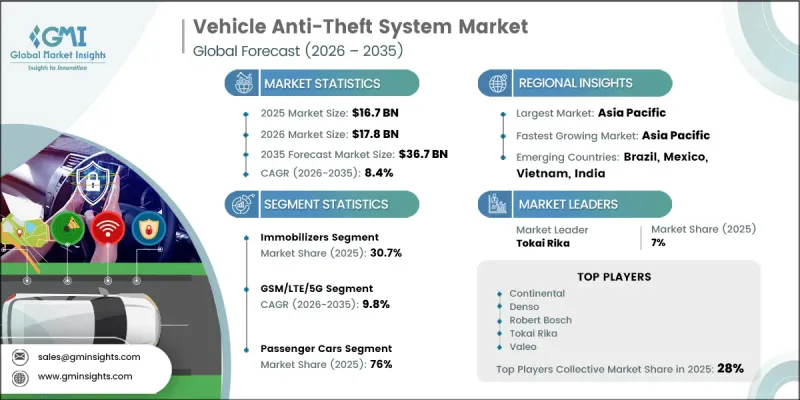
전 세계에서 차량 도난 사건이 증가함에 따라 무단 접근을 방지하고 차량 보안을 강화하기 위해 설계된 첨단 보안 솔루션에 대한 수요가 크게 증가하고 있습니다. 최신 도난 방지 기술에는 이모빌라이저, GPS 기반 추적 시스템, 디지털 잠금 장치 등이 포함됩니다. 차량 보안 위험에 대한 소비자의 인식이 높아짐에 따라 생체 인증 출입 시스템, 스마트 키, 모바일 앱 기반 보안 플랫폼의 도입이 가속화되고 있습니다. 무선도어잠금를 악용한 도난이나 릴레이 공격에 대한 우려가 커짐에 따라 자동차 제조사들은 특히 고급 SUV와 전기자동차 분야에서 자동차 보안 아키텍처를 강화해야 할 필요성에 직면해 있습니다. 이러한 변화에 따라 보안성이 뛰어난 디지털 키 기능을 강화하고 릴레이 공격을 통한 침입 시도를 방지하는 데 도움이 되는 초광대역(UWB) 기술의 도입이 가속화되고 있습니다. 기존의 기계식 열쇠에서 스마트폰 기반 디지털 출입 시스템으로의 전환은 산업 환경을 더욱 변화시키고 있습니다. 또한 인공지능(AI)과 텔레매틱스의 통합을 통해 실시간 모니터링, 예측 기반 도난 방지, 강화된 차량 회수가 가능해졌습니다. 지문 및 얼굴 인식 시스템을 포함한 생체 인증 방식은 기존의 키 기반 접근 방식을 점차 대체하며, 현대 차량의 편의성과 보안성을 모두 향상시키고 있습니다.
| 시장 범위 | |
|---|---|
| 시작연도 | 2025년 |
| 예측 기간 | 2026-2035년 |
| 개시 금액 | 167억 달러 |
| 예측액 | 367억 달러 |
| CAGR | 8.4% |
이모빌라이저 시장은 2025년에 30.7%의 점유율을 차지하며, 2026-2035년 연평균 성장률(CAGR) 9.2%로 성장할 것으로 전망됩니다. 규제 강화와 도난에 대한 우려가 커짐에 따라 다양한 차종에 이모빌라이저가 기본 사양으로 장착되면서 이 시장은 계속해서 성장세를 보이고 있습니다. 최신 이모빌라이저 시스템에서는 차량의 보안을 강화하기 위해 RFID 기술, 암호화된 전자제어 장치, 스마트폰 기반 인증 방식이 점점 더 많이 도입되고 있습니다.
승용차 부문은 2025년에 76%의 시장 점유율을 차지하며, 2035년까지 연평균 성장률(CAGR) 8.7%로 성장할 것으로 전망됩니다. 편의성과 보안 강화에 대한 소비자의 수요가 계속 증가함에 따라 승용차에 출고시 디지털 키, 이모빌라이저, 생체 인증 기술이 탑재되는 사례가 늘고 있습니다. 첨단 전자 보안 시스템의 통합은 현대 승용차 설계에서 표준 기능으로 자리 잡고 있습니다.
미국 차량 도난 방지 시스템 시장은 2025년에 28억 달러에 달하며, 2026-2035년 연평균 성장률(CAGR) 8%로 성장할 것으로 전망됩니다. SUV 및 픽업트럭을 대상으로 한 도난 사건이 증가함에 따라 이모빌라이저, 스티어링 락, 차량 회수 솔루션의 도입이 확대되고 있습니다. 자동차 제조사와 보험사는 첨단 커넥티드 보안 시스템 및 사후 장착형 도난 방지 솔루션을 제공함으로써, 위험이 높은 도시 지역에 주력하고 있습니다. 스마트폰용 차량 보안 앱이 급속히 보급되면서, 사용자는 도난 차량을 추적하고 위치를 확인하며 원격으로 엔진을 정지시킬 수 있게 되었습니다. 자동차 제조사가 제공하는 구독형 커넥티드 서비스 역시 현대 차량 보안 생태계에서 널리 채택되는 기능으로 자리 잡고 있습니다.
자주 묻는 질문
목차
제1장 조사 방법
제2장 개요
제3장 산업 인사이트
제4장 경쟁 구도
제5장 시장 추정·예측 : 제품별, 2022-2035년
제6장 시장 추정·예측 : 기술별, 2022-2035년
제7장 시장 추정·예측 : 차량별, 2022-2035년
제8장 시장 추정·예측 : 유통 채널별, 2022-2035년
제9장 시장 추정·예측 : 지역별, 2022-2035년
제10장 기업 개요
KSA 26.06.24The Global Vehicle Anti-Theft System Market was valued at USD 16.7 billion in 2025 and is estimated to grow at a CAGR of 8.4% to reach USD 36.7 billion by 2035.
Rising global vehicle theft incidents are significantly increasing the demand for advanced security solutions designed to prevent unauthorized access and improve vehicle protection. Modern anti-theft technologies include immobilizers, GPS-based tracking systems, and digital locking mechanisms. Growing consumer awareness regarding vehicle security risks is driving the adoption of biometric access systems, smart keys, and mobile application-based security platforms. Increasing concerns over keyless entry thefts and relay attacks have pushed automotive manufacturers to strengthen in-vehicle security architectures, particularly in premium SUVs and electric vehicles. This shift is accelerating the adoption of ultra-wideband technology, which enhances secure digital key functionality and helps prevent relay-based intrusion attempts. The transition from traditional mechanical keys to smartphone-enabled digital access systems is further transforming the industry landscape. In addition, artificial intelligence and telematics integration are enabling real-time monitoring, predictive theft prevention, and enhanced recovery capabilities. Biometric authentication methods, including fingerprint and facial recognition systems, are gradually replacing conventional key-based access, improving both convenience and security in modern vehicles.
| Market Scope | |
|---|---|
| Start Year | 2025 |
| Forecast Year | 2026-2035 |
| Start Value | $16.7 Billion |
| Forecast Value | $36.7 Billion |
| CAGR | 8.4% |
The immobilizers segment accounted for 30.7% share in 2025 and is expected to grow at a CAGR of 9.2% from 2026 to 2035. This segment continues to gain traction as immobilizers become standard features across a wide range of vehicles due to stricter regulations and rising theft concerns. Modern immobilizer systems increasingly incorporate RFID technology, encrypted electronic control units, and smartphone-based authentication methods to strengthen vehicle security.
The passenger cars segment held a 76% share in 2025 and is projected to grow at a CAGR of 8.7% during 2035. Passenger vehicles are increasingly equipped with factory-installed digital keys, immobilizers, and biometric access technologies as consumer demand for convenience and enhanced security continues to rise. The integration of advanced electronic security systems is becoming a standard feature in modern passenger vehicle designs.
U.S. Vehicle Anti-Theft System Market reached USD 2.8 billion in 2025 and is expected to grow at a CAGR of 8% from 2026 to 2035. Increasing theft incidents involving SUVs and pickup trucks are driving higher adoption of immobilizers, steering locks, and vehicle recovery solutions. Automotive manufacturers and insurance providers are focusing on high-risk urban regions by offering enhanced connected security systems and retrofit anti-theft solutions. Smartphone-enabled vehicle security applications are gaining rapid popularity, allowing users to track, locate, and remotely disable stolen vehicles. Subscription-based connected services offered by automakers are also becoming a widely adopted feature in modern vehicle security ecosystems.
Key companies operating in the Global Vehicle Anti-Theft System Industry include Alps Alpine, Aptiv, Continental, Denso, Forvia Hella, Hella, Lear, Minda, Mitsubishi Electric, Robert Bosch, Tokai Rika, Valeo, and ZF Friedrichshafen. Companies operating in the vehicle anti-theft system market are adopting a range of strategies to strengthen their competitive positioning and expand market penetration. Industry participants are investing heavily in advanced electronic security technologies such as biometric authentication, encrypted communication systems, and ultra-wideband-based digital key solutions. Many companies are integrating artificial intelligence and telematics platforms to enable real-time vehicle monitoring, predictive threat detection, and rapid recovery capabilities. Strategic collaborations with automakers are supporting the integration of factory-installed security systems across new vehicle models. Firms are also focusing on enhancing smartphone-based security ecosystems that allow remote access control and tracking functionalities. Continuous research and development efforts are being directed toward improving system accuracy, reducing cyber vulnerabilities, and enhancing user convenience.
Table of Contents
Chapter 1 Methodology
- 1.1 Research approach
- 1.2 Quality Commitments
- 1.2.1 GMI AI policy & data integrity commitment
- 1.2.1.1 Source consistency protocol
- 1.2.1 GMI AI policy & data integrity commitment
- 1.3 Research Trail & Confidence Scoring
- 1.3.1 Research Trail Components
- 1.3.2 Scoring Components
- 1.4 Data Collection
- 1.4.1 Partial list of primary sources
- 1.5 Data mining sources
- 1.5.1 Paid sources
- 1.5.1.1 Sources, by region
- 1.5.1 Paid sources
- 1.6 Base estimates and calculations
- 1.6.1 Base year calculation
- 1.7 Forecast model
- 1.7.1 Quantified market impact analysis
- 1.7.1.1 Mathematical impact of growth parameters on forecast
- 1.7.1 Quantified market impact analysis
- 1.8 Research transparency addendum
- 1.8.1 Source attribution framework
- 1.8.2 Quality assurance metrics
- 1.8.3 Our commitment to trust
Chapter 2 Executive Summary
- 2.1 Industry 360° synopsis
- 2.2 Key market trends
- 2.2.1 Regional
- 2.2.2 Product
- 2.2.3 Technology
- 2.2.4 Vehicle
- 2.2.5 Sales channel
- 2.3 TAM analysis, 2026-2035
- 2.4 CXO perspectives: Strategic imperatives
Chapter 3 Industry Insights
- 3.1 Industry ecosystem analysis
- 3.1.1 Supplier landscape
- 3.1.2 Profit margin
- 3.1.3 Cost structure
- 3.1.4 Value addition at each stage
- 3.1.5 Factor affecting the value chain
- 3.1.6 Disruptions
- 3.2 Industry impact forces
- 3.2.1 Growth drivers
- 3.2.1.1 Rising vehicle theft incidents
- 3.2.1.2 Increasing adoption of connected vehicles
- 3.2.1.3 Stringent government vehicle safety regulations
- 3.2.1.4 Growing consumer demand for advanced security features
- 3.2.2 Industry pitfalls and challenges
- 3.2.2.1 High installation and maintenance costs
- 3.2.2.2 Risk of cybersecurity breaches in connected systems
- 3.2.3 Market opportunities
- 3.2.3.1 Integration of AI and IoT in vehicle security systems
- 3.2.3.2 Expansion of electric and autonomous vehicle markets
- 3.2.3.3 Rising demand for fleet management and tracking solutions
- 3.2.3.4 Growth of biometric-based vehicle authentication systems
- 3.2.1 Growth drivers
- 3.3 Growth potential analysis
- 3.4 Technology and innovation landscape
- 3.4.1 Current technological trends
- 3.4.1.1 Ultra-Wideband (UWB) Digital Key Technology
- 3.4.1.2 Biometric Authentication Systems
- 3.4.2 Emerging technologies
- 3.4.2.1 Motion-Detection Enhanced Keyless Systems
- 3.4.2.2 Multi-Factor Authentication Integration
- 3.4.1 Current technological trends
- 3.5 Cost breakdown analysis
- 3.6 Regulatory landscape
- 3.6.1 North America
- 3.6.1.1 National Highway Traffic Safety Administration
- 3.6.1.2 Transport Canada
- 3.6.2 Europe
- 3.6.2.1 European Commission Directorate-General for Internal Market, Industry, Entrepreneurship and SMEs
- 3.6.2.2 European Union Agency for Cybersecurity
- 3.6.3 Asia Pacific
- 3.6.3.1 Ministry of Land, Infrastructure, Transport and Tourism
- 3.6.3.2 3.6.3.2. Ministry of Road Transport and Highways
- 3.6.4 Latin America
- 3.6.4.1 National Traffic Secretariat
- 3.6.4.2 Secretariat of Infrastructure, Communications and Transportation
- 3.6.5 Middle East & Africa
- 3.6.5.1 Dubai Roads and Transport Authority
- 3.6.5.2 National Regulator for Compulsory Specifications
- 3.6.1 North America
- 3.7 Porter's analysis
- 3.8 PESTEL analysis
- 3.9 Patent analysis (Driven by Primary Research)
- 3.10 Impact of AI & Generative AI on the Market
- 3.10.1 AI-driven disruption of existing business models
- 3.10.2 Gen AI use cases & adoption roadmap by segment
- 3.10.3 Risks, limitations & regulatory considerations
- 3.11 Sustainability and environmental aspects
- 3.11.1 Sustainable practices
- 3.11.2 Waste reduction strategies
- 3.11.3 Energy efficiency in production
- 3.11.4 Eco-friendly initiatives
- 3.11.5 Carbon footprint considerations
- 3.12 Forecast assumptions & scenario analysis (Driven by primary research)
- 3.12.1 Base Case - key macro & industry variables driving CAGR
- 3.12.2 Optimistic Scenarios - Favorable macro and industry tailwinds
- 3.12.3 Pessimistic Scenario - Macroeconomic slowdown or industry headwinds
Chapter 4 Competitive Landscape, 2025
- 4.1 Introduction
- 4.2 Company market share analysis
- 4.2.1 North America
- 4.2.2 Europe
- 4.2.3 Asia Pacific
- 4.2.4 LATAM
- 4.2.5 MEA
- 4.3 Competitive analysis of major market players
- 4.4 Competitive positioning matrix
- 4.5 Key developments
- 4.5.1 Mergers & acquisitions
- 4.5.2 Partnerships & collaborations
- 4.5.3 New product launches
- 4.5.4 Expansion plans and funding
Chapter 5 Market Estimates & Forecast, By Product, 2022 - 2035 ($Mn, Units)
- 5.1 Key trends
- 5.2 Alarm
- 5.3 Immobilizers
- 5.4 Steering Wheel/Column Locks
- 5.5 Passive Keyless Entry
- 5.6 Biometric Capture Devices
- 5.7 Central Locking Systems
Chapter 6 Market Estimates & Forecast, By Technology, 2022 - 2035 ($Mn)
- 6.1 Key trends
- 6.2 RFID (Radio Frequency Identification)
- 6.3 GPS/GNSS
- 6.4 GSM/LTE/5G
- 6.5 Bluetooth/BLE
- 6.6 Ultra-wideband (UWB)
- 6.7 Biometric Technologies
- 6.8 Real-Time Location Systems (RTLS)
Chapter 7 Market Estimates & Forecast, By Vehicle, 2022 - 2035 ($Mn)
- 7.1 Key trends
- 7.2 Passenger cars
- 7.2.1 Sedans
- 7.2.2 Hatchbacks
- 7.2.3 SUV
- 7.3 Commercial vehicles
- 7.3.1 Light duty
- 7.3.2 Medium duty
- 7.3.3 Heavy duty
Chapter 8 Market Estimates & Forecast, By Sales Channel, 2022 - 2035 ($Mn)
- 8.1 Key trends
- 8.2 OEM
- 8.3 Aftermarket
Chapter 9 Market Estimates & Forecast, By Region, 2022 - 2035 ($Mn)
- 9.1 Key trends
- 9.2 North America
- 9.2.1 U.S.
- 9.2.2 Canada
- 9.3 Europe
- 9.3.1 Germany
- 9.3.2 UK
- 9.3.3 France
- 9.3.4 Italy
- 9.3.5 Spain
- 9.3.6 Russia
- 9.3.7 Netherlands
- 9.4 Asia Pacific
- 9.4.1 China
- 9.4.2 India
- 9.4.3 Japan
- 9.4.4 South Korea
- 9.4.5 Australia
- 9.4.6 Vietnam
- 9.4.7 Indonesia
- 9.5 Latin America
- 9.5.1 Brazil
- 9.5.2 Mexico
- 9.5.3 Argentina
- 9.6 MEA
- 9.6.1 South Africa
- 9.6.2 Saudi Arabia
- 9.6.3 UAE
Chapter 10 Company Profiles
- 10.1 Global players
- 10.1.1 Aptiv
- 10.1.2 Continental
- 10.1.3 Denso
- 10.1.4 Forvia Hella
- 10.1.5 Mitsubishi Electric
- 10.1.6 Robert Bosch
- 10.1.7 Valeo
- 10.1.8 ZF Friedrichshafen
- 10.2 Regional players
- 10.2.1 ALPHA
- 10.2.2 Alps Alpine
- 10.2.3 AVS
- 10.2.4 Cobra Automotive Technologies
- 10.2.5 Lear
- 10.2.6 Minda
- 10.2.7 Panasonic Automotive Systems
- 10.2.8 Tokai Rika
- 10.2.9 U-Shin
- 10.3 Emerging players
- 10.3.1 Autowatch
- 10.3.2 Queclink Wireless Solutions
- 10.3.3 Tramigo