

|
시장보고서
상품코드
2071170
BESS 컨테이너 및 인클루저 시장 : 기회, 성장 촉진요인, 업계 동향 분석 및 예측(2026-2035년)BESS Container and Enclosure Market Opportunity, Growth Drivers, Industry Trend Analysis, and Forecast 2026 - 2035 |
||||||

세계의 BESS 컨테이너 및 인클루저 시장은 2025년에 68억 달러 규모가 되어, CAGR 15.3%로 성장하여 2035년에는 314억 달러에 이를 것으로 추정되고 있습니다.
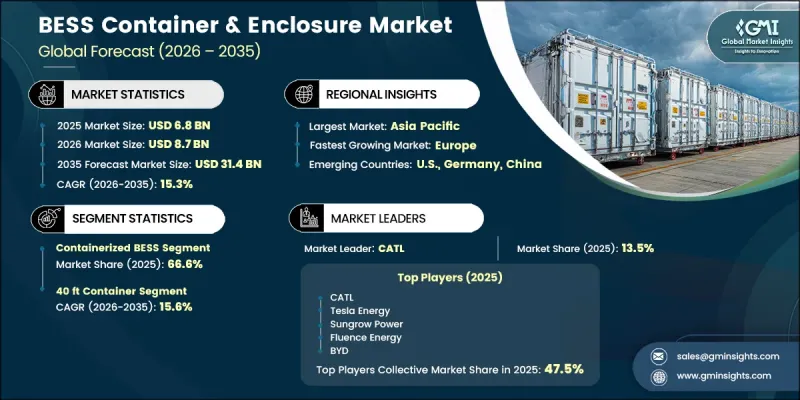
시장 성장을 뒷받침하고 있는 것은 리튬인산철(LFP) 배터리 가격이 급격히 하락하고 있다는 점입니다. 2025년 말까지 중국 내수 시장에서 kWh당 약 40달러에 달하게 되면서, 프로젝트의 경제성이 크게 향상됨에 따라 고성능 컨테이너형 에너지 저장 시스템의 도입이 확대되고 있습니다. 동시에, 인클로저 시스템은 시스템 총비용 구조에서 점점 더 큰 비중을 차지하고 있으며, kWh당 75달러인 핵심 장비의 기준 비용의 90% 가까이를 차지하고 있어, 시스템 차원의 가치 창출에서 그 중요성이 커지고 있음을 여실히 보여주고 있습니다. 업계는 기본적인 보호 하우징에서 조립식 유닛 내에 온도 조절, 배터리 관리 시스템, 전력 변환 기술을 통합한 완전 통합형 컨테이너형 에너지 플랫폼으로 명확한 전환을 이루고 있습니다. 이러한 변화로 인해 설치 과정이 간소화되고, 도입 기간이 단축되었으며, 개발업체 및 EPC 시공사에게 요구되는 토목 공사 요건도 완화되었습니다. 안전 기준 준수 및 열 성능 기준은 현재 인클로저 설계에서 핵심적인 기술적 우선순위로 자리 잡고 있으며, 제품의 고도화를 더욱 촉진하고 있습니다. 표준화된 공장 조립 시스템으로의 전환을 통해 전 세계의 에너지 저장 프로젝트에서 조달 주기를 단축하고 확장성이 더 뛰어난 도입 모델을 구현할 수 있게 되었습니다.
| 시장 범위 | |
|---|---|
| 시작 연도 | 2025년 |
| 예측 기간 | 2026-2035년 |
| 개시 금액 | 68억 달러 |
| 예측 금액 | 314억 달러 |
| CAGR | 15.3% |
컨테이너형 BESS 시스템은 2025년에 66.6%의 시장 점유율을 차지해, 2035년까지 연평균 성장률(CAGR) 15.3%를 유지하며 성장할 것으로 전망됩니다. 이 부문이 주도적인 위치를 차지하는 배경에는 유틸리티 규모 및 그리드 규모의 에너지 저장 용도에 적합하다는 점이 있습니다. 표준화된 컨테이너 치수, 통합형 배터리 모듈, 내장형 열 관리 시스템, 배터리 관리 시스템 및 전력 변환 부품 덕분에 높은 운영 효율이 실현되고 있습니다. 또한, 이러한 설비는 전 세계 해운 및 물류 체계와 호환되므로, 국제 에너지 프로젝트에 도입할 때의 유연성이 한층 더 높아지고 있습니다.
캐비닛 및 랙형 인클로저 시스템 부문은 2025년에 21.8%의 시장 점유율을 차지하고, 2035년까지 연평균 성장률(CAGR) 14.8%로 성장할 것으로 전망됩니다. 이러한 시스템은 주로 컴팩트한 설계, 모듈식 확장성, 실내 설치의 유연성이 필수적인 상업 및 산업 환경, 데이터센터, 그리고 계량기 후면 설치 용도로 도입되고 있습니다. 이러한 도입은 에너지 신뢰성을 높이고, 제한된 공간에서 피크 부하 관리를 지원하는 지역 밀착형 에너지 저장 솔루션에 대한 수요 증가에 힘입은 것입니다.
북미의 BESS 컨테이너 및 인클로저 시장은 2025년에 29.9%의 점유율을 차지하고, 2035년까지 연평균 성장률(CAGR) 14.9%로 성장할 것으로 전망됩니다. 이는 유틸리티급 배터리 도입이 꾸준히 증가함에 따라 뒷받침되고 있습니다. 최근 연방 정부 자료에 따르면, 2025년에는 57.6GWh의 신규 에너지 저장 용량이 추가될 예정이며, 이는 역대 최고치를 기록한 해보다 30% 증가한 수치입니다. 재생에너지의 확대와 송전망의 신뢰성 향상을 지원하기 위해, 수 기가와트 규모의 추가적인 에너지 저장 용량이 전국 송전망에 통합됨에 따라 지속적인 확대가 예상됩니다.
자주 묻는 질문
목차
제1장 조사 방법과 범위
제2장 주요 요약
제3장 업계 인사이트
제4장 경쟁 구도
제5장 시장 규모 및 예측 : 제품별, 2022-2035년
제6장 시장 규모 및 예측 : 컨테이너 사이즈별, 2022-2035년
제7장 시장 규모 및 예측 : 냉각별, 2022-2035년
제8장 시장 규모 및 예측 : 설치 형태별, 2022-2035년
제9장 시장 규모 및 예측 : 용도별, 2022-2035년
제10장 시장 규모 및 예측 : 지역별, 2022-2035년
제11장 기업 개요
JHS 26.07.01The Global BESS Container & Enclosure Market was valued at USD 6.8 billion in 2025 and is estimated to grow at a CAGR of 15.3% to reach USD 31.4 billion in 2035.
Market growth is reinforced by rapidly falling lithium iron phosphate (LFP) cell prices, which reached approximately USD 40 per kWh in Chinese domestic markets by late 2025, significantly improving project economics and expanding adoption across higher-performance containerized storage systems. At the same time, enclosure systems are increasingly capturing a larger share of total system cost structures, accounting for nearly 90% of the USD 75 per kWh core equipment baseline, highlighting their rising importance in system-level value creation. The industry is undergoing a clear transition from basic protective housing toward fully integrated containerized energy platforms that combine thermal regulation, battery management systems, and power conversion technologies within prefabricated units. This shift is reducing installation complexity, shortening deployment timelines, and lowering civil engineering requirements for developers and EPC contractors. Safety compliance and thermal performance standards are now central engineering priorities in enclosure design, further elevating product sophistication. The move toward standardized, factory-assembled systems is enabling faster procurement cycles and more scalable deployment models across global energy storage projects.
| Market Scope | |
|---|---|
| Start Year | 2025 |
| Forecast Year | 2026-2035 |
| Start Value | $6.8 Billion |
| Forecast Value | $31.4 Billion |
| CAGR | 15.3% |
Containerized BESS systems accounted for 66.6% share in 2025, maintaining growth at a CAGR of 15.3% through 2035. This segment's leadership is driven by its suitability for utility-scale and grid-scale energy storage applications, where standardized container dimensions, integrated battery modules, built-in thermal management systems, battery management systems, and power conversion components deliver high operational efficiency. The compatibility of these units with global shipping and logistics frameworks further enhances their deployment flexibility across international energy projects.
The cabinet and rack-based enclosure systems segment held a 21.8% share in 2025 and is projected to grow at a CAGR of 14.8% through 2035. These systems are primarily deployed in commercial and industrial environments, data centers, and behind-the-meter applications where compact design, modular scalability, and indoor installation flexibility are essential. Their adoption is supported by increasing demand for localized energy storage solutions that enhance energy reliability and support peak load management in constrained spaces.
North America BESS Container & Enclosure Market 29.9% share in 2025 and is projected to grow at a CAGR of 14.9% through 2035, supported by strong growth in utility-scale battery installations. Recent federal data indicates that 57.6 GWh of new storage capacity was added in 2025, representing a 30% increase over the previous record year. Continued expansion is expected as additional multi-gigawatt storage capacity is integrated into the national grid to support renewable energy expansion and grid reliability improvements.
Major companies operating in the BESS Container & Enclosure market include CATL (Contemporary Amperex Technology Co., Ltd.), BYD, Sungrow Power, Fluence Energy, Hitachi Energy, Schneider Electric, Samsung SDI, Eaton, Canadian Solar, Huawei Digital Power, Gotion High-Tech, AlphaESS, Hithium Energy Storage Technology, Hyperstrong Energy Technology, Powin, and Samsung SDI. Companies operating in the BESS Container & Enclosure market are focusing on several strategic initiatives to strengthen their competitive position and expand global market share. A key strategy involves developing highly integrated, prefabricated container systems that combine batteries, thermal management, and power conversion technologies into standardized units. Manufacturers are also investing heavily in improving safety architecture, fire suppression systems, and thermal stability mechanisms to meet increasingly strict regulatory requirements. Strategic partnerships with utilities, EPC contractors, and renewable developers are enabling large-scale deployment and long-term supply agreements. Firms are expanding manufacturing capacity in key regions to reduce logistics costs and improve delivery timelines.
Table of Contents
Chapter 1 Methodology & Scope
- 1.1 Research approach
- 1.2 Quality commitments
- 1.2.1 GMI AI policy & data integrity commitment
- 1.2.1.1 Source consistency protocol
- 1.2.1 GMI AI policy & data integrity commitment
- 1.3 Research trail & confidence scoring
- 1.3.1 Research trail components
- 1.3.2 Scoring components
- 1.4 Data collection
- 1.4.1 Partial list of primary sources
- 1.5 Data mining sources
- 1.5.1 Paid sources
- 1.5.1.1 Sources, by region
- 1.5.1 Paid sources
- 1.6 Base estimates and calculations
- 1.6.1 Base year calculation for any one approach
- 1.7 Market estimates & forecasts parameters
- 1.8 Forecast model
- 1.8.1 Quantified market impact analysis
- 1.8.1.1 Mathematical impact of growth parameters on forecast
- 1.8.1 Quantified market impact analysis
- 1.9 Research transparency addendum
- 1.9.1 Source attribution framework
- 1.9.2 Quality assurance metrics
- 1.9.3 Our commitment to trust
- 1.10 Market definitions
Chapter 2 Executive Summary
- 2.1 Industry synopsis, 2022 - 2035
- 2.1.1 Business trends
- 2.1.2 Product trends
- 2.1.3 Container size trends
- 2.1.4 Cooling trends
- 2.1.5 Installation trends
- 2.1.6 Application trends
- 2.1.7 Regional trends
Chapter 3 Industry Insights
- 3.1 Industry ecosystem analysis
- 3.1.1 Raw material suppliers analysis
- 3.1.2 Component manufacturers analysis
- 3.1.3 Enclosure OEMs & integrators
- 3.1.4 EPC contractors & project developers
- 3.1.5 End-users & asset operators
- 3.2 Regulatory landscape
- 3.3 Industry impact forces
- 3.3.1 Growth drivers
- 3.3.2 Industry pitfalls & challenges
- 3.4 Growth potential analysis
- 3.5 Porter's analysis
- 3.5.1 Bargaining power of suppliers
- 3.5.2 Bargaining power of buyers
- 3.5.3 Threat of new entrants
- 3.5.4 Threat of substitutes
- 3.6 PESTEL analysis
- 3.6.1 Political factors
- 3.6.2 Economic factors
- 3.6.3 Social factors
- 3.6.4 Technological factors
- 3.6.5 Legal factors
- 3.6.6 Environmental factors
- 3.7 Investment & funding analysis
- 3.7.1 Capital investment trends in small-scale LNG infrastructure
- 3.7.2 Government grants & subsidies
- 3.8 Trade Data Analysis (Driven by Primary Research)
- 3.8.1 Import/export analysis
- 3.8.2 Key trade corridors & tariff impact
- 3.9 Impact of AI & Generative AI on the market
- 3.9.1 AI-Driven disruption of existing business models
- 3.9.2 GenAI use cases & adoption roadmap
- 3.9.3 Risks, limitations & regulatory considerations
- 3.10 Sustainability initiatives & industry 4.0 integration
- 3.11 Investment & funding analysis
Chapter 4 Competitive Landscape, 2026
- 4.1 Introduction
- 4.2 Company market share analysis, by region, 2025
- 4.2.1 North America
- 4.2.2 Europe
- 4.2.3 Asia Pacific
- 4.2.4 Middle East & Africa
- 4.2.5 Latin America
- 4.3 Key developments
- 4.3.1 Key partnerships & collaborations
- 4.3.2 Major M&A activities
- 4.3.3 Product innovations & launches
- 4.3.4 Market expansion strategies
- 4.4 Competitive positioning matrix
- 4.4.1 Tier classification criteria & qualifying thresholds
- 4.4.2 Tier positioning matrix by revenue, geography & innovation
Chapter 5 Market Size and Forecast, By Product, 2022 - 2035 (USD Million)
- 5.1 Key trends
- 5.2 Containerized BESS
- 5.3 Cabinet & Rack
- 5.4 Mobile & Trailer-Mounted
Chapter 6 Market Size and Forecast, By Container Size, 2022 - 2035 (USD Million)
- 6.1 Key trends
- 6.2 40 ft
- 6.3 20 ft
- 6.4 10 ft
- 6.5 Custom/Non-Standard
Chapter 7 Market Size and Forecast, By Cooling, 2022 - 2035 (USD Million)
- 7.1 Key trends
- 7.2 Air Cooling
- 7.3 Liquid Cooling
- 7.4 Hybrid Cooling
- 7.5 PCM Cooling
Chapter 8 Market Size and Forecast, By Installation, 2022 - 2035 (USD Million)
- 8.1 Key trends
- 8.2 Indoor
- 8.3 Outdoor
- 8.4 Offshore/Marine
Chapter 9 Market Size and Forecast, By Application, 2022 - 2035 (USD Million)
- 9.1 Key trends
- 9.2 Utility Scale
- 9.3 Renewable Energy Integration
- 9.4 Commercial & Industrial (C&I)
- 9.5 Data Centers
- 9.6 EV Charging Infrastructure
- 9.7 Military & Defense
- 9.8 Residential
- 9.9 Healthcare & Hospitals
- 9.10 Others
Chapter 10 Market Size and Forecast, By Region, 2022 - 2035 (USD Million)
- 10.1 Key trends
- 10.2 North America
- 10.2.1 U.S.
- 10.2.2 Canada
- 10.2.3 Mexico
- 10.3 Europe
- 10.3.1 UK
- 10.3.2 Germany
- 10.3.3 France
- 10.3.4 Spain
- 10.3.5 Russia
- 10.3.6 Italy
- 10.4 Asia Pacific
- 10.4.1 China
- 10.4.2 Japan
- 10.4.3 South Korea
- 10.4.4 India
- 10.4.5 Australia
- 10.5 Middle East & Africa
- 10.5.1 UAE
- 10.5.2 Saudi Arabia
- 10.5.3 South Africa
- 10.5.4 Egypt
- 10.6 Latin America
- 10.6.1 Brazil
- 10.6.2 Chile
- 10.6.3 Argentina
Chapter 11 Company Profiles
- 11.1 AlphaESS
- 11.2 BYD
- 11.3 CATL
- 11.4 Canadian Solar
- 11.5 Eaton
- 11.6 Fluence Energy
- 11.7 Gotion High-tech
- 11.8 Hithium Energy Storage Technology
- 11.9 Hitachi Energy
- 11.10 Honeywell International
- 11.11 Hyperstrong Energy Technology
- 11.12 Huawei Digital Power
- 11.13 Powin
- 11.14 Sungrow Power
- 11.15 Samsung SDI
- 11.16 Schneider Electric
- 11.17 Saft
- 11.18 Tesla Energy
- 11.19 TLS Energy
- 11.20 Voltra Energy
- 11.21 Wartsila Energy


