

|
시장보고서
상품코드
2071273
전기 자극기 시장 : 비즈니스 기회, 성장요인, 업계 동향 분석 및 예측(2026-2035년)Electrical Stimulators Market Opportunity, Growth Drivers, Industry Trend Analysis, and Forecast 2026 - 2035 |
||||||

세계의 전기 자극기 시장은 2025년에 69억 달러로 평가되었고 CAGR 7.3%로 성장하여 2035년까지 141억 달러에 이를 것으로 추정되고 있습니다.
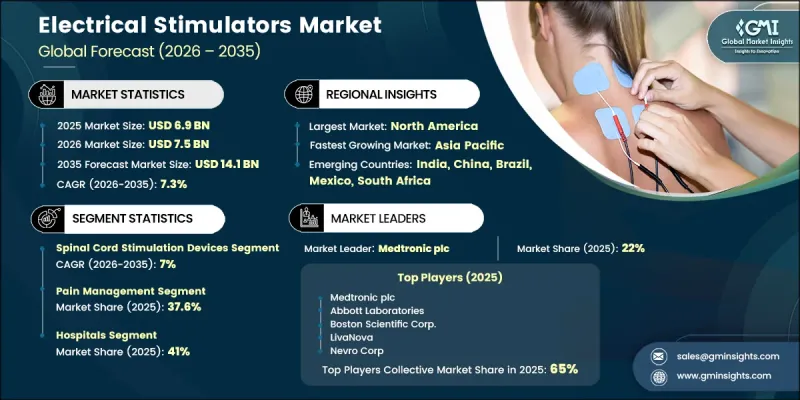
시장 성장은 신경 질환의 유병률 증가, 비침습적이고 약물을 사용하지 않는 치료법에 대한 선호도 상승, 자극 기술의 지속적인 발전, 그리고 재활 및 물리치료 분야에서 이러한 기기의 역할 확대에 힘입어 이루어지고 있습니다. 지속적인 혁신은 여전히 주요 성장 요인으로, 최신 장비는 정밀도 향상, 컴팩트한 설계, 개별 환자의 요구에 맞춘 프로그래밍 가능한 기능을 갖추고 있어 치료 성과 향상에 기여하고 있습니다. 무선 연결, 충전식 임플란트 시스템, 폐쇄 루프 피드백 메커니즘, 인공지능(AI) 통합과 같은 기술 발전 덕분에 기기의 효율성과 환자 경험이 크게 향상되고 있습니다. 웨어러블형 및 가정용 자극기의 등장으로, 기존의 임상 환경을 넘어선 활용 범위가 더욱 확대되면서 장기적인 시장 성장이 뒷받침되고 있습니다.
| 시장 범위 | |
|---|---|
| 시작 연도 | 2025년 |
| 예측 기간 | 2026-2035년 |
| 시작 연도 시장 규모 | 69억 달러 |
| 예측 금액 | 141억 달러 |
| CAGR | 7.3% |
전기 자극기는 신경, 근육 또는 대상 뇌 부위에 제어된 전기 자극을 전달하여 기능 회복, 통증 완화 또는 재활을 돕는 치료용 의료기기입니다. 이러한 자극은 체내의 자연스러운 전기 신호 전달 과정을 재현하여, 생리 기능 향상 및 회복 효과 촉진을 돕습니다.
척수 자극기 부문은 2025년에 41.7%의 시장 점유율을 차지하고, 2035년까지 57억 달러에 달하고 연평균 성장률(CAGR) 7%를 나타낼 것으로 전망됩니다. 이 부문은 특히 기존 치료법으로는 효과가 미흡한 만성 통증 관리 분야에서 도입이 증가하고 있어 선도적인 위치를 유지하고 있습니다. 이러한 임플란트형 시스템은 전기 신호를 전달함으로써 통증 전달 경로를 차단하는 원리로 작동합니다. 만성 질환 사례 증가와 저침습 치료에 대한 선호도가 높아지면서 이 부문 수요가 가속화되고 있습니다. 첨단 전원 시스템, 무선 제어, 자극 기능 향상과 같은 기술적 진보에 힘입어, 도입 확대와 치료 성과 향상이 더욱 가속화되고 있습니다.
병원 부문은 2025년에 41%의 점유율을 차지하고, 2026년부터 2035년까지 57억 달러에 달할 것으로 전망됩니다. 병원은 첨단 인프라와 훈련을 받은 의료 전문가들이 갖춰져 있어 여전히 주요 최종 사용처로 자리 잡고 있습니다. 이러한 시설에서는 통증 관리, 신경학적 치료, 수술 후 회복 등 여러 치료 분야에서 전기 자극기가 활용되고 있습니다. 환자 수가 많고 전문적인 치료 솔루션을 이용할 수 있다는 점이, 이식형 및 비침습형 기기 모두에 대한 수요를 지속적으로 견인하고 있습니다. 또한, 병원은 신기술 도입에 있어 중요한 역할을 수행하고 있으며, 이것이 시장 전체의 발전을 뒷받침하고 있습니다.
2025년, 북미의 전기 자극기 시장은 38.5%의 점유율을 차지했습니다. 이 지역은 견고한 의료 제도와 첨단 의료 기술의 급속한 도입에 힘입어 고도로 발달한 시장입니다. 만성 질환 및 신경 질환을 앓는 환자 수가 증가함에 따라 신경 조절 요법에 대한 수요가 늘어나고 있습니다. 유리한 보험 환급 정책과 규제 측면의 지원이 더해지면서, 해당 지역 전체에서 이식형 및 비침습형 자극 솔루션의 도입이 더욱 촉진되고 있습니다.
자주 묻는 질문
목차
제1장 조사 방법
제2장 주요 요약
제3장 업계 인사이트
제4장 경쟁 구도
제5장 시장 추산 및 예측 : 제품 유형별, 2022-2035년
제6장 시장 추산 및 예측 : 용도별, 2022-2035년
제7장 시장 추산 및 예측 : 최종 용도별, 2022-2035년
제8장 시장 추산 및 예측 : 지역별, 2022-2035년
제9장 기업 개요
JHS 26.07.01The Global Electrical Stimulators Market was valued at USD 6.9 billion in 2025 and is estimated to grow at a CAGR of 7.3% to reach USD 14.1 billion by 2035.
Market growth is driven by the rising incidence of neurological conditions, increasing preference for non-invasive and drug-free treatment approaches, ongoing advancements in stimulation technologies, and the expanding role of these devices in rehabilitation and physiotherapy applications. Continuous innovation remains a key growth driver, with modern devices offering enhanced precision, compact designs, and programmable features tailored to individual patient needs, leading to improved therapeutic outcomes. Advancements such as wireless connectivity, rechargeable implant systems, closed-loop feedback mechanisms, and integration of artificial intelligence are significantly improving device efficiency and patient experience. The emergence of wearable and home-based stimulators is further broadening accessibility beyond traditional clinical environments, strengthening long-term market expansion.
| Market Scope | |
|---|---|
| Start Year | 2025 |
| Forecast Year | 2026-2035 |
| Start Value | $6.9 Billion |
| Forecast Value | $14.1 Billion |
| CAGR | 7.3% |
Electrical stimulators are therapeutic medical devices that deliver controlled electrical impulses to nerves, muscles, or targeted brain regions to restore function, alleviate pain, or aid in rehabilitation. These impulses replicate the body's natural electrical signaling processes to support improved physiological performance and recovery outcomes.
The spinal cord stimulation devices segment accounted for 41.7% share in 2025 and is projected to reach USD 5.7 billion by 2035, growing at a CAGR of 7%. This segment maintains its leading position due to increasing adoption for chronic pain management, particularly in cases where conventional treatments are less effective. These implantable systems function by transmitting electrical signals that disrupt pain transmission pathways. Rising cases of chronic conditions and growing preference for minimally invasive therapies are accelerating segment demand. Technological enhancements, including advanced power systems, wireless control, and improved stimulation capabilities, are further strengthening adoption and treatment outcomes.
The hospitals segment held a 41% share in 2025 and is expected to reach USD 5.7 billion during 2026- 2035. Hospitals remain the primary end-use setting due to the availability of advanced infrastructure and trained healthcare professionals. These facilities utilize electrical stimulators across multiple therapeutic areas, including pain management, neurological care, and post-procedure recovery. High patient volumes and access to specialized treatment solutions continue to drive demand for both implantable and non-invasive devices. Additionally, hospitals play a critical role in adopting emerging technologies, which supports overall market development.
North America Electrical Stimulators Market accounted for 38.5% share in 2025. The region represents a highly developed market supported by strong healthcare systems and rapid integration of advanced medical technologies. A growing patient population affected by chronic conditions and neurological disorders is driving demand for neuromodulation therapies. Favorable reimbursement policies and regulatory support are further encouraging the adoption of both implantable and non-invasive stimulation solutions across the region.
Major players operating in the global electrical stimulators industry include Abbott Laboratories, Medtronic plc, Boston Scientific Corp., LivaNova plc, BIOTRONIK, Nevro Corp, electroCore, DJO Global, Omron Healthcare, Zynex Medical, BTL Corporate, HASOMED, Mainstay Medical, and Nalu Medical. Companies in the electrical stimulators market are focusing on innovation-driven growth strategies to strengthen their competitive position. Manufacturers are investing in research and development to introduce advanced technologies such as AI-enabled stimulation systems, wireless devices, and personalized therapy solutions. Strategic collaborations with healthcare providers and research institutions are supporting product development and clinical validation. Firms are expanding their product portfolios to address a wider range of medical conditions and patient needs. Increasing emphasis on minimally invasive and home-use devices is improving accessibility and patient compliance.
Table of Contents
Chapter 1 Research Methodology
- 1.1 Research approach
- 1.2 Quality commitments
- 1.2.1 GMI AI policy & data integrity commitment
- 1.2.1.1 Source consistency protocol
- 1.2.1 GMI AI policy & data integrity commitment
- 1.3 Research trail & confidence scoring
- 1.3.1 Research trail components
- 1.3.2 Scoring components
- 1.4 Data collection
- 1.4.1 Partial list of primary sources
- 1.5 Data mining sources
- 1.5.1 Paid sources
- 1.5.1.1 Sources, by region
- 1.5.1 Paid sources
- 1.6 Base estimates and calculations
- 1.6.1 Base year calculation for any one approach
- 1.7 Forecast model
- 1.7.1 Quantified market impact analysis
- 1.7.1.1 Mathematical impact of growth parameters on forecast
- 1.7.1 Quantified market impact analysis
- 1.8 Research transparency addendum
- 1.8.1 Source attribution framework
- 1.8.2 Quality assurance metrics
- 1.8.3 Our commitment to trust
Chapter 2 Executive Summary
- 2.1 Industry 3600 synopsis
- 2.2 Key market trends
- 2.2.1 Regional trends
- 2.2.2 Product type trends
- 2.2.3 Application trends
- 2.2.4 End use trends
- 2.3 CXO perspectives: Strategic imperatives
Chapter 3 Industry Insights
- 3.1 Industry ecosystem analysis
- 3.2 Industry impact forces
- 3.2.1 Growth drivers
- 3.2.1.1 Increasing prevalence of neuro-degenerative disorder
- 3.2.1.2 Technological advancements in electrical stimulators
- 3.2.1.3 Growing demand for non-invasive and drug-free therapies
- 3.2.1.4 Expanding applications in rehabilitation and physiotherapy
- 3.2.2 Industry pitfalls and challenges
- 3.2.2.1 Stringent regulatory process for stimulation devices
- 3.2.2.2 High upfront cost of implantable stimulators and associated procedure complexity
- 3.2.3 Market opportunities
- 3.2.3.1 Integration with digital health and telemedicine platforms
- 3.2.3.2 Development of home-based and remote therapy solutions
- 3.2.1 Growth drivers
- 3.3 Growth potential analysis
- 3.4 Regulatory landscape (Driven by primary research)
- 3.4.1 North America
- 3.4.2 Europe
- 3.4.3 Asia Pacific
- 3.4.4 Latin America
- 3.4.5 MEA
- 3.5 Technology landscape
- 3.5.1 Current technological trends
- 3.5.2 Emerging technologies
- 3.6 Future market trends (Driven by primary research)
- 3.7 Porter's analysis
- 3.8 PESTEL analysis
- 3.9 Pricing trend analysis (Driven by primary research)
- 3.10 Start-up scenarios (Driven by primary research)
- 3.11 Impact of AI and Generative AI on the market
- 3.12 Investment and funding analysis
- 3.13 Gap analysis
Chapter 4 Competitive Landscape, 2025
- 4.1 Introduction
- 4.2 Company matrix analysis
- 4.3 Company market share analysis (Driven by primary research)
- 4.3.1 Global
- 4.3.2 North America
- 4.3.3 Europe
- 4.3.4 Asia Pacific
- 4.4 Competitive positioning matrix
- 4.5 Competitive analysis of major market players
- 4.6 Key developments
- 4.6.1 Mergers & acquisitions
- 4.6.2 Partnerships & collaborations
- 4.6.3 New product launches
- 4.6.4 Expansion plans
Chapter 5 Market Estimates and Forecast, By Product Type, 2022 - 2035 ($ Mn)
- 5.1 Key trends
- 5.2 Transcutaneous electrical nerve stimulation (TENS) devices
- 5.3 Neuromuscular electric stimulator (NMES)
- 5.4 Deep brain stimulation devices
- 5.5 Spinal cord stimulation devices
- 5.6 Sacral nerve stimulation (SNS) devices
- 5.7 Vagus nerve stimulation (VNS) devices
- 5.8 Other products
Chapter 6 Market Estimates and Forecast, By Application, 2022 - 2035 ($ Mn)
- 6.1 Key trends
- 6.2 Pain management
- 6.3 Musculoskeletal disorder management
- 6.4 Neurological and movement disorder management
- 6.5 Incontinence and pelvic health management
- 6.6 Metabolism and GIT management
- 6.7 Aesthetics
- 6.8 Other applications
Chapter 7 Market Estimates and Forecast, By End Use, 2022 - 2035 ($ Mn)
- 7.1 Key trends
- 7.2 Hospitals
- 7.3 Ambulatory surgical centers (ASCs)
- 7.4 Physiotherapy and rehabilitation centers
- 7.5 Home care settings
- 7.6 Other end users
Chapter 8 Market Estimates and Forecast, By Region, 2022 - 2035 ($ Mn)
- 8.1 Key trends
- 8.2 North America
- 8.2.1 U.S.
- 8.2.2 Canada
- 8.3 Europe
- 8.3.1 Germany
- 8.3.2 UK
- 8.3.3 France
- 8.3.4 Spain
- 8.3.5 Italy
- 8.3.6 Netherlands
- 8.4 Asia Pacific
- 8.4.1 China
- 8.4.2 Japan
- 8.4.3 India
- 8.4.4 Australia
- 8.4.5 South Korea
- 8.5 Latin America
- 8.5.1 Brazil
- 8.5.2 Mexico
- 8.5.3 Argentina
- 8.6 Middle East and Africa
- 8.6.1 South Africa
- 8.6.2 Saudi Arabia
- 8.6.3 UAE
Chapter 9 Company Profiles
- 9.1 Abbott Laboratories
- 9.2 BIOTRONIK
- 9.3 Boston Scientific Corp.
- 9.4 BTL Corporate
- 9.5 DJO Global
- 9.6 electroCore
- 9.7 HASOMED
- 9.8 LivaNova plc
- 9.9 Mainstay Medical
- 9.10 Medtronic plc
- 9.11 Nalu Medical
- 9.12 Nevro Corp
- 9.13 Omron Healthcare
- 9.14 Zynex Medical


