

|
시장보고서
상품코드
2119826
경두개 자기 자극기 : 시장 점유율 분석, 업계 동향 및 통계, 성장 예측(2026-2031년)Transcranial Magnetic Stimulator - Market Share Analysis, Industry Trends & Statistics, Growth Forecasts (2026 - 2031) |
||||||
 Mordor Intelligence
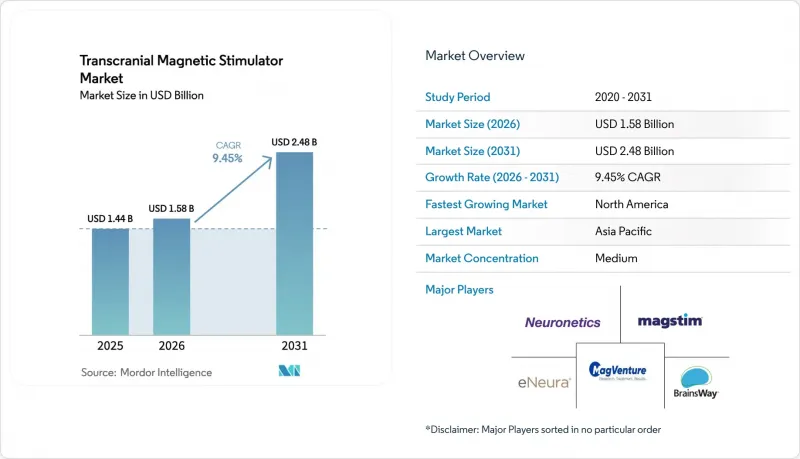
Mordor Intelligence에 의하면, 경두개 자기 자극기 시장 규모는 2025년 14억 4,000만 달러로 평가되었습니다. 2026년에는 15억 8,000만 달러로 확대되어 2026-2031년에 걸쳐 CAGR 9.45%로 성장을 지속하여, 2031년에는 24억 8,000만 달러에 이를 것으로 예측됩니다.
본 보고서는 제품 유형(딥 TMS, 반복 TMS, 가속 TMS, 기타), 용도(우울증, 알츠하이머병, 기타), 연령대(성인, 기타), 최종 사용자(병원, 전문 클리닉, 기타),지역(북미, 유럽, 아시아태평양, 중동 및 아프리카, 남미)별로 분류되어 있습니다. 시장 전망은 금액(달러) 기준으로 제시되어 있습니다.
세계의 경두개 자기 자극기 시장 동향 및 인사이트
치료 저항성 우울증 유병률 증가와 FDA의 적응증 확대
치료 저항성 우울증은 주요 우울 장애 환자의 약 30%에 영향을 미치고 있으며, TMS 치료가 시급히 대응해야 할 환자층을 형성하고 있습니다. 2024년 15-21세 청소년을 대상으로 한 NeuroStar Advanced Therapy의 FDA 승인은 이 연령층에 있어 최초의 비약물 치료 옵션이 되었으며, 1,169명의 환자 코호트에서 78%의 임상적 개선을 달성했습니다. 이어 BrainsWay는 노인기 우울증에 대한 적응증 확대 승인을 받아, 고령층에 대한 적용 범위가 더욱 넓어졌습니다. 주요 보험사들이 이러한 FDA의 결정을 따름에 따라 보험 적용 대상자 수가 증가했고, 보험 환급과 관련된 마찰도 감소했습니다.
급속한 고령화가 진행되며 신경퇴행성 질환의 부담이 증가하고 있습니다.
유럽, 북미, 아시아 일부 지역에서 65세 이상 인구의 비율이 증가함에 따라, 질환 진행을 억제하는 치료법에 대한 수요가 높아지고 있습니다. 전두엽을 표적으로 한 52주간의 맞춤형 반복 TMS 프로토콜은 임상 치매 평가(CDR) 점수의 개선으로 입증된 바와 같이, 경증에서 중등도의 알츠하이머병 사례에서 인지 기능 저하를 지연시켰습니다. 이와 병행하여, 10일간의 rTMS는 염증 조절 T세포를 조절함으로써 파킨슨병의 운동 기능을 개선했으며, 그 효과는 치료 후 40일간 지속되었습니다. 이러한 임상적 성과에 더해, 경두개 자기 자극기 시장의 보상 채널이 성숙해지고 있는 점이 맞물려, 신경학 부문에서 이 치료법의 확장이 가속화되고 있습니다.
전기경련요법(ECT) 및 심부 뇌 자극 요법(DBS)에 대한 선호
ECT는 중증 기분 장애에서 뛰어난 관해율을 유지하고 있어, 3차 정신과 의료 센터에서 TMS 도입을 제한하는 요인이 될 수 있습니다. ASCERTAIN-TRD 연구에서 rTMS군의 MADRS 점수 평균 개선치는 -17.39였던 반면, 약물 요법 전환군은 -13.22로 보고되었는데, 이는 중요한 효과이긴 하지만 여전히 확립된 ECT의 기준치에는 미치지 못합니다. 또한, Vercise PC와 같은 이식형 DBS 시스템 제조업체들은 간섭 위험을 이유로 TMS를 금기 사항으로 꼽고 있어, 임상의는 환자 1명당 하나의 치료법만을 선택할 수밖에 없습니다. 실시간 신경 피드백을 갖춘 폐쇄 루프형 DBS의 혁신적인 기술은 이러한 성능 격차를 더욱 벌리고 있습니다.
부문 분석
2025년, 반복 TMS는 경두개 자기 자극기 시장에서 57.71%의 점유율을 차지했습니다. 이는 30년에 걸친 임상적 검증과 FDA 승인을 받은 광범위한 정신과 적응증을 반영한 것입니다. 높은 시장 인지도, 유리한 보험 급여, 기기 가격 하락으로 인해 이 치료법은 신규 진입 업체들에게 여전히 기본적인 진입점으로 자리 잡고 있습니다. 그럼에도 불구하고 딥 TMS는 13.29%의 연평균 성장률(CAGR)을 기록하고 있으며, 이는 해당 부문 내에서 가장 높은 성장률입니다. 이 H 코일 구조는 8자형 코일로는 도달할 수 없는 변연계 및 피질하 영역에 도달하여, 우울증, 강박 장애, 니코틴 의존증에 대한 승인을 뒷받침하고 있습니다. 실제 임상 등록 자료를 통해 더 깊은 부위의 자극이 치료 저항성 환자군에서 재발률 감소와 관련이 있는 것으로 나타나면서, 이 치료법에 대한 관심은 더욱 높아지고 있습니다.
프로토콜의 신속화로 인해 임상 처리 능력이 재구축되고 있습니다. 스탠포드 대학의 SAINT 요법에서는 50회의 세션을 5일 동안으로 압축하여, 환자의 내원 횟수와 관련된 간접 비용을 6분의 1로 줄이고 있습니다. 동시에, 세타 버스트 자극은 표준 10Hz 시리즈와 동등한 치료 성과를 3분의 1의 시간 내에 실현하여 운영상의 확장성을 뒷받침하고 있습니다. 내비게이션 TMS는 코일 위치 결정에 영상 데이터를 통합함으로써 치료 결과의 편차를 줄입니다. 마지막으로, 폐쇄 루프 및 다초점 자극에 관한 연구개발(R&D) 활동은 실시간으로 측정된 피질의 흥분성에 맞추어 환자별로 동적으로 파형을 조정할 수 있게 해줄 것으로 기대됩니다. 이러한 하위 부문을 종합해 보면, 치료법의 혁신이 경두개 자기 자극기 시장의 기회를 어떻게 지속적으로 확대하고 있는지 알 수 있습니다.
2025년, 우울증은 경두개 자기 자극기 시장 규모의 45.05%를 차지했으며, 견실한 보험 환급, 풍부한 안전성 실적, 전 세계적으로 690만 건을 넘는 치료 실적이 이를 뒷받침했습니다. 이러한 중심적인 역할에도 불구하고, 관심은 신경퇴행성 질환으로 점차 이동하고 있습니다. 알츠하이머병은 전두엽을 표적으로 한 반복 TMS가 대조군에 비해 인지 기능 저하를 늦춘다는 데이터를 바탕으로 16.61%의 연평균 성장률(CAGR)을 기록하고 있습니다. 의료 기술 평가 기관들은 현재 이러한 결과를 보험 적용 논의에 반영하고 있으며, 이에 따라 도입이 가속화되고 있습니다.
파킨슨병의 경우, 신경 염증을 억제하고 피질 및 피질하 계통의 연결성을 높이는 보조적인 rTMS 프로토콜이 효과적이며, 최대 40일 동안 측정 가능한 운동 점수의 개선을 가져오고 있습니다. 만성 통증에 대한 적용은 신경병성 통증의 적응증을 넘어 섬유근통으로 확대되고 있으며, 한편 뇌졸중 재활 임상시험에서는 운동 피질의 가소성을 촉진하는 세타 버스트 전략이 표준 물리치료 단독보다 우수한 것으로 나타났습니다. 강박 장애(OCD)의 경우, 반복 TMS와 딥 TMS 모두 FDA 승인을 획득하여 안정적인 틈새 시장을 유지하고 있습니다. 적응증의 전반적인 폭이 넓어 수익원을 안정화시키고, 특정 질환 영역에서의 보험 급여 및 임상 지침 변경으로부터 경두개 자기 자극기 시장을 보호하는 역할을 하고 있습니다.
지역별 분석
북미는 초기 FDA 승인, 광범위한 보험 적용, 제조업체의 본사의 집중으로 인해 2025년에도 44.58%의 매출 점유율로 선두를 유지했습니다. 안정적인 보험 환급, 성숙한 임상 연구 생태계, 서비스 기반 TMS 네트워크의 점유율 확대가 꾸준한 시술 건수를 뒷받침하고 있습니다. 또한, 미국은 효율적인 의료 제공을 위한 인센티브를 조율하는 외래 치료 번들링 등 새로운 결제 모델을 선도적으로 도입하고 있습니다.
유럽은 CE 마크를 획득한 의료기기와 의료기기 규정(MDR) 체계에 따른 규제 조화에 힘입어 매출 규모 2위를 유지하고 있습니다. 일부 회원국에서는 우울증 및 강박 장애(OCD)에 관한 국가 지침에 TMS가 포함되어 있어 지역 간 일관성이 촉진되고 있습니다. 보험 급여 제도의 차이는 여전히 존재하지만, 독일이나 프랑스 등 고소득 국가에서는 1코스당 하루 최대 30회의 세션이 보험 급여 대상에 포함되어 있어 도입 추세를 뒷받침하고 있습니다.
아시아태평양은 연평균 성장률(CAGR) 12.05%를 기록하며, 경두개 자기 자극기 시장에서 가장 빠르게 성장하고 있는 지역입니다. 일본의 TMS 전문 클리닉에서는 건강보험에 의한 보험 적용에 힘입어 높은 이용량을 기반으로 한 비즈니스 모델이 확립되어 있습니다. 중국에서는 병원 현대화 추진과 국내 생산 능력 확대로 도입 비용이 절감되고 있는 반면, 인도에서는 민간 의료비 증가가 도시 지역 주민들 수요를 촉진하고 있습니다. 남미와 중동 및 아프리카는 초기 성장 궤도에 올라 있으며, 3차 의료 체계 확충에 따라 신경 질환의 부담이 증가하고 있습니다.
기타 혜택
- 엑셀 형식 시장 예측(ME) 시트
- 3개월간의 애널리스트 지원
자주 묻는 질문
목차
제1장 서론
제2장 조사 방법
제3장 주요 요약
제4장 시장 구도
제5장 시장 규모 및 성장 예측
제6장 경쟁 구도
제7장 시장 기회 및 향후 전망
KTH 26.09.10According to Mordor Intelligence, the transcranial magnetic stimulator market size is expected to grow from USD 1.44 billion in 2025 to USD 1.58 billion in 2026 and is forecast to reach USD 2.48 billion by 2031 at 9.45% CAGR over 2026-2031.
This report is Segmented by Product Type (Deep TMS, Repetitive TMS, Accelerated TMS, and More), Application (Depression, Alzheimer's Disease, and More), Age Group (Adults, and More), End User (Hospitals, Specialty Clinics, and More), and Geography (North America, Europe, Asia-Pacific, Middle East & Africa, South America). The Market Forecasts are Provided in Terms of Value (USD).
Global Transcranial Magnetic Stimulator Market Trends and Insights
Rising Prevalence of Treatment-Resistant Depression & Expanded FDA Clearances
Treatment-resistant depression affects about 30% of major depressive disorder patients, creating an urgently addressable pool for TMS therapy. NeuroStar Advanced Therapy's 2024 FDA clearance for adolescents aged 15-21 marked the first non-pharmacological option for this group and achieved 78% clinical improvement in a 1,169-patient cohort. BrainsWay subsequently received an expanded label for late-life depression, supporting broader geriatric coverage. As major insurers mirrored these FDA decisions, covered lives multiplied and reimbursement friction declined.
Rapidly Aging Population Elevating Neurodegenerative Disease Burden
The rising share of citizens aged 65 and above in Europe, North America, and parts of Asia has intensified demand for disease-modifying interventions. A 52-week personalized repetitive TMS protocol targeting the precuneus slowed cognitive decline in mild-to-moderate Alzheimer's cases as evidenced by improved Clinical Dementia Rating scores. In parallel, 10 days of rTMS improved motor function in Parkinson's disease by modulating inflammatory regulatory T-cells, maintaining benefit for 40 days post-treatment. These clinical gains, coupled with the transcranial magnetic stimulator market's maturing reimbursement pathways, reinforce the modality's neurological expansion.
Preference for Electroconvulsive Therapy (ECT) & Deep Brain Stimulation (DBS)
ECT maintains superior remission rates in severe mood disorders and can limit TMS adoption in tertiary psychiatric centers. The ASCERTAIN-TRD trial reported a mean MADRS score improvement of -17.39 for rTMS versus -13.22 for pharmacological switching, an important benefit yet still below established ECT benchmarks. Moreover, manufacturers of implantable DBS systems such as the Vercise PC list TMS as a contraindication because of interference risks, obliging clinicians to choose one modality per patient. Closed-loop DBS innovations with real-time neural feedback widen this performance gap.
Other drivers and restraints analyzed in the detailed report include:
- Favorable Insurance Reimbursement in Developed Nations
- AI-Guided Coil Positioning & Closed-Loop Stimulation Enhancing Outcomes
- High Capital Cost & Technician Shortage
For complete list of drivers and restraints, kindly check the Table Of Contents.
Segment Analysis
Repetitive TMS held a 57.71% transcranial magnetic stimulator market share in 2025, reflecting three decades of clinical validation and the breadth of FDA-cleared psychiatric indications. Commercial familiarity, favorable reimbursement, and declining device prices keep the modality a default entry point for new providers. Deep TMS nevertheless records a 13.29% CAGR, the fastest within the segment hierarchy. Its H-coil architecture penetrates limbic and subcortical areas unreachable by figure-8 coils, supporting approvals for depression, obsessive-compulsive disorder, and nicotine addiction. Therapeutic interest is further reinforced as real-world registries link deeper stimulation targets to reduced relapse rates in treatment-resistant cohorts.
Accelerated protocols are reshaping clinical throughput. Stanford's SAINT regimen compresses 50 sessions into 5 days, a six-fold reduction in patient visits and associated indirect costs. Concurrently, theta-burst stimulation produces equivalent outcomes to standard 10 Hz series in one-third the time, supporting operational scalability. Navigated TMS adds imaging data to coil positioning, thereby reducing outcome variability. Finally, R&D activity in closed-loop and multi-focal stimulation promises dynamic, patient-specific waveform adjustments aligned to cortical excitability measured in real time. Combined, these sub-segments show how therapeutic innovation continues to widen the transcranial magnetic stimulator market opportunity.
Depression kept a 45.05% slice of the transcranial magnetic stimulator market size in 2025, buoyed by robust reimbursement, extensive safety history, and over 6.9 million delivered treatments worldwide. Despite its central role, sentiment is shifting toward neurodegenerative targets. Alzheimer's disease posts a 16.61% CAGR thanks to data showing that precuneus-targeted repetitive TMS slows cognitive decline relative to control arms. Health-technology-assessment agencies now factor these results into coverage discussions, accelerating uptake.
Parkinson's disease benefits from adjunctive rTMS protocols that dampen neuro-inflammation and enhance cortical-subcortical connectivity, delivering measurable motor-score improvements for up to 40 days. Chronic pain applications expand beyond neuropathic indications into fibromyalgia, while stroke-rehabilitation trials find theta-burst strategies promoting motor-cortex plasticity superior to standard physiotherapy alone. OCD remains a steady niche courtesy of both repetitive and deep TMS FDA approvals. The overall breadth of indications buffers revenue streams and cushions the transcranial magnetic stimulator market against reimbursement or clinical-guideline shifts in any single disease area.
Complete Report Scope:
- By Product Type
- Deep TMS
- Repetitive TMS
- Accelerated TMS
- Theta-Burst Stimulation
- Navigated TMS
- Other Types
- By Application
- Depression
- Alzheimer's Disease
- Parkinson's Disease
- Epilepsy
- Chronic Pain
- Obsessive-Compulsive Disorder
- Stroke Rehabilitation
- Other Applications
- By Age Group
- Adults
- Pediatric & Adolescents
- Geriatric
- By End User
- Hospitals
- Specialty Clinics
- Research & Academic Institutes
- Home-Care Settings
- By Geography
- North America
- United States
- Canada
- Mexico
- Europe
- Germany
- United Kingdom
- France
- Italy
- Spain
- Rest of Europe
- Asia-Pacific
- China
- Japan
- India
- Australia
- South Korea
- Rest of Asia-Pacific
- Middle East & Africa
- GCC
- South Africa
- Rest of Middle East & Africa
- South America
- Brazil
- Argentina
- Rest of South America
- North America
Geography Analysis
North America retained 44.58% revenue leadership in 2025 owing to early FDA approvals, broad insurance coverage, and concentrated manufacturer headquarters. Stable reimbursement, a mature clinical-research ecosystem, and the growing share of service-based TMS networks underpin steady procedure volumes. The United States also pioneers novel payment models, including bundled outpatient episodes, that align incentives for efficient care delivery.
Europe holds the second-largest revenue base, supported by CE-marked devices and harmonized regulations under the Medical Device Regulation framework. Several member states have integrated TMS into national guidelines for depression and OCD, facilitating regional convergence. Reimbursement heterogeneity persists, but high-income nations such as Germany and France reimburse up to 30 daily sessions per index course, reinforcing adoption momentum.
Asia-Pacific is the transcranial magnetic stimulator market's fastest-growing region at 12.05% CAGR. Japan's specialized TMS clinics demonstrate high-volume models aided by health-insurance reimbursement. China's hospital-modernization drive and domestic manufacturing capacity reduce acquisition costs, while private-health spend in India unlocks demand among urban populations. South America and the Middle East & Africa follow in early-stage growth corridors, where neurological disease burden rises against expanding tertiary-care capacity.
- BrainsWay Ltd.
- Magstim
- Neuronetics (NeuroStar)
- MagVenture
- Nexstim Plc
- CloudTMS (Neuronavigation)
- Apollo Health
- YINGCHI (Brain Ultimate)
- Brainsight (Rogue Research)
- eNeura Inc.
- TMS Neuro Solutions
- Neurosoft
- REMED Co. Ltd.
- ANT Neuro
- Mag & More GmbH
- MST Solutions
- Salience TMS
- Fischer Wallace Labs
- Monteris Medical
- StimSherpa
Additional Benefits:
- The market estimate (ME) sheet in Excel format
- 3 months of analyst support
TABLE OF CONTENTS
1 Introduction
- 1.1 Study Assumptions & Market Definition
- 1.2 Scope of the Study
2 Research Methodology
3 Executive Summary
4 Market Landscape
- 4.1 Market Overview
- 4.2 Market Drivers
- 4.2.1 Rising Prevalence of Treatment-Resistant Depression & Expanded FDA Clearances
- 4.2.2 Rapidly Aging Population Elevating Neurodegenerative Disease Burden
- 4.2.3 Favorable Insurance Reimbursement in Developed Nations
- 4.2.4 AI-Guided Coil Positioning & Closed-Loop Stimulation Enhancing Outcomes
- 4.2.5 Portable & Home-Use TMS Devices Unlocking Post-Acute Care Channels
- 4.2.6 Cross-Specialty Adoption in Pain, Addiction & Neurorehabilitation Clinics
- 4.3 Market Restraints
- 4.3.1 Preference for Electroconvulsive Therapy (ECT) & Deep Brain Stimulation (DBS)
- 4.3.2 High Capital Cost & Technician Shortage
- 4.3.3 Outcome Variability Due to Coil Placement Inconsistency
- 4.3.4 Pediatric Cognitive-Safety Concerns Tightening Regulatory Oversight
- 4.4 Regulatory Landscape
- 4.5 Technological Outlook
- 4.6 Porter's Five Forces Analysis
- 4.6.1 Bargaining Power of Suppliers
- 4.6.2 Bargaining Power of Buyers/Consumers
- 4.6.3 Threat of New Entrants
- 4.6.4 Threat of Substitute Products
- 4.6.5 Intensity of Competitive Rivalry
5 Market Size & Growth Forecasts (Value in USD)
- 5.1 By Product Type
- 5.1.1 Deep TMS
- 5.1.2 Repetitive TMS
- 5.1.3 Accelerated TMS
- 5.1.4 Theta-Burst Stimulation
- 5.1.5 Navigated TMS
- 5.1.6 Other Types
- 5.2 By Application
- 5.2.1 Depression
- 5.2.2 Alzheimer's Disease
- 5.2.3 Parkinson's Disease
- 5.2.4 Epilepsy
- 5.2.5 Chronic Pain
- 5.2.6 Obsessive-Compulsive Disorder
- 5.2.7 Stroke Rehabilitation
- 5.2.8 Other Applications
- 5.3 By Age Group
- 5.3.1 Adults
- 5.3.2 Pediatric & Adolescents
- 5.3.3 Geriatric
- 5.4 By End User
- 5.4.1 Hospitals
- 5.4.2 Specialty Clinics
- 5.4.3 Research & Academic Institutes
- 5.4.4 Home-Care Settings
- 5.5 By Geography
- 5.5.1 North America
- 5.5.1.1 United States
- 5.5.1.2 Canada
- 5.5.1.3 Mexico
- 5.5.2 Europe
- 5.5.2.1 Germany
- 5.5.2.2 United Kingdom
- 5.5.2.3 France
- 5.5.2.4 Italy
- 5.5.2.5 Spain
- 5.5.2.6 Rest of Europe
- 5.5.3 Asia-Pacific
- 5.5.3.1 China
- 5.5.3.2 Japan
- 5.5.3.3 India
- 5.5.3.4 Australia
- 5.5.3.5 South Korea
- 5.5.3.6 Rest of Asia-Pacific
- 5.5.4 Middle East & Africa
- 5.5.4.1 GCC
- 5.5.4.2 South Africa
- 5.5.4.3 Rest of Middle East & Africa
- 5.5.5 South America
- 5.5.5.1 Brazil
- 5.5.5.2 Argentina
- 5.5.5.3 Rest of South America
- 5.5.1 North America
6 Competitive Landscape
- 6.1 Market Concentration
- 6.2 Market Share Analysis
- 6.3 Company Profiles (includes Global level Overview, Market level overview, Core Segments, Financials as available, Strategic Information, Market Rank/Share for key companies, Products & Services, and Recent Developments)
- 6.3.1 BrainsWay Ltd.
- 6.3.2 Magstim
- 6.3.3 Neuronetics (NeuroStar)
- 6.3.4 MagVenture A/S
- 6.3.5 Nexstim Plc
- 6.3.6 CloudTMS (Neuronavigation)
- 6.3.7 Apollo Health
- 6.3.8 YINGCHI (Brain Ultimate)
- 6.3.9 Brainsight (Rogue Research)
- 6.3.10 eNeura Inc.
- 6.3.11 TMS Neuro Solutions
- 6.3.12 Neurosoft
- 6.3.13 REMED Co. Ltd.
- 6.3.14 ANT Neuro
- 6.3.15 Mag & More GmbH
- 6.3.16 MST Solutions
- 6.3.17 Salience TMS
- 6.3.18 Fischer Wallace Labs
- 6.3.19 Monteris Medical
- 6.3.20 StimSherpa
7 Market Opportunities & Future Outlook
- 7.1 White-space & Unmet-need Assessment


