
|
시장보고서
상품코드
2071346
캠핑카 시장 : 기회, 성장요인, 업계 동향 분석 및 예측(2026-2035년)Motorhome Market Opportunity, Growth Drivers, Industry Trend Analysis, and Forecast 2026 - 2035 |
||||||

세계의 캠핑카 시장은 2025년에 388억 달러 규모가 되어, 2035년까지 연평균 복합 성장률(CAGR) 4.1%로 성장하여 596억 달러에 이를 것으로 추정되고 있습니다.
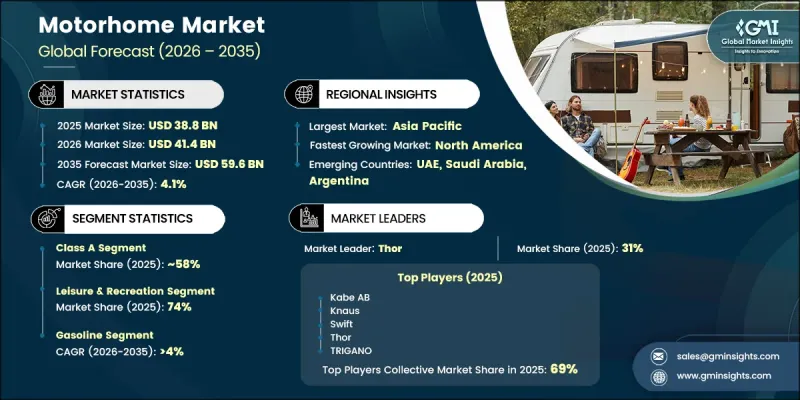
체험 중심의 여행에 대한 소비자들의 선호도가 높아지면서 시장 상황이 크게 변화하고 있으며, 여행객들은 유연성과 자율성, 그리고 나만의 여행을 점점 더 중요하게 여기고 있습니다. 이러한 변화로 인해, 기존의 여행 방식에 얽매이지 않고 다양한 여행지를 탐험할 수 있는 캠핑카의 보급이 촉진되고 있습니다. 다양한 소비자층에서 수요가 나타나고 있는 만큼, 제조업체들은 제품 라인업을 확충하고 쾌적성을 중시한 첨단 기능을 탑재하고 있습니다. 동시에, 재택근무와 하이브리드 근무 모델의 확산에 따라 캠핑카는 다기능 생활 공간으로 변모하고 있으며, 개인이 여행과 업무를 병행할 수 있게 되었습니다. 커넥티비티 솔루션이나 에너지 효율이 높은 시스템 등, 차량 기술의 지속적인 발전이 그 매력을 한층 더 높여주고 있습니다. 또한, 레크리에이션용 차량(RV) 시설 및 서비스 생태계와 같은 지원 인프라에 대한 투자 확대가 시장 환경 전반을 강화하고 있으며, 이는 보다 원활한 여행 경험을 실현하는 동시에 보급률 향상을 뒷받침하고 있습니다.
| 시장 범위 | |
|---|---|
| 시작 연도 | 2025년 |
| 예측 기간 | 2026-2035년 |
| 시작 연도 시장 규모 | 388억 달러 |
| 예측 금액 | 596억 달러 |
| CAGR | 4.1% |
A급 캠핑카 부문은 2025년에 58%의 시장 점유율을 차지하고, 2035년까지 연평균 성장률(CAGR) 4% 이상으로 성장할 것으로 전망됩니다. 이 부문의 성장은 프리미엄 여행 경험에 대한 수요 증가에 힘입고 있습니다. 이 캠핑카들은 주택 수준의 생활 환경을 재현하도록 설계된 널찍한 실내 공간, 첨단 시설, 그리고 높은 쾌적성을 갖추고 있어 장기 여행에 매력적이기 때문입니다.
레저·여가 부문은 2025년에 74%의 점유율을 차지하고 있으며, 이는 도로를 이용한 관광의 인기가 높아지고 있음을 반영하고 있습니다. 소비자들은 정해진 여정에 얽매이지 않고 여러 목적지를 방문할 수 있는 유연한 여행 옵션을 점점 더 많이 선택하고 있으며, 캠핑카는 이러한 변화하는 선호도에 부응하는 편리하고 쾌적한 해결책을 제공합니다.
2025년, 독일의 캠핑카 시장은 45%의 점유율을 차지하며 103억 달러 규모 시장 규모를 기록했습니다. 이 나라에서 높은 보급률은 레저용 차량을 이용한 여행이 뿌리내린 문화에 힘입어, 이를 통해 꾸준한 수요가 지속되고 있습니다. 또한, 캠핑카 이용을 지원하기 위해 구축된 인프라가 잘 갖춰져 있는 점도 시장 성장을 더욱 뒷받침하고 있습니다.
자주 묻는 질문
목차
제1장 조사 방법
제2장 주요 요약
제3장 업계 인사이트
제4장 경쟁 구도
제5장 시장 추산 및 예측 : 차 유형별, 2022-2035년
제6장 시장 추산 및 예측 : 추진력별, 2022-2035년
제7장 시장 추산 및 예측 : 연료별, 2022-2035년
제8장 시장 추산 및 예측 : 용도별, 2022-2035년
제9장 시장 추산 및 예측 : 가격별, 2022-2035년
제10장 시장 추산 및 예측 : 최종 용도별, 2022-2035년
제11장 시장 추산 및 예측 : 지역별, 2022-2035년
제12장 기업 개요
JHS 26.07.01The Global Motorhome Market was valued at USD 38.8 billion in 2025 and is estimated to grow at a CAGR of 4.1% to reach USD 59.6 billion by 2035.
Rising consumer inclination toward experience-focused travel is significantly reshaping the market landscape, with travelers increasingly prioritizing flexibility, independence, and personalized journeys. This shift is encouraging widespread adoption of motorhomes, as they allow users to explore diverse destinations without being restricted by traditional travel arrangements. Demand is being observed across various consumer groups, prompting manufacturers to broaden their portfolios and incorporate advanced comfort-oriented features. At the same time, the emergence of remote and hybrid work models is transforming motorhomes into multifunctional living spaces, enabling individuals to combine travel with work. Continuous advancements in onboard technologies, including connectivity solutions and energy-efficient systems, are further enhancing their appeal. Additionally, growing investments in supporting infrastructure such as recreational vehicle facilities and service ecosystems are strengthening the overall market environment, enabling smoother travel experiences and encouraging higher adoption rates.
| Market Scope | |
|---|---|
| Start Year | 2025 |
| Forecast Year | 2026-2035 |
| Start Value | $38.8 Billion |
| Forecast Value | $59.6 Billion |
| CAGR | 4.1% |
The Class A motorhome segment accounted for 58% share in 2025 and is expected to grow at a CAGR of over 4% through 2035. Growth in this segment is supported by increasing demand for premium travel experiences, as these motorhomes offer spacious interiors, advanced amenities, and high levels of comfort designed to replicate residential living standards, making them attractive for extended travel.
The leisure and recreation segment held a share of 74% in 2025, reflecting the rising popularity of road-based tourism. Consumers are increasingly choosing flexible travel options that allow them to visit multiple destinations without fixed itineraries, and motorhomes offer a convenient and comfortable solution aligned with these evolving preferences.
Germany Motorhome Market accounted for 45% share and generated USD 10.3 billion in 2025. The country's strong adoption is supported by a well-established culture surrounding recreational vehicle travel, which continues to sustain consistent demand. In addition, the availability of developed infrastructure designed to support motorhome usage further reinforces market growth.
Key players operating in the global motorhome market include Thor, TRIGANO, Knaus, Swift, Kabe, Bailey of Bristol, Auto-Sleepers, Burstner, Coachmen RV, and Dethleffs. Companies in the motorhome market are strengthening their market position through product innovation, portfolio diversification, and expansion into new geographic regions. They are focusing on integrating advanced technologies such as smart connectivity, energy-efficient systems, and modular interior designs to enhance user experience. Strategic partnerships with tourism infrastructure providers and service networks are helping improve ecosystem support and customer accessibility. In addition, manufacturers are investing in premium product development to cater to evolving consumer preferences for comfort and personalization. Mergers, acquisitions, and collaborations are also being pursued to expand production capabilities and technological expertise. Continuous focus on sustainability and lightweight materials is further enabling companies to align with regulatory requirements and improve operational efficiency.
Table of Contents
Chapter 1 Methodology
- 1.1 Research approach
- 1.2 Quality Commitments
- 1.2.1 GMI AI policy & data integrity commitment
- 1.2.1.1 Source consistency protocol
- 1.2.1 GMI AI policy & data integrity commitment
- 1.3 Research Trail & Confidence Scoring
- 1.3.1 Research Trail Components
- 1.3.2 Scoring Components
- 1.4 Data Collection
- 1.4.1 Partial list of primary sources
- 1.5 Data mining sources
- 1.5.1 Paid sources
- 1.5.2 Sources, by region
- 1.6 Base estimates and calculations
- 1.6.1 Base year calculation
- 1.7 Forecast model
- 1.7.1 Quantified market impact analysis
- 1.7.1.1 Mathematical impact of growth parameters on forecast
- 1.7.1 Quantified market impact analysis
- 1.8 Research transparency addendum
- 1.8.1 Source attribution framework
- 1.8.2 Quality assurance metrics
- 1.8.3 Our commitment to trust
Chapter 2 Executive Summary
- 2.1 Industry 360° synopsis, 2022 - 2035
- 2.2 Key market trends
- 2.2.1 Regional
- 2.2.2 Vehicle Class
- 2.2.3 Fuel
- 2.2.4 Application
- 2.2.5 Price Tier
- 2.2.6 End Use
- 2.3 TAM Analysis, 2026-2035
- 2.4 CXO perspectives: Strategic imperatives
Chapter 3 Industry Insights
- 3.1 Industry ecosystem analysis
- 3.1.1 Supplier landscape
- 3.1.2 Profit margin analysis
- 3.1.3 Cost structure
- 3.1.4 Value addition at each stage
- 3.1.5 Factor affecting the value chain
- 3.1.6 Disruptions
- 3.2 Industry impact forces
- 3.2.1 Growth drivers
- 3.2.1.1 Rising global leisure & outdoor recreation travel demand
- 3.2.1.2 Growing nomadic lifestyle & remote work adoption fueling full-time motorhome living
- 3.2.1.3 Expanding campground & RV park infrastructure globally
- 3.2.1.4 Increasing preference for domestic travel over international air travel
- 3.2.2 Industry pitfalls and challenges
- 3.2.2.1 High motorhome prices and affordability concerns
- 3.2.2.2 Emission regulations and compliance challenges
- 3.2.2.3 Excess dealer inventory and demand fluctuations
- 3.2.2.4 Shortage of skilled RV technicians and service support
- 3.2.3 Market opportunities
- 3.2.3.1 Growth of electric motorhomes
- 3.2.3.2 Expansion in Asia Pacific and Latin America
- 3.2.3.3 Increasing adoption among Millennials and Gen Z
- 3.2.3.4 Rise of RV subscription and rental platforms
- 3.2.1 Growth drivers
- 3.3 Growth potential analysis
- 3.4 Regulatory landscape
- 3.4.1 North America
- 3.4.1.1 Environmental Protection Agency (EPA)
- 3.4.1.2 National Highway Traffic Safety Administration (NHTSA)
- 3.4.1.3 Federal Motor Vehicle Safety Standards (FMVSS)
- 3.4.1.4 U.S. Department of Transportation (DOT)
- 3.4.1.5 Canadian Motor Vehicle Safety Standards (CMVSS)
- 3.4.2 Europe
- 3.4.2.1 EU Whole Vehicle Type Approval (WVTA)
- 3.4.2.2 CE Marking Compliance
- 3.4.2.3 REACH (Registration, Evaluation, Authorisation and Restriction of Chemicals)
- 3.4.2.4 General Safety Regulation (GSR)
- 3.4.2.5 National Vehicle Registration & Road Homologation Requirements
- 3.4.3 Asia Pacific
- 3.4.3.1 China Compulsory Certification (CCC)
- 3.4.3.2 Automotive Industry Standard (AIS) & Central Motor Vehicle Rules (CMVR)
- 3.4.3.3 Japanese Road Vehicle Act & Safety Regulations
- 3.4.3.4 ASEAN Harmonized Technical Regulations
- 3.4.3.5 Australian Design Rules (ADR)
- 3.4.4 Latin America
- 3.4.4.1 Brazilian National Institute of Metrology (INMETRO) Regulations
- 3.4.4.2 Brazilian National Traffic Council (CONTRAN)
- 3.4.4.3 Mexican Official Standards (NOM) for Motor Vehicles
- 3.4.4.4 Regional Import & Vehicle Certification Requirements
- 3.4.5 Middle East & Africa
- 3.4.5.1 GCC Standardization Organization (GSO) Vehicle Regulations
- 3.4.5.2 Saudi Standards, Metrology and Quality Organization (SASO)
- 3.4.5.3 South African National Regulator for Compulsory Specifications (NRCS)
- 3.4.5.4 National Road Traffic Act (NRTA) Compliance
- 3.4.1 North America
- 3.5 Porter's analysis
- 3.6 PESTEL analysis
- 3.7 Technology and innovation landscape
- 3.7.1 Current technological trends
- 3.7.2 Emerging technologies
- 3.8 Price analysis (Driven by Primary Research)
- 3.8.1 Historical Price Trend Analysis
- 3.8.2 Pricing Strategy by Player Type (Premium / Value / Cost-plus)
- 3.9 Trade data analysis (Driven by Paid Research)
- 3.9.1 Import/export volume & value trends
- 3.9.2 Key trade corridors & tariff impact
- 3.10 Cost breakdown analysis
- 3.11 Patent analysis (Driven by Primary Research)
- 3.12 Impact of AI & generative AI on the market
- 3.12.1 AI-driven disruption of existing business models
- 3.12.2 GenAI use cases & adoption roadmap by segment
- 3.12.3 Risks, limitations & regulatory considerations
- 3.13 Capacity & production landscape (Driven by Primary Research)
- 3.13.1 Installed capacity by region & key producer
- 3.13.2 Capacity utilization rates & expansion pipelines
- 3.14 Sustainability and environmental aspects
- 3.14.1 Sustainable practices
- 3.14.2 Waste reduction strategies
- 3.14.3 Energy efficiency in production
- 3.14.4 Eco-friendly Initiatives
- 3.14.5 Carbon footprint considerations
- 3.15 Forecast assumptions & scenario analysis (Driven by Primary Research)
- 3.15.1 Base Case - key macro & industry variables driving CAGR
- 3.15.2 Optimistic Scenarios - Favorable macro and industry tailwinds
- 3.15.3 Pessimistic Scenario - Macroeconomic slowdown or industry headwinds
Chapter 4 Competitive Landscape, 2025
- 4.1 Introduction
- 4.2 Company market share analysis
- 4.2.1 North America
- 4.2.2 Europe
- 4.2.3 Asia Pacific
- 4.2.4 LATAM
- 4.2.5 MEA
- 4.3 Competitive analysis of major market players
- 4.4 Competitive positioning matrix
- 4.5 Key developments
- 4.5.1 Mergers & acquisitions
- 4.5.2 Partnerships & collaborations
- 4.5.3 New Product Launches
- 4.5.4 Expansion Plans and funding
- 4.6 Company tier benchmarking
- 4.6.1 Tier classification criteria & qualifying thresholds
- 4.6.2 Tier positioning matrix by revenue, geography & innovation
Chapter 5 Market Estimates & Forecast, By Vehicle Class, 2022 - 2035 ($Mn, Units)
- 5.1 Key trends
- 5.2 Class A
- 5.3 Class B
- 5.4 Class C
Chapter 6 Market Estimates & Forecast, By Propulsion, 2022 - 2035 ($Mn, Units)
- 6.1 Key trends
- 6.2 ICE
- 6.3 BEV
- 6.4 PHEV
- 6.5 HEV
- 6.6 FCEV
Chapter 7 Market Estimates & Forecast, By Fuel, 2022 - 2035 ($Mn)
- 7.1 Key trends
- 7.2 Gasoline
- 7.3 Diesel
- 7.4 Electric
Chapter 8 Market Estimates & Forecast, By Application, 2022 - 2035 ($Mn, Units)
- 8.1 Key trends
- 8.2 Leisure & Recreation
- 8.3 Full-Time Living
- 8.4 Commercial & Rental
Chapter 9 Market Estimates & Forecast, By Price Tier, 2022 - 2035 ($Mn, Units)
- 9.1 Key trends
- 9.2 Economy/Budget
- 9.3 Mid-Range/Standard
- 9.4 Premium/Luxury
Chapter 10 Market Estimates & Forecast, By End Use, 2022 - 2035 ($Mn, Units)
- 10.1 Key trends
- 10.2 Individual/Direct Buyers
- 10.3 Owners/Commercial
Chapter 11 Market Estimates & Forecast, By Region, 2022 - 2035 ($Mn, Units)
- 11.1 Key trends
- 11.2 North America
- 11.2.1 US
- 11.2.2 Canada
- 11.3 Europe
- 11.3.1 UK
- 11.3.2 Germany
- 11.3.3 France
- 11.3.4 Italy
- 11.3.5 Spain
- 11.3.6 Russia
- 11.3.7 Nordics
- 11.4 Asia Pacific
- 11.4.1 China
- 11.4.2 India
- 11.4.3 Japan
- 11.4.4 South Korea
- 11.4.5 Southeast Asia
- 11.4.5.1 Indonesia
- 11.4.5.2 Malaysia
- 11.4.5.3 Singapore
- 11.4.5.4 Thailand
- 11.4.5.5 Vietnam
- 11.4.6 ANZ
- 11.5 Latin America
- 11.5.1 Brazil
- 11.5.2 Argentina
- 11.5.3 Mexico
- 11.6 MEA
- 11.6.1 UAE
- 11.6.2 Saudi Arabia
- 11.6.3 South Africa
Chapter 12 Company Profiles
- 12.1 Global Players
- 12.1.1 Forest River
- 12.1.2 Hymer
- 12.1.3 Jayco
- 12.1.4 Knaus Tabbert
- 12.1.5 Thor Industries
- 12.1.6 TRIGANO
- 12.1.7 Winnebago Industries
- 12.2 Regional Players
- 12.2.1 Auto-Sleepers
- 12.2.2 Auto-Trail VR
- 12.2.3 Bailey of Bristol
- 12.2.4 Burstner
- 12.2.5 Coachmen RV
- 12.2.6 Dethleffs
- 12.2.7 Hobby-Wohnwagenwerk
- 12.2.8 Kabe AB
- 12.2.9 Newmar
- 12.2.10 Pilote Group
- 12.2.11 Rapido Group
- 12.2.12 Swift
- 12.2.13 Tiffin Motorhomes
- 12.3 Emerging Players
- 12.3.1 JCBL