|
시장보고서
상품코드
2071399
농업기계 시장 기회, 성장 촉진요인, 산업 동향 분석, 예측(2026-2035년)Agriculture Equipment Market Opportunity, Growth Drivers, Industry Trend Analysis, and Forecast 2026 - 2035 |
||||||

세계의 농업기계 시장은 2025년에 1,236억 달러 규모에 달하고, CAGR 5.9%로 성장하여 2035년까지 2,012억 달러에 달할 것으로 추정됩니다.
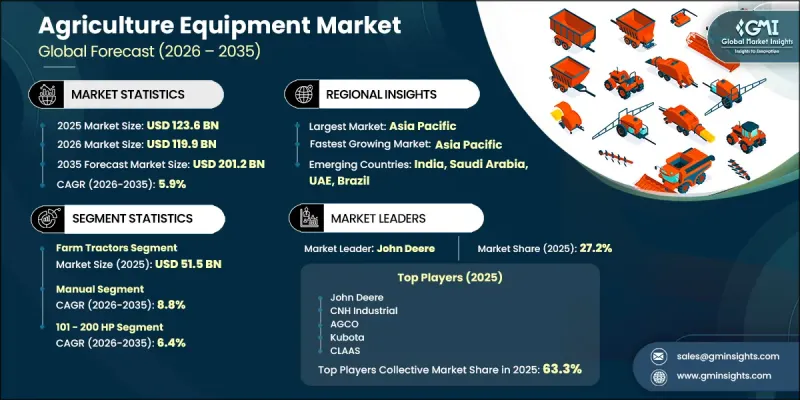
전 세계 식량 수요의 증가가 농업 생산성에 점점 더 큰 압박을 가하고 있는 가운데, 농업기계 시장은 꾸준히 성장하고 있습니다. 인구 증가와 농산물 수요 증가에 따라 농가들은 업무 효율을 높이고 수확량을 극대화할 수 있는 현대식 기계에 대한 투자를 확대하고 있습니다. 농업 생산자들이 제한된 경작지에서 생산을 최적화하는 동시에 인력 확보 문제를 해결하고자 하는 가운데, 기계화 농업의 중요성은 점점 더 커지고 있습니다. 정밀 농업 기술의 도입은 보다 정확한 농지 관리와 자원 활용을 가능하게함으로써 업계에 새로운 변화를 가져오고 있습니다. 기술의 발전에 따라, 감시, 재배, 수확 작업을 개선하는 지능형 시스템을 탑재한 첨단 농업기계가 등장하고 있습니다. 자동화, 위치 파악 기술, 디지털 농업 도구의 통합을 통해 생산자들은 생산성을 높이는 동시에 업무의 복잡성을 줄일 수 있게 되었습니다. 또한, 지속가능한 농업 실천에 대한 관심이 높아지는 가운데, 배출량 감축, 자원 효율 향상, 토양 관리 개선에 기여하는 친환경 농기계에 대한 수요가 증가하고 있습니다. 이러한 요인들은 지속적인 혁신 및 진화하는 농업 관행과 맞물려, 농업기계 시장의 장기적인 전망을 계속해서 더욱 견고하게 만들고 있습니다.
| 시장 범위 | |
|---|---|
| 시작 연도 | 2025년 |
| 예측 기간 | 2026-2035년 |
| 개시 금액 | 1,236억 달러 |
| 예측 금액 | 2,012억 달러 |
| CAGR | 5.9% |
농업용 트랙터 부문은 2025년에 515억 달러의 시장 규모를 기록했습니다. 정밀 농업 기술에 대한 인식이 높아짐에 따라, 종자 배치와 양분 시비를 최적화할 수 있는 첨단 파종·시비 장비에 대한 수요가 증가하고 있습니다. 농가들은 생산성 향상, 작물 수확량 극대화, 그리고 자원의 효율적인 활용을 지원하기 위해 설계된 전용 기계에 대한 투자를 점점 더 늘리고 있습니다. 농업 생산량 증가와 농업 효율 향상에 대한 수요가 높아짐에 따라, 앞으로도 이 부문 전체의 수요를 지속적으로 견인할 것으로 예상됩니다.
수동식 기기 부문은 2025년에 49%의 시장 점유율을 차지했습니다. 수동식 장비는 특히 농업 활동의 규모가 비교적 작고 첨단 기술에 대한 접근성이 제한된 지역에서 농업 운영에 있어 여전히 중요한 역할을 하고 있습니다. 높은 비용 대비 효과, 쉬운 조작, 실용적인 기능성 덕분에 수동식 기기에 대한 수요가 계속해서 유지되고 있습니다. 한편, 자동화에 대한 투자가 증가함에 따라 첨단 농업기계 분야에는 큰 성장 기회가 생겨나고 있습니다. 다만, 일부 농업 활동에서는 여전히 기존의 수동식 도구나 기기에 의존하고 있습니다.
2025년, 미국의 농업기계 시장은 80%의 점유율을 차지하며 274억 달러의 시장 규모를 기록했습니다. 미국 전역의 시장 성장은 지속적인 기술 발전, 기계화의 진전, 그리고 정밀 농업 기법의 보급에 힘입어 이루어지고 있습니다. 대규모 농업 경영자들은 생산성 향상, 운영 효율 증대 및 농업 공정의 합리화를 도모하기 위해 첨단 농업기계에 대한 막대한 투자를 계속하고 있습니다. 현대화, 자원 최적화, 그리고 고수확 농업 기술에 대한 강한 중시 덕분에, 예측 기간 동안 미국 전역에서 농업기계 수요가 지속될 것으로 전망됩니다.
자주 묻는 질문
목차
제1장 조사 방법과 범위
제2장 주요 요약
제3장 업계 인사이트
제4장 경쟁 구도
제5장 시장 추정 및 예측 : 기계별, 2022-2035년
제6장 시장 추정 및 예측 : 출력별, 2022-2035년
제7장 시장 추정 및 예측 : 기술별, 2022-2035년
제8장 시장 추정 및 예측 : 용도별, 2022-2035년
제9장 시장 추정 및 예측 : 유통 채널별, 2022-2035년
제10장 시장 추정 및 예측 : 지역별, 2022-2035년
제11장 기업 개요
KSM 26.07.03The Global Agriculture Equipment Market was valued at USD 123.6 billion in 2025 and is estimated to grow at a CAGR of 5.9% to reach USD 201.2 billion by 2035.
The agriculture equipment market is witnessing steady expansion as rising food requirements continue to place greater pressure on agricultural productivity worldwide. Growing population levels and increasing demand for agricultural output are encouraging farmers to invest in modern machinery capable of improving operational efficiency and maximizing crop yields. Mechanized farming has become increasingly important as agricultural producers seek to optimize production on limited arable land while addressing labor availability challenges. The adoption of precision agriculture technologies is further transforming the industry by enabling more accurate field management and resource utilization. Technological developments have introduced advanced equipment equipped with intelligent systems that improve monitoring, cultivation, and harvesting activities. The integration of automation, positioning technologies, and digital farming tools is helping producers enhance productivity while reducing operational complexity. In addition, the growing emphasis on sustainable farming practices is supporting demand for environmentally responsible machinery that contributes to lower emissions, improved resource efficiency, and better soil management. These factors, combined with ongoing innovation and evolving agricultural practices, continue to strengthen the long-term outlook for the agriculture equipment market.
| Market Scope | |
|---|---|
| Start Year | 2025 |
| Forecast Year | 2026-2035 |
| Start Value | $123.6 Billion |
| Forecast Value | $201.2 Billion |
| CAGR | 5.9% |
The farm tractors segment generated USD 51.5 billion in 2025. Rising awareness regarding precision farming techniques is increasing demand for advanced planting and fertilization equipment capable of optimizing seed placement and nutrient application. Farmers are increasingly investing in specialized machinery designed to improve productivity, maximize crop performance, and support efficient resource utilization. The growing need for higher agricultural output and improved farming efficiency is expected to continue driving demand across this segment.
The manual equipment segment accounted for 49% share in 2025. Manual equipment continues to play a vital role in agricultural operations, particularly in regions where farming activities remain smaller in scale and access to advanced technologies is limited. Cost-effectiveness, ease of operation, and practical functionality continue to support demand for manual equipment. At the same time, increasing investments in automation are creating significant growth opportunities for advanced agricultural machinery, although certain farming activities still rely on conventional manual tools and equipment.
United States Agriculture Equipment Market held an 80% share and generated USD 27.4 billion in 2025. Market growth across the country is being supported by ongoing technological advancements, increased mechanization, and the wider adoption of precision farming practices. Large-scale agricultural operations continue to invest heavily in advanced machinery to improve productivity, enhance operational efficiency, and streamline farming processes. Strong emphasis on modernization, resource optimization, and high-yield farming techniques is expected to sustain equipment demand across the country throughout the forecast period.
Key participants operating in the global agriculture equipment market include John Deere, Mahindra & Mahindra, Kubota, CNH Industrial, CLAAS, AGCO, Yanmar Holdings, Zoomlion Heavy Industry, Escorts Kubota, TAFE, YTO Group, International Tractors, Lovol, Stara, Lindsay, Topcon Agriculture, Carbon Robotics, Naio Technologies, Energreen, Oxbo, and XAG. Companies operating in the agriculture equipment market are focusing on product innovation, automation, and precision farming technologies to strengthen their competitive position and expand market presence. Manufacturers are investing heavily in research and development to introduce intelligent machinery equipped with advanced monitoring, automation, and connectivity features. Strategic partnerships with technology providers are helping companies enhance digital farming capabilities and deliver integrated solutions to agricultural producers. Market participants are also expanding manufacturing facilities and distribution networks to improve product accessibility across key agricultural regions. In addition, businesses are emphasizing sustainability by developing equipment that improves fuel efficiency, reduces emissions, and supports environmentally responsible farming practices.
Table of Contents
Chapter 1 Methodology and scope
- 1.1 Research approach
- 1.2 Quality Commitments
- 1.2.1 GMI AI policy & data integrity commitment
- 1.2.1.1 Source consistency protocol
- 1.2.1 GMI AI policy & data integrity commitment
- 1.3 Research Trail & Confidence Scoring
- 1.3.1 Research Trail Components
- 1.3.2 Scoring Components
- 1.4 Data Collection
- 1.4.1 Partial list of primary sources
- 1.5 Data mining sources
- 1.5.1 Paid sources
- 1.5.1.1 Sources, by region
- 1.5.1 Paid sources
- 1.6 Base estimates and calculations
- 1.6.1 Base year calculation for any one approach
- 1.7 Forecast model
- 1.7.1 Quantified market impact analysis
- 1.7.1.1 Mathematical impact of growth parameters on forecast
- 1.7.1 Quantified market impact analysis
- 1.8 Research transparency addendum
- 1.8.1 Source attribution framework
- 1.8.2 Quality assurance metrics
- 1.8.3 Our commitment to trust
Chapter 2 Executive summary
- 2.1 Industry 360° synopsis
- 2.2 Key market trends
- 2.2.1 Regional
- 2.2.2 Machinery
- 2.2.3 Power
- 2.2.4 Technology
- 2.2.5 Application
- 2.2.6 Distribution channel
Chapter 3 Industry insights
- 3.1 Industry ecosystem analysis
- 3.1.1 Supplier landscape
- 3.1.2 Profit margin
- 3.1.3 Value addition at each stage
- 3.1.4 Factor affecting the value chain
- 3.1.5 Disruptions
- 3.2 Supply chain analysis
- 3.2.1 Key input materials
- 3.2.2 Manufacturing hubs & sourcing patterns by region
- 3.2.3 Supply chain vulnerabilities & risk mitigation
- 3.3 Industry impact forces
- 3.3.1 Growth drivers
- 3.3.2 Industry pitfalls & challenges
- 3.3.3 Opportunities
- 3.4 Growth potential analysis
- 3.5 Price trends
- 3.5.1 Historical price trend analysis
- 3.5.2 Pricing strategy by player type
- 3.6 Regulatory framework
- 3.6.1 Global Emissions & Safety Standards (EPA Tier 4, EU Stage V, China Stage III/IV)
- 3.6.2 North America Regulatory Framework
- 3.6.3 Europe Regulatory Framework (EU Green Deal, Farm to Fork Impact)
- 3.6.4 Asia Pacific: China & India Regulatory Framework & Subsidy Programs
- 3.6.5 Trade Policy, Tariffs & Import/Export Regulations
- 3.7 Porter's five forces analysis
- 3.8 PESTEL analysis
- 3.9 Trade data analysis (based on paid database) (HS Code: 8432)
- 3.9.1 Import/export volume & value trends
- 3.9.2 Key trade corridors & tariff impact
- 3.10 Impact of AI & generative AI on the market
- 3.10.1 AI-driven disruption of traditional business models
- 3.10.2 GenAI use cases & adoption roadmap by customer segment
- 3.10.3 Risks, limitations & regulatory considerations
- 3.11 Future market trends
- 3.12 Technology and innovation landscape
- 3.12.1 Current technological trends
- 3.12.2 Emerging technologies
Chapter 4 Competitive landscape, 2025
- 4.1 Introduction
- 4.2 Company market share analysis
- 4.2.1 North America
- 4.2.2 Europe
- 4.2.3 Asia Pacific
- 4.2.4 Latin America
- 4.2.5 MEA
- 4.3 Company matrix analysis
- 4.4 Competitive analysis of major market players
- 4.5 Competitive positioning matrix
- 4.6 Key developments
- 4.6.1 Mergers & acquisitions
- 4.6.2 Partnerships & collaborations
- 4.6.3 New product launches
- 4.6.4 Expansion plans
Chapter 5 Market Estimates & Forecast, By Machinery, 2022 - 2035 ($Billion, Thousand Units)
- 5.1 Key trends
- 5.2 Farm tractors
- 5.2.1 Sub-compact & garden tractors
- 5.2.2 Compact tractors
- 5.2.3 Utility tractors
- 5.2.4 Row crop tractors
- 5.2.5 Orchard & vineyard tractors
- 5.2.6 High-power & 4WD tractors
- 5.2.7 Others (track / crawler tractors etc.)
- 5.3 Harvesting machinery
- 5.3.1 Combine harvester
- 5.3.2 Forage harvester
- 5.3.3 Thresher
- 5.3.4 Reaper
- 5.4 Plowing and cultivation machinery
- 5.4.1 Ploughs
- 5.4.2 Harrows
- 5.4.3 Cultivators & tillers
- 5.5 Planting and fertilizing machinery
- 5.5.1 Seed drills
- 5.5.2 Planters
- 5.5.3 Spreaders
- 5.5.4 Sprayers
- 5.6 Haying machinery
- 5.6.1 Balers
- 5.6.2 Mower-conditioner
- 5.6.3 Tedders & rakes
- 5.7 Others (irrigation machinery, post-harvest equipment etc.)
Chapter 6 Market Estimates & Forecast, By Power, 2022 - 2035 ($Billion, Thousand Units)
- 6.1 Key trends
- 6.2 < 30 HP
- 6.3 31 - 100 HP
- 6.4 101 - 200 HP
- 6.5 > 200 HP
Chapter 7 Market Estimates & Forecast, By Technology, 2022 - 2035 ($Billion, Thousand Units)
- 7.1 Key trends
- 7.2 Manual
- 7.3 Semi-automated
- 7.4 Fully automated
Chapter 8 Market Estimates & Forecast, By Application, 2022 - 2035 ($Billion, Thousand Units)
- 8.1 Key trends
- 8.2 Row crops
- 8.3 Fruit & vegetables
- 8.4 Vineyards & orchards
- 8.5 Livestock farming
- 8.6 Forestry
Chapter 9 Market Estimates & Forecast, By Distribution Channel, 2022 - 2035 ($Billion, Thousand Units)
- 9.1 Key trends
- 9.2 Direct sales
- 9.3 Indirect sales
Chapter 10 Market Estimates & Forecast, By Region, 2022 - 2035 ($Billion, Thousand Units)
- 10.1 Key trends
- 10.2 North America
- 10.2.1 U.S.
- 10.2.2 Canada
- 10.3 Europe
- 10.3.1 Germany
- 10.3.2 UK
- 10.3.3 France
- 10.3.4 Spain
- 10.3.5 Italy
- 10.3.6 Netherlands
- 10.4 Asia Pacific
- 10.4.1 China
- 10.4.2 Japan
- 10.4.3 India
- 10.4.4 Australia
- 10.4.5 South Korea
- 10.5 Latin America
- 10.5.1 Brazil
- 10.5.2 Mexico
- 10.5.3 Argentina
- 10.6 MEA
- 10.6.1 South Africa
- 10.6.2 Saudi Arabia
- 10.6.3 UAE
Chapter 11 Company Profiles
- 11.1 Global Key Players
- 11.1.1 AGCO
- 11.1.2 CLAAS
- 11.1.3 CNH Industrial
- 11.1.4 John Deere
- 11.1.5 Kubota
- 11.1.6 Mahindra & Mahindra
- 11.1.7 Yanmar Holdings
- 11.2 Regional Players
- 11.2.1 Escorts Kubota
- 11.2.2 International Tractors
- 11.2.3 Lovol
- 11.2.4 Stara
- 11.2.5 TAFE
- 11.2.6 YTO Group
- 11.2.7 Zoomlion Heavy Industry
- 11.3 Emerging/Niche Specialists
- 11.3.1 Carbon Robotics
- 11.3.2 Energreen
- 11.3.3 Lindsay
- 11.3.4 Naio Technologies
- 11.3.5 Oxbo
- 11.3.6 Topcon Agriculture
- 11.3.7 XAG