

|
시장보고서
상품코드
2071415
그리드 스케일 고정식 배터리 에너지 저장 장치 시장 기회, 성장 촉진요인, 업계 동향 분석 및 예측(2026-2035년)Grid Scale Stationary Battery Storage Market Opportunity, Growth Drivers, Industry Trend Analysis, and Forecast 2026 - 2035 |
||||||

세계의 그리드 스케일 고정식 배터리 에너지 저장 장치 시장은 2025년에 1,198억 달러로 평가되었고, CAGR 22.8%로 성장하여 2035년까지 9,965억 달러에 달할 것으로 추정되고 있습니다.
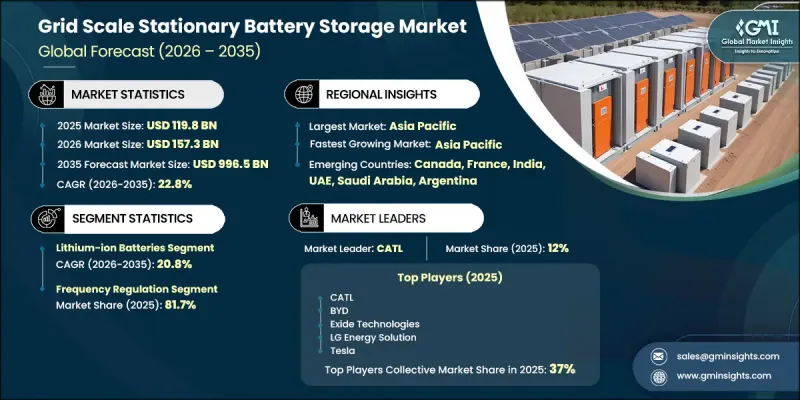
시장 확대는 장기간 축전 시스템이 시범 도입 단계에서 여러 지역에 걸친 상용 규모의 조달 프로그램으로 전환되고 있는 데서 점점 더 큰 영향을 받고 있습니다. 계통 운영 사업자들은 단시간 균형 조정 시스템에서 재생에너지의 장기적인 간헐성을 관리하고 저녁 시간대의 피크 수요 기간을 뒷받침할 수 있는 8-12시간 규모의 축전 설비로 전환하고 있습니다. 경쟁이 치열한 전력 시장에서 에너지 저장 설비가 주파수 조정 서비스, 차익 거래, 용량 대금 지급 등 다양한 수익원을 통해 수익을 창출하기 때문에 경제적 최적화 또한 중요한 촉진요인으로 작용하고 있습니다. 이러한 다각적인 수익 창출 기능을 통해 단일 용도의 용도에 비해 프로젝트의 실현 가능성이 크게 향상됩니다. 또한, 대규모 시설에서 발생한 발열 사고를 계기로 안전에 대한 고려가 규제 측면에서도 중요시되게 되었으며, 시스템 설계, 화재 예방 대책, 시설 공학에 관한 기준이 더욱 엄격해지고 있습니다. 재생에너지 도입률이 높아짐에 따라, 배터리 저장 시스템은 전력 계통 현대화 전략의 핵심 요소로 자리매김하며, 전력 시스템의 유연성, 안정성 및 탈탄소화를 촉진하고 있습니다.
| 시장 범위 | |
|---|---|
| 개시 연도 | 2025년 |
| 예측 기간 | 2026-2035년 |
| 개시 금액 | 1,198억 달러 |
| 예측 금액 | 9,965억 달러 |
| CAGR | 22.8% |
리튬이온 기술은 2025년에 75.5%의 시장 점유율을 차지할 것으로 예상되며, 2035년까지 연평균 성장률(CAGR) 20.8%로 성장할 것으로 전망됩니다. 이 범주에서 리튬인산철(LFP) 계열 배터리는 뛰어난 비용 효율성, 3,000-6,000회 이상에 달하는 높은 사이클 내구성, 그리고 부분 충전 상태에서도 안정적인 성능을 바탕으로 신규 유틸리티 규모 도입의 약 90%를 차지하고 있습니다. 확립된 공급망과 대규모 생산 능력 덕분에 그리드 저장 분야에서 이 회사의 지배적 지위가 더욱 공고해지고 있습니다.
주파수 조정 부문은 2025년에 81.7%의 시장 점유율을 차지하고 있으며, 2035년까지 연평균 성장률(CAGR) 22.7%를 나타낼 것으로 예측됩니다. 배터리 저장 시스템은 계통 주파수의 변동에 거의 즉각적으로 대응하며, 기존의 화력 및 수력 발전이 제공하는 조절 자원을 크게 능가하는 성능을 발휘합니다. 이러한 신속한 대응 능력 덕분에, 재생에너지 도입률이 높은 시스템에서 전력 계통의 안정성을 유지하는 데 없어서는 안 될 존재가 되었습니다.
북미의 그리드 규모 고정형 배터리 저장 시장은 2025년에 29.4%의 점유율을 차지할 것으로 예상되며, 2035년까지 연평균 성장률(CAGR) 16.6%로 성장할 것으로 전망됩니다. 해당 지역의 성장은 연방 정부의 정책 체계, 특히 미국의 “인플레이션 억제법”에 의해 강력하게 뒷받침되고 있습니다. 이 법은 독립형 에너지 저장 프로젝트에 대해 30%의 투자 세액 공제를 별도로 제공함으로써, 프로젝트의 경제성을 대폭 향상시키고, 유틸리티 규모의 활용 분야에서의 도입을 가속화하고 있습니다.
자주 묻는 질문
목차
제1장 조사 방법과 범위
제2장 주요 요약
제3장 업계 인사이트
제4장 경쟁 구도
제5장 시장 규모와 예측 : 배터리별, 2022년-2035년
제6장 시장 규모와 예측 : 용도별, 2022년-2035년
제7장 시장 규모와 예측 : 지역별, 2022년-2035년
제8장 기업 개요
LSH 26.07.02The Global Grid Scale Stationary Battery Storage Market was valued at USD 119.8 billion in 2025 and is estimated to grow at a CAGR of 22.8% to reach USD 996.5 billion by 2035.
Market expansion is increasingly influenced by the transition of long-duration storage from pilot deployments into commercial-scale procurement programs across multiple regions. Grid operators are shifting away from short-duration balancing systems toward 8-12 hour storage assets capable of managing extended renewable intermittency and sustaining peak evening demand periods. Economic optimization is also a key driver, as storage assets in competitive power markets generate revenue through stacked revenue streams including frequency services, arbitrage, and capacity payments. This multi-revenue functionality significantly improves project viability compared to single-use applications. Safety considerations have also gained regulatory prominence following thermal incidents in large-scale installations, prompting stricter standards for system design, fire mitigation, and facility engineering. As renewable penetration increases, battery storage is becoming a central pillar of grid modernization strategies, enabling greater flexibility, stability, and decarbonization of electricity systems.
| Market Scope | |
|---|---|
| Start Year | 2025 |
| Forecast Year | 2026-2035 |
| Start Value | $119.8 Billion |
| Forecast Value | $996.5 Billion |
| CAGR | 22.8% |
Lithium-ion technology accounted for 75.5% share in 2025 and is projected to grow at a CAGR of 20.8% through 2035. Within this category, lithium iron phosphate (LFP) chemistry represents around 90% of new utility-scale deployments due to its cost efficiency, strong cycle durability ranging from 3,000 to over 6,000 cycles, and stable performance under partial charge conditions. Established supply chains and large-scale manufacturing capacity further reinforce its dominant position in grid storage applications.
The frequency regulation segment held an 81.7% share in 2025 and is expected to grow at a CAGR of 22.7% through 2035. Battery storage systems provide near-instantaneous response to grid frequency fluctuations, significantly outperforming conventional thermal and hydro-based balancing resources. This rapid response capability makes them essential for maintaining grid stability in systems with high renewable energy penetration.
North America Grid Scale Stationary Battery Storage Market accounted for 29.4% share in 2025 and is projected to grow at a CAGR of 16.6% through 2035. Growth in the region is strongly supported by federal policy frameworks, particularly the U.S. Inflation Reduction Act, which provides an independent 30% Investment Tax Credit for standalone energy storage projects, significantly improving project economics and accelerating deployment across utility-scale applications.
Major companies operating in the global grid scale stationary battery storage market include Tesla, CATL (Contemporary Amperex Technology Co. Limited), BYD Company, LG Energy Solution, Siemens Energy, Samsung SDI, Hitachi Energy, Fluence Energy, Panasonic Corporation, SK Innovation, Wartsila, Johnson Controls, Powin Energy, Eos Energy Enterprises, Form Energy, Toshiba Corporation, Invinity Energy Systems, GS Yuasa International, Exide Technologies, and HOPPECKE Batterien. Companies in the grid scale stationary battery storage market are focusing on scaling high-capacity energy storage projects through long-term utility partnerships and independent power producer collaborations. Many players are investing heavily in advanced battery chemistries such as LFP and next-generation solid-state technologies to improve safety, efficiency, and lifecycle performance. Vertical integration strategies, including in-house cell manufacturing and system integration, are being adopted to reduce costs and strengthen supply chain control. Firms are also enhancing revenue optimization platforms that enable energy storage assets to participate in multiple grid services simultaneously, improving project profitability.
Table of Contents
Chapter 1 Methodology & Scope
- 1.1 Research approach
- 1.2 Quality commitments
- 1.2.1 GMI AI policy & data integrity commitment
- 1.2.1.1 Source consistency protocol
- 1.2.1 GMI AI policy & data integrity commitment
- 1.3 Research trail & confidence scoring
- 1.3.1 Research trail components
- 1.3.2 Scoring components
- 1.4 Data collection
- 1.4.1 Partial list of primary sources
- 1.5 Data mining sources
- 1.5.1 Paid sources
- 1.5.1.1 Sources, by region
- 1.5.1 Paid sources
- 1.6 Base estimates and calculations
- 1.6.1 Base year calculation for any one approach
- 1.7 Market estimates & forecasts parameters
- 1.8 Forecast model
- 1.8.1 Quantified market impact analysis
- 1.8.1.1 Mathematical impact of growth parameters on forecast
- 1.8.1 Quantified market impact analysis
- 1.9 Research transparency addendum
- 1.9.1 Source attribution framework
- 1.9.2 Quality assurance metrics
- 1.9.3 Our commitment to trust
- 1.10 Market definitions
Chapter 2 Executive Summary
- 2.1 Industry synopsis, 2022 - 2035
- 2.1.1 Business trends
- 2.1.2 Battery trends
- 2.1.3 Application trends
- 2.1.4 Regional trends
Chapter 3 Industry Insights
- 3.1 Industry ecosystem analysis
- 3.1.1 Raw material availability & sourcing analysis
- 3.1.2 Manufacturing capacity assessment
- 3.1.3 Supply chain resilience & risk factors
- 3.1.4 Distribution network analysis
- 3.2 Regulatory landscape
- 3.3 Industry impact forces
- 3.3.1 Growth drivers
- 3.3.2 Industry pitfalls & challenges
- 3.4 Growth potential analysis
- 3.5 Porter's analysis
- 3.5.1 Bargaining power of suppliers
- 3.5.2 Bargaining power of buyers
- 3.5.3 Threat of new entrants
- 3.5.4 Threat of substitutes
- 3.6 PESTEL analysis
- 3.6.1 Political factors
- 3.6.2 Economic factors
- 3.6.3 Social factors
- 3.6.4 Technological factors
- 3.6.5 Legal factors
- 3.6.6 Environmental factors
- 3.7 Price trend analysis (USD/MW)
- 3.7.1 By Battery
- 3.7.2 By Region
- 3.8 Capacity & production landscape (Driven by Primary Research)
- 3.8.1 Capacity by key producer (Driven by Primary Research)
- 3.8.2 Capacity utilization rates & expansion pipelines (Driven by Primary Research)
- 3.9 Impact of AI & Generative AI on the market (Core Solution)
- 3.9.1 AI-Driven production optimization (Core Solution)
- 3.9.2 Predictive maintenance & fault detection (Core Solution)
- 3.10 Emerging opportunities & trends
- 3.11 Investment analysis & future prospects
- 3.12 Sustainability initiatives & industry 4.0 integration
Chapter 4 Competitive Landscape, 2026
- 4.1 Introduction
- 4.2 Company market share analysis, by region, 2025
- 4.2.1 North America
- 4.2.2 Europe
- 4.2.3 Asia Pacific
- 4.2.4 Middle East & Africa
- 4.2.5 Latin America
- 4.3 Key developments
- 4.3.1 Key partnerships & collaborations
- 4.3.2 Major M&A activities
- 4.3.3 Product innovations & launches
- 4.3.4 Market expansion strategies
- 4.4 Competitive positioning matrix
Chapter 5 Market Size and Forecast, By Battery, 2022 - 2035 (MW & USD Million)
- 5.1 Key trends
- 5.2 Lithium ion
- 5.2.1 LFP
- 5.2.2 NMC
- 5.2.3 Others
- 5.3 Sodium sulphur
- 5.4 Lead acid
- 5.5 Flow battery
- 5.6 Others
Chapter 6 Market Size and Forecast, By Application, 2022 - 2035 (MW & USD Million)
- 6.1 Key trends
- 6.2 Frequency regulation
- 6.3 Flexible ramping
- 6.4 Black start services
- 6.5 Energy shifting & capacity deferral
- 6.6 T & D congestion relief
- 6.7 Capacity firming
- 6.8 Reduced RE curtailment
- 6.9 Reduced reliance on diesel gensets
Chapter 7 Market Size and Forecast, By Region, 2022 - 2035 (MW & USD Million)
- 7.1 Key trends
- 7.2 North America
- 7.2.1 U.S.
- 7.2.2 Canada
- 7.2.3 Mexico
- 7.3 Europe
- 7.3.1 UK
- 7.3.2 France
- 7.3.3 Germany
- 7.3.4 Italy
- 7.3.5 Russia
- 7.3.6 Spain
- 7.4 Asia Pacific
- 7.4.1 China
- 7.4.2 Australia
- 7.4.3 India
- 7.4.4 Japan
- 7.4.5 South Korea
- 7.5 Middle East & Africa
- 7.5.1 Saudi Arabia
- 7.5.2 UAE
- 7.5.3 South Africa
- 7.6 Latin America
- 7.6.1 Brazil
- 7.6.2 Argentina
Chapter 8 Company Profiles
- 8.1 BYD Company
- 8.2 Contemporary Amperex Technology Co. Limited (CATL)
- 8.3 Eos Energy Enterprises
- 8.4 Exide Technologies
- 8.5 Fluence Energy
- 8.6 Form Energy
- 8.7 GS Yuasa International
- 8.8 Hitachi Energy
- 8.9 HOPPECKE Batterien
- 8.10 Invinity Energy Systems
- 8.11 Johnson Controls
- 8.12 LG Energy Solution
- 8.13 Panasonic Corporation
- 8.14 Powin Energy
- 8.15 Samsung SDI
- 8.16 Siemens Energy
- 8.17 SK Innovation
- 8.18 Tesla
- 8.19 Toshiba Corporation
- 8.20 Wartsila


