|
시장보고서
상품코드
2083047
자동차 이모빌라이저 시장 기회, 성장요인, 업계 동향 분석 및 예측(2026-2035년)Automotive Immobilizer Market Opportunity, Growth Drivers, Industry Trend Analysis, and Forecast 2026 - 2035 |
||||||

세계의 자동차 이모빌라이저 시장은 2025년에 54억 달러로 평가되었고, CAGR 6.6%로 성장하여 2035년까지 100억 달러에 달할 것으로 예측됩니다.
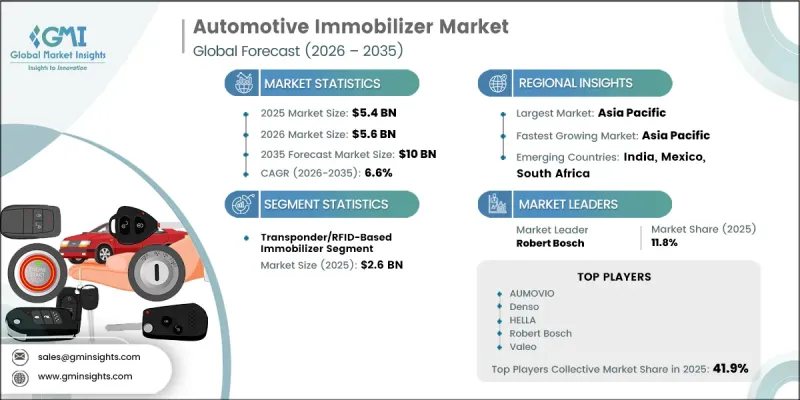
차량 보안 및 도난 방지에 대한 우려가 커짐에 따라, OEM(순정 부품 제조업체)과 애프터마켓 모두에서 첨단 이모빌라이저 기술에 대한 수요가 계속해서 증가하고 있습니다. 차량 안전에 대한 규제가 강화되고, 도난 방지 기술에 대한 소비자의 관심이 높아지면서, 전 세계 자동차 이모빌라이저 시장에 유리한 성장 기회가 창출되고 있습니다. 또한, 이 업계에서는 기존의 보안 솔루션에서 더 강력한 보안 기능과 고도의 기능성을 갖춘, 보다 지능적인 차량 보호 시스템으로의 단계적인 전환이 진행되고 있습니다. 커넥티드카 기술의 지속적인 발전에 따라, 제조업체들은 원격 관리 및 향후 시스템 업그레이드에 대응할 수 있는 소프트웨어 기반 보안 기능을 통합하도록 요구받고 있습니다. 이러한 기술적 발전은 시장 전체경쟁 구도를 재편하는 동시에 차세대 이모빌라이저 솔루션의 가치 제안을 높이고 있습니다. 동시에, 일부 지역에서 규제 체계가 발전함에 따라 출고 시 기본으로 장착된 차량 보안 시스템의 보급이 촉진되고 있으며, 이는 장기적인 시장 확대를 더욱 뒷받침하고 있습니다. 자동차 제조업체들이 통합형 전자 보안 기술을 지속적으로 우선시함에 따라, 자동차 이모빌라이저 시장은 예측 기간 동안 꾸준한 성장세를 유지할 것으로 전망됩니다.
| 시장 범위 | |
|---|---|
| 개시연도 | 2025년 |
| 예측 기간 | 2026-2035년 |
| 개시 연도 시장 규모 | 54억 달러 |
| 예측액 | 100억 달러 |
| CAGR | 6.6% |
자동차 이모빌라이저와 커넥티드카 플랫폼의 통합은 시장 발전에 영향을 미치는 가장 중요한 동향 중 하나로 자리 잡고 있습니다. 각 제조업체들은 원격 기능 및 향후 무선(OTA) 소프트웨어 업그레이드를 지원하는 소프트웨어 중심의 보안 시스템에 점점 더 주력하고 있으며, 이에 따라 차량 보호 기술은 제품의 수명 주기 전반에 걸쳐 지속적으로 발전하고 있습니다. 이러한 전환으로 인해 기술적으로 고도화된 전자 보안 솔루션에 대한 수요가 증가하는 한편, 여러 기술 분야에 걸친 제품 가치 향상도 촉진되면서 공급업체 간경쟁 구도가 재편되고 있습니다. 또한, 일부 국가에서 자동차 보험을 규제하는 정책은 인센티브 기반의 도입에서 보험 가입 요건으로서의 의무적 장착으로 점차 전환되고 있으며, 이는 자동차 이모빌라이저 제조업체들에게 새로운 기회를 창출하고 있습니다.
트랜스폰더/RFID 기반 이모빌라이저 분야는 2025년에 26억 달러 시장 규모를 기록하며 48.7%의 점유율을 차지했습니다. 이러한 선도적인 위상은 전 세계 자동차 생산 분야에서 표준적인 차량 보안 기술로 널리 인정받고 있음을 반영합니다. 업계에서 오랫동안 채택되어 온 점, 광범위한 서비스 인프라, 합리적인 교체 비용, 그리고 규제 측면에서의 폭넓은 수용이 트랜스폰더 및 RFID 기반 이모빌라이저 시스템의 지속적인 우위를 뒷받침하고 있습니다. 이러한 입증된 신뢰성과 비용 효율성은 전 세계 자동차 산업 전반에 걸쳐 계속해서 견조한 수요를 뒷받침하고 있습니다.
OEM 판매 채널 부문은 규제 요건의 확대와 이모빌라이저 시스템이 차량의 표준 보안 장비로 점점 더 많이 탑재되고 있는 것을 배경으로, 2025년에는 상당한 시장 점유율을 차지했습니다. 자동차 제조업체와 부품 공급업체 간의 장기 공급 계약은 이 부문 내경쟁 구도를 지속적으로 형성하고 있으며, 공급업체들은 확립된 기술 제휴 관계와 플랫폼 통합 능력의 혜택을 누리고 있습니다. 자동차 제조업체들이 차량 개발 과정에서 통합형 전자 보안 기술을 점점 더 중시하는 가운데, 자동차 제조업체와 부품 공급업체 간의 강력한 협력은 OEM 채널의 지속적인 성장을 뒷받침하는 중요한 요인으로 자리 잡고 있습니다.
아시아태평양의 자동차 이모빌라이저 시장은 2025년에 21억 달러에 달했으며, 시장 점유율의 38.1%를 차지했습니다. 국내 자동차 생산의 지속적인 확대, 규제 준수 요건, 그리고 기존의 방대한 차량 대수가 자동차 이모빌라이저 시스템에 대한 OEM 및 애프터마켓 양측 수요를 계속해서 뒷받침하고 있습니다. 자동차 제조에 대한 지속적인 투자와 첨단 자동차 보안 기술의 도입 확대를 통해, 예측 기간 동안 해당 지역 시장에서의 리더십이 더욱 공고해질 것으로 예측됩니다.
자주 묻는 질문
목차
제1장 조사 방법
제2장 주요 요약
제3장 업계 인사이트
제4장 경쟁 구도
제5장 시장 추산 및 예측 : 기술별, 2022년-2035년
제6장 시장 추산 및 예측 : 판매채널별, 2022년-2035년
제7장 시장 추산 및 예측 : 차량별, 2022년-2035년
제8장 시장 추산 및 예측 : 지역별, 2022년-2035년
제9장 기업 개요
LSH 26.07.13The Global Automotive Immobilizer Market was valued at USD 5.4 billion in 2025 and is estimated to grow at a CAGR of 6.6% to reach USD 10 billion by 2035.
Rising concerns regarding vehicle security and theft prevention continue to accelerate demand for advanced immobilizer technologies across both original equipment manufacturers (OEMs) and the aftermarket. Increasing regulatory emphasis on vehicle safety, coupled with growing consumer awareness of anti-theft technologies, is creating favorable growth opportunities for the global automotive immobilizer market. The industry is also witnessing a gradual transition from conventional security solutions toward more intelligent vehicle protection systems that deliver stronger security capabilities and enhanced functionality. Continuous advancements in connected vehicle technologies are encouraging manufacturers to integrate software-enabled security features capable of supporting remote management and future system upgrades. These technological developments are reshaping competitive dynamics across the market while increasing the value proposition of next-generation immobilizer solutions. At the same time, evolving regulatory frameworks across several regions are encouraging wider adoption of factory-installed vehicle security systems, further supporting long-term market expansion. As automotive manufacturers continue to prioritize integrated electronic security technologies, the automotive immobilizer market is expected to maintain steady growth throughout the forecast period.
| Market Scope | |
|---|---|
| Start Year | 2025 |
| Forecast Year | 2026-2035 |
| Start Value | $5.4 Billion |
| Forecast Value | $10 Billion |
| CAGR | 6.6% |
The integration of automotive immobilizers with connected vehicle platforms is becoming one of the most significant trends influencing market development. Manufacturers are increasingly focusing on software-driven security systems that support remote functionality and future over-the-air software upgrades, allowing vehicle protection technologies to evolve throughout the product lifecycle. This transition is reshaping supplier competition by increasing demand for technologically advanced electronic security solutions while supporting higher product values across multiple technology categories. In addition, regulatory policies governing vehicle insurance in several countries are progressively moving from incentive-based adoption toward mandatory installation requirements for insurance eligibility, creating additional opportunities for automotive immobilizer manufacturers.
The transponder/RFID-based immobilizer segment generated USD 2.6 billion, holding 48.7% share in 2025. Its leading position reflects widespread acceptance as a standard vehicle security technology across global automotive production. Long-term industry adoption, extensive service infrastructure, affordable replacement costs, and broad regulatory acceptance have contributed to the continued dominance of transponder and RFID-based immobilizer systems. Their proven reliability and cost efficiency continue to support strong demand across the global automotive sector.
The OEM sales channel segment captured a significant share in 2025, supported by expanding regulatory requirements and the increasing integration of immobilizer systems as standard vehicle security equipment. Long-term supply agreements between automotive manufacturers and component suppliers continue to shape competitive dynamics within this segment, with suppliers benefiting from established engineering relationships and platform integration capabilities. Strong collaboration between vehicle manufacturers and component suppliers remains a key factor supporting continued growth within the OEM channel, as automakers increasingly prioritize integrated electronic security technologies during vehicle development.
Asia Pacific Automotive Immobilizer Market reached USD 2.1 billion, accounting for 38.1% share in 2025. Continued expansion of domestic vehicle production, regulatory compliance requirements, and a large existing vehicle fleet continue to support both OEM and aftermarket demand for automotive immobilizer systems. Sustained investments in vehicle manufacturing and the growing adoption of advanced automotive security technologies are expected to reinforce the region's market leadership over the forecast period.
Major companies operating in the global automotive immobilizer market include AUMOVIO, Robert Bosch, Denso, Valeo, Hella, Lear, ZF Friedrichshafen, Alps Alpine, Tokai Rika, Aisin, Mitsubishi Electric, and Marquardt. Companies operating in the automotive immobilizer market are strengthening their market position through continuous investment in advanced vehicle security technologies and product innovation. Manufacturers are focusing on developing intelligent immobilizer systems that integrate with connected vehicle platforms and support software-based upgrades to improve long-term functionality. Strategic collaborations with automotive OEMs are helping suppliers secure long-term production contracts while expanding their presence across new vehicle platforms. Businesses are also investing in research and development to enhance cybersecurity, reliability, and compatibility with evolving automotive electronics. Geographic expansion, manufacturing capacity enhancements, and stronger distribution networks are supporting broader market penetration.
Table of Contents
Chapter 1 Methodology
- 1.1 Research approach
- 1.2 Quality Commitments
- 1.2.1 GMI AI policy & data integrity commitment
- 1.3 Research Trail & Confidence Scoring
- 1.3.1 Research Trail Components
- 1.3.2 Scoring Components
- 1.4 Data Collection
- 1.5 Data mining sources
- 1.5.1 Paid sources
- 1.6 Base estimates and calculations
- 1.6.1 Base year calculation
- 1.7 Forecast model
- 1.7.1 Quantified market impact analysis
- 1.8 Research transparency addendum
- 1.8.1 Source attribution framework
- 1.8.2 Quality assurance metrics
- 1.8.3 Our commitment to trust
Chapter 2 Executive Summary
- 2.1 Industry 360° synopsis
- 2.2 Key market trends
- 2.2.1 Regional
- 2.2.2 Technology
- 2.2.3 Sales Channel
- 2.2.4 Vehicle
- 2.3 TAM analysis, 2026-2035
- 2.4 CXO perspectives: Strategic imperatives
Chapter 3 Industry Insights
- 3.1 Industry ecosystem analysis
- 3.1.1 Supplier landscape
- 3.1.2 Profit margin
- 3.1.3 Cost structure
- 3.1.4 Value addition at each stage
- 3.1.5 Factor affecting the value chain
- 3.1.6 Disruptions
- 3.2 Industry impact forces
- 3.2.1 Growth drivers
- 3.2.1.1 Rising vehicle theft rates in emerging markets driving aftermarket retrofit demand
- 3.2.1.2 OEM immobilizer penetration nearing saturation in developed markets
- 3.2.1.3 Insurance mandate expansion as structural aftermarket demand driver
- 3.2.1.4 EV immobilizer architecture differences and new entry points for aftermarket players
- 3.2.2 Industry pitfalls and challenges
- 3.2.2.1 OEM market maturity compressing new installation volumes in developed markets
- 3.2.2.2 Cybersecurity vulnerabilities in digitally connected immobilizers
- 3.2.3 Market opportunities
- 3.2.3.1 Growing Adoption of Electric Vehicles (EVs)
- 3.2.3.2 Rising Demand for Aftermarket Vehicle Security Solutions
- 3.2.3.3 Increasing Deployment of AI-Enabled Anti-Theft Technologies
- 3.2.1 Growth drivers
- 3.3 Technology and innovation landscape
- 3.3.1 Current technological trends
- 3.3.1.1 RFID-Based Immobilizers
- 3.3.1.2 Transponder Key Systems
- 3.3.1.3 ECU Immobilization
- 3.3.2 Emerging technologies
- 3.3.2.1 Smartphone-Based Digital Keys
- 3.3.2.2 Biometric Vehicle Authentication
- 3.3.2.3 AI-Based Vehicle Security Systems
- 3.3.1 Current technological trends
- 3.4 Growth potential analysis
- 3.5 Pricing Analysis (Driven by Primary Research)
- 3.5.1 Historical Price Trend Analysis
- 3.5.2 Pricing Strategy by Player Type (Premium / Value / Cost-plus)
- 3.6 Regulatory landscape
- 3.6.1 North America
- 3.6.1.1 US - NHTSA (National Highway Traffic Safety Administration)
- 3.6.1.2 Canada - ISED (Innovation, Science and Economic Development Canada)
- 3.6.2 Europe
- 3.6.2.1 EU - EC (European Commission)
- 3.6.2.2 Germany - KBA (Kraftfahrt-Bundesamt)
- 3.6.3 Asia Pacific
- 3.6.3.1 China - MIIT (Ministry of Industry and Information Technology)
- 3.6.3.2 Japan - MLIT (Ministry of Land, Infrastructure, Transport and Tourism)
- 3.6.3.3 India - BIS (Bureau of Indian Standards / Department of Transport)
- 3.6.4 LATAM
- 3.6.4.1 Brazil - CONTRAN (Conselho Nacional de Transito)
- 3.6.4.2 Brazil - DENATRAN / SENATRAN
- 3.6.5 MEA
- 3.6.5.1 GCC - GSO (GCC Standardization Organization)
- 3.6.5.2 UAE - ESMA (Emirates Authority for Standardization and Metrology)
- 3.6.1 North America
- 3.7 Porter's analysis
- 3.8 PESTEL analysis
- 3.9 Trade Data Analysis (Driven by Paid Database)
- 3.9.1 Import/Export Volume & Value Trends
- 3.9.2 Key Trade Corridors & Tariff Impact
- 3.10 Capacity & Production Landscape (Driven by Primary Research)
- 3.10.1 Installed Capacity by Region & Key Producer
- 3.10.2 Capacity Utilization Rates & Expansion Pipelines
- 3.11 Cost breakdown analysis
- 3.12 Patent analysis (Driven by Primary Research)
- 3.13 Theft Trends and Vehicle Security Threat Analysis
- 3.14 Case studies
- 3.15 Impact of AI & generative AI on the market
- 3.15.1 AI-driven disruption of existing business models
- 3.15.2 GenAI use cases & adoption roadmap by segment
- 3.15.3 Risks, limitations & regulatory considerations
- 3.16 Forecast assumptions & scenario analysis (Driven by Primary Research)
- 3.16.1 Base Case- Key Macro & Industry Variables Driving CAGR
- 3.16.2 Optimistic Scenarios- Favorable macro and industry tailwinds
- 3.16.3 Pessimistic Scenario - Macroeconomic slowdown or industry headwinds
Chapter 4 Competitive Landscape, 2025
- 4.1 Introduction
- 4.2 Company market share analysis
- 4.2.1 North America
- 4.2.2 Europe
- 4.2.3 Asia Pacific
- 4.2.4 LATAM
- 4.2.5 MEA
- 4.3 Competitive analysis of major market players
- 4.4 Competitive positioning matrix
- 4.5 Key developments
- 4.5.1 Mergers & acquisitions
- 4.5.2 Partnerships & collaborations
- 4.5.3 New product launches
- 4.5.4 Expansion plans and funding
- 4.6 Company tier benchmarking
- 4.6.1 Tier classification criteria & qualifying thresholds
- 4.6.2 Tier positioning matrix by revenue, geography & innovation
Chapter 5 Market Estimates and Forecast, By Technology, 2022 - 2035 ($ Mn, Units)
- 5.1 Key trends
- 5.2 Transponder / RFID-Based Immobilizer
- 5.2.1 Passive Transponder Systems
- 5.2.2 Active Transponder Systems
- 5.3 Rolling Code Immobilizer
- 5.3.1 Fixed Code Systems
- 5.3.2 Dynamic Rolling Code Systems
- 5.4 GPS / Telematics-Integrated Immobilizer
- 5.4.1 Standalone GPS Immobilizer
- 5.4.2 Fleet Telematics-Integrated Immobilizer
- 5.5 OBD-Port Based Immobilizer
- 5.6 Biometric Immobilizer
- 5.6.1 Fingerprint Recognition
- 5.6.2 Facial / Voice Recognition
- 5.7 Others
Chapter 6 Market Estimates and Forecast, By Sales Channel, 2022 - 2035 ($ Mn, Units)
- 6.1 Key trends
- 6.2 OEM
- 6.3 Aftermarket
- 6.3.1 New Vehicle Aftermarket
- 6.3.2 Used Vehicle Aftermarket
Chapter 7 Market Estimates and Forecast, By Vehicle, 2022 - 2035 ($ Mn, Units)
- 7.1 Key trends
- 7.2 Passenger Vehicle
- 7.2.1 Hatchback
- 7.2.2 Sedan
- 7.2.3 SUV
- 7.3 Commercial Vehicle
- 7.3.1 Light Commercial Vehicles (LCV)
- 7.3.2 Medium Commercial Vehicles (MCV)
- 7.3.3 Heavy Commercial Vehicles (HCV)
Chapter 8 Market Estimates & Forecast, By Region, 2022 - 2035 ($Mn, Units)
- 8.1 Key trends
- 8.2 North America
- 8.2.1 US
- 8.2.2 Canada
- 8.3 Europe
- 8.3.1 Germany
- 8.3.2 UK
- 8.3.3 France
- 8.3.4 Italy
- 8.3.5 Spain
- 8.3.6 Netherlands
- 8.3.7 Sweden
- 8.3.8 Poland
- 8.4 Asia Pacific
- 8.4.1 China
- 8.4.2 India
- 8.4.3 Japan
- 8.4.4 Australia
- 8.4.5 South Korea
- 8.4.6 Thailand
- 8.4.7 Vietnam
- 8.4.8 Indonesia
- 8.5 Latin America
- 8.5.1 Brazil
- 8.5.2 Mexico
- 8.5.3 Argentina
- 8.5.4 Chile
- 8.6 MEA
- 8.6.1 South Africa
- 8.6.2 Saudi Arabia
- 8.6.3 UAE
Chapter 9 Company Profiles
- 9.1 Global players
- 9.1.1 AUMOVIO
- 9.1.2 Robert Bosch
- 9.1.3 Denso
- 9.1.4 Valeo
- 9.1.5 Hella
- 9.1.6 Lear
- 9.1.7 ZF Friedrichshafen
- 9.1.8 Alps Alpine
- 9.1.9 Tokai Rika
- 9.1.10 Aisin
- 9.1.11 Mitsubishi Electric
- 9.1.12 Marquardt
- 9.2 Regional players
- 9.2.1 Asahi Denso
- 9.2.2 Scorpion Automotive
- 9.2.3 Pandora Security
- 9.2.4 Dynamco
- 9.2.5 Ravelco
- 9.3 Emerging players
- 9.3.1 Teltonika Telematics
- 9.3.2 Synaptics
- 9.3.3 Goodix Technology