|
시장보고서
상품코드
2083057
전력망 관리 분야 AI : 시장 기회, 성장 촉진요인, 업계 동향 분석 및 예측(2026-2035년)AI in Power Grid Management Market Opportunity, Growth Drivers, Industry Trend Analysis, and Forecast 2026 - 2035 |
||||||

세계의 전력망 관리 분야 AI 시장은 2025년에 84억 달러로 평가되었으며, CAGR 17.7%로 성장하여 2035년까지 467억 달러에 달할 것으로 추정됩니다.
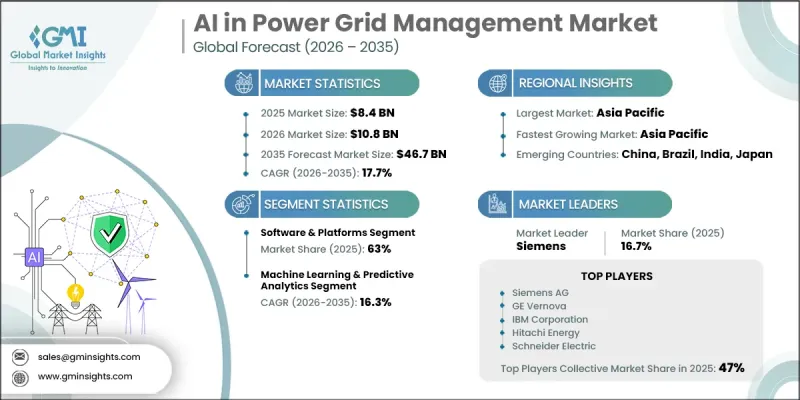
전력망 관리 분야 AI 시장은 전력 회사들이 전력망 모니터링, 예측 유지보수 및 실시간 운영 의사결정을 개선하기 위해 지능형 기술을 점점 더 많이 도입함에 따라 눈부신 성장을 이루고 있습니다. 예기치 못한 정전 감소, 서비스 신뢰성 향상, 노후화된 송배전 인프라의 현대화에 대한 압박이 커지면서 전력망 전반에 걸쳐 인공지능 도입이 가속화되고 있습니다. 동시에, 재생에너지원의 통합이 진행됨에 따라 전력망 운영은 점점 더 복잡해지고 있으며, 전력 회사들은 공급, 수요 및 분산형 에너지 자원의 균형을 보다 효율적으로 조정할 수 있는 AI 기반 솔루션의 도입을 추진하고 있습니다. 인공지능을 통해 전력 회사는 고장이 발생하기 전에 장비의 문제를 파악하고, 정교한 분석을 통해 운영 성능을 최적화함으로써, 사후 대응형 유지보수에서 예측형 전력망 관리로 전환할 수 있게 되었습니다. 이러한 기능들은 평균 복구 시간(MTTR) 단축, 운영 비용 절감, 그리고 전력망 전체의 신뢰성 향상에 기여합니다. AI 도입이 시범 사업 단계에서 본격적인 상용화 단계로 계속 전환되는 가운데, 전력망 관리 분야 AI 시장은 전 세계 에너지 분야 전반에서 진행 중인 디지털 전환 노력의 혜택을 받을 것으로 예상됩니다.
| 시장 범위 | |
|---|---|
| 시작 연도 | 2025년 |
| 예측 기간 | 2026-2035년 |
| 시작 시점 시장 규모 | 84억 달러 |
| 예측액 | 467억 달러 |
| CAGR | 17.7% |
소프트웨어 및 플랫폼 부문은 2025년에 63%의 점유율을 차지했으며, 2035년까지 연평균 성장률(CAGR) 16.9%를 기록할 것으로 전망됩니다. 이 부문이 우위를 점하고 있는 이유는, 소프트웨어 솔루션이 고도화된 분석, 의사결정, AI 모델 도입을 지원함으로써 스마트한 공공사업 운영의 기반이 되고 있기 때문입니다. 이 부문에는 기업용 에너지 관리 시스템, 배전 관리 플랫폼, 그리고 고장 예측, 수요 반응 관리, 재생에너지 통합, 전력 시스템 전반의 최적화를 개선하기 위해 설계된 기계 학습 지원 소프트웨어가 포함됩니다. 운영 효율 향상과 전력 계통 성능 강화를 목표로 하는 전력 사업자에게 있어, 지능형 소프트웨어 플랫폼에 대한 지속적인 투자는 여전히 필수적입니다.
기계 학습 및 예측 분석 부문은 2025년에 35%의 시장 점유율을 차지했으며, 2035년까지 연평균 성장률(CAGR) 16.3%로 성장할 것으로 전망됩니다. 이 부문이 시장을 선도하고 있는 이유는, 기계 학습 기술이 전력 수요 예측, 예측 유지보수, 이상 감지 등 수많은 송배전망 관리 기능에 폭넓게 적용되고 있기 때문입니다. 이 분야의 적극적인 도입은 전력 회사의 방대한 이력 데이터 활용 가능성, 기계 학습 개발 도구의 성숙도, 그리고 운영 및 규제 요건을 충족하면서 투명하고 신뢰할 수 있는 인사이트를 제공할 수 있는 예측 모델의 역량에 힘입어 이루어지고 있습니다. 이러한 장점들은 현대 전력망 관리에서 기계 학습의 역할을 지속적으로 강화하고 있습니다.
북미 전력 계통 관리 분야 AI 시장은 2025년에 38.5%의 점유율을 차지했으며, 2035년까지 연평균 성장률(CAGR) 17.6%로 성장할 것으로 전망됩니다. 지역 시장의 성장은 주로 전력 계통의 현대화, 디지털 전력 인프라, 그리고 전력 계통의 회복탄력성과 운영 효율성을 향상시키는 첨단 기술에 대한 투자 확대에 의해 주도되고 있습니다. 이 지역의 전력 회사들은 전력 시스템의 신뢰성을 강화하고, 탈탄소화 노력을 지원하며, 재생에너지의 통합을 최적화하기 위해 계속해서 인공지능을 우선시하고 있으며, 이를 통해 북미는 세계 시장에서 리더십을 더욱 공고히 하고 있습니다.
자주 묻는 질문
목차
제1장 조사 방법과 범위
제2장 주요 요약
제3장 업계 인사이트
제4장 경쟁 구도
제5장 시장 규모 및 예측 : 구성요소별, 2022-2035년
제6장 시장 규모 및 예측 : AI 기술별, 2022-2035년
제7장 시장 규모 및 예측 : 용도별, 2022-2035년
제8장 시장 규모 및 예측 : 최종사용자별, 2022-2035년
제9장 시장 규모 및 예측 : 지역별, 2022-2035년
제10장 기업 개요
KSM 26.07.15The Global AI in Power Grid Management Market was valued at USD 8.4 billion in 2025 and is estimated to grow at a CAGR of 17.7% to reach USD 46.7 billion by 2035.
The AI in power grid management market is witnessing significant growth as electric utilities increasingly adopt intelligent technologies to improve grid monitoring, predictive maintenance, and real-time operational decision-making. Rising pressure to reduce unplanned power outages, improve service reliability, and modernize aging transmission and distribution infrastructure is accelerating the deployment of artificial intelligence across utility networks. At the same time, the growing integration of renewable energy sources is increasing the complexity of grid operations, encouraging utilities to implement AI-powered solutions capable of balancing supply, demand, and distributed energy resources more efficiently. Artificial intelligence is enabling utilities to shift from reactive maintenance to predictive grid management by identifying equipment issues before failures occur and optimizing operational performance through advanced analytics. These capabilities help reduce mean time to repair (MTTR), lower operating expenses, and improve overall grid reliability. As AI adoption continues to move beyond pilot initiatives toward full-scale commercial deployment, the AI in power grid management market is expected to benefit from ongoing digital transformation initiatives across the global energy sector.
| Market Scope | |
|---|---|
| Start Year | 2025 |
| Forecast Year | 2026-2035 |
| Start Value | $8.4 Billion |
| Forecast Value | $46.7 Billion |
| CAGR | 17.7% |
The software and platforms segment accounted for 63% share in 2025 and is expected to register a CAGR of 16.9% through 2035. This segment maintains its dominant position because software solutions serve as the foundation for intelligent utility operations by supporting advanced analytics, decision-making, and AI model deployment. The segment includes enterprise energy management systems, distribution management platforms, and machine learning-enabled software designed to improve fault prediction, demand response management, renewable energy integration, and overall grid optimization. Continued investment in intelligent software platforms remains essential for utilities seeking greater operational efficiency and enhanced grid performance.
The machine learning and predictive analytics segment represented 35% share in 2025 and is projected to grow at a CAGR of 16.3% during 2035. This segment leads the market because machine learning technologies are widely applied across numerous grid management functions, including electricity demand forecasting, predictive equipment maintenance, and anomaly detection. Strong adoption is supported by the availability of extensive historical utility data, the maturity of machine learning development tools, and the ability of predictive models to deliver transparent, reliable insights that align with operational and regulatory requirements. These advantages continue to strengthen the role of machine learning in modern power grid management.
North America AI in Power Grid Management Market accounted for 38.5% share in 2025 and is projected to grow at a CAGR of 17.6% throughout 2035. Regional market growth is primarily driven by increasing investments in grid modernization, digital utility infrastructure, and advanced technologies that improve grid resilience and operational efficiency. Utilities across the region continue to prioritize artificial intelligence to strengthen power system reliability, support decarbonization initiatives, and optimize renewable energy integration, reinforcing North America's leadership within the global market.
Major companies operating in the global AI in power grid management market include Siemens, ABB, Oracle Utilities, Honeywell, GridBeyond, Cognite, Baker Hughes, Toshiba Energy Systems, AVEVA, Uplight, C3.ai, IBM, Hitachi Energy, BluWave-ai, GE Vernova, AspenTech, Schneider Electric, Envision Digital, Utilidata, Buzz Solutions, and Enel Group. Companies operating in the AI in power grid management market are strengthening their competitive position by investing in advanced artificial intelligence algorithms, cloud-based grid management platforms, and predictive analytics solutions that improve utility performance and operational efficiency. Many organizations are expanding research and development activities to enhance machine learning capabilities, automate grid operations, and improve renewable energy management. Strategic collaborations with utility providers, technology companies, and energy infrastructure operators are accelerating product deployment and expanding market reach. Businesses are also focusing on scalable software platforms, cybersecurity enhancements, and real-time analytics to address evolving utility requirements.
Table of Contents
Chapter 1 Methodology & Scope
- 1.1 Research approach
- 1.2 Quality commitment
- 1.2.1 GMI AI policy & data integrity commitment
- 1.2.1.1 Source consistency protocol
- 1.2.1 GMI AI policy & data integrity commitment
- 1.3 Research Trail & Confidence Scoring
- 1.3.1 Research Trail Components
- 1.3.2 Scoring Components
- 1.4 Data Collection
- 1.4.1 Partial list of primary sources
- 1.5 Data mining sources
- 1.5.1 Paid sources
- 1.5.1.1 Sources, by region
- 1.5.1 Paid sources
- 1.6 Base estimates and calculations
- 1.6.1 Base year calculation for any one approach
- 1.7 Forecast model
- 1.8 Research transparency addendum
- 1.8.1 Source attribution framework
- 1.8.2 Quality assurance metrics
- 1.8.3 Our commitment to trust
- 1.8.3.1 Market definitions
Chapter 2 Executive Summary
- 2.1 Industry synopsis, 2022 - 2035
- 2.2 Business trends
- 2.3 Component trends
- 2.4 AI technology trends
- 2.5 Application trends
- 2.6 End User trends
- 2.7 Regional trends
Chapter 3 Industry Insights
- 3.1 Industry ecosystem analysis
- 3.2 Industry impact forces
- 3.2.1 Growth drivers
- 3.2.2 Industry pitfalls & challenges
- 3.3 Growth potential analysis
- 3.4 Regulatory landscape
- 3.5 Porter's analysis
- 3.5.1 Bargaining power of suppliers
- 3.5.2 Bargaining power of buyers
- 3.5.3 Threat of new entrants
- 3.5.4 Threat of substitutes
- 3.6 PESTEL analysis
- 3.7 Technology & Innovation Landscape
- 3.7.1 AI & machine learning in power grid management
- 3.7.2 IoT-enabled condition monitoring in power plants
- 3.7.3 Digital twin applications in power grid assets
- 3.7.4 Edge computing & real-time analytics
- 3.8 Pricing Analysis (Driven by Primary Research)
- 3.8.1 Pricing trends by Component
- 3.9 Impact of AI & generative AI on the market
- 3.9.1 AI-driven Predictive Maintenance & Fault Detection
- 3.9.2 GenAI use cases in maintenance planning & asset management
- 3.9.3 Autonomous maintenance & decision intelligence
- 3.9.4 Risks, limitations & cybersecurity challenges
- 3.10 Emerging opportunities & trends
- 3.11 Investment analysis & future outlook
Chapter 4 Competitive Landscape, 2026
- 4.1 Introduction
- 4.2 Company market share analysis, by region, 2025
- 4.2.1 North America
- 4.2.2 Europe
- 4.2.3 Asia Pacific
- 4.2.4 Middle East & Africa
- 4.2.5 Latin America
- 4.3 Competitive positioning matrix
- 4.4 Key Developments
- 4.4.1 Mergers & acquisitions
- 4.4.2 Partnerships & collaborations
- 4.4.3 New product launches
- 4.4.4 Expansion plans and funding
Chapter 5 Market Size and Forecast, By Component, 2022 - 2035 (USD Million)
- 5.1 Key trends
- 5.2 Software & platforms
- 5.2.1 Grid analytics & situational awareness platforms
- 5.2.2 AI-integrated SCADA & energy management systems
- 5.2.3 Demand forecasting & load optimization software
- 5.2.4 Others
- 5.3 Services
- 5.3.1 Consulting & advisory services
- 5.3.2 System integration & implementation services
- 5.3.3 Others
Chapter 6 Market Size and Forecast, By AI Technology, 2022 - 2035 (USD Million)
- 6.1 Key trends
- 6.2 Machine learning & predictive analytics
- 6.3 Deep learning & neural networks
- 6.4 Computer vision & image processing
- 6.5 Others
Chapter 7 Market Size and Forecast, By Application, 2022 - 2035 (USD Million)
- 7.1 Key trends
- 7.2 Demand forecasting & load management
- 7.3 Fault detection & predictive maintenance
- 7.4 Grid optimization & energy balancing
- 7.5 Renewable energy integration
- 7.6 Others
Chapter 8 Market Size and Forecast, By End User, 2022 - 2035 (USD Million)
- 8.1 Key trends
- 8.2 Investor-Owned Utilities (IOUs)
- 8.3 Public power utilities & cooperatives
- 8.4 Industrial & commercial microgrids
- 8.5 Others
Chapter 9 Market Size and Forecast, By Region, 2022 - 2035 (USD Million)
- 9.1 Key trends
- 9.2 North America
- 9.2.1 U.S.
- 9.2.2 Canada
- 9.2.3 Mexico
- 9.3 Europe
- 9.3.1 Germany
- 9.3.2 UK
- 9.3.3 France
- 9.3.4 Denmark
- 9.3.5 Sweden
- 9.4 Asia Pacific
- 9.4.1 China
- 9.4.2 Japan
- 9.4.3 India
- 9.4.4 South Korea
- 9.4.5 Australia
- 9.5 Middle East & Africa
- 9.5.1 Saudi Arabia
- 9.5.2 UAE
- 9.5.3 South Africa
- 9.6 Latin America
- 9.6.1 Brazil
- 9.6.2 Chile
Chapter 10 Company Profiles
- 10.1 ABB
- 10.2 AspenTech
- 10.3 AVEVA
- 10.4 Baker Hughes
- 10.5 BluWave-ai
- 10.6 Buzz Solutions
- 10.7 C3.ai
- 10.8 Cognite
- 10.9 Enel Group
- 10.10 Envision Digital
- 10.11 GE Vernova
- 10.12 GridBeyond
- 10.13 Hitachi Energy
- 10.14 Honeywell
- 10.15 IBM
- 10.16 Oracle Utilities
- 10.17 Schneider Electric
- 10.18 Siemens
- 10.19 Toshiba Energy Systems
- 10.20 Uplight
- 10.21 Utilidata