

|
시장보고서
상품코드
2083065
자동차 블랙박스 시장 기회, 성장 촉진요인, 업계 동향 분석 및 예측(2026-2035년)Automotive Dashcam Market Opportunity, Growth Drivers, Industry Trend Analysis, and Forecast 2026 - 2035 |
||||||

세계의 자동차 블랙박스 시장은 2025년에 23억 달러 규모에 달하고, CAGR 7.6%로 성장하여 2035년까지 48억 달러에 달할 것으로 예측됩니다.
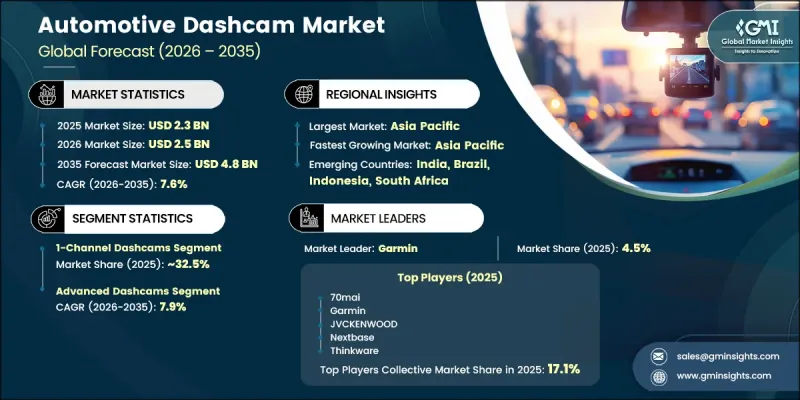
차량 소유주, 차량 관리 업체, 보험사, 운송사 등이 영상 기반 감시 및 증거 수집 솔루션의 가치를 점점 더 인식함에 따라 시장의 성장세는 계속해서 이어지고 있습니다. 차량용 대시캠은 단순한 녹화 장치에서 벗어나, 폭넓은 차량 관리 기능을 지원할 수 있는 첨단 안전 및 커넥티비티 플랫폼으로 진화하고 있습니다. 교통 안전, 사고 기록, 책임 면제, 그리고 운전자에 대한 책임 추궁에 대한 우려가 커지면서 시장 확대에 크게 기여하고 있습니다. 또한, 인공지능, 실시간 분석 및 지능형 모니터링 기능의 통합이 진행됨에 따라, 현대 차량에서 블랙박스의 역할은 큰 변화를 겪고 있습니다. 이러한 시스템은 현재 주행 상황, 차량의 움직임 및 운전자의 행동을 지속적으로 모니터링함으로써 예방적 안전 기능을 지원하고 있습니다. 커넥티드카 기술과 첨단 텔레매틱스 플랫폼의 도입 확대는 승용차 및 상용차 양 부문에서 수요를 더욱 가속화하고 있습니다. 또한 화질, 데이터 저장 용량, 무선 연결, 클라우드 기반 서비스의 개선으로 제품의 가치가 높아지면서, 더욱 광범위한 보급이 촉진되고 있습니다. 자동차 기술이 지속적으로 발전함에 따라, 블랙박스는 전 세계적으로 차량의 안전성, 보안 및 운영 효율성 전략에서 점점 더 중요한 요소로 자리 잡고 있습니다.
| 시장 범위 | |
|---|---|
| 시작 연도 | 2025년 |
| 예측 기간 | 2026-2035년 |
| 초기 시장 규모 | 23억 달러 |
| 예측액 | 48억 달러 |
| CAGR | 7.6% |
2025년에는 1채널형 블랙박스 부문이 시장 점유율의 32.5%를 차지하며 7억 6,180만 달러의 매출을 올렸습니다. 1채널형 시스템은 신뢰성이 높은 동영상 녹화 솔루션을 찾는 첫 구매자나 가격을 중시하는 소비자들 사이에서 계속해서 꾸준한 수요를 유지하고 있습니다. 각 제조사는 합리적인 가격을 유지하면서도 첨단 기능을 탑재함으로써, 이러한 제품의 성능을 대폭 향상시키고 있습니다. 기능성, 설치 편의성, 그리고 가성비 면에서 균형을 잘 갖추고 있어 다양한 차종에서 계속해서 널리 보급되고 있습니다.
2025년에는 첨단 기능을 갖춘 블랙박스 부문이 51.9%의 시장 점유율을 차지하며 12억 2,000만 달러의 매출을 올렸습니다. 시장 성장을 주도하고 있는 것은, 고도화된 연결성, 위치 추적, 원격 접속 기능 및 자동 이벤트 감지 기능을 제공하는 지능형 차량 모니터링 솔루션에 대한 수요 증가입니다. 첨단 블랙박스는 동영상 녹화, 차량 모니터링, 데이터 관리 기능을 결합한 통합 생태계를 통해 더 큰 가치를 제공합니다. 차량 소유자들이 보호 강화, 보안 향상 및 종합적인 주행 분석 정보를 추구함에 따라, 이러한 시스템의 도입이 점점 더 확대되고 있습니다.
중국의 자동차 블랙박스 시장은 2025년에 5억 2,290만 달러의 시장 규모를 기록했으며, 2035년까지 12억 7,000만 달러에 달할 것으로 전망되어 연평균 성장률(CAGR)은 9.3%에 달할 것으로 보입니다. 시장 확대는 해당 국가의 막대한 자동차 보유 대수, 자동차 안전 기술에 대한 소비자의 인식 제고, 그리고 강력한 국내 생산 역량에 힘입어 이루어지고 있습니다. 커넥티드카 솔루션, 지능형 교통 기술 및 첨단 자동차 전자기기에 대한 수요가 증가함에 따라, 이러한 기술들의 도입이 계속해서 촉진되고 있습니다. 경쟁력 있는 가격 책정, 신속한 기술 통합, 그리고 다양한 기능을 갖춘 제품의 공급 확대 역시 전국적인 시장 성장에 더욱 기여하고 있습니다.
자주 묻는 질문
목차
제1장 조사 방법
제2장 주요 요약
제3장 업계 인사이트
제4장 경쟁 구도
제5장 시장 추정 및 예측 : 제품별, 2022-2035년
제6장 시장 추정 및 예측 : 기술별, 2022-2035년
제7장 시장 추정 및 예측 : 영상 품질별, 2022-2035년
제8장 시장 추정 및 예측 : 차량별, 2022-2035년
제9장 시장 추정 및 예측 : 판매 채널별, 2022-2035년
제10장 시장 추정 및 예측 : 지역별, 2022-2035년
제11장 기업 개요
KSM 26.07.15The Global Automotive Dashcam Market was valued at USD 2.3 billion in 2025 and is estimated to grow at a CAGR of 7.6% to reach USD 4.8 billion by 2035.
The market continues to gain momentum as vehicle owners, fleet operators, insurers, and transportation companies increasingly recognize the value of video-based monitoring and evidence collection solutions. Automotive dashcams have evolved from basic recording devices into sophisticated safety and connectivity platforms capable of supporting a broad range of vehicle management functions. Growing concerns regarding road safety, accident documentation, liability protection, and driver accountability are significantly contributing to market expansion. In addition, the rising integration of artificial intelligence, real-time analytics, and intelligent monitoring capabilities is transforming the role of dashcams within modern vehicles. These systems now support proactive safety functions by continuously monitoring driving conditions, vehicle movements, and driver behavior. The increasing adoption of connected vehicle technologies and advanced telematics platforms is further accelerating demand across both consumer and commercial vehicle segments. Furthermore, improvements in image quality, data storage capabilities, wireless connectivity, and cloud-based services are enhancing product value and encouraging wider adoption. As automotive technologies continue to advance, dashcams are becoming an increasingly important component of vehicle safety, security, and operational efficiency strategies worldwide.
| Market Scope | |
|---|---|
| Start Year | 2025 |
| Forecast Year | 2026-2035 |
| Start Value | $2.3 Billion |
| Forecast Value | $4.8 Billion |
| CAGR | 7.6% |
The 1-channel dashcam segment accounted for 32.5% share in 2025, generating USD 761.8 million. Single-channel systems continue to maintain strong demand among first-time users and budget-conscious consumers seeking dependable video recording solutions. Manufacturers have significantly improved the capabilities of these products by incorporating advanced features while maintaining affordability. Their balance of functionality, ease of installation, and cost-effectiveness continues to support widespread adoption across multiple vehicle categories.
The advanced dashcam segment held a 51.9% share, generating USD 1.22 billion in 2025. Market growth is being driven by increasing demand for intelligent vehicle monitoring solutions that offer enhanced connectivity, location tracking, remote access capabilities, and automated event detection. Advanced dashcams provide greater value through integrated ecosystems that combine video recording, vehicle monitoring, and data management functionalities. These systems are increasingly being adopted as vehicle owners seek enhanced protection, improved security, and comprehensive driving insights.
China Automotive Dashcam Market generated USD 522.9 million in 2025 and is projected to reach USD 1.27 billion by 2035, reflecting a CAGR of 9.3%. Market expansion is supported by the country's extensive vehicle population, growing consumer awareness of vehicle safety technologies, and strong domestic manufacturing capabilities. Increasing demand for connected vehicle solutions, intelligent transportation technologies, and advanced automotive electronics continues to drive adoption. Competitive pricing, rapid technology integration, and expanding availability of feature-rich products are further contributing to the market's growth across the country.
Key companies operating in the global automotive dashcam market include DDPAI, Nexar, Vantrue, Garmin, Thinkware, Pittasoft (BlackVue), Nextbase, Rexing, VIOFO, 70mai, JVCKENWOOD, Mio Technology, Cobra Electronics, Papago, Redtiger, Qubo, KENT Cam, Apeman, Momento, and Transcend Information. Companies operating in the automotive dashcam market are focusing on product innovation, technology integration, and strategic partnerships to strengthen their market position. Manufacturers are investing in artificial intelligence, cloud connectivity, real-time analytics, and advanced video processing capabilities to enhance product performance and differentiate their offerings. Many companies are expanding their portfolios with smart dashcams that integrate seamlessly with connected vehicle ecosystems and mobile applications. Strategic collaborations with automotive manufacturers, fleet operators, insurance providers, and telematics companies are helping increase market penetration and customer reach.
Table of Contents
Chapter 1 Methodology
- 1.1 Research approach
- 1.2 Quality Commitments
- 1.2.1 GMI AI policy & data integrity commitment
- 1.3 Research Trail & Confidence Scoring
- 1.3.1 Research Trail Components
- 1.3.2 Scoring Components
- 1.4 Data Collection
- 1.5 Data mining sources
- 1.5.1 Paid sources
- 1.6 Base estimates and calculations
- 1.6.1 Base year calculation
- 1.7 Forecast model
- 1.7.1 Quantified market impact analysis
- 1.8 Research transparency addendum
- 1.8.1 Source attribution framework
- 1.8.2 Quality assurance metrics
- 1.8.3 Our commitment to trust
Chapter 2 Executive Summary
- 2.1 Industry 360° synopsis
- 2.2 Key market trends
- 2.2.1 Regional
- 2.2.2 Product
- 2.2.3 Technology
- 2.2.4 Video Quality
- 2.2.5 Vehicle
- 2.2.6 Sales Channel
- 2.3 TAM analysis, 2026-2035
- 2.4 CXO perspectives: Strategic imperatives
Chapter 3 Industry Insights
- 3.1 Industry ecosystem analysis
- 3.1.1 Supplier landscape
- 3.1.2 Profit margin
- 3.1.3 Cost structure
- 3.1.4 Value addition at each stage
- 3.1.5 Factor affecting the value chain
- 3.1.6 Disruptions
- 3.2 Industry impact forces
- 3.2.1 Growth drivers
- 3.2.1.1 Rising Road Accidents & Demand for Evidence Collection
- 3.2.1.2 Increasing Insurance Fraud Cases & Claims Verification Needs
- 3.2.1.3 Integration with AI-Powered ADAS & Safety Systems
- 3.2.1.4 Expansion of Commercial Fleets, Ride-Hailing & Logistics Services
- 3.2.2 Industry pitfalls and challenges
- 3.2.2.1 Data Privacy Concerns & Regulatory Restrictions
- 3.2.2.2 Product Quality Issues & Fragmented Competitive Landscape
- 3.2.3 Market opportunities
- 3.2.3.1 Convergence with Usage-Based Insurance (UBI) Data Platforms
- 3.2.3.2 Adoption of Cloud-Connected 4G/LTE/5G Video Telematics
- 3.2.3.3 Institutional Support & Government Mandates
- 3.2.1 Growth drivers
- 3.3 Technology and innovation landscape
- 3.3.1 Current technological trends
- 3.3.2 Emerging technologies
- 3.4 Growth potential analysis
- 3.5 Pricing Analysis (Driven by Primary Research)
- 3.5.1 Historical Price Trend Analysis
- 3.5.2 Pricing Strategy by Player Type (Premium / Value / Cost-plus)
- 3.6 Regulatory landscape
- 3.6.1 North America
- 3.6.1.1 US - National Highway Traffic Safety Administration
- 3.6.1.2 US - Federal Motor Carrier Safety Administration
- 3.6.1.3 Canada - Transport Canada
- 3.6.2 Europe
- 3.6.2.1 EU - EU Directorate-General for Mobility and Transport
- 3.6.2.2 UK - Driver and Vehicle Standards Agency
- 3.6.3 Asia Pacific
- 3.6.3.1 China - Ministry of Industry and Information Technology
- 3.6.3.2 Japan - Ministry of Land, Infrastructure, Transport and Tourism
- 3.6.4 LATAM
- 3.6.4.1 Brazil - National Traffic Department
- 3.6.4.2 Argentina - National Road Safety Agency
- 3.6.5 MEA
- 3.6.5.1 South Africa - Road Traffic Management Corporation
- 3.6.5.2 Saudi Arabia - Saudi Standards, Metrology and Quality Organization
- 3.6.1 North America
- 3.7 Porter's analysis
- 3.8 PESTEL analysis
- 3.9 Trade Data Analysis (Driven by Paid Database)
- 3.9.1 Import/Export Volume & Value Trends
- 3.9.2 Key Trade Corridors & Tariff Impact
- 3.10 Capacity & Production Landscape (Driven by Primary Research)
- 3.10.1 Installed Capacity by Region & Key Producer
- 3.10.2 Capacity Utilization Rates & Expansion Pipelines
- 3.11 Cost breakdown analysis
- 3.12 Patent analysis (Driven by Primary Research)
- 3.13 Sustainability and environmental aspects
- 3.13.1 Sustainable Practices
- 3.13.2 Waste Reduction Strategies
- 3.13.3 Energy Efficiency in Production
- 3.13.4 Eco-friendly Initiatives
- 3.13.5 Carbon Footprint Considerations
- 3.14 Impact of AI & generative AI on the market
- 3.14.1 AI-driven disruption of existing business models
- 3.14.2 GenAI use cases & adoption roadmap by segment
- 3.14.3 Risks, limitations & regulatory considerations
- 3.15 Forecast assumptions & scenario analysis (Driven by Primary Research)
- 3.15.1 Base Case- Key Macro & Industry Variables Driving CAGR
- 3.15.2 Optimistic Scenarios- Favorable macro and industry tailwinds
- 3.15.3 Pessimistic Scenario - Macroeconomic slowdown or industry headwinds
Chapter 4 Competitive Landscape, 2025
- 4.1 Introduction
- 4.2 Company market share analysis
- 4.2.1 North America
- 4.2.2 Europe
- 4.2.3 Asia Pacific
- 4.2.4 LATAM
- 4.2.5 MEA
- 4.3 Competitive analysis of major market players
- 4.4 Competitive positioning matrix
- 4.5 Key developments
- 4.5.1 Mergers & acquisitions
- 4.5.2 Partnerships & collaborations
- 4.5.3 New product launches
- 4.5.4 Expansion plans and funding
- 4.6 Company tier benchmarking
- 4.6.1 Tier classification criteria & qualifying thresholds
- 4.6.2 Tier positioning matrix by revenue, geography & innovation
Chapter 5 Market Estimates and Forecast, By Product, 2022 - 2035 ($ Mn, Units)
- 5.1 Key trends
- 5.2 1-Channel
- 5.3 2-Channel
- 5.4 Rear View
- 5.5 Multi-Channel
Chapter 6 Market Estimates and Forecast, By Technology, 2022 - 2035 ($ Mn, Units)
- 6.1 Key trends
- 6.2 Basic Dashcams
- 6.3 Advanced Dashcams
- 6.4 Smart Dashcams
Chapter 7 Market Estimates and Forecast, By Video Quality, 2022 - 2035 ($ Mn, Units)
- 7.1 Key trends
- 7.2 SD & HD (up to 1080p)
- 7.3 Full HD & 4K (1080p and above)
Chapter 8 Market Estimates and Forecast, By Vehicle, 2022 - 2035 ($ Mn, Units)
- 8.1 Key trends
- 8.2 Passenger cars
- 8.2.1 Hatchback
- 8.2.2 Sedan
- 8.2.3 SUV
- 8.3 Commercial vehicles
- 8.3.1 Light commercial vehicles
- 8.3.2 Medium commercial vehicles
- 8.3.3 Heavy commercial vehicles
Chapter 9 Market Estimates and Forecast, By Sales Channel, 2022 - 2035 ($ Mn, Units)
- 9.1 Key trends
- 9.2 OEM/OE-Integrated
- 9.3 Aftermarket
- 9.3.1 Online
- 9.3.2 In-Store/Offline
Chapter 10 Market Estimates & Forecast, By Region, 2022 - 2035 ($Mn, Units)
- 10.1 Key trends
- 10.2 North America
- 10.2.1 US
- 10.2.2 Canada
- 10.3 Europe
- 10.3.1 Germany
- 10.3.2 UK
- 10.3.3 France
- 10.3.4 Italy
- 10.3.5 Spain
- 10.3.6 Russia
- 10.3.7 Poland
- 10.3.8 Norway
- 10.4 Asia Pacific
- 10.4.1 China
- 10.4.2 India
- 10.4.3 Japan
- 10.4.4 Australia
- 10.4.5 Indonesia
- 10.4.6 South Korea
- 10.4.7 Thailand
- 10.4.8 Vietnam
- 10.5 Latin America
- 10.5.1 Brazil
- 10.5.2 Mexico
- 10.5.3 Argentina
- 10.6 MEA
- 10.6.1 South Africa
- 10.6.2 Saudi Arabia
- 10.6.3 UAE
Chapter 11 Company Profiles
- 11.1 Global players
- 11.1.1 Garmin
- 11.1.2 Pittasoft (BlackVue)
- 11.1.3 Thinkware
- 11.1.4 70mai
- 11.1.5 Nextbase
- 11.1.6 Rexing
- 11.1.7 VIOFO
- 11.1.8 JVCKENWOOD
- 11.1.9 Cobra Electronics
- 11.1.10 Mio Technology
- 11.1.11 Transcend Information
- 11.2 Regional players
- 11.2.1 Papago
- 11.2.2 Redtiger
- 11.2.3 Qubo
- 11.2.4 KENT Cam
- 11.2.5 Apeman
- 11.2.6 Vantrue
- 11.3 Emerging players
- 11.3.1 Nexar
- 11.3.2 Momento
- 11.3.3 DDPAI


