|
시장보고서
상품코드
2122953
북미의 대시보드 카메라 시장 : 시장 점유율 분석, 업계 동향 및 통계, 성장 예측(2026-2031년)North America Dashboard Camera - Market Share Analysis, Industry Trends & Statistics, Growth Forecasts (2026 - 2031) |
||||||
 Mordor Intelligence
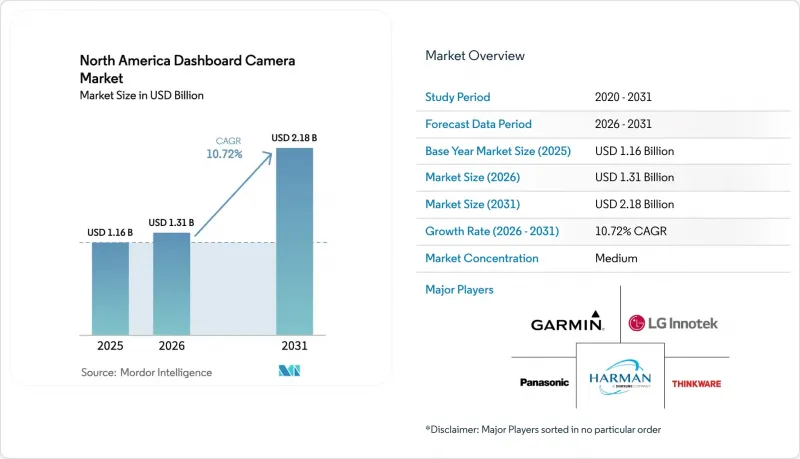
Mordor Intelligence에 의하면, 북미의 대시보드 카메라 시장 규모는 2025년 11억 6,000만 달러로 평가되었고, 2026년 13억 1,000만 달러에서 2031년까지 21억 8,000만 달러로 확대될 것으로 예측되며, 2026-2031년 연평균 복합 성장률(CAGR)은 10.72%를 기록할 전망입니다.
본 보고서는 기술별(기본형, 스마트형), 유통 채널별(오프라인, 온라인), 차종별(승용차, 상용차), 해상도별(SD(720p 이하), HD(1080p), 기타), 용도별(개인용, 상용 차량, 법 집행 기관), 가격대별(이코노미(100달러 이하), 기타), 지역별로 분류되어 있습니다. 시장 예측은 금액(달러) 기준으로 제시되어 있습니다.
북미의 대시보드 카메라 시장 동향 및 인사이트
운전자 안전 및 법적 증거로서의 채택에 대한 중요성 증대
이 지역의 법원에서는 대시보드 카메라 영상을 증거로 인정하는 사례가 증가하고 있으며, 이로 인해 보험사 및 차량 소유 사업자의 소송 소요 기간과 화해 비용이 절감되고 있습니다. 현재 상업용 보험사 5곳 중 4곳 이상이 인수 심사 과정에 텔레매틱스 데이터를 통합하고 있으며, AI 탑재 카메라를 30개월간 사용한 차량 소유 사업자의 경우 사고 발생률이 73% 감소했습니다. 코네티컷주가 2025년부터 분쟁 중인 사고에 대해 최소 90일간의 보관 및 4년간의 아카이브 기간을 의무화하는 것은 다른 주들도 따를 가능성이 높은 모델을 확립하는 것입니다. 이러한 요인들이 결합되면서 대시보드 카메라는 단순한 선택적 기기에서 표준 위험 관리 도구로 그 위상이 재정의되고 있습니다.
스마트형·커넥티드형 대시보드 카메라의 기술적 진보
5nm 시스템 온 칩(SoC) 설계를 통해 4K60 동영상을 인코딩하고, 2와트 이하의 전력 소비로 신경망을 구동할 수 있게 되어, 소비자용 기기와 차량용 기기의 비용 차이가 줄어들고 있습니다. 최근 출시된 제품에서는 200달러 미만의 기기에 졸음 경고, 사각지대 감지, 실시간 클라우드 동기화 기능이 통합되어 있습니다. 예전에는 프리미엄 기능이었던 음성 제어 및 지속적인 클라우드 백업이 현재는 중급 제품에도 탑재되어, 구매자를 기능이 풍부한 구독 서비스로 유도하고 있습니다. 영상, GPS, 차량 상태 데이터를 융합하는 벤더들은 더 심층적인 인사이트력을 제공하여 고객 유지율을 높이고 있습니다.
개인정보 보호에 대한 우려와 데이터 보호 규제
캘리포니아주 상원 법안 296호에 따라 자동차 제조업체는 명시적인 동의를 얻고 카메라 데이터를 로컬에 저장해야 할 의무가 있으며, 이로 인해 규정 준수 비용이 증가하고 공장 출하 시 탑재가 지연되고 있습니다. 일리노이주와 텍사스주의 생체 인식 개인정보 보호 관련 법안은 얼굴 인식 알림을 제공하는 공급업체에 불확실성을 초래하고 있으며, 주마다 펌웨어 사양을 변경할 수밖에 없는 상황입니다. 옹호 단체들은 통일된 공개 기준의 확립을 계속해서 요구하고 있으며, 연방 차원의 프레임워크가 확립될 때까지는 기능의 도입이 불균일한 상태가 지속될 것으로 보입니다.
부문 분석
2025년에는 클라우드 영상, AI 기반 이벤트 감지, 텔레매틱스 통합에 힘입어 스마트형 장치가 62.34%의 점유율을 차지했습니다. 북미 대시보드 카메라 시장에서 스마트 모델 시장 규모는 증거 자료의 자동 업로드 및 라이브 뷰를 통한 운전자 지도가 가능한 구독 서비스가 구매자들에게 받아들여짐에 따라 2031년까지 연평균 성장률(CAGR) 11.13%로 확대될 것으로 예측됩니다.월 9.99달러의 클라우드 요금제 등 정기 과금을 통해 벤더의 수익 구조는 소프트웨어를 통한 지속적 수익으로 전환되고 있습니다. Nextbase가 2025년에 보행자 감지 기능을 기기에 직접 내장한 머신 비전 스타트업(startup)을 인수한 것은 현재 광학 기술이 아닌 소프트웨어야말로 차별화의 기반이 되고 있음을 보여줍니다.
가격 하락으로 인해 기본형 카메라와의 가격 차이가 줄어들고 있어, 녹화 데이터를 로컬에 저장하는 예산 중시형 소비자들에게는 후자의 매력이 점차 사라지고 있습니다. 차량 운영 사업자들은 영상과 GPS, 차량 진단 기능을 통합한 카메라에 매력을 느끼고 있으며, 사고 발생률이 최대 80% 감소한다는 점을 그 이유로 꼽고 있습니다. 향후에는 엣지 AI용 실리콘 칩의 보급으로 인해 엔트리 레벨 부문에서도 스마트 기능이 표준이 되는 한편, 기본형 카메라는 주차 모니터링이나 첫 구매자를 위한 입문용 기기 등 틈새 시장 역할로 전환될 것으로 예측됩니다.
2025년에는 매장 내 설치 및 즉시 구매 가능성을 배경으로 오프라인 매장에서의 거래가 전체의 73.49%를 차지했으나, 온라인 판매는 연평균 성장률(CAGR) 11.19%로 확대되고 있습니다. 북미 대시보드 카메라 시장에서 온라인 채널의 점유율 확대는 익일 배송 및 원활한 클라우드 요금제 활성화와 같은 이점에 힘입은 것으로, 이는 오프라인 소매업체가 따라잡기 어려운 부분입니다. 아마존 베스트셀러 목록에는 약 130달러짜리 3채널 4K 모델이 꾸준히 순위에 올라 있으며, 신뢰성을 높이는 수만 건의 리뷰가 이를 뒷받침하고 있습니다.
상용 차량fleet은 일괄 조달 및 보증 서비스와 관련하여 여전히 오프라인 매장을 보유한 대리점에 의존하고 있습니다. 보험사가 주도하는 보조금 프로그램은 고객을 공인 설치 업체로 유도하여, 그 결과 매장 방문객 수를 증가시키고 있습니다. 이에 대응하여 전자상거래 사업자들은 현재 출장 기술자와 제휴함으로써 편의성의 격차를 좁혀가고 있습니다. 유통 채널의 구성이 점차 온라인 플랫폼으로 전환되고 있는 가운데에서도, 오프라인 매장 판매는 실제 기기를 통한 지원에 힘입어 적어도 향후 10년 중반까지는 그 우위를 계속 유지할 것으로 보입니다.
기타 혜택
- 엑셀 형식 시장 예측(ME) 시트
- 3개월간의 애널리스트 지원
자주 묻는 질문
목차
제1장 서론
제2장 조사 방법
제3장 주요 요약
제4장 시장 구도
제5장 시장 규모 및 성장 예측
제6장 경쟁 구도
제7장 시장 기회 및 향후 전망
AJY 26.09.09According to Mordor Intelligence, the North America dashboard camera market size is projected to expand from USD 1.16 billion in 2025 and USD 1.31 billion in 2026 to USD 2.18 billion by 2031, registering a CAGR of 10.72% between 2026 to 2031.
This report is Segmented by Technology (Basic, and Smart), Distribution Channel (Offline, and Online), Vehicle Type (Passenger Cars, and Commercial Vehicles), Resolution (SD Below 720p, HD 1080p, and More), Application (Personal Use, Commercial Fleet, Law Enforcement), Price Range (Economy Below USD 100, and More), and Geography. The Market Forecasts are Provided in Terms of Value (USD).
North America Dashboard Camera Market Trends and Insights
Growing Emphasis on Driver Safety and Legal Evidence Acceptance
Courts across the region are increasingly accepting dashcam footage, which cuts litigation timelines and settlement costs for insurers and fleets. More than four in five commercial insurers now incorporate telematics data into their underwriting processes, and fleets that have used AI-enabled cameras for 30 months have seen a 73% reduction in crash rates. Connecticut's 2025 requirement of a 90-day minimum retention and four-year archival period for disputed incidents establishes a template that other states are likely to replicate. Together, these factors recast the camera from a discretionary gadget to a standard risk-management tool.
Technological Advancements in Smart and Connected Dash Cams
Five-nanometer system-on-chip designs encode 4K60 video and run neural networks at under 2 watts, shrinking the cost difference between consumer and fleet-grade units. Recent launches integrate drowsiness alerts, blind-spot detection, and live cloud sync into devices priced below USD 200. Voice control and continuous cloud backup, once premium perks, now appear in mid-range offerings, nudging buyers toward feature-rich subscriptions. Vendors that fuse video, GPS, and vehicle health data deliver deeper insights and retain customers longer.
Privacy Concerns and Data-Protection Regulations
California's Senate Bill 296 requires automakers to obtain explicit consent and localize camera data, thereby increasing compliance costs and slowing factory installations. Illinois and Texas biometric-privacy statutes create uncertainty for vendors offering facial-recognition alerts, forcing firmware variations by state. Advocacy groups continue to press for uniform disclosure standards, and until a federal framework emerges, feature rollouts will remain staggered.
Other drivers and restraints analyzed in the detailed report include:
- Falling Dash Cam Prices Across Retail Channels
- Rising Online Retail Penetration for Aftermarket Accessories
- CMOS Sensor Supply Constraints Limiting 4K Models
For complete list of drivers and restraints, kindly check the Table Of Contents.
Segment Analysis
Smart units captured a 62.34% share in 2025, supported by cloud video, AI event detection, and telematics integration. The North America dashboard camera market size for smart models is forecast to grow at an 11.13% CAGR through 2031 as buyers embrace subscription services that automate evidence uploads and enable live-view driver coaching. Recurring fees, such as a USD 9.99 monthly cloud plan, are recasting vendor economics toward software annuities. Nextbase's 2025 acquisition of a machine-vision startup, which embedded pedestrian detection directly on the device, illustrates how software, not optics, now anchors differentiation.
Price erosion narrows the gap with basic cameras, eroding the latter's appeal to budget consumers who back up footage locally. Fleet operators are drawn to cameras that integrate video with GPS and vehicle diagnostics, citing reductions in crash rates of up to 80%. Over time, edge-AI silicon will make smart capabilities standard even in entry-level segments, while basic cameras will retreat to niche roles, such as parking surveillance or serving as starter devices for first-time owners.
Offline stores accounted for 73.49% of transactions in 2025, driven by on-site installations and immediate availability; however, online sales are expanding at an 11.19% CAGR. The North America dashboard camera market share for online channels benefits from next-day delivery and seamless cloud plan activation, which physical retailers struggle to match. Amazon's best-seller lists regularly feature 3-channel 4K units at roughly USD 130, backed by tens of thousands of reviews that amplify trust.
Commercial fleets continue to rely on brick-and-mortar distributors for bulk procurement and warranty services. Insurer-led subsidy programs direct customers to certified installers, thereby increasing store traffic. In response, e-commerce players now partner with mobile technicians, narrowing the convenience gap. Even as the channel mix slowly pivots to online platforms, offline retail will maintain its dominance, bolstered by hands-on support, at least until the middle of the decade.
Complete Report Scope:
- By Technology
- Basic
- Smart
- By Distribution Channel
- Offline
- Online
- By Vehicle Type
- Passenger Cars
- Commercial Vehicles
- By Resolution
- SD (Below 720p)
- HD (1080p)
- Full HD and Above
- By Application
- Personal Use
- Commercial Fleet
- Law Enforcement
- By Price Range
- Economy (Below USD 100)
- Mid-Range (USD 100-200)
- Premium (Above USD 200)
- By Country
- United States
- Canada
- Mexico
List of Companies Covered in this Report:
- Garmin Ltd
- Portable Multimedia Limited
- Thinkware Corporation
- Pittasoft Co. Ltd
- Rexing USA
- LG Innotek
- Panasonic Corporation
- Harman International Industries Inc.
- Transcend Information Inc.
- YI Technologies, Inc.
- Papago Inc.
- Waylens Inc
- Cobra Electronics Corporation
- HP Inc.
- Vantrue
- Scosche Industries, Inc.
- DOD Technologies
- Finedigital Inc.
- Huizhou Topcens Technology Co., Ltd
Additional Benefits:
- The market estimate (ME) sheet in Excel format
- 3 months of analyst support
TABLE OF CONTENTS
1 INTRODUCTION
- 1.1 Study Assumptions and Market Definition
- 1.2 Scope of the Study
2 RESEARCH METHODOLOGY
3 EXECUTIVE SUMMARY
4 MARKET LANDSCAPE
- 4.1 Market Overview
- 4.2 Market Drivers
- 4.2.1 Growing Emphasis on Driver Safety and Legal Evidence Acceptance
- 4.2.2 Technological Advancements in Smart and Connected Dash Cams
- 4.2.3 Falling Dash Cam Prices Across Retail Channels
- 4.2.4 Rising Online Retail Penetration for After-Market Accessories
- 4.2.5 Insurance Telematics Discounts for Dash Cam Users
- 4.2.6 Autonomous Delivery Pilots Requiring Video Event Recorders
- 4.3 Market Restraints
- 4.3.1 Privacy Concerns and Data-Protection Regulations
- 4.3.2 Lower Penetration versus Incentivized European Markets
- 4.3.3 CMOS Sensor Supply Constraints Limiting 4K Models
- 4.3.4 Cyber-security Risks in Connected Dash Cams
- 4.4 Industry Value Chain Analysis
- 4.5 Regulatory Landscape
- 4.6 Technological Outlook
- 4.7 Porter's Five Forces Analysis
- 4.7.1 Bargaining Power of Suppliers
- 4.7.2 Bargaining Power of Buyers
- 4.7.3 Threat of New Entrants
- 4.7.4 Threat of Substitutes
- 4.7.5 Intensity of Competitive Rivalry
- 4.8 Impact of Macroeconomic Factors on the Market
5 MARKET SIZE AND GROWTH FORECASTS (VALUE)
- 5.1 By Technology
- 5.1.1 Basic
- 5.1.2 Smart
- 5.2 By Distribution Channel
- 5.2.1 Offline
- 5.2.2 Online
- 5.3 By Vehicle Type
- 5.3.1 Passenger Cars
- 5.3.2 Commercial Vehicles
- 5.4 By Resolution
- 5.4.1 SD (Below 720p)
- 5.4.2 HD (1080p)
- 5.4.3 Full HD and Above
- 5.5 By Application
- 5.5.1 Personal Use
- 5.5.2 Commercial Fleet
- 5.5.3 Law Enforcement
- 5.6 By Price Range
- 5.6.1 Economy (Below USD 100)
- 5.6.2 Mid-Range (USD 100-200)
- 5.6.3 Premium (Above USD 200)
- 5.7 By Country
- 5.7.1 United States
- 5.7.2 Canada
- 5.7.3 Mexico
6 COMPETITIVE LANDSCAPE
- 6.1 Market Concentration
- 6.2 Strategic Moves
- 6.3 Market Share Analysis
- 6.4 Company Profiles (includes Global level Overview, Market level overview, Core Segments, Financials as available, Strategic Information, Market Rank/Share for key companies, Products and Services, and Recent Developments)
- 6.4.1 Garmin Ltd
- 6.4.2 Portable Multimedia Limited
- 6.4.3 Thinkware Corporation
- 6.4.4 Pittasoft Co. Ltd
- 6.4.5 Rexing USA
- 6.4.6 LG Innotek
- 6.4.7 Panasonic Corporation
- 6.4.8 Harman International Industries Inc.
- 6.4.9 Transcend Information Inc.
- 6.4.10 YI Technologies, Inc.
- 6.4.11 Papago Inc.
- 6.4.12 Waylens Inc
- 6.4.13 Cobra Electronics Corporation
- 6.4.14 HP Inc.
- 6.4.15 Vantrue
- 6.4.16 Scosche Industries, Inc.
- 6.4.17 DOD Technologies
- 6.4.18 Finedigital Inc.
- 6.4.19 Huizhou Topcens Technology Co., Ltd
7 MARKET OPPORTUNITIES AND FUTURE OUTLOOK
- 7.1 White-Space and Unmet-Need Assessment