

|
시장보고서
상품코드
2083099
군용 보조동력장치(APU) 시장 기회, 성장요인, 업계 동향 분석 및 예측(2026-2035년)Military Auxiliary Power Unit Market Opportunity, Growth Drivers, Industry Trend Analysis, and Forecast 2026 - 2035 |
||||||

세계의 군용 보조동력장치(APU) 시장은 2025년에 19억 달러로 평가되었고, CAGR 4.7%로 성장하여 2035년까지 31억 달러에 달할 것으로 예측됩니다.
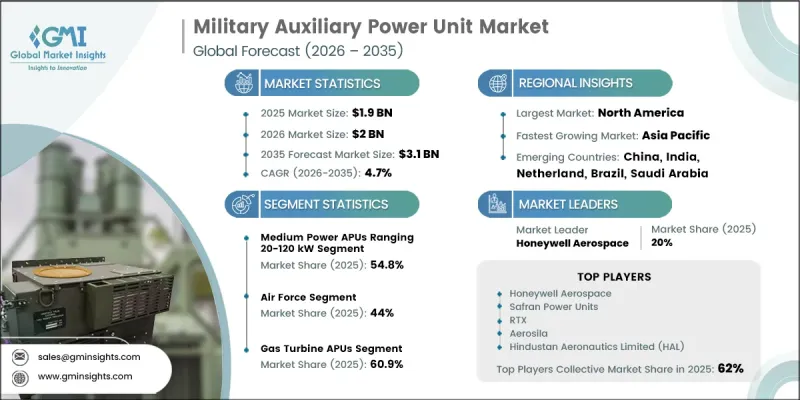
군용 보조동력장치(APU)는 외부 지상 지원 시스템에 의존하지 않고 전기, 공압 및 기계 동력을 공급함으로써 항공기 운용을 뒷받침하는 데 있어 매우 중요한 역할을 수행하고 있습니다. 이러한 시스템은 광범위한 군사 항공 플랫폼에서 운용상의 유연성과 임무 수행 능력을 향상시킵니다. 이 시장에는 가스 터빈식 APU, 디젤 및 내연기관식 APU, 전동식 장치, 하이브리드 구성, 그리고 국방 용도로 개발된 신흥 연료전지 기술이 포함됩니다. 전 세계 국방비 증가는 군 기관의 항공기 조달 프로그램과 기체 군 현대화 계획에 힘입어, 시장 확대에 계속해서 유리한 여건을 조성하고 있습니다. 군에서 노후화된 기체를 기술적으로 선진적인 항공기로 교체함에 따라, 보다 효율적이고 고성능인 보조 동력 시스템에 대한 수요는 계속해서 증가하고 있습니다. 지정학적 불확실성이 커지고 항공기 함대의 가동률을 높여야 할 필요성도 대두되면서, 보조 동력 인프라에 중점을 둔 정비, 업그레이드 및 현대화 프로그램에 대한 투자가 촉진되고 있습니다. 이러한 요인들로 인해, 운용 효율 향상, 항공기 성능 강화, 그리고 전 세계 군용 항공기 함대의 장기적인 방위 태세 목표 달성을 지원하는 첨단 APU 기술의 도입이 촉진되고 있습니다.
| 시장 범위 | |
|---|---|
| 개시연도 | 2025년 |
| 예측 기간 | 2026-2035년 |
| 초기 시장 규모 | 19억 달러 |
| 예측액 | 31억 달러 |
| CAGR | 4.7% |
출력 용량이 20kW에서 120kW 사이인 중출력 APU 부문은 2025년에 54.8%의 시장 점유율을 차지했습니다. 이 부문은 다양한 유형의 군용기를 다루고 있으며, 수많은 항공 분야에서 확립된 수요의 혜택을 지속적으로 누리고 있습니다. 이 부문 시장 성장은 시장의 성숙도와 기존 기술의 지속적인 발전 덕분에 안정적인 상태를 유지하고 있습니다. 현재 이 출력 범위에서는 가스 터빈 시스템이 여전히 강력한 입지를 보이고 있지만, 군용기 운용자들이 효율성과 운용상의 유연성 향상을 추구하는 가운데, 전기식 및 하이브리드식 대체 기술에 대한 관심이 높아지고 있는 것이 시장의 점진적인 다양화에 기여하고 있습니다.
가스 터빈식 APU 부문은 2025년에 60.9%의 시장 점유율을 차지했습니다. 이러한 광범위한 채택은 오랜 기간에 걸친 운영상의 신뢰성, 높은 출력 밀도, 그리고 가혹한 환경 조건에서도 효과적으로 작동하는 능력에 힘입은 것입니다. 이러한 시스템은 광범위한 작동 온도 및 고도 조건에서 일관된 성능을 유지하면서, 전기, 공압, 유압 지원 기능을 제공하도록 설계되었습니다. 이러한 입증된 성능 덕분에, 많은 군용 항공 분야에서 여전히 선호되는 기술로 자리 잡고 있습니다.
2025년, 북미의 군용 보조동력장치(APU) 시장은 36.6%의 점유율을 차지했습니다. 이 시장 특징은 방위 항공 분야가 성숙 단계에 접어들었습니다는 점이며, 투자는 주로 기체 수의 대규모 확대보다는 기체군의 유지, 현대화 사업 및 기술 업그레이드에 중점을 두고 있습니다. 작전 준비 태세의 유지와 플랫폼 성능 향상에 지속적으로 중점을 둠에 따라, 해당 지역 전체에서 첨단 보조 동력 시스템에 대한 수요가 앞으로도 지속될 것으로 예측됩니다.
자주 묻는 질문
목차
제1장 조사 방법과 범위
제2장 주요 요약
제3장 업계 인사이트
제4장 경쟁 구도
제5장 시장 추산 및 예측 : APU 기술 유형별, 2022년-2035년
제6장 시장 추산 및 예측 : 플랫폼 유형별, 2022년-2035년
제7장 시장 추산 및 예측 : 정격 출력별, 2022년-2035년
제8장 시장 추산 및 예측 : 최종사용자별, 2022년-2035년
제9장 시장 추산 및 예측 : 지역별, 2022년-2035년
제10장 기업 개요
LSH 26.07.13The Global Military Auxiliary Power Unit Market was valued at USD 1.9 billion in 2025 and is estimated to grow at a CAGR of 4.7% to reach USD 3.1 billion by 2035.
Military auxiliary power units play a critical role in supporting aircraft operations by supplying electrical, pneumatic, and mechanical power independently of external ground-based support systems. These systems enhance operational flexibility and mission readiness across a wide range of military aviation platforms. The market includes gas turbine APUs, diesel and internal combustion APUs, electric-powered units, hybrid configurations, and emerging fuel-cell-based technologies developed for defense applications. Growing defense expenditures worldwide continue to create favorable conditions for market expansion, supported by aircraft procurement programs and fleet modernization initiatives undertaken by military organizations. As armed forces replace aging platforms with technologically advanced aircraft, demand for more efficient and capable auxiliary power systems continues to rise. Increasing geopolitical uncertainty and the need for higher fleet availability are also driving investments in maintenance, upgrade, and modernization programs focused on auxiliary power infrastructure. These factors are encouraging the adoption of advanced APU technologies that improve operational efficiency, enhance aircraft performance, and support long-term defense readiness objectives across global military aviation fleets.
| Market Scope | |
|---|---|
| Start Year | 2025 |
| Forecast Year | 2026-2035 |
| Start Value | $1.9 Billion |
| Forecast Value | $3.1 Billion |
| CAGR | 4.7% |
The medium-power APUs with output capacities ranging from 20 kW to 120 kW segment held a 54.8% share in 2025. This segment serves a broad range of military aircraft categories and continues to benefit from established demand across numerous aviation applications. Market growth within this category remains stable due to its maturity and the ongoing evolution of existing technologies. Gas turbine systems currently maintain a strong presence in this power range, although increasing interest in electric and hybrid alternatives is contributing to gradual diversification as military operators seek improved efficiency and operational flexibility.
The gas turbine APUs segment held a 60.9% share in 2025. Their widespread adoption is supported by a long history of operational reliability, high power density, and the ability to perform effectively under demanding environmental conditions. These systems are designed to deliver electrical, pneumatic, and hydraulic support functions while maintaining consistent performance across a broad range of operating temperatures and altitude conditions. Their proven capability continues to make them the preferred technology for many military aviation applications.
North America Military Auxiliary Power Unit Market accounted for 36.6% share in 2025. The market is characterized by a mature defense aviation environment where investments are primarily focused on fleet sustainment, modernization initiatives, and technology upgrades rather than large-scale fleet expansion. Continued emphasis on maintaining operational readiness and improving platform performance is expected to support ongoing demand for advanced auxiliary power systems throughout the region.
Key companies operating in the Global Military Auxiliary Power Unit Market include Honeywell Aerospace, Safran Power Units, RTX, PBS Group, Aerosila, The Marvin Group / Marvin Land Systems, Motor Sich, Dewey Electronics Corporation, Suter Industries, Aegis Power Systems, Falck Schmidt Defence Systems, Liebherr-Aerospace, Hindustan Aeronautics Limited (HAL), UAV Turbines, Inc., and Fischer Panda GmbH. Companies active in the Military Auxiliary Power Unit Market are pursuing several strategic initiatives to strengthen their market position and expand their competitive advantage. Product innovation remains a primary focus, with manufacturers investing in advanced technologies that improve fuel efficiency, reduce weight, enhance reliability, and support next-generation military aircraft requirements. Many companies are increasing research and development spending to advance electric, hybrid, and alternative power solutions while maintaining high-performance operational capabilities.
Table of Contents
Chapter 1 Methodology and Scope
- 1.1 Market scope and definition
- 1.2 Research design
- 1.2.1 Research approach
- 1.2.2 Data collection methods
- 1.3 Data mining sources
- 1.3.1 Global
- 1.3.2 Regional/Country
- 1.4 Base estimates and calculations
- 1.4.1 Base year calculation
- 1.4.2 Key trends for market estimation
- 1.5 Primary research and validation
- 1.5.1 Primary sources
- 1.6 Forecast model
- 1.7 Research assumptions and limitations
Chapter 2 Executive Summary
- 2.1 Industry 360° synopsis, 2022 - 2035
- 2.2 Key market trends
- 2.2.1 APU Technology Type trends
- 2.2.2 Platform Type trends
- 2.2.3 Power Rating trends
- 2.2.4 End-user industry trends
- 2.2.5 Regional trends
- 2.3 TAM Analysis, 2026-2035
- 2.4 CXO perspectives: Strategic imperatives
Chapter 3 Industry Insights
- 3.1 Industry ecosystem analysis
- 3.1.1 Supplier Landscape
- 3.1.2 Profit Margin
- 3.1.3 Cost structure
- 3.1.4 Value addition at each stage
- 3.1.5 Factor affecting the value chain
- 3.1.6 Disruptions
- 3.2 Industry impact forces
- 3.2.1 Growth drivers
- 3.2.1.1 Rising Global Defense Spending
- 3.2.1.2 Expansion of Military Aircraft Fleets
- 3.2.1.3 Increasing APU Maintenance and Upgrades
- 3.2.1.4 Advancements in Fuel-Efficient APU Technologies
- 3.2.1.5 Growing Adoption of Military UAVs
- 3.2.2 Industry pitfalls and challenges
- 3.2.2.1 High development and integration costs for advanced military-grade APUs
- 3.2.2.2 Supply chain disruptions and geopolitical trade restrictions
- 3.2.3 Market opportunities
- 3.2.3.1 Growing demand for hybrid-electric and more-electric military aircraft
- 3.2.3.2 Expansion of indigenous defense manufacturing programs in emerging economies
- 3.2.1 Growth drivers
- 3.3 Growth potential analysis
- 3.4 Pricing Analysis (Driven by Primary Research)
- 3.4.1 Historical Price Trend Analysis
- 3.4.2 Pricing Strategy by Player Type (Premium / Value / Cost-plus)
- 3.5 Regulatory landscape
- 3.5.1 North America
- 3.5.2 Europe
- 3.5.3 Asia Pacific
- 3.5.4 Latin America
- 3.5.5 Middle East & Africa
- 3.6 Porter’s analysis
- 3.7 PESTEL analysis
- 3.8 Technology and Innovation landscape
- 3.8.1 Current technological trends
- 3.8.2 Emerging technologies
- 3.9 Emerging Business Models
- 3.10 Compliance Requirements
- 3.11 Patent and IP analysis
- 3.12 Trade Data Analysis (Based on Paid Database)
- 3.12.1 Import/Export Volume & Value Trends
- 3.12.2 Key Trade Corridors & Tariff Impact
- 3.13 Impact of AI & Generative AI on the Market (Driven by Primary Research)
- 3.13.1 AI-Driven Disruption of Existing Business Models
- 3.13.2 GenAI Use Cases & Adoption Roadmap by Segment
- 3.14 Capacity & Production Landscape (Driven by Primary Research)
- 3.14.1 Production Capacity by Key Producer
- 3.14.2 Capacity Utilization Rates & Expansion Pipelines
Chapter 4 Competitive Landscape, 2025
- 4.1 Introduction
- 4.2 Company market share analysis, 2025
- 4.2.1 By Region
- 4.2.1.1 North America
- 4.2.1.2 Europe
- 4.2.1.3 Asia-Pacific
- 4.2.1.4 Latin America
- 4.2.1.5 Middle East and Africa
- 4.2.2 Market Concentration Analysis
- 4.2.1 By Region
- 4.3 Competitive analysis of major market players
- 4.4 Competitive positioning matrix
- 4.5 Key developments
- 4.5.1 Mergers & acquisitions
- 4.5.2 Partnerships & collaborations
- 4.5.3 New product launches
- 4.5.4 Expansion plans and funding
- 4.6 Company tier benchmarking
- 4.6.1 Tier classification criteria & qualifying thresholds
- 4.6.2 Tier positioning matrix by revenue, geography & innovation
Chapter 5 Market Estimates and Forecast, By APU Technology Type, 2022 - 2035 (USD Billion)
- 5.1 Key trends
- 5.2 Gas Turbine APU
- 5.3 Diesel/ICE APU
- 5.4 Electric APU
- 5.5 Hybrid APU
- 5.6 Fuel Cell APU
Chapter 6 Market Estimates and Forecast, By Platform Type, 2022 - 2035 (USD Billion)
- 6.1 Key trends
- 6.2 Manned Fixed-Wing Aircraft
- 6.3 Manned Rotary-Wing Aircraft
- 6.4 Ground Combat & Tactical Vehicles
- 6.5 Naval Surface Ships & Submarines
- 6.6 Unmanned Systems (UAS/UGV)
Chapter 7 Market Estimates and Forecast, By Power Rating, 2022 - 2035 (USD Billion)
- 7.1 Key trends
- 7.2 Low Power (<20 kW)
- 7.3 Medium Power (20 kW to 120 kW)
- 7.4 High Power (>120 kW)
Chapter 8 Market Estimates and Forecast, By End-User, 2022 - 2035 (USD Billion)
- 8.1 Key trends
- 8.2 Air Force
- 8.3 Army
- 8.4 Navy & Marine Corps
Chapter 9 Market Estimates and Forecast, By Region, 2022 - 2035 (USD Billion)
- 9.1 Key trends
- 9.2 North America
- 9.2.1 U.S.
- 9.2.2 Canada
- 9.3 Europe
- 9.3.1 Germany
- 9.3.2 UK
- 9.3.3 France
- 9.3.4 Spain
- 9.3.5 Italy
- 9.4 Asia Pacific
- 9.4.1 China
- 9.4.2 India
- 9.4.3 Japan
- 9.4.4 Australia
- 9.4.5 South Korea
- 9.5 Latin America
- 9.5.1 Brazil
- 9.5.2 Mexico
- 9.5.3 Argentina
- 9.6 Middle East and Africa
- 9.6.1 South Africa
- 9.6.2 Saudi Arabia
- 9.6.3 UAE
Chapter 10 Company Profiles
- 10.1 Global Key Players
- 10.1.1 Honeywell Aerospace
- 10.1.2 Safran Power Units
- 10.1.3 RTX
- 10.1.4 Aerosila
- 10.1.5 Hindustan Aeronautics Limited (HAL)
- 10.2 Regional key players
- 10.2.1 North America
- 10.2.1.1 The Marvin Group / Marvin Land Systems
- 10.2.1.2 Dewey Electronics Corporation
- 10.2.1.3 Aegis Power Systems
- 10.2.2 Asia Pacific
- 10.2.2.1 Motor Sich
- 10.2.2.2 UAV Turbines, Inc.
- 10.2.3 Europe
- 10.2.3.1 Liebherr-Aerospace
- 10.2.3.2 PBS Group
- 10.2.3.3 Suter Industries
- 10.2.3.4 Fischer Panda GmbH
- 10.2.1 North America
- 10.3 Niche Players/Disruptors
- 10.3.1 Suter Industries


