
|
시장보고서
상품코드
2123137
항공기 보조 동력 장치 시장 : 점유율 분석, 산업 동향 및 통계 데이터, 성장 예측(2026-2031년)Aircraft Auxiliary Power Unit - Market Share Analysis, Industry Trends & Statistics, Growth Forecasts (2026 - 2031) |
||||||
 Mordor Intelligence
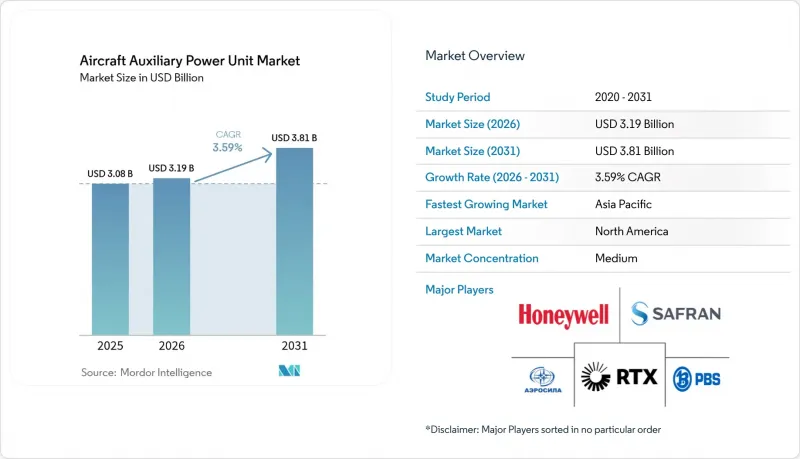
Mordor Intelligence에 의하면, 항공기 보조 동력 장치(APU) 시장 규모는 2025년 30억 8,000만 달러에서 2026년에는 31억 9,000만 달러로 확대되어 2026년부터 2031년까지 CAGR 3.59%로 성장을 지속하여, 2031년에는 38억 1,000만 달러에 이를 것으로 예측됩니다.
본 보고서는 플랫폼(민간기, 군용기, 일반 항공), 기종(고정익기, 회전익기), 정격 출력(50kVA 미만, 50-150kVA, 150kVA 초과),기술(기존 터보샤프트, 배터리식 전동, 연료전지), 지역(북미, 유럽, 아시아태평양, 기타)별로 분류되어 있습니다. 시장 예측은 금액(달러) 기준으로 제시되어 있습니다.
전 세계 항공기 보조 동력 장치 시장 동향 및 인사이트
차세대 저연비 협폭기 인도 대수 증가
중국의 상업용 항공기 기단은 2043년까지 9,740대로 두 배로 증가할 것으로 예상되며, 이는 단일 통로 운항에 최적화된 APU에 대한 지속적인 수요를 뒷받침하고 있습니다. 에어 아라비아(Air Arabia)와 같은 항공사는 A320neo 기종에 하네웰(Honeywell)사의 131-9A 유닛 131대를 채택하여 고효율 모드에서 1-2%의 연료 절감을 달성했습니다. 신속한 시동과 열 부하 최소화에 중점을 둔 컴팩트한 설계는 사이클 횟수가 많은 협폭기 운항 일정에 적합합니다. 각 항공사가 기존의 CFM56 기종을 LEAP 엔진이 탑재된 기종으로 교체함에 따라, LEAP 엔진과의 시너지 효과로 운항 신뢰성이 향상되고 있습니다. 이러한 납품 물결은 항공기 보조 동력 장치(APU) 시장에서 LINE-FIT 관련 수익과 확대되는 예비 부품 수요를 뒷받침하는 기반이 되고 있습니다.
APU 정지를 의무화하는 규제로 인해 개조 활동이 활발해지고 있습니다.
현재 유럽의 허브 공항에서는 턴어라운드 중 지상 전원 사용이 의무화되어 있어, 각 항공사는 새로운 APU를 조달하는 대신 호환 가능한 인터페이스 키트를 사용하여 구형 제트기를 업그레이드할 수밖에 없는 상황입니다. 카타르항공은 규정 준수 비용을 절감하면서 자산 수명을 연장하기 위해, 해당 지역에서 최초로 HGT1700의 오버홀 역량을 확보했습니다. 아사이아(Asaya)사의 램프 모니터링 분석 솔루션을 통해 공항은 APU 정지 준수 여부를 검증할 수 있게 되었으며, 자발적인 환경 대책이 의무적인 업그레이드로 전환되고 있습니다. 그 결과, 순정 부품 판매량이 정체되는 상황에서도 애프터마켓의 이익률은 상승하고 있어, 확고한 입지를 가진 공급업체들에게 매력적인 서비스 수익원이 되고 있습니다.
발전기 부품에 사용되는 희토류 재료의 가격 변동
중국의 네오디뮴 및 디스프로슘 수출 규제로 인해 자석 비용이 상승하여 APU용 영구 자석 발전기 가격에 불확실성이 발생하고 있습니다. 미국 공군의 분석에 따르면, 희토류에 대한 의존도가 항공우주 공급망의 주요 취약점 중 하나로 지적되고 있으며, 이에 따라 각 OEM 업체들은 재활용 및 페라이트 기반 설계를 검토하고 있지만, 이러한 조치들은 출력 밀도를 저하시킬 가능성이 있습니다. 계약 가격은 현재 원자재 가격 변동에 연동되어 있어, 장기 유지보수 계약에 영향을 미치고 있으며, 항공기 보조 동력 장치 시장 전체의 이익률을 압박하고 있습니다.
부문별 분석
민간 항공기 부문은 2025년 매출의 67.72%를 차지하며, 항공기 보조 동력 장치 시장의 핵심으로 자리 잡고 있습니다. 라인 핏 수요는 에어버스 및 보잉의 생산 확대와 연동되는 반면, 항공사들은 배기가스 규제를 준수하기 위해 APU를 교체하는 대신 개조를 진행하고 있습니다. 군사 플랫폼은 현재 시장 규모가 작지만, 미국의 회전익기 현대화 프로그램 등에서 고출력 전기 시스템이 지정됨에 따라 2031년까지 연평균 성장률(CAGR) 4.55%로 확대되고 있습니다. 이러한 방위 분야의 호재는 민간 기종으로의 기술 파급을 뒷받침하며, 항공기 보조 동력 장치 업계 전체의 가치 창출을 지속시키고 있습니다.
아시아와 북미의 협폭기(narrow-body)에 대한 지속적인 납품이 공급량의 기반을 이루고 있는 반면, 광폭기(wide-body)의 경우 갤리 및 공조 시스템에 전력을 공급하기 위해 더 높은 출력의 APU가 요구되고 있습니다. 군사 분야에서는 무인 항공기(UAV)와 수송기가 마이크로 및 매크로급 솔루션을 채택하고 있어 적용 범위가 확대되고 있습니다. 비즈니스 제트기는 신속한 시동 성능과 객실의 쾌적성을 중시하는 프리미엄 틈새 시장을 형성하고 있으며, 애프터마켓에서 평균 이상의 수익을 창출하고 있습니다.
2025년 출하 대수에서 고정익 항공기가 차지하는 비율은 80.12%를 유지하고 있으며, 이는 단일 통로 항공기의 생산 주기와 화물기로의 개조를 반영한 것입니다. 회전익 항공기의 업그레이드는 연평균 성장률(CAGR) 3.78%로 성장을 지속하고, 있으며, 더 깨끗한 전력 공급이 필요한 디지털 항공 전자 장비 및 전자전 패키지를 통합하는 프로그램이 이를 주도하고 있습니다. 헬리콥터용 APU는 제한된 설치 공간에 들어맞아야 하고 진동을 견뎌야 하기 때문에 열교환기의 소형화와 가변 속도 아키텍처가 요구되고 있습니다.
신흥 eVTOL 프로토타입은 백업 전원 및 시스템의 중복성 확보를 위해 보조 발전에 의존하고 있어, 새로운 설계 기준이 도입되고 있습니다. 에어버스 A330에서 진행 중인 고정익기용 연료전지 시험은 인증 장벽이 해소된다면 장거리 플랫폼이 대체 에너지로 전환될 가능성을 보여주고 있으며, 이는 항공기 보조 동력 장치 시장의 향후 수요 패턴을 결정짓는 요인이 될 것입니다.
지역별 분석
북미는 2025년에도 32.35%의 점유율을 유지했습니다. 이는 보잉사의 납품 실적과 차세대 솔루션 연구 개발을 뒷받침하는 미국 국방부의 지속적인 지출에 힘입은 결과입니다. 또한, 국내 내 중요 광물 처리에 대한 정부의 지원책은 희토류에 대한 의존도를 낮추는 것을 목적으로 하고 있습니다. GTF 및 LEAP 엔진이 탑재된 항공기가 성숙기에 접어들고 대규모 정비 주기에 진입함에 따라, 항공기 보조 동력 장치 시장 규모는 꾸준히 확대될 것으로 전망됩니다.
아시아태평양은 2031년까지 연평균 성장률(CAGR)이 5.22%로 가장 높은 성장세를 보이고 있으며, 중국의 C919 취항과 2043년까지 19,500대의 신규 항공기 도입이 예상되는 인도가 주도적인 역할을 하고 있습니다. 사프란과 HAL의 합작 사업 등에서는 부품 생산의 현지화가 추진되어 리드 타임 단축 및 지역별 오프셋 요건 충족을 도모하고 있습니다. 2043년까지 지역 내 항공기 보유 규모가 1,290억 달러의 서비스 가치에 도달함에 따라 애프터마켓 수익은 두 배로 증가할 것이며, 항공기 보조 동력 장치(APU) 시장의 입지는 더욱 공고해질 전망입니다.
유럽은 정책적 리더십을 활용하여 ‘청정 항공(Clean Aviation)’ 프레임워크 하에서 저배출 동력 장치의 보급을 추진하고 있습니다. 수소 인프라 시범 사업과 APU 가동 중단의 엄격한 시행은 저NOx 연소 기술 및 연료전지 분야의 혁신을 촉진하고 있습니다. 지상 전원 이용이 보편화되면서 장치 판매 대수는 억제되고 있지만, 한편으로는 엄격한 턴어라운드 시간과 환경 규제에 대응해야 하는 항공사의 요구를 충족시키는 초고효율 제품의 제공이 공급업체에게 요구되고 있습니다.
기타 혜택:
- Excel 형식 시장 예측(ME) 시트
- 3개월간의 애널리스트 지원
자주 묻는 질문
목차
제1장 서론
제2장 분석 방법
제3장 주요 요약
제4장 시장 구도
제5장 시장 규모 및 성장률 예측
제6장 경쟁 구도
제7장 시장 기회와 향후 전망
JHS 26.09.09According to Mordor Intelligence, the aircraft auxiliary power unit (APU) market size is expected to grow from USD 3.08 billion in 2025 to USD 3.19 billion in 2026 and is forecast to reach USD 3.81 billion by 2031 at 3.59% CAGR over 2026-2031.
This report is Segmented by Platform (Commercial, Military, and General Aviation), Aircraft Type (Fixed-Wing and Rotary-Wing), Power Rating (Less Than 50 KVA, 50 To 150 KVA, and More Than 150 KVA), Technology (Conventional Turboshaft, Battery-Electric, and Fuel-Cell), and Geography (North America, Europe, Asia-Pacific, and More). The Market Forecasts are Provided in Terms of Value (USD).
Global Aircraft Auxiliary Power Unit Market Trends and Insights
Increased Deliveries of Next-Gen Fuel-Efficient Narrowbody Aircraft
China's commercial fleet is expected to double to 9,740 aircraft by 2043, underscoring the sustained demand for APUs optimized for single-aisle operations. Airlines such as Air Arabia selected 131 Honeywell 131-9A units for A320neo aircraft to secure 1-2% fuel savings in High Efficiency Mode. Compact architectures emphasizing rapid starts and minimal thermal loads suit higher-cycle narrowbody schedules. Synergies with LEAP engines enhance dispatch reliability as carriers replace legacy CFM56 fleets. This delivery wave underpins line-fit revenue and a growing spares pipeline for the aircraft auxiliary power unit market.
Rising Retrofit Activity Due to Regulatory APU-Off Mandates
European hubs now enforce electrical ground power use during turnarounds, forcing carriers to upgrade legacy jets with compatible interface kits rather than procure new APUs. Qatar Airways secured the region's first HGT1700 overhaul capacity to cut compliance costs while extending asset life. Assaia's ramp-monitoring analytics enable airports to validate APU-off adherence, converting voluntary eco-measures into compulsory upgrades. As a result, aftermarket margins rise even as original-equipment volumes plateau, offering attractive service income for established suppliers.
Price Instability of Rare-Earth Materials Used in Generator Components
China's export curbs on neodymium and dysprosium inflate magnet costs, creating pricing uncertainty for APU permanent-magnet generators. US Air Force analyses list rare-earth dependence among top aerospace supply vulnerabilities, prompting OEMs to explore recycling and ferrite-based designs that may compromise power density. Contract pricing is now indexed to commodity exposure, affecting long-term maintenance agreements and eroding margins across the aircraft auxiliary power unit market.
Other drivers and restraints analyzed in the detailed report include:
- Expansion of Military UAV Fleets in High-Threat Environments
- Electrification of Ground Operations Driving Adoption of e-APUs
- Preference for Airport Ground Power Units Reducing APU Operating Hours
For complete list of drivers and restraints, kindly check the Table Of Contents.
Segment Analysis
The commercial segment generated 67.72% of 2025 revenue and retains the backbone of the aircraft auxiliary power unit market. Line-fit demand matches Airbus and Boeing production ramps, while airlines pursue APU refurbishments instead of replacements to meet emission rules. Military platforms contribute a smaller base today but accelerate at 4.55% CAGR through 2031 as programs such as US rotary-wing modernization specify higher-output electric systems. This defense tailwind supports technology spillovers into civil variants, sustaining value creation across the aircraft auxiliary power unit industry.
Sustained narrowbody deliveries in Asia and North America anchor volume, whereas widebody jets require higher-rated APUs to power galleys and environmental control packs. On the military side, UAVs and transport aircraft adopt micro-and macro-rated solutions, broadening the application matrix. Business jets form a premium niche valuing rapid spool-up and cabin comfort, generating above-average aftermarket yields.
Fixed-wing deliveries kept an 80.12% hold on 2025 shipments, reflecting single-aisle production cycles and freighter conversions. Rotary-wing upgrades add 3.78% CAGR, propelled by programs that embed digital avionics and electronic warfare packages requiring a cleaner electrical supply. Helicopter APUs must fit constrained bays and tolerate vibration, driving miniaturized heat exchangers and variable-speed architectures.
Emerging eVTOL prototypes rely on auxiliary generation for backup power and system redundancy, injecting new design criteria. Fixed-wing fuel-cell trials on Airbus A330 demonstrate how long-range platforms may pivot toward alternative energy once certification hurdles are cleared, setting future demand patterns for the aircraft auxiliary power unit market.
Complete Report Scope:
- By Platform
- Commercial
- Narrowbody Aircraft
- Widebody Aircraft
- Regional Jets
- Military
- Combat
- Special Mission
- Transport
- Trainer
- Unmanned Aerial Vehicles (UAVs)
- General Aviation
- Light Aircraft
- Business Jets
- Helicopters
- Commercial
- By Aircraft Type
- Fixed-Wing
- Rotary-Wing
- By Power Rating
- less than 50 kVA
- 50 to 150 kVA
- more than 150 kVA
- By Technology
- Conventional Turboshaft
- Battery-Electric
- Fuel-Cell
- By Geography
- North America
- United States
- Canada
- Mexico
- Europe
- United Kingdom
- Germany
- France
- Italy
- Rest of Europe
- Asia-Pacific
- China
- India
- Japan
- South Korea
- Rest of Asia-Pacific
- South America
- Brazil
- Rest of South America
- Middle East and Africa
- Middle East
- United Arab Emirates
- Saudi Arabia
- Qatar
- Rest of Middle East
- Africa
- South Africa
- Egypt
- Rest of Africa
- Middle East
- North America
Geography Analysis
North America retained a 32.35% share in 2025, anchored by Boeing deliveries and sustained Pentagon spending that underwrite R&D for next-generation solutions. Government stimulus for domestic critical minerals processing also intends to reduce rare-earth exposure. The aircraft auxiliary power unit market size is forecasted to grow steadily as GTF and LEAP fleets mature and enter heavy maintenance cycles.
Asia-Pacific is the fastest riser at 5.22% CAGR through 2031, driven by China's C919 rollout and India's forecast for 19,500 new aircraft by 2043. Joint ventures such as Safran-HAL localize parts production, trimming lead times, and aligning with regional offset mandates. Aftermarket revenues will multiply as the regional fleet reaches 129 USD billion service value by 2043, deepening the aircraft auxiliary power unit market footprint.
Europe leverages policy leadership to push low-emission power units under the Clean Aviation umbrella. Hydrogen infrastructure pilots and stringent APU-off enforcement foster innovation in low-NOx combustion and fuel cells. While ground power prevalence tempers unit sales, it pressures suppliers to deliver ultra-efficient products that satisfy airlines facing tight turnaround and environmental compliance.
- Honeywell International Inc.
- RTX Corporation
- Safran SA
- JSC SPE Aerosila
- Technodinamika (Rostec)
- PBS Group a.s.
- Rolls-Royce plc
- Motor Sich JSC
- Aegis Power Systems, Inc.
- Eaton Corporation plc
- Liebherr Aerospace (Liebherr Group)
- Jakadofsky GmbH
Additional Benefits:
- The market estimate (ME) sheet in Excel format
- 3 months of analyst support
TABLE OF CONTENTS
1 INTRODUCTION
- 1.1 Study Assumptions and Market Definition
- 1.2 Scope of the Study
2 RESEARCH METHODOLOGY
3 EXECUTIVE SUMMARY
4 MARKET LANDSCAPE
- 4.1 Market Overview
- 4.2 Market Drivers
- 4.2.1 Increased deliveries of next-gen fuel-efficient narrowbody aircraft
- 4.2.2 Rising retrofit activity due to regulatory mandates on APU-off operations
- 4.2.3 Expansion of military UAV fleets in high-threat environments
- 4.2.4 Electrification of ground operations driving adoption of e-APUs
- 4.2.5 Emergence of commercial spaceplanes creating demand for micro-APUs
- 4.2.6 Integration of APUs into hybrid-electric propulsion architectures
- 4.3 Market Restraints
- 4.3.1 Price instability of rare-earth materials used in generator components
- 4.3.2 Preference for airport ground power units reducing APU operating hours
- 4.3.3 Lengthy and rigid certification processes for new-energy APU technologies
- 4.3.4 Thermal management challenges in compact aircraft APU designs
- 4.4 Value Chain Analysis
- 4.5 Regulatory Landscape
- 4.6 Technological Outlook
- 4.7 Porter's Five Forces Analysis
- 4.7.1 Threat of New Entrants
- 4.7.2 Bargaining Power of Buyers
- 4.7.3 Bargaining Power of Suppliers
- 4.7.4 Threat of Substitutes
- 4.7.5 Intensity of Competitive Rivalry
5 MARKET SIZE AND GROWTH FORECASTS (VALUE)
- 5.1 By Platform
- 5.1.1 Commercial
- 5.1.1.1 Narrowbody Aircraft
- 5.1.1.2 Widebody Aircraft
- 5.1.1.3 Regional Jets
- 5.1.2 Military
- 5.1.2.1 Combat
- 5.1.2.2 Special Mission
- 5.1.2.3 Transport
- 5.1.2.4 Trainer
- 5.1.2.5 Unmanned Aerial Vehicles (UAVs)
- 5.1.3 General Aviation
- 5.1.3.1 Light Aircraft
- 5.1.3.2 Business Jets
- 5.1.3.3 Helicopters
- 5.1.1 Commercial
- 5.2 By Aircraft Type
- 5.2.1 Fixed-Wing
- 5.2.2 Rotary-Wing
- 5.3 By Power Rating
- 5.3.1 less than 50 kVA
- 5.3.2 50 to 150 kVA
- 5.3.3 more than 150 kVA
- 5.4 By Technology
- 5.4.1 Conventional Turboshaft
- 5.4.2 Battery-Electric
- 5.4.3 Fuel-Cell
- 5.5 By Geography
- 5.5.1 North America
- 5.5.1.1 United States
- 5.5.1.2 Canada
- 5.5.1.3 Mexico
- 5.5.2 Europe
- 5.5.2.1 United Kingdom
- 5.5.2.2 Germany
- 5.5.2.3 France
- 5.5.2.4 Italy
- 5.5.2.5 Rest of Europe
- 5.5.3 Asia-Pacific
- 5.5.3.1 China
- 5.5.3.2 India
- 5.5.3.3 Japan
- 5.5.3.4 South Korea
- 5.5.3.5 Rest of Asia-Pacific
- 5.5.4 South America
- 5.5.4.1 Brazil
- 5.5.4.2 Rest of South America
- 5.5.5 Middle East and Africa
- 5.5.5.1 Middle East
- 5.5.5.1.1 United Arab Emirates
- 5.5.5.1.2 Saudi Arabia
- 5.5.5.1.3 Qatar
- 5.5.5.1.4 Rest of Middle East
- 5.5.5.2 Africa
- 5.5.5.2.1 South Africa
- 5.5.5.2.2 Egypt
- 5.5.5.2.3 Rest of Africa
- 5.5.5.1 Middle East
- 5.5.1 North America
6 COMPETITIVE LANDSCAPE
- 6.1 Market Concentration
- 6.2 Strategic Moves
- 6.3 Market Share Analysis
- 6.4 Company Profiles (includes Global level Overview, Market level overview, Core Segments, Financials as available, Strategic Information, Market Rank/Share for key companies, Products and Services, and Recent Developments)
- 6.4.1 Honeywell International Inc.
- 6.4.2 RTX Corporation
- 6.4.3 Safran SA
- 6.4.4 JSC SPE Aerosila
- 6.4.5 Technodinamika (Rostec)
- 6.4.6 PBS Group a.s.
- 6.4.7 Rolls-Royce plc
- 6.4.8 Motor Sich JSC
- 6.4.9 Aegis Power Systems, Inc.
- 6.4.10 Eaton Corporation plc
- 6.4.11 Liebherr Aerospace (Liebherr Group)
- 6.4.12 Jakadofsky GmbH
7 MARKET OPPORTUNITIES AND FUTURE OUTLOOK
- 7.1 White-space and Unmet-Need Assessment