

|
시장보고서
상품코드
2083277
항체-약물 접합체(ADC) 시장 기회, 성장요인, 업계 동향 분석 및 예측(2026-2035년)Antibody Drug Conjugates Market Opportunity, Growth Drivers, Industry Trend Analysis, and Forecast 2026 - 2035 |
||||||

세계의 항체-약물 접합체(ADC) 시장은 2025년에 169억 달러로 평가되었고, CAGR 11.2%로 성장하여 2035년까지 481억 달러에 달할 것으로 추정되고 있습니다.
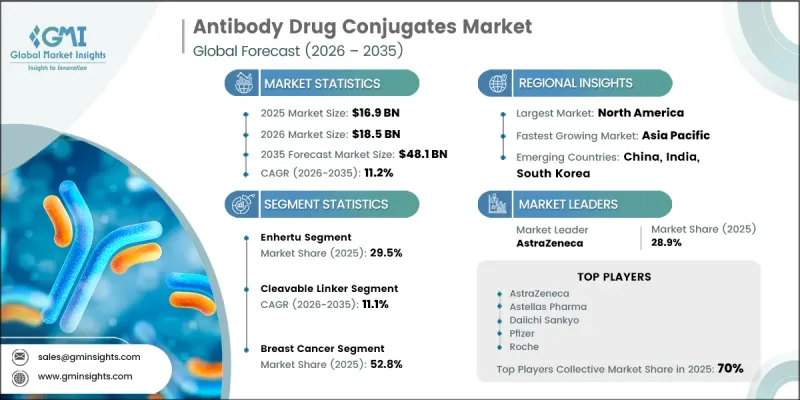
이러한 시장 확대는 기존 화학요법에 비해 종양에 대한 표적성을 높이고 전신 독성을 줄여주는 정밀 암 치료에 대한 임상 현장의 선호도가 높아지고 있는 데 기인합니다. ADC는 항체 성분이 종양 관련 항원에 선택적으로 결합할 수 있게 하고, 결합된 유효 성분이 유효한 치료 농도에서 국소적인 세포 독성 작용을 발휘한다는 점에서 차별화된 치료제 군으로 점점 더 자리매김하고 있습니다. 이러한 이중 작용기전은 여러 종양 적응증에 걸쳐 치료 패러다임을 지속적으로 변화시키고 있으며, 전 세계적으로 표준 치료 프로토콜에 도입되는 추세가 확대되고 있습니다. 또한, 바이오마커를 기반으로 한 환자 선정 범위의 확대, 링커 화학 기술의 발전, 그리고 초기 치료부터 후기 치료에 이르는 광범위한 임상적 유효성 검증에 힘입어 시장은 더욱 공고해지고 있습니다. 선진국과 신흥국 양측의 의료 시스템에서 이 기술이 널리 채택됨에 따라, ADC 분야 전반의 장기적인 상업적 확장성이 뒷받침되고 있습니다.
| 시장 범위 | |
|---|---|
| 개시 연도 | 2025년 |
| 예측 기간 | 2026-2035년 |
| 개시 연도 시장 규모 | 169억 달러 |
| 예측액 | 481억 달러 |
| CAGR | 11.2% |
엔헤르투(트라스투주맙-델크스테칸) 부문은 2025년에 29.5%의 시장 점유율을 차지했으며, 2035년까지 연평균 성장률(CAGR) 11.3%로 성장할 것으로 전망됩니다. 이 치료법은 다이이치 산쿄의 DXd 플랫폼을 채택하고 있습니다. 이 플랫폼은 토포이소메라제 I 억제제 페이로드에 결합된 절단 가능한 펩타이드 링커를 포함하고 있으며, 약 8이라는 높은 약물 대 항체 비율을 달성하도록 설계되었습니다. 이를 통해 항원 발현 수준이 낮은 종양 세포에서도 세포 내 약물 전달 효율과 치료 효과가 향상됩니다.
병원 및 종양학 클리닉 부문은 2025년에 57.4%의 점유율을 차지했으며, 2035년까지 연평균 성장률(CAGR) 11.1%로 성장할 것으로 전망됩니다. 이 부문이 우위를 점하고 있는 이유는 승인된 모든 ADC 치료법이 정맥 내 투여를 필요로 하기 때문이며, 이를 위해서는 전문 종양학 인력이 배치된 통제된 임상 환경이 필수적이기 때문입니다. 치료는 병원 내 수액 투여 병동에 집중되어 있으며, 전체 치료 주기 동안 환자 모니터링, 부작용 관리, 그리고 고효능 생물학적 제제에 관한 규제 준수 프로토콜이 엄격하게 유지되고 있습니다.
북미의 항체-약물 복합체(ADC) 시장은 2025년에 41.9%의 점유율을 차지했으며, 2035년까지 연평균 성장률(CAGR) 10.8%로 성장할 것으로 전망되어 가장 발전된 지역 시장으로 자리매김하고 있습니다. 미국은 의약품 승인을 신속화하고 조기 상용화를 가능하게 하는 선진적인 규제 환경의 뒷받침을 받아, 해당 지역 내 수요를 주도하고 있습니다. 이를 통해 혁신적인 종양학용 생물학적 제제가 다른 세계 시장과 비교해 더 신속하게 환자에게 제공되고 있습니다.
자주 묻는 질문
목차
제1장 조사 방법과 범위
제2장 주요 요약
제3장 업계 인사이트
제4장 경쟁 구도
제5장 시장 추산 및 예측 : 제품 유형별, 2022년-2035년
제6장 시장 추산 및 예측 : 기술별, 2022년-2035년
제7장 시장 추산 및 예측 : 약제 유형별, 2022년-2035년
제8장 시장 추산 및 예측 : 용도별, 2022년-2035년
제9장 시장 추산 및 예측 : 타겟 유형별, 2022년-2035년
제10장 시장 추산 및 예측 : 작용기전별, 2022년-2035년
제11장 시장 추산 및 예측 : 최종 용도별, 2022년-2035년
제12장 시장 추산 및 예측 : 지역별, 2022년-2035년
제13장 기업 개요
LSH 26.07.14The Global Antibody Drug Conjugates (ADC) Market was valued at USD 16.9 billion in 2025 and is estimated to grow at a CAGR of 11.2% to reach USD 48.1 billion by 2035.
The market expansion is supported by a growing clinical preference for precision oncology treatments that offer improved tumor targeting and reduced systemic toxicity compared to conventional chemotherapy. ADCs are increasingly positioned as a differentiated therapeutic class, where the antibody component enables selective binding to tumor-associated antigens while the conjugated payload delivers localized cytotoxic activity at effective therapeutic concentrations. This dual mechanism continues to reshape treatment paradigms across multiple oncology indications, with rising integration into standard-of-care protocols globally. The market is further strengthened by expanding biomarker-driven patient identification, improved linker chemistry technologies, and broader clinical validation across earlier and later lines of therapy. Increasing adoption in both developed and emerging healthcare systems is reinforcing long-term commercial scalability across the ADC landscape.
| Market Scope | |
|---|---|
| Start Year | 2025 |
| Forecast Year | 2026-2035 |
| Start Value | $16.9 Billion |
| Forecast Value | $48.1 Billion |
| CAGR | 11.2% |
Enhertu (trastuzumab deruxtecan), segment held a 29.5% share in 2025 and is projected to grow at a CAGR of 11.3% through 2035. The therapy utilizes Daiichi Sankyo's DXd platform, which incorporates a cleavable peptide linker connected to a topoisomerase I inhibitor payload, engineered to achieve a high drug-to-antibody ratio of around 8, enhancing intracellular drug delivery efficiency and therapeutic potency across tumor cells expressing low antigen levels.
The hospitals and oncology clinics segment accounted for 57.4% share in 2025 and is expected to grow at a CAGR of 11.1% through 2035. The dominance of this segment is linked to the intravenous administration requirement of all approved ADC therapies, which necessitates controlled clinical environments with specialized oncology staff. Treatment delivery is concentrated in hospital-based infusion units where patient monitoring, adverse reaction management, and regulatory compliance protocols for high-potency biologics are strictly maintained throughout therapy cycles.
North America Antibody Drug Conjugates (ADC) Market captured 41.9% share in 2025 and is projected to grow at a CAGR of 10.8% through 2035, making it the most developed regional market. The United States leads regional demand, supported by an advanced regulatory ecosystem that enables accelerated drug approvals and early commercialization pathways, allowing innovative oncology biologics to reach patients more rapidly compared to other global markets.
Key players involved in the Antibody Drug Conjugates (ADC) Market are AbbVie, ADC Therapeutics, Astellas Pharma, AstraZeneca, Daiichi Sankyo, Gilead Sciences, GSK, Pfizer, Roche, and Takeda Pharmaceutical are among the leading companies shaping the antibody drug conjugates market. Key strategies adopted by companies in the ADC market focus on advancing next-generation linker and payload technologies to improve tumor selectivity and reduce off-target toxicity. Firms are heavily investing in clinical pipeline expansion across multiple oncology indications to strengthen lifecycle value and broaden label opportunities. Strategic collaborations between biopharma companies are accelerating R&D capabilities and enabling co-development of novel ADC candidates. Companies are also pursuing biomarker-driven patient stratification approaches to improve clinical trial success rates and treatment precision. In addition, acquisitions and licensing agreements are being used to access innovative ADC platforms and diversify portfolios. Manufacturing scale-up investments are strengthening commercial supply reliability, while geographic expansion into emerging healthcare markets is supporting wider patient access and long-term revenue growth.
Table of Contents
Chapter 1 Methodology & Scope
- 1.1 Research approach
- 1.2 Quality commitments
- 1.2.1 GMI AI policy & data integrity commitment
- 1.2.1.1 Source consistency protocol
- 1.2.1 GMI AI policy & data integrity commitment
- 1.3 Research trail & confidence scoring
- 1.3.1 Research trail components
- 1.3.2 Scoring components
- 1.4 Data collection
- 1.4.1 Partial list of primary sources
- 1.5 Data mining sources
- 1.5.1 Paid sources
- 1.5.1.1 Sources, by region
- 1.5.1 Paid sources
- 1.6 Base estimates and calculations
- 1.6.1 Base year calculation for any one approach
- 1.7 Market estimates & forecasts parameters
- 1.8 Forecast model
- 1.8.1 Quantified market impact analysis
- 1.8.1.1 Mathematical impact of growth parameters on forecast
- 1.8.1 Quantified market impact analysis
- 1.9 Research transparency addendum
- 1.9.1 Source attribution framework
- 1.9.2 Quality assurance metrics
- 1.9.3 Our commitment to trust
Chapter 2 Executive Summary
- 2.1 Industry 360°synopsis
- 2.1.1 Business trends
- 2.1.2 Product type trends
- 2.1.3 Technology trends
- 2.1.4 Application trends
- 2.1.5 Target type trends
- 2.1.6 Mechanism of action trends
- 2.1.7 End use trends
- 2.1.8 Regional trends
- 2.2 CXO perspectives: Strategic imperatives
Chapter 3 Industry Insights
- 3.1 Industry ecosystem analysis
- 3.2 Industry impact forces
- 3.2.1 Growth drivers
- 3.2.1.1 Rising prevalence of cancer
- 3.2.1.2 Growing demand for antibody-based cancer therapies
- 3.2.1.3 Increasing advancements in antibody technology
- 3.2.1.4 Expanding approval of ADCs
- 3.2.2 Industry pitfalls and challenges
- 3.2.2.1 High development and manufacturing costs
- 3.2.2.2 Safety and toxicity concerns associated with ADCs
- 3.2.3 Market opportunities
- 3.2.3.1 Shift toward solid tumor ADCs with higher unmet needs.
- 3.2.3.2 Adoption of next-generation ADC technologies
- 3.2.1 Growth drivers
- 3.3 Growth potential analysis
- 3.4 Technology and innovation landscape
- 3.4.1 Current technological trends
- 3.4.2 Emerging technologies
- 3.5 Pipeline analysis
- 3.6 Regulatory landscape (Driven by primary research)
- 3.6.1 North America
- 3.6.2 Europe
- 3.6.3 Asia Pacific
- 3.6.4 Latin America
- 3.6.5 MEA
- 3.7 Commercial CDMO landscape and supply chain architecture
- 3.8 Porter's analysis
- 3.9 PESTEL analysis
- 3.10 Future market trends
- 3.11 Impact of AI and Generative AI on the market (Driven by primary research)
Chapter 4 Competitive Landscape, 2025
- 4.1 Introduction
- 4.2 Company market share analysis
- 4.2.1 North America
- 4.2.2 Europe
- 4.2.3 Asia Pacific
- 4.3 Company matrix analysis
- 4.4 Competitive analysis of major market players
- 4.5 Competitive positioning matrix
- 4.6 Key developments
- 4.6.1 Merger and acquisition
- 4.6.2 Partnership and collaboration
- 4.6.3 New product launches
- 4.6.4 Expansion plans
Chapter 5 Market Estimates and Forecast, By Product Type, 2022 - 2035 ($ Mn)
- 5.1 Key trends
- 5.2 Enhertu
- 5.3 Kadcyla
- 5.4 Adcetris
- 5.5 Padcev
- 5.6 Trodelvy
- 5.7 Polivy
- 5.8 Other product types
Chapter 6 Market Estimates and Forecast, By Technology, 2022 - 2035 ($ Mn)
- 6.1 Key trends
- 6.2 Cleavable linker
- 6.3 Non-cleavable linker
Chapter 7 Market Estimates and Forecast, By Drug Type, 2022 - 2035 ($ Mn)
- 7.1 Key trends
- 7.2 Small-molecule drugs
- 7.3 Large-molecule drugs
Chapter 8 Market Estimates and Forecast, By Application, 2022 - 2035 ($ Mn)
- 8.1 Key trends
- 8.2 Breast cancer
- 8.3 Blood cancer
- 8.3.1 Lymphoma
- 8.3.2 Leukemia
- 8.3.3 Multiple myeloma
- 8.4 Urothelial cancer & bladder cancer
- 8.5 Other applications
Chapter 9 Market Estimates and Forecast, By Target Type, 2022 - 2035 ($ Mn)
- 9.1 Key trends
- 9.2 HER2
- 9.3 CD30
- 9.4 CD22
- 9.5 Other target types
Chapter 10 Market Estimates and Forecast, By Mechanism of Action, 2022 - 2035 ($ Mn)
- 10.1 Key trends
- 10.2 Microtubule inhibitors
- 10.3 Topoisomerase I inhibitors
- 10.4 DNA-damaging agents
- 10.5 Others
Chapter 11 Market Estimates and Forecast, By End Use, 2022 - 2035 ($ Mn)
- 11.1 Key trends
- 11.2 Hospitals and clinics
- 11.3 Oncology centers
- 11.4 Other end users
Chapter 12 Market Estimates and Forecast, By Region, 2022 - 2035 ($ Mn)
- 12.1 Key trends
- 12.2 North America
- 12.2.1 U.S.
- 12.2.2 Canada
- 12.3 Europe
- 12.3.1 Germany
- 12.3.2 France
- 12.3.3 UK
- 12.3.4 Spain
- 12.3.5 Italy
- 12.3.6 Netherlands
- 12.4 Asia Pacific
- 12.4.1 China
- 12.4.2 Japan
- 12.4.3 India
- 12.4.4 Australia
- 12.4.5 South Korea
- 12.5 Latin America
- 12.5.1 Brazil
- 12.5.2 Mexico
- 12.5.3 Argentina
- 12.6 Middle East & Africa
- 12.6.1 Saudi Arabia
- 12.6.2 South Africa
- 12.6.3 UAE
Chapter 13 Company Profiles
- 13.1 AbbVie
- 13.2 ADC Therapeutics
- 13.3 Astellas Pharma
- 13.4 AstraZeneca
- 13.5 Daiichi Sankyo
- 13.6 Gilead
- 13.7 GSK
- 13.8 Pfizer
- 13.9 Roche
- 13.10 Takeda Pharmaceutical


