

|
시장보고서
상품코드
2083293
원격 방사선 진단 시장 비즈니스 기회, 성장요인, 업계 동향 분석 및 예측(2026-2035년)Teleradiology Market Opportunity, Growth Drivers, Industry Trend Analysis, and Forecast 2026 - 2035 |
||||||

세계의 원격 방사선 진단 시장은 2025년에 169억 달러로 평가되었고, CAGR 20.6%로 확대되어 2035년까지 1,085억 달러에 달할 것으로 추정되고 있습니다.
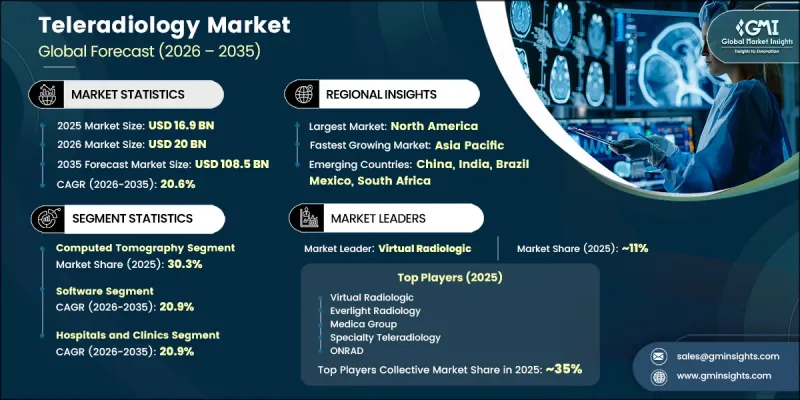
이 시장은 보다 신속한 진단 서비스에 대한 수요 증가, 의료 영상 검사 수요 증가, 그리고 의료 시스템 전반에 걸친 방사선과 전문의 확보와 관련된 지속적인 과제로 인해 급속한 성장을 이루고 있습니다. 텔레라디올로지는 자격을 갖춘 전문가가 원격으로 분석, 상담 및 보고서 작성을 수행할 수 있도록 의료 영상을 안전하게 디지털 방식으로 교환할 수 있게 함으로써, 중요한 의료 기술 솔루션으로 부상해 왔습니다. 이 기술은 전문가의 영상 판독 접근성을 개선하고, 보고 효율을 높이며, 지속적인 진단 체계를 지원함으로써 방사선과 업무를 혁신하고 있습니다. 의료 제공업체들이 증가하는 환자 수와 더욱 복잡해지는 진단 요건에 대응해 나가는 가운데, 원격 영상 진단 솔루션은 임상 워크플로우를 최적화하기 위해 점점 더 중요한 역할을 하고 있습니다. 만성 질환의 유병률 증가는 정기적인 영상 진단을 바탕으로 한 평가 및 모니터링의 필요성을 높임으로써 시장 발전에 더욱 기여하고 있습니다. 의료기관은 자원을 효율적으로 활용하고, 진단 지연을 줄이며, 일관된 환자 관리를 유지하기 위해 원격 방사선 진단 플랫폼을 도입하고 있습니다. 디지털 의료 인프라, 클라우드 기반 기술, 그리고 인공지능(AI)의 통합에 있어 이루어진 진전 또한 텔레라디올로지의 도입을 촉진하고 있으며, 이는 현대 의료 제공 시스템에서 중요한 구성 요소로서의 위상을 확립하고 있습니다.
| 시장 범위 | |
|---|---|
| 개시 연도 | 2025년 |
| 예측 기간 | 2026-2035년 |
| 개시 연도 시장 규모 | 169억 달러 |
| 예측액 | 1,085억 달러 |
| CAGR | 20.6% |
컴퓨터 단층촬영(CT) 부문은 2025년에 30.3%의 시장 점유율을 차지했으며, 2035년까지 연평균 성장률(CAGR) 21%로 성장할 것으로 전망됩니다. 이 부문의 성장은 신속한 영상 진단이 필수적인 주요 진단 분야에서 CT 영상 진단에 대한 의존도가 높아지고 있는 데 힘입고 있습니다. 원격 방사선 진단 서비스를 통해 의료기관은 원격지에 있는 방사선 전문가의 전문 지식을 활용하고, 소견 보고 지연을 줄임으로써 CT 영상 진단 업무의 효율을 높일 수 있습니다. 화질 향상, 스캔 처리 속도 향상, 영상 진단 효율 증대 등 CT 기술의 지속적인 발전이 원격 판독 서비스 도입을 더욱 촉진하고 있습니다. 의료 시스템이 방대한 양의 영상 진단 자료를 관리하기 위해 지속적으로 노력하고 있는 가운데, 워크플로우의 성능 향상과 진단 접근성 제고를 위해 CT 기반의 원격 방사선 진단 솔루션의 중요성은 점점 더 커지고 있습니다.
소프트웨어 분야는 2026년부터 2035년까지 연평균 성장률(CAGR) 20.9%를 기록하며 성장할 것으로 전망됩니다. 소프트웨어 솔루션은 이미지 관리, 안전한 데이터 교환, 워크플로우 조정 및 진단 보고서 작성 과정을 지원함으로써 원격 방사선 진단 인프라의 핵심적인 역할을 담당하고 있습니다. 첨단 영상 진단 플랫폼, 통합형 방사선 관리 시스템, 클라우드 기반 솔루션 및 인공지능(AI)을 활용한 워크플로우의 도입 확대가 이 분야의 성장에 기여하고 있습니다. 의료 서비스 제공업체들은 확장성, 접근성 및 운영 효율성을 향상시키는 디지털 소프트웨어 환경으로의 전환을 가속화하고 있습니다. 클라우드 기반 아키텍처의 확대는 의료 기관과 원격지의 방사선과 전문가 간의 원활한 협력을 가능하게 하고, 진단 워크플로우 관리 전반을 개선함으로써 시장 발전을 더욱 촉진하고 있습니다.
2025년, 북미의 텔레라디올로지 시장은 44.3%의 점유율을 차지했습니다. 이 지역은 선진적인 의료 인프라, 디지털 영상 기술의 광범위한 도입, 그리고 전자 의료 시스템의 적극적인 도입으로 인한 혜택을 누리고 있습니다. 지속적인 방사선 진단 서비스에 대한 수요 증가, 진단 영상 검사 건수 증가, 그리고 자격을 갖춘 방사선 전문가의 만성적인 부족으로 인해 의료 제공업체들은 원격 판독 솔루션 도입을 가속화하고 있습니다. 원격의료의 도입이 지속적으로 확대되고, 인공지능(AI)을 활용한 진단 기술의 통합이 진행됨에 따라, 해당 지역 전체의 원격 방사선 진단 서비스의 효율성과 확장성이 더욱 향상되고 있습니다. 이러한 요인들 덕분에 북미는 앞으로도 전 세계 원격 방사선 진단 업계에서 주도적인 위치를 계속 유지할 것입니다.
자주 묻는 질문
목차
제1장 조사 방법과 범위
제2장 주요 요약
제3장 업계 인사이트
제4장 경쟁 구도
제5장 시장 추산 및 예측 : 영상 진단 기술별, 2022년-2035년
제6장 시장 추산 및 예측 : 기술별, 2022년-2035년
제7장 시장 추산 및 예측 : 컴포넌트별, 2022년-2035년
제8장 시장 추산 및 예측 : 용도별, 2022년-2035년
제9장 시장 추산 및 예측 : 최종 용도별, 2022년-2035년
제10장 시장 추산 및 예측 : 지역별, 2022년-2035년
제11장 기업 개요
LSH 26.07.14The Global Teleradiology Market was valued at USD 16.9 billion in 2025 and is estimated to grow at a CAGR of 20.6% to reach USD 108.5 billion by 2035.
The market is experiencing rapid expansion due to the rising need for faster diagnostic services, increasing demand for medical imaging procedures, and ongoing challenges related to radiologist availability across healthcare systems. Teleradiology has emerged as an important healthcare technology solution by enabling the secure digital exchange of medical images for remote analysis, consultation, and reporting by qualified specialists. The technology is transforming radiology operations by improving accessibility to expert interpretation, enhancing reporting efficiency, and supporting continuous diagnostic coverage. As healthcare providers manage increasing patient volumes and more complex diagnostic requirements, remote imaging solutions are becoming increasingly valuable for optimizing clinical workflows. The growing prevalence of chronic health conditions is further contributing to market development by increasing the need for regular imaging-based evaluation and monitoring. Healthcare organizations are adopting teleradiology platforms to improve resource utilization, reduce diagnostic delays, and maintain consistent patient care. Advancements in digital healthcare infrastructure, cloud-based technologies, and artificial intelligence integration are also strengthening adoption, positioning teleradiology as a key component of modern healthcare delivery systems.
| Market Scope | |
|---|---|
| Start Year | 2025 |
| Forecast Year | 2026-2035 |
| Start Value | $16.9 Billion |
| Forecast Value | $108.5 Billion |
| CAGR | 20.6% |
The computed tomography segment accounted for 30.3% share in 2025, and is expected to grow at a CAGR of 21% through 2035. The segment's growth is supported by the increasing reliance on CT imaging for critical diagnostic applications where timely interpretation is essential. Teleradiology services allow healthcare facilities to improve the efficiency of CT imaging operations by providing access to remote radiology expertise and reducing reporting delays. The continued advancement of CT technologies, including improved image quality, faster scanning processes, and enhanced imaging efficiency, is further encouraging the adoption of remote interpretation services. As healthcare systems continue to manage growing imaging volumes, CT-based teleradiology solutions are becoming increasingly important for improving workflow performance and diagnostic accessibility.
The software segment is projected to grow at a CAGR of 20.9% between 2026 and 2035. Software solutions represent a fundamental part of the teleradiology infrastructure by supporting image management, secure data exchange, workflow coordination, and diagnostic reporting processes. Increasing adoption of advanced imaging platforms, integrated radiology management systems, cloud-based solutions, and artificial intelligence-supported workflows is contributing to segment growth. Healthcare providers are increasingly shifting toward digital software environments that improve scalability, accessibility, and operational efficiency. The expansion of cloud-based architectures is further supporting market development by enabling seamless collaboration between healthcare facilities and remote radiology professionals while improving overall diagnostic workflow management.
North America Teleradiology Market held a 44.3% share in 2025. The region benefits from advanced healthcare infrastructure, widespread adoption of digital imaging technologies, and strong implementation of electronic healthcare systems. Rising demand for continuous radiology services, increasing diagnostic imaging volumes, and ongoing shortages of qualified radiology professionals are encouraging healthcare providers to implement remote interpretation solutions. The continued growth of telehealth adoption and the increasing integration of artificial intelligence-based diagnostic technologies are further improving the efficiency and scalability of teleradiology services across the region. These factors continue to support North America's leading position within the global teleradiology industry.
Major companies operating in the global teleradiology market include Siemens Healthineers, GE HealthCare, Koninklijke Philips, Radiology Partners, Virtual Radiologic, ONRAD, Medica Group, Dicom Systems, Aster Medical Imaging, Specialty Teleradiology, Everlight Radiology, Vesta Teleradiology, CompuMed, Experity, imeXHS, and Vision XRay Group. Companies operating in the teleradiology market are adopting multiple strategies to strengthen their market position and expand their global presence. Key players are focusing on technology innovation by developing advanced imaging platforms, artificial intelligence-enabled diagnostic tools, and cloud-based solutions that improve reporting efficiency. Strategic collaborations with healthcare providers and technology companies are helping organizations enhance service capabilities and expand their customer base. Companies are also investing in scalable digital infrastructure to support remote diagnostics and improve accessibility across healthcare networks. Expansion into emerging markets, enhancement of cybersecurity capabilities, and development of integrated healthcare solutions are additional focus areas.
Table of Contents
Chapter 1 Methodology & Scope
- 1.1 Market scope and definition
- 1.2 Research approach
- 1.3 Quality commitments
- 1.3.1 GMI AI policy and data integrity commitment
- 1.3.1.1 Source consistency protocol
- 1.3.1 GMI AI policy and data integrity commitment
- 1.4 Research trail and confidence scoring
- 1.4.1 Research trail components
- 1.4.2 Scoring components
- 1.5 Data collection
- 1.5.1 Partial list of primary sources
- 1.6 Data mining sources
- 1.6.1 Paid sources
- 1.6.1.1 Sources, by region
- 1.6.1 Paid sources
- 1.7 Base estimates and calculations
- 1.7.1 Revenue share analysis
- 1.7.2 Base year calculation
- 1.8 Forecast model
- 1.9 Research transparency addendum
- 1.9.1 Source attribution framework
- 1.9.2 Quality assurance metrics
- 1.9.3 Our commitment to trust
Chapter 2 Executive Summary
- 2.1 Industry 360° synopsis
- 2.2 Key market trends
- 2.2.1 Regional trends
- 2.2.2 Imaging technique trends
- 2.2.3 Technology trends
- 2.2.4 Component trends
- 2.2.5 Application trends
- 2.2.6 End use trends
- 2.3 CXO perspectives: Strategic imperatives
Chapter 3 Industry Insights
- 3.1 Industry ecosystem analysis
- 3.2 Industry impact forces
- 3.2.1 Growth drivers
- 3.2.1.1 Increasing demand for radiology services
- 3.2.1.2 Growing adoption of telemedicine
- 3.2.1.3 Advancement in imaging technologies
- 3.2.1.4 Increasing adoption of cloud-based teleradiology platforms
- 3.2.2 Industry pitfalls & challenges
- 3.2.2.1 Data security and privacy concerns
- 3.2.2.2 Regulatory and legal issues
- 3.2.3 Market opportunities
- 3.2.3.1 AI integrated teleradiology workflows
- 3.2.3.2 Expansion into emerging markets with limited radiology infrastructure
- 3.2.1 Growth drivers
- 3.3 Growth potential analysis
- 3.4 Technology and innovation landscape
- 3.5 Regulatory landscape
- 3.5.1 North America
- 3.5.2 Europe
- 3.5.3 Asia Pacific
- 3.5.4 Latin America
- 3.5.5 MEA
- 3.6 Future trends
- 3.7 Impact of AI and Generation AI on the market
- 3.8 Pricing analysis
- 3.9 Porter's analysis
- 3.10 PESTEL analysis
Chapter 4 Competitive Landscape, 2025
- 4.1 Introduction
- 4.2 Company market share analysis
- 4.3 Company matrix analysis
- 4.4 Competitive analysis of major market players
- 4.5 Competitive positioning matrix
- 4.6 Key developments
- 4.6.1 Merger and acquisition
- 4.6.2 Partnership and collaboration
- 4.6.3 New product launches
- 4.6.4 Expansion plans
Chapter 5 Market Estimates and Forecast, By Imaging Technique, 2022 - 2035 ($ Mn)
- 5.1 Key trends
- 5.2 X-ray
- 5.3 Computed tomography
- 5.4 Magnetic resonance imaging
- 5.5 Ultrasound
- 5.6 Nuclear imaging
- 5.7 Mammography
Chapter 6 Market Estimates and Forecast, By Technology, 2022 - 2035 ($ Mn)
- 6.1 Key trends
- 6.2 Cloud-based teleradiology
- 6.3 On-premise teleradiology
Chapter 7 Market Estimates and Forecast, By Component, 2022 - 2035 ($ Mn)
- 7.1 Key trends
- 7.2 Software
- 7.3 Services
Chapter 8 Market Estimates and Forecast, By Application, 2022 - 2035 ($ Mn)
- 8.1 Key trends
- 8.2 Cardiology
- 8.3 Neurology
- 8.4 Orthopedics
- 8.5 Oncology
- 8.6 Gastroenterology
- 8.7 Other applications
Chapter 9 Market Estimates and Forecast, By End Use, 2022 - 2035 ($ Mn)
- 9.1 Key trends
- 9.2 Hospitals and clinics
- 9.3 Diagnostic imaging centers
- 9.4 Ambulatory surgical centers
- 9.5 Other end users
Chapter 10 Market Estimates and Forecast, By Region, 2022 - 2035 ($ Mn)
- 10.1 Key trends
- 10.2 North America
- 10.2.1 U.S.
- 10.2.2 Canada
- 10.3 Europe
- 10.3.1 Germany
- 10.3.2 UK
- 10.3.3 France
- 10.3.4 Spain
- 10.3.5 Italy
- 10.3.6 Netherlands
- 10.4 Asia Pacific
- 10.4.1 Japan
- 10.4.2 China
- 10.4.3 India
- 10.4.4 Australia
- 10.4.5 South Korea
- 10.5 Latin America
- 10.5.1 Brazil
- 10.5.2 Mexico
- 10.5.3 Argentina
- 10.6 Middle East and Africa
- 10.6.1 South Africa
- 10.6.2 Saudi Arabia
- 10.6.3 UAE
Chapter 11 Company Profiles
- 11.1 Aster Medical Imaging
- 11.2 CompuMed
- 11.3 Dicom Systems
- 11.4 Everlight Radiology
- 11.5 Experity
- 11.6 GE HealthCare Technologies
- 11.7 imeXHS
- 11.8 Koninklijke Philips
- 11.9 Medica Group
- 11.10 ONRAD
- 11.11 Radiology partners
- 11.12 Siemens Healthineers
- 11.13 Specialty Teleradiology
- 11.14 Vesta Teleradiology
- 11.15 Virtual Radiologic
- 11.16 Vision XRay Group


