

|
시장보고서
상품코드
2107346
원격 방사선 진단 서비스 시장 : 영상 진단 모달리티별, 최종사용자별, 비즈니스 모델별, 지역별 - 동향 및 예측(-2035년)Teleradiology Services Market by Imaging Modality, End User, Business Model, and Geographical Regions - Trends and Forecast Till 2035 |
||||||

원격 방사선 진단 서비스 시장 : 개요
세계의 원격 방사선 진단 서비스 시장 규모는 2035년까지 예측 기간 동안 CAGR 9.7%라는 눈부신 성장을 나타내고, 올해 101억 달러에서 2035년에는 233억 달러에 달할 것으로 추정됩니다.
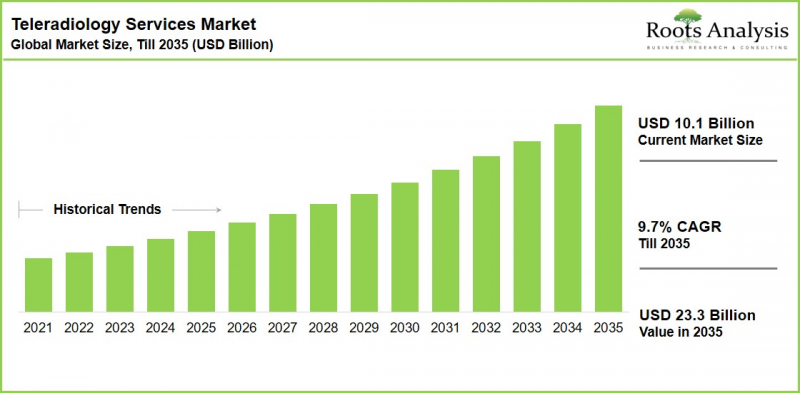
원격 방사선 진단 서비스 시장 : 성장 및 동향
보다 신속하고 정확한 진단 서비스를 제공해야 한다는 의료 시스템에 대한 압박이 커지는 가운데, 의료 영상 기술이 전 세계적으로 대규모로 도입되고 있습니다. 의료 영상 기술 중에서도 원격 방사선 진단 서비스는 원격 진단을 가능하게 하는 중요한 기술로 부상했습니다. 원격 방사선 의학을 통해 의료 영상을 안전하게 전송하여, 지리적 경계를 넘어 자격을 갖춘 방사선과 전문의가 영상을 판독할 수 있게 됩니다.
이러한 서비스는 컴퓨터 단층촬영(CT), 자기공명영상(MRI), 초음파 검사, 유방촬영술, X선 검사 등 광범위한 영상 진단 기법에 대응하며, 일상 진료부터 응급 의료 현장까지 폭넓게 활용되고 있습니다. 영상 진단 검사 건수의 증가에 더해 만성 질환 유병률의 상승까지 겹치면서, 효율적인 방사선 진단 보고 서비스에 대한 수요가 높아지고 있습니다. 이에 따라 의료 제공자들은 환자 치료에 지장을 주지 않으면서도 증가하는 영상 진단 업무 부담을 관리할 수 있는 확장성이 뛰어난 솔루션의 도입을 촉진하고 있습니다.
이러한 수요는 인력 부족의 심화와 데이터 양의 증가로 인해 더욱 절실해지고 있습니다. 의사 부족 전망과 과도한 업무 부담으로 인한 방사선과 의사의 번아웃 증가가 보다 효율적인 진단 워크플로우에 대한 수요를 가속화하고 있습니다. 이러한 압박은 증가하는 영상 진단 수요에 지속적으로 대응해야 하는 의료 시스템의 장기적인 대응 능력에 대한 우려를 높이고 있습니다. 이러한 과제를 해결하기 위해 시장 관계자들은 보고서 작성 효율을 높이고 지속적인 진단 체계를 가능하게 하는 첨단 원격 방사선학 솔루션의 도입을 점점 더 확대하고 있습니다. 또한, 클라우드 기반 영상 진단 인프라, AI를 활용한 영상 진단, 통합 워크플로우 플랫폼의 발전으로 인해 이러한 서비스의 편의성과 효율성은 더욱 향상되고 있습니다. 이러한 노력과 의료 분야 전반에 걸친 수요 확대가 맞물리면서, 텔레라디올로지는 단순한 보조 서비스에서 현대 진단 제공의 핵심 요소로 전환되고 있습니다.
성장 요인 : 전 세계 원격 방사선 진단 서비스 시장 확장을 뒷받침하는 요소
이 시장의 주요 촉진요인 중 하나는 전 세계적으로 지속되고 있는 자격을 갖춘 방사선과 전문의의 부족입니다. CT, MRI, 유방촬영술, X선 등의 영상 검사 건수가 증가함에 따라, 병원 및 진단 센터는 적시적인 보고 작성, 미처리 사례 감소, 그리고 신속한 진단 확보를 위해 텔레라디올로지 제공업체에 대한 의존도를 높이고 있습니다.
또한, 의료 제공자들은 판독의 정확성을 유지하면서도 더 신속한 진단을 내리도록 요구받고 있습니다. 그 결과, 병원 및 영상 진단센터에서는 24시간 영상 판독 체계를 확보하고, 신경방사선학, 근골격계 방사선학, 소아 방사선학, 종양 영상 진단 등 각 전문 분야의 전문 지식을 활용하기 위해 영상 진단 외주화를 점점 더 확대하고 있습니다. 이러한 외부 위탁 추세에 따라 응급 의료 및 일상 진료 양 분야에서 텔레라디올로지의 역할은 계속해서 확대되고 있습니다.
시장의 과제 : 발전을 저해하는 중대한 장벽
수요가 증가하고 있음에도 불구하고, 시장에는 몇 가지 제약요인이 존재합니다. 텔레라디올로지 사업자는 여러 의료 네트워크와 관할 구역에 걸쳐 방대한 양의 기밀성이 높은 환자 영상 데이터를 관리하고 있으며, 엄격한 데이터 개인정보 보호 규정, 사이버 보안 요건 및 의료 정보 기준 준수가 요구됩니다. 원활한 영상 전송과 보고서를 유지하면서 이러한 의무를 관리하는 것은 시장 진입 기업들에게 여전히 지속적인 운영상의 과제로 남아 있습니다.
또한, 의료 서비스 제공자들은 복잡한 의사 면허 요건과 일관성 없는 보상 체계에도 계속해서 대응해야 합니다. 일부 지역에서는 방사선과 의사가 다른 주나 국가에서 영상 진단을 수행하기 위해 여러 개의 면허를 취득해야 하며, 이로 인해 행정적 부담과 운영 비용이 증가하고 있습니다. 원격 방사선 진단 서비스에 대한 보상 정책의 불일치는 이러한 불확실성을 더욱 가중시켜 특정 시장에서의 도입 속도를 둔화시키고 있습니다.
원격 방사선 진단 서비스 시장 : 주요 인사이트
본 보고서는 원격 방사선 진단 서비스 시장의 현황을 상세히 분석하고, 업계 내 잠재적인 성장 기회를 파악하고 있습니다. 주요 조사 결과는 다음과 같습니다:
- 활발한 M&A 및 제휴 활동 : 최근 업계 동향은 통합과 플랫폼 확장에 초점을 맞추고 있습니다. 대표적인 사례로, Evidia가 Teleconsult 및 Meditecs를 인수하여 범유럽 규모의 원격 진단 사업 기반을 확대한 것과, Sirona Medical이 Everlight Radiology와 제휴하여 수백 개의 제휴 병원에 클라우드 기반 방사선 진단 운영 플랫폼을 구축하고 있는 점을 들 수 있습니다.
- 경쟁 차별화 요인으로서의 AI : 인공지능(AI)은 사례의 우선순위 지정, 이상 징후 탐지 및 소요 시간 단축을 지원하기 위해 보고서 작성 워크플로우에 점점 더 많이 통합되고 있으며, AI 기능은 병원 및 진단 네트워크에서 제공업체 선정의 새로운 기준으로 자리 잡고 있습니다.
- 외래 및 세부 전문 분야로의 확장 : 각 서비스 제공업체들은 병원과의 계약에 그치지 않고, 외래 및 정형외과 관련 영상 진단 네트워크로 사업 범위를 확대하고 있습니다. 이는 프리미어 라디오로지 서비스(Premier Radiology Services)가 세계 이미징 솔루션즈(Global Imaging Solutions)를 인수한 데서도 드러나며, 이를 통해 외래 센터를 위한 세부 전문 분야 판독 서비스가 추가되었습니다.
- 의료기관별 적극적인 도입 : 공적 의료 네트워크 내 원격 판독을 지원하는 전국적인 원격 방사선 진단 프로그램 등 정부 주도의 노력에 힘입어, 원격 판독 모델에 대한 의료기관의 신뢰는 계속해서 높아지고 있습니다.
- 향후 고려해야 할 주요 요인 : 원격 방사선 진단 서비스에 관한 면허 상호 인정 및 보상 균등화는 지역별로 여전히 일관되지 않은 상황입니다. 규제 조화의 진전 속도는 국경을 초월한 서비스 확장성을 좌우하는 중요한 요인이 될 것으로 예상되며, 투자자들에게는 주목해야 할 점입니다.
원격 방사선 진단 서비스 시장의 세분화
시장 규모 및 기회 분석은 다음 매개변수를 기반으로 세분화되어 있습니다:
영상 진단 모달리티별
- CT 스캔
- MRI
- 초음파
- X선
- 기타
최종사용자별
- 병원
- 진단·영상 진단 센터
- 외래 수술 센터
- 기타
비즈니스 모델별
- B2B
- B2C
지역별
- 북미
- 유럽
- 아시아태평양
- 중동 및 북아프리카
- 라틴아메리카
원격 방사선 진단 서비스 시장 : 주요 시장 세분화에 대한 인사이트
CT 스캔 부문이 시장을 주도
당사의 시장 평가에 따르면, CT 스캔 부문은 원격 방사선 진단 서비스 시장에서 가장 큰 점유율을 차지할 것으로 예상됩니다. 이러한 우위는 응급 의료, 종양학, 외상 사례에서 CT 영상 진단이 널리 활용되고 있기 때문입니다. 이러한 분야에서는 대규모 병원이나 진단 체인에서 하루당 스캔 건수가 많기 때문에 원격 판독 서비스에 대한 견고하고 안정적인 수요가 발생하고 있습니다. 또한, 일부 지역의 방사선과 전문의 부족도 의료 기관이 CT 영상 판독을 외부에 위탁하는 요인이 되고 있습니다. 게다가 뇌졸중이나 외상 사례는 시간과의 싸움이 요구되므로, 텔레라디올로지는 신속한 대응을 실현하는 데 최적의 수단이 됩니다.
한편, MRI 분야는 예측 기간 동안 가장 높은 연평균 성장률(CAGR)을 기록할 것으로 전망됩니다. 이러한 성장은 신경 질환, 근골격계 질환 및 암의 유병률 증가에 기인하며, 이들이 전 세계적으로 MRI 검사 건수의 급증세를 주도하고 있습니다. MRI 기술이 중규모 병원이나 영상 진단센터에서도 보다 합리적인 가격으로 이용하기 쉬워짐에 따라, 원격 판독 서비스에 대한 수요도 이에 따라 높아질 것으로 예상됩니다.
병원이 시장을 독점
당사의 독자적인 시장 보고서에 따르면, 원격 방사선 진단 서비스 시장에서 병원이 가장 큰 점유율을 차지하고 있습니다. 대규모 다학제 진료 시설이나 3차 의료 기관에서는 응급의학, 종양학, 정형외과, 신경내과 등 각 진료과에서 매일 방대한 양의 의료 영상이 생성되고 있습니다. 이 방대한 양의 진단 데이터를 관리하기 위해서는 병원 내에서 방사선과 전문의의 지속적인 대응이 필요합니다. 또한, 교외나 지방의 의료 시설에서는 현장 방사선과 전문의 부족이 만성화되어 있어, 텔레라디올로지는 이러한 최종사용자 그룹에게 운영상 필수적인 서비스가 되고 있습니다.
향후 몇 년간, 진단·영상 센터는 예측 기간 동안 가장 높은 연평균 성장률(CAGR)을 기록할 것으로 예상됩니다. 이러한 성장은 아시아태평양, 중동 및 아프리카의 신흥 경제국에서 독립형 진단·영상 센터가 급속히 확대되고 있는 데 힘입은 것입니다. 이러한 시설에서는 운영 팀이 상근 전문 방사선과 의사를 배치할 여력이 없기 때문에 텔레라디오로지가 비용 대비 효율이 높고 확장성이 뛰어난 대안으로 자리 잡고 있습니다.
B2B 모델이 시장을 주도
비즈니스 모델별로는 B2B 모델이 가장 큰 시장 점유율을 차지할 것으로 예상됩니다. 이는 병원, 진단 체인, 방사선과 그룹 등의 의료 기관이 원격 방사선 진단 서비스의 주요 구매자이기 때문입니다. 이러한 기관들은 안정적이고 대량의 영상 진단 사례를 확보하기 위해 텔레라디올로지 기업과 장기 서비스 계약을 체결하고 있으며, 이로 인해 B2B 모델은 양측 모두에게 경제적으로 매력적일 뿐만 아니라 운영 면에서도 안정적인 모델이 되고 있습니다.
향후 몇 년간 B2C 모델은 예측 기간 동안 가장 높은 연평균 성장률(CAGR)을 기록할 것으로 예상됩니다. 방사선 진단에 대한 제2의견(세컨드 오피니언)에 대한 직접적인 접근, 원격 진료, 신속한 소견서 제공에 대한 환자 수요 증가에 더해, 디지털 헬스 플랫폼 및 원격의료 애플리케이션의 확대로 인해 원격 방사선 진단 제공업체는 개인 소비자에게 직접 접근할 수 있게 되었으며, B2C는 급속히 부상하는 성장 분야로 자리매김하고 있습니다
북미가 최대 점유율을 차지
Roots Analysis의 지역별 시장 보고서에 따르면, 예측 기간 동안 북미가 세계 시장 매출에서 가장 큰 점유율을 차지하고 있습니다. 이 지역은 고도로 발달된 의료 인프라, 첨단 영상 진단 기술의 광범위한 보급, 그리고 20년 이상 성숙해 온 원격 방사선 진단 생태계를 모두 갖추고 있습니다. 미국은 진료 시간 외 방사선 진단 서비스에 대한 견고한 수요, 만성적인 방사선과 의사 부족, 그리고 원격 진단 솔루션에 대한 투자를 지속할 수 있는 재정적 여력을 갖춘 민간 의료 시스템에 힘입어 여전히 가장 큰 기여국으로 자리 잡고 있습니다. 재향군인 및 공공 의료 네트워크로 원격 판독 서비스를 확대하는 전국적인 원격 방사선 진단 프로그램 등의 노력에 힘입어, 의료 기관에서의 도입은 더욱 강화되고 있습니다.
아시아태평양에는 장기적인 기회가 기대
아시아태평양은 예측 기간 동안 가장 높은 연평균 성장률(CAGR)을 기록할 것으로 전망됩니다. 이러한 성장 추세는 의료 인프라 확충, 만성 질환 부담 증가, 영상 진단 건수 증가, 그리고 인도, 중국, 인도네시아, 베트남 등 국가들의 자격을 갖춘 방사선과 전문의 심각한 부족에 의해 주도되고 있습니다. 이러한 성장은 주로 아시아태평양 및 중동 및 아프리카의 신흥 경제국에서 진단 및 영상 진단 센터가 급속히 확대되고 있기 때문입니다. 이러한 시설 중 다수는 상근 방사선과 전문의를 확보할 수 없기 때문에 텔레라디올로지는 비용 대비 효과가 높고 확장성이 뛰어난 솔루션을 제공합니다.
원격 방사선 진단 서비스 시장의 주요 기업 사례
- 4ways
- Envision Physician Services
- Everlight Radiology
- Krsnaa Diagnostics
- Medica
- ONRAD
- USARAD 홀딩스
- vRad
전문가 인터뷰 및 업계 인사이트
본 조사에서 제시된 견해와 인사이트는 여러 이해관계자와의 논의를 바탕으로 합니다. 본 조사 보고서에는 다음 업계 관계자들과의 인터뷰에 대한 상세한 기록이 수록되어 있습니다:
- 미국 중견 기업 대표이사 사장 겸 최고경영자(CEO)
- 인도 소규모 기업 공동 창업자
또한, 본 시장 보고서에는 다음과 같은 기타 제3자와의 논의 기록도 포함되어 있습니다:
- 미국 중견 기업 의료 이사
- 미국 소규모 기업 최고 의료 책임자
- 영국 중견 기업 최고경영자
- 최고경영자(CEO), 중견 기업, 영국
- 인도 대기업 최고경영자 겸 수석 방사선과 전문의
- 인도 중견 기업, 창업자 겸 수석 방사선과 컨설턴트
- 미국 중소기업 사장 겸 회장
- 미국 중견 기업, 최고정보책임자 겸 소프트웨어 엔지니어링 부장
- 아랍에미리트(UAE) 중견 기업, 최고경영자(CEO)
- 공동 창업자, 미국 중견 기업
원격 방사선 진단 서비스 시장 : 조사 범위
- 시장 규모 및 기회 분석 : 본 보고서에서는 영상 진단 모달리티, 최종사용자, 비즈니스 모델, 지역 등 주요 시장 부문에 초점을 맞춰 원격 방사선 진단 서비스 시장에 대한 상세한 분석을 담고 있습니다.
- 원격 방사선 진단 서비스 시장 동향 : 원격 방사선 진단 서비스 시장 전체에 대한 상세한 평가를 수행하고, 영상 진단 기법, 최종사용자, 비즈니스 모델, 서비스 제공업체의 지리적 확장 등 관련 여러 매개변수에 대한 정보를 수록하고 있습니다. 또한, 설립 연도, 기업 규모(직원 수 기준), 본사 소재지 등의 매개변수를 바탕으로 한 원격 방사선 진단 기업에 대한 분석도 수록하고 있습니다.
- 기업 개요 : 원격 방사선 진단 서비스 제공에 종사하는 주요 기업의 상세한 프로필입니다. 설립 연도, 본사 소재지, 기업 규모(직원 수 기준), 경영진, 서비스 포트폴리오 및 주요 이니셔티브에 관한 정보를 수록하고 있습니다.
- 최근 동향 및 이니셔티브 : 합병·인수, 파트너십 및 제휴, 기타 전략적 이니셔티브 등 이 업계의 다양한 최근 동향에 대해 관련 여러 매개변수를 바탕으로 상세히 분석하고 있습니다.
- 블루 오션 전략 분석 : 블루 오션 전략 프레임워크에 대한 정성적 평가로, 그 핵심 개념, 주요 전략적 도구, 그리고 원격 방사선 진단 시장에서의 실질적인 적용 사례에 초점을 맞추고 있습니다. 본 장에서는 레드 오션과 블루 오션의 개요, 두 전략적 접근 방식의 비교, 그리고 가치 혁신, 전략 캔버스, 4가지 액션 프레임워크, ERRC 그리드, 6가지 패스 프레임워크, PMS 맵, 비고객의 3계층, 구매자 효용 맵, 대중의 가격대, 전략 실행의 장벽, 티핑 포인트 리더십, 그리고 지속가능한 차별화와 장기적인 경쟁 우위 기회를 파악하기 위한 공정한 프로세스에 대해 분석합니다.
- 비용 절감 분석 : 기본 시나리오, 보수적 시나리오, 낙관적 시나리오별 원격 방사선 진단 서비스의 비용 절감 가능성을 비교 평가하고, 주요 가정, 영상 진단 건수, 인건비, 기술 도입률, 보험 급여 동향 및 지역 시장 역학이 예측되는 비용 절감에 미치는 영향을 밝히고 있습니다.
- 시장 영향 분석 : 본 보고서에서는 시장 성장에 영향을 미치는 촉진요인, 제약요인, 기회, 과제 등 다양한 요인을 분석하고 있습니다.
본 보고서에서 다루는 주요 질문
- 원격 방사선 진단 서비스 시장의 주요 기업은 어디입니까?
- 원격 방사선 진단 서비스 시장을 주도하는 지역은 어디입니까?
- 원격 방사선 진단 서비스 시장에서 관찰되는 주요 동향은 무엇입니까?
- 이 시장의 향후 전개에 영향을 미칠 수 있는 요인은 무엇입니까?
- 원격 방사선 진단 서비스 제공업체가 직면하고 있는 주요 과제는 무엇입니까?
- 현재 및 향후 시장 규모는 어느 정도입니까?
- 원격 방사선 진단 서비스 시장의 연평균 성장률(CAGR)은 어느 정도입니까?
- 현재 및 향후 시장 기회는 주요 시장 부문 간에 어떻게 분포될 것으로 예상됩니까?
본 보고서를 구매해야 하는 이유
- 실무자별 검증을 거친 인사이트 : 조사 결과는 데스크 리서치에만 기반한 것이 아니라, 현직 방사선과 전문의, 최고 의료 책임자(CMO), 원격 방사선 진단 기업의 경영진에 대한 직접 인터뷰와 대조하여 검증되었으며, 이를 통해 부문별 점유율 및 성장 예측의 신뢰성을 높였습니다.
- 상세하고 투자자 중심의 세분화 : 시장 추정치는 영상 진단 모달리티, 최종사용자, 비즈니스 모델 및 국가 수준까지 세분화된 지역별로 제공되므로, 이해관계자는 단일 집계값에만 의존하지 않고 특정 목표 기회의 규모를 파악할 수 있습니다.
- 미래 지향적인 기술적 관점 : 정적인 시장 규모 조사와 달리, 본 보고서는 AI를 활용한 보고서 작성 워크플로가 경쟁적 포지셔닝에 미치는 영향을 명확히 평가하며, 전략 및 기업 개발 팀에 차별화의 초점이 어디로 이동하고 있는지에 대한 인사이트를 제공합니다.
- 지속적으로 추적된 거래 동향 : 본 보고서는 최근의 인수합병 및 플랫폼 제휴를 포함한 실시간 업계 재편 동향을 포착하고 있으며, 단순한 특정 시점의 스냅샷이 아닌 M&A 스크리닝 및 제휴 벤치마킹을 위한 최신 참고 자료로서의 위치를 차지하고 있습니다.
- 애널리스트별 해설 및 구매 후 지원 : 보고서를 구매하신 고객께는 조사팀이 제공하는 보고서에 대한 상세한 해설, 무료 엑셀 데이터 팩, 그리고 무료 맞춤화 서비스를 제공합니다. 이를 통해 조사 결과를 고정된 산출물로 받아들이는 것이 아니라, 특정 비즈니스 과제에 맞춰 활용할 수 있게 됩니다.
목차
제1장 서문
제2장 주요 요약
제3장 소개
제4장 시장 구도
제5장 기업 경쟁력
제6장 기업 개요
제7장 최근 동향과 대처
제8장 블루 대양 전략 : 경쟁이 치열한 시장에 참여하는 스타트업을 위한 전략 가이드
제9장 비용 절감 분석
제10장 시장 예측
제11장 결론
제12장 경영진 인사이트
제13장 부록 I : 표형식 데이터
제14장 부록 II : 기업 및 조직 리스트
KSM 26.08.13TELERADIOLOGY SERVICES MARKET: OVERVIEW
As per Roots Analysis, the global teleradiology services market is estimated to grow from USD 10.1 billion in the current year to USD 23.3 billion by 2035, at an impressive CAGR of 9.7%, during the forecast period, till 2035.
Teleradiology Services Market: Growth and Trends
Driven by the growing pressure on healthcare systems to deliver faster and more accurate diagnostic services, medical imaging technologies have been adopted on a large scale worldwide. Within medical imaging technologies, teleradiology services have emerged as a key technology that enables remote diagnostics. Teleradiology allows medical images to be transmitted securely and interpreted by qualified radiologists across geographic boundaries.
These services support a broad range of imaging modalities, including computed tomography, magnetic resonance imaging, ultrasound, mammography, and X-ray examinations, across both routine and emergency care settings. The rising volume of diagnostic imaging procedures, coupled with the increasing prevalence of chronic diseases, has driven demand for efficient radiology reporting services. It encourages healthcare providers to adopt scalable solutions capable of managing growing imaging workloads without compromising patient care.
This need has become more critical due to growing workforce shortages and increasing data volumes. A projected shortage of physicians and rising burnout among radiologists, driven by heavy workloads, are accelerating the demand for more efficient diagnostic workflows. These pressures have raised concerns regarding the long-term capacity of healthcare systems to keep pace with rising diagnostic imaging demand. To address these challenges, market players are increasingly deploying advanced teleradiology solutions that improve reporting efficiency and enable continuous diagnostic coverage. Further, advancements in cloud-based imaging infrastructure, AI-assisted image interpretation, and integrated workflow platforms are further enhancing the accessibility and efficiency of these services. These initiatives along with growing demand across healthcare sector are reinforcing teleradiology's transition from a supplemental offering to a core component of modern diagnostic delivery.
Growth Drivers: Factors Fueling Expansion of the Global Teleradiology Services Market
One of the significant drivers of this market is the persistent global shortage of qualified radiologists. As imaging volumes rise across CT, MRI, mammography, and X-ray modalities, hospitals and diagnostic centers are increasingly relying on teleradiology providers for timely reporting, reducing case backlogs, and ensure timely diagnosis.
In addition, healthcare providers face pressure to deliver faster diagnostic decisions while preserving reporting accuracy. Consequently, hospitals and imaging centers are increasingly outsourcing image interpretation to secure round-the-clock reporting coverage and gain access to subspecialty expertise across neuroradiology, musculoskeletal radiology, paediatric radiology, and oncology imaging. This outsourcing trend continues to widen the role of teleradiology across both emergency and routine care settings.
Market Challenges: Critical Barriers Hindering Progress
Despite growing demand, the market faces several restraining factors. Teleradiology providers manage substantial volumes of sensitive patient imaging data across multiple healthcare networks and jurisdictions, requiring compliance with stringent data privacy regulations, cybersecurity requirements, and healthcare information standards. Managing these obligations while maintaining seamless image transmission and reporting remains an ongoing operational challenge for market participants.
In addition, providers continue to contend with complex physician licensing requirements and inconsistent reimbursement frameworks. In several regions, radiologists must secure multiple licenses to interpret scans across different states or countries, adding administrative burden and operational cost. Variability in reimbursement policy for remote radiology services further compounds this uncertainty, tempering the pace of adoption in certain markets.
Teleradiology Services Market: Key Insights
The report delves into the current state of the teleradiology services market and identifies potential growth opportunities within the industry. Some key findings include:
- Active M&A and Partnership Activity: Recent industry activity has centred on consolidation and platform expansion, exemplified by Evidia's acquisition of Teleconsult and Meditecs to broaden its pan-European tele-diagnostics footprint, and Sirona Medical's collaboration with Everlight Radiology to deploy its cloud-based radiology operating platform across hundreds of partner hospitals.
- AI as a Competitive Differentiator: Artificial intelligence is increasingly embedded within reporting workflows to support case prioritization, anomaly detection, and turnaround-time reduction, positioning AI capability as an emerging benchmark for provider selection among hospitals and diagnostic networks.
- Outpatient and Subspecialty Expansion: Providers are extending reach beyond hospital contracts into outpatient and orthopedic-linked imaging networks, as reflected in Premier Radiology Services' acquisition of Global Imaging Solutions, which added subspecialty reads for outpatient centers.
- Favorable Institutional Adoption: Government-backed initiatives, including national teleradiology programs supporting remote interpretation for public healthcare networks, continue to reinforce institutional confidence in remote reporting models.
- Key Factors for Future Consideration: Licensing portability and reimbursement parity for remote radiology services remain inconsistent across geographies. The pace of regulatory harmonization is expected to be an important determinant of cross-border service scalability and is worth close monitoring by investors.
Teleradiology Services Market Segments
The market sizing and opportunity analysis has been segmented across the following parameters:
By Imaging Modality
- CT scan
- MRI
- Ultrasound
- X-Ray
- Others
By End User
- Hospitals
- Diagnostic / Imaging Centers
- Ambulatory Surgical Centers
- Others
By Business Model
- B2B
- B2C
By Geographical Regions
- North America
- Europe
- Asia-Pacific
- Middle East and North Africa
- Latin America
Teleradiology Services Market: Key Segmentation Insights
CT-Scan Segment Leads the Market
Based on our market assessment, the CT scan segment is expected to account for the largest share of the teleradiology services market. This dominance is due to the widespread use of CT imaging across emergency care, oncology, and trauma cases, where high daily scan volumes at large hospitals and diagnostic chains generate strong, consistent demand for remote reading services. Radiologist shortages in several regions further encourage facilities to outsource CT interpretation. In addition, the time-sensitive nature of stroke and trauma cases makes teleradiology a natural fit for faster turnaround times.
On the other hand, the MRI segment is projected to witness the highest CAGR during the forecast period. This growth is attributed to the rising prevalence of neurological disorders, musculoskeletal conditions, and cancer, which is driving a sudden increase in MRI scan volumes globally. As MRI technology becomes more affordable and accessible across mid-sized hospitals and imaging centers, demand for remote interpretation services is expected to rise correspondingly.
Hospitals Dominate the Market
According to our proprietary market report, hospitals hold the highest share of the teleradiology services market. Large multi-specialty and tertiary care facilities generate the highest volume of medical imaging on a daily basis across departments such as emergency, oncology, orthopedics, and neurology. In order to manage large volume of diagnostic data, there is need for continuous radiology coverage in hospitals. Further, the persistent on-site radiologist shortages in semi-urban and rural facilities makes teleradiology an operationally essential service for this end-user group.
In the coming years, diagnostic and imaging centers are expected to register the highest CAGR during the forecast period. This growth is driven by the rapid proliferation of standalone diagnostic and imaging centers across emerging economies in Asia-Pacific, and Middle East, and Africa, operating teams cannot justify full-time specialist radiologists, making teleradiology a cost-effective and scalable alternative.
B2B Model Leads the Market
On the basis of business model, the B2B model is expected to hold the highest market share. This can be attributed to the fact that healthcare institutions, including hospitals, diagnostic chains, and radiology groups are the primary buyers of teleradiology services. These institutions enter into long-term service contracts with teleradiology companies to ensure a steady, high-volume flow of imaging cases, making the B2B model financially attractive and operationally stable for both parties.
In the coming years, the B2C model is expected to register the highest CAGR during the forecast period. Growing patient demand for direct access to radiology second opinions, remote consultations, and faster report delivery, alongside the expansion of digital health platforms and telemedicine applications, is enabling teleradiology providers to reach individual consumers directly, positioning B2C as a fast-emerging growth avenue
North America Holds the Highest Share
According to Roots Analysis regional market report, North America holds the largest share of global market revenue through the forecast period. The region combines highly developed healthcare infrastructure, widespread adoption of advanced imaging technologies, and a teleradiology ecosystem that has matured over two decades. The US remains the single largest contributor, supported by robust demand for after-hours radiology coverage, consistent radiologist shortage, and a well-funded private healthcare system that continues to invest in remote diagnostic solutions. Institutional adoption is further reinforced through initiatives such as national teleradiology programs that extend remote interpretation services to veteran and public healthcare networks.
Asia-Pacific Offers Long-Term Opportunity
Asia-Pacific is expected to grow at the highest CAGR during the forecast period. This trajectory is driven by expanding healthcare infrastructure, a rising chronic disease burden, increasing imaging volumes, and a significant shortage of qualified radiologists in countries such as India, China, Indonesia, and Vietnam. This growth is largely due to the rapid expansion of diagnostic and imaging centers across emerging economies in Asia-Pacific, the Middle East, and Africa. As many of these facilities cannot support full-time radiologists, teleradiology offers a cost-effective and scalable solution.
Example Players in Teleradiology Services Market
- 4ways
- Envision Physician Services
- Everlight Radiology
- Krsnaa Diagnostics
- Medica
- ONRAD
- USARAD Holdings
- vRad
Expert Interview and Industry Insights
The opinions and insights presented in this study were influenced by discussions conducted with multiple stakeholders. The research report features detailed transcripts of interviews held with the following industry stakeholders:
- President and Chief Executive Officer, Mid-sized Company, US
- Co-Founder, Small Company, India
In addition, the market report includes transcripts of the following other third-party discussions:
- Medical Director, Mid-sized Company, US
- Chief Medical Officer, Small Company, US
- Chief Executive Officer, Mid-sized Company, UK
- Chief Executive Officer, Mid-sized Company, UK
- Chief Executive Officer and Chief Radiologist, Large Company, India
- Founder and Chief Consultant Radiologist, Mid-sized, India
- President and Chairman, Small Company, US
- Chief Information Officer, and Director of Software Engineering, Mid-sized Company, US
- Chief Executive Officer, Mid-sized Company, UAE
- Co-Founder, Mid-sized Company, US
TELERADIOLOGY SERVICES MARKET: RESEARCH COVERAGE
- Market Sizing and Opportunity Analysis: The report features an in-depth analysis of the teleradiology services market, focusing on key market segments, including imaging modality, end user, business model, and geographical regions.
- Teleradiology Services Landscape: A detailed assessment of the overall teleradiology services market landscape, featuring information on several relevant parameters, such as imaging modality, end user, business model, and geographical presence of service providers. Additionally, it features an analysis of teleradiology companies, based on parameters such as year of establishment, company size (based on employee count), and location of headquarters.
- Company Profiles: In-depth profiles of prominent players engaged in offering teleradiology services, featuring information on their year of establishment, location of headquarters, company size (in terms of number of employees), management team, service portfolio, and key initiatives.
- Recent Developments and Initiatives: A detailed analysis of the various recent developments in this industry, including mergers and acquisitions, partnerships and collaborations, and other strategic initiatives, based on several relevant parameters.
- Blue Ocean Strategy Analysis: A qualitative assessment of the blue ocean strategy framework, highlighting its core concepts, key strategic tools, and practical applications in the teleradiology market. The chapter includes an overview of red and blue oceans, a comparison of both strategic approaches, and an analysis of value innovation, strategy canvas, four actions framework, ERRC grid, six path framework, PMS map, three tiers of noncustomers, buyer utility map, price corridor of the mass, strategy execution hurdles, tipping point leadership, and fair process to identify opportunities for sustainable differentiation and long-term competitive advantage.
- Cost Saving Analysis: A comparative assessment of the cost saving potential of teleradiology services under base, conservative, and optimistic scenarios, highlighting the impact of key assumptions, imaging volumes, labor costs, technology adoption rates, reimbursement trends, and regional market dynamics on projected cost savings.
- Market Impact Analysis: The report analyzes various factors such as drivers, restraints, opportunities, and challenges affecting market growth.
Key Questions Answered in this Report
- Which are the leading companies in the teleradiology services market?
- Which region dominates the teleradiology services market?
- What are the key trends observed in the teleradiology services market?
- What factors are likely to influence the evolution of this market?
- What are the primary challenges faced by teleradiology services providers?
- What is the current and future market size?
- What is the CAGR of the teleradiology services market?
- How is the current and future market opportunity likely to be distributed across key market segments?
Reasons to Buy this Report
- Practitioner-Validated Insights: Findings are triangulated against primary interviews held with practicing radiologists, chief medical officers, and teleradiology company executives, rather than being based on desk research alone, lending greater confidence to segment-level share and growth estimates.
- Granular, Investor-Ready Segmentation: Market estimates are provided across imaging modality, end user, business model, and geographical regions, down to the country level, enabling stakeholders to size specific addressable pockets of opportunity rather than working from a single aggregate figure.
- Forward-Looking Technology Lens: Unlike static market-sizing studies, the report explicitly evaluates the influence of AI-enabled reporting workflows on competitive positioning, giving strategy and corporate development teams a view on where differentiation is shifting.
- Continuously Tracked Deal Activity: The report captures live consolidation trends, including recent acquisitions and platform partnerships, positioning the study as a current reference for M&A screening and partnership benchmarking rather than a point-in-time snapshot.
- Analyst Access and Post-Purchase Support: Buyers receive a dedicated report walkthrough with the research team, complimentary Excel data packs, and free customization, allowing the findings to be adapted to a specific business question rather than consumed as a fixed deliverable.
Additional Benefits
- Complementary Insights Packs
- 15% Free Content Customization
- Detailed Report Walkthrough Session with Research Team
- Free Updated report if the report is 6-12 months old or older
TABLE OF CONTENTS
1. PREFACE
- 1.1. Scope of the Report
- 1.2. Research Methodology
- 1.3. Key Questions Answered
- 1.4. Chapter Outlines
2. EXECUTIVE SUMMARY
3. INTRODUCTION
- 3.1. Chapter Overview
- 3.2. Overview of Teleradiology
- 3.2.1. Historical Evolution of Teleradiology
- 3.2.2. Need for Teleradiology Services
- 3.3. Types of Medical Images Processed
- 3.4. Types of Medical Image Storage and Transmission Systems
- 3.5. Current Regulatory Scenario
- 3.6. Benefits and Limitations of Teleradiology
- 3.7. Concluding Remarks
4. MARKET LANDSCAPE
- 4.1. Chapter Overview
- 4.2. Teleradiology Services: Overall Market Landscape
- 4.2.1. Analysis by Target Market
- 4.2.2. Analysis by Imaging Modality
- 4.2.3. Analysis by Target Market and Imaging Modality
- 4.2.4. Analysis by Type of Subspeciality Offered
- 4.2.5. Analysis by End User
- 4.2.6. Analysis by Imaging Modality and End User
- 4.2.7. Analysis by Type of Subspeciality Offered and End User
- 4.2.8. Analysis by Type of Software
- 4.2.9. Analysis by Additional Capabilities
- 4.2.10. Analysis by Imaging Modality and Additional Capabilities
- 4.3. Teleradiology: Service Providers Landscape
- 4.3.1. Analysis by Year of Establishment
- 4.3.2. Analysis by Company Size
- 4.3.3. Analysis by Type of Business Model
- 4.3.4. Analysis by Location of Headquarters
5. COMPANY COMPETITIVENESS
- 5.1. Chapter Overview
- 5.2. Key Assumptions and Parameters
- 5.3. Methodology
- 5.3.1. Company Competitiveness Analysis: Very Small Companies
- 5.3.2. Company Competitiveness Analysis: Small Companies
- 5.3.3. Company Competitiveness Analysis: Mid-Sized Companies
- 5.3.4. Company Competitiveness Analysis: Large Companies
6. COMPANY PROFILES
- 6.1. Chapter Overview
- 6.2. 4ways Healthcare
- 6.2.1. Company Overview
- 6.2.2. Recent Developments and Future Outlook
- 6.3. Envision Physician Services
- 6.3.1. Company Overview
- 6.3.2. Recent Developments and Future Outlook
- 6.4. Everlight Radiology
- 6.4.1. Company Overview
- 6.4.2. Recent Developments and Future Outlook
- 6.5. Krsnaa Diagnostics
- 6.5.1. Company Overview
- 6.5.2. Recent Developments and Future Outlook
- 6.6. Medica
- 6.6.1. Company Overview
- 6.6.2. Recent Developments and Future Outlook
- 6.7. ONRAD
- 6.7.1. Company Overview
- 6.7.2. Recent Developments and Future Outlook
- 6.8. USARAD Holdings
- 6.8.1. Company Overview
- 6.8.2. Recent Developments and Future Outlook
- 6.9. vRad
- 6.9.1. Company Overview
- 6.9.2. Recent Developments and Future Outlook
7. RECENT DEVELOPMENTS AND INITIATIVES
- 7.1. Chapter Overview
- 7.2. Teleradiology Services Market: Partnerships and Collaborations
- 7.2.1. Partnership Models
- 7.2.2. List of Partnerships and Collaborations
- 7.2.3. Analysis by Number of Partnership Instances
- 7.2.4. Analysis by Type of Partnership
- 7.2.5. Analysis by Year and Type of Partnership
- 7.2.6. Analysis by Type of Partnership and Company Size
- 7.2.7. Most Active Players: Analysis by Number of Partnerships
- 7.2.8. Analysis by Region
- 7.2.9. Intercontinental and Intracontinental Agreements
- 7.3. Teleradiology Services Market: Funding and Investment
- 7.3.1. Type of Funding
- 7.3.2. List of Funding and Investments
- 7.3.3. Analysis by Number of Funding Instances
- 7.3.4. Analysis by Amount Invested
- 7.3.5. Analysis by Type of Funding
- 7.3.6. Analysis by Region
- 7.3.7. Most Active Players: Analysis by Number of Funding Instances
- 7.3.8. Most Active Players: Analysis by Amount Raised
- 7.4. Teleradiology Services Market: Recent Initiatives
- 7.4.1. Analysis by Number of Initiatives
- 7.4.2. Analysis by Type of Initiative
- 7.4.3. Analysis by Region
- 7.5. Teleradiology Services Market: COVID-19 Specific Initiatives
8. BLUE OCEAN STRATEGY: A STRATEGIC GUIDE FOR START-UPS TO ENTER INTO HIGHLY COMPETITIVE MARKET
- 8.1. Chapter Overview
- 8.2. Overview of Blue Ocean Strategy
- 8.2.1. Red Oceans
- 8.2.2. Blue Oceans30
- 8.2.3. Comparison of Red Ocean Strategy and Blue Ocean Strategy
- 8.2.4. Blue Ocean Strategy and Shift in Tools Used in Teleradiology
- 8.2.4.1. Value Innovation
- 8.2.4.2. Strategy Canvas
- 8.2.4.3. Four Action Framework
- 8.2.4.4. Eliminate-Raise-Reduce-Create (ERRC) Grid
- 8.2.4.5. Six Path Framework
- 8.2.4.6. Pioneer-Migrator-Settler (PMS) Map
- 8.2.4.7. Three Tiers of Noncustomers
- 8.2.4.8. Sequence of Blue Ocean Strategy
- 8.2.4.9. Buyer Utility Map
- 8.2.4.10. The Price Corridor of the Mass
- 8.2.4.11. Four Hurdles to Strategy Execution
- 8.2.4.12. Tipping Point Leadership
- 8.2.4.13. Fair Process
- 8.3. Conclusion
9. COST SAVING ANALYSIS
- 9.1. Chapter Overview
- 9.2. Key Assumptions and Methodology
- 9.3. Key Parameters Influencing the Cost of Teleradiology Services
- 9.4. Overall Cost Saving Potential of Teleradiology Services, Since 2021
- 9.5. Cost Saving Potential of Teleradiology Services: Analysis by Imaging Modality
- 9.5.1. Cost Saving Potential of Teleradiology Services in CT Scan, Since 2021
- 9.5.2. Cost Saving Potential of Teleradiology Services in MRI, Since 2021
- 9.5.3. Cost Saving Potential of Teleradiology Services in Ultrasound, Since 2021
- 9.5.4. Cost Saving Potential of Teleradiology Services in X-Ray, Since 2021
- 9.6. Cost Saving Potential of Teleradiology Services: Analysis by Region
- 9.6.1. Cost Saving Potential of Teleradiology Services in North America, Since 2021
- 9.6.2. Cost Saving Potential of Teleradiology Services in Europe, Since 2021
- 9.6.3. Cost Saving Potential of Teleradiology Services in Asia-Pacific, Since 2021
- 9.6.4. Cost Saving Potential of Teleradiology Services in Rest of the World, Since 2021
- 9.7. Cost Saving Potential of Teleradiology Services: Analysis by Economic Strength
- 9.7.1. Cost Saving Potential of Teleradiology Services in High Income Countries, Since 2021
- 9.7.2. Cost Saving Potential of Teleradiology Services in Middle Income Countries, Since 2021
- 9.8. Concluding Remarks: Base, Conservative and Optimistic Scenarios
10. MARKET FORECAST
- 10.1. Chapter Overview
- 10.2. Forecast Methodology and Key Assumptions
- 10.3. Teleradiology Services Market, Historical Trends (Since 2021) and Forecasted Estimates (Till 2035)
- 10.4. Teleradiology Services Market: Analysis by Imaging Modality
- 10.4.1. Teleradiology Services Market for CT scan, Historical Trends (Since 2021) and Forecasted Estimates (Till 2035)
- 10.4.2. Teleradiology Services Market for MRI, Historical Trends (Since 2021) and Forecasted Estimates (Till 2035)
- 10.4.3. Teleradiology Services Market for Ultrasound, Historical Trends (Since 2021) and Forecasted Estimates (Till 2035)
- 10.4.4. Teleradiology Services Market for X-Ray, Historical Trends (Since 2021) and Forecasted Estimates (Till 2035)
- 10.4.5. Teleradiology Services Market for Others, Historical Trends (Since 2021) and Forecasted Estimates (Till 2035)
- 10.5. Teleradiology Services Market: Analysis by End User
- 10.5.1. Teleradiology Services Market for Hospitals, Historical Trends (Since 2021) and Forecasted Estimates (Till 2035)
- 10.5.2. Teleradiology Services Market for Diagnostic / Imaging Centers, Historical Trends (Since 2021) and Forecasted Estimates (Till 2035)
- 10.5.3. Teleradiology Services Market for Ambulatory Surgical Centers, Historical Trends (Since 2021) and Forecasted Estimates (Till 2035)
- 10.5.4. Teleradiology Services Market for Others, Historical Trends (Since 2021) and Forecasted Estimates (Till 2035)
- 10.6. Teleradiology Services Market: Analysis by Type of Business Model
- 10.6.1. Teleradiology Services Market for B2B, Historical Trends (Since 2021) and Forecasted Estimates (Till 2035)
- 10.6.2. Teleradiology Services Market for B2C, Historical Trends (Since 2021) and Forecasted Estimates (Till 2035)
- 10.7. Teleradiology Services Market: Analysis by Geographical Regions
- 10.7.1. Teleradiology Services Market in North America, Historical Trends (Since 2021) and Forecasted Estimates (Till 2035)
- 10.7.2. Teleradiology Services Market in Europe, Historical Trends (Since 2021) and Forecasted Estimates (Till 2035)
- 10.7.3. Teleradiology Services Market in Asia-Pacific, Historical Trends (Since 2021) and Forecasted Estimates (Till 2035)
- 10.7.4. Teleradiology Services Market in Middle East and North Africa, Historical Trends (Since 2021) and Forecasted Estimates (Till 2035)
- 10.7.5. Teleradiology Services Market in Latin America, Historical Trends (Since 2021) and Forecasted Estimates (Till 2035)
- 10.8. Concluding Remarks


