|
시장보고서
상품코드
2083295
재생 농업 기술 시장 기회, 성장요인, 업계 동향 분석 및 예측(2026-2035년)Regenerative Agriculture Technology Market Opportunity, Growth Drivers, Industry Trend Analysis, and Forecast 2026 - 2035 |
||||||

세계의 재생 농업 기술 시장은 2025년에 29억 달러로 평가되었고, CAGR 13.7%로 성장하여 2035년까지 105억 달러에 달할 것으로 추정되고 있습니다.
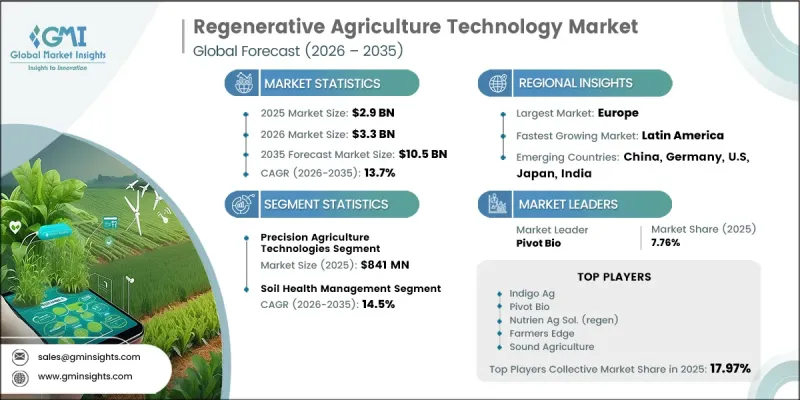
이 시장은 기후 변화 대응에 중점을 둔 정책의 일관성이 강화되고 있는 점, 인공지능(AI)을 활용한 농업 기술의 급속한 발전, 그리고 전 세계 공급망 전반에 걸쳐 지속 가능한 조달 관행에 대한 수요가 증가하고 있는 점 등의 요인으로 인해 혜택을 보고 있습니다. 재생형 농업 기술은 환경의 지속가능성을 뒷받침하는 동시에 농장의 생산성과 자원 효율성을 향상시킬 수 있는 능력을 갖추고 있어, 광범위한 농업 기술 생태계 내에서 전략적으로 중요한 분야로 부상하고 있습니다. 시장에서의 도입은 시범 프로그램이나 초기 단계의 구현에서 대규모 기업의 조달로 점차 전환되고 있으며, 농업 밸류체인 전반에 걸친 확산이 가속화되고 있습니다. 이러한 전환으로 인해, 단기적인 농산물 가격 변동에 대한 의존도가 낮은 보다 안정적인 수요 환경이 조성되고 있습니다. 동시에, 지속가능성과 배출량 감축을 위한 기업의 노력이 강화됨에 따라, 토양 성능 모니터링, 탄소 측정, 농업의 추적성을 지원하는 기술에 대한 수요가 증가하고 있습니다. 견조한 성장이 예상되는 반면, 소규모 농업 경영을 디지털 기술과 통합된 재생형 생산 모델로 전환하는 데 필요한 막대한 초기 투자 비용은 시장 확산을 가속화하는 데 있어 여전히 주요 제약 요인 중 하나입니다.
| 시장 범위 | |
|---|---|
| 개시 연도 | 2025년 |
| 예측 기간 | 2026-2035년 |
| 초기 시장 규모 | 29억 달러 |
| 예측액 | 105억 달러 |
| CAGR | 13.7% |
2025년, 정밀 농업 기술 부문은 29%의 점유율을 차지했습니다. 데이터 기반 농업 도구, 자동화된 농지 관리 시스템, 그리고 첨단 작물 모니터링 솔루션의 도입이 활발히 진행되고 있으며, 이것이 해당 부문의 성장을 지속적으로 견인하고 있습니다. 농업 생산자들은 자원 활용을 최적화하고, 업무 효율을 높이며, 지속가능성 성과를 향상시키기 위해 정밀 기술의 활용을 점점 더 확대되고 있습니다. 재생형 농업의 실천이 더욱 널리 보급됨에 따라, 정확한 의사 결정과 성과 측정을 가능하게 하는 기술에 대한 수요는 계속해서 견조한 추세를 보일 것으로 예측됩니다.
2025년, 토양 건강 관리 부문 시장 점유율은 31.74%를 차지했으며, 해당 시장 규모는 9억 달러에 달했습니다. 토양 품질 개선, 양분 이용 효율 향상, 그리고 장기적인 농업 생산성 향상에 대한 관심이 높아지고 있는 것이 이 응용 분야 수요를 지속적으로 뒷받침하고 있습니다. 농가와 농업 관련 기관들은 토양 상태에 관한 실용적인 지식을 제공하고, 지속 가능한 토지 관리 기법을 지원하는 기술에 대한 투자를 점점 더 늘리고 있습니다. 재생 농업의 기반이 되는 요소로서 토양 건강의 중요성은 예측 기간 내내 강력한 성장세를 유지할 것으로 전망됩니다.
북미의 재생형 농업 기술 시장은 2025년에 39%의 점유율을 차지하며 11억 3,100만 달러 시장 규모를 기록했습니다. 농업 기술의 적극적인 도입, 지속가능성을 위한 노력의 확대, 그리고 기후 변화에 초점을 맞춘 농업 관행에 대한 투자 증가에 힘입어, 북미는 재생형 농업 솔루션의 주요 시장으로서의 입지를 계속해서 공고히 하고 있습니다. 지원적인 업계 프로그램, 선진적인 디지털 인프라, 그리고 측정 가능한 환경 성과에 대한 관심의 고조가 해당 지역 전체 시장 성장에 더욱 기여하고 있습니다.
자주 묻는 질문
목차
제1장 조사 방법과 범위
제2장 주요 요약
제3장 업계 인사이트
제4장 경쟁 구도
제5장 시장 추산 및 예측 : 기술 유형별, 2022년-2035년
제6장 시장 추산 및 예측 : 용도별, 2022년-2035년
제7장 시장 추산 및 예측 : 최종사용자별, 2022년-2035년
제8장 시장 추산 및 예측 : 지역별, 2022년-2035년
제9장 기업 개요
LSH 26.07.14The Global Regenerative Agriculture Technology Market was valued at USD 2.9 billion in 2025 and is estimated to grow at a CAGR of 13.7% to reach USD 10.5 billion by 2035.
The market is benefiting from the increasing alignment of climate-focused policies, rapid advancements in artificial intelligence-driven agricultural technologies, and growing demand for sustainable sourcing practices throughout global supply chains. Regenerative agriculture technologies are emerging as a strategically important segment within the broader agricultural technology ecosystem due to their ability to support environmental sustainability while improving farm productivity and resource efficiency. Market adoption is increasingly moving beyond pilot programs and early-stage implementation toward large-scale enterprise procurement, accelerating deployment across agricultural value chains. This transition is creating a more stable demand environment that is less dependent on short-term agricultural commodity fluctuations. At the same time, increasing corporate commitments to sustainability and emissions reduction are driving demand for technologies that support soil performance monitoring, carbon measurement, and agricultural traceability. Despite strong growth prospects, the significant upfront investment required to transition smaller farming operations toward regenerative production models integrated with digital technologies remains one of the primary factors limiting faster market penetration.
| Market Scope | |
|---|---|
| Start Year | 2025 |
| Forecast Year | 2026-2035 |
| Start Value | $2.9 Billion |
| Forecast Value | $10.5 Billion |
| CAGR | 13.7% |
The precision agriculture technologies segment held a 29% share in 2025. Strong adoption of data-driven farming tools, automated field management systems, and advanced crop monitoring solutions continues to support segment growth. Agricultural producers are increasingly utilizing precision technologies to optimize resource utilization, improve operational efficiency, and enhance sustainability outcomes. As regenerative farming practices become more widely adopted, demand for technologies that enable accurate decision-making and performance measurement is expected to remain robust.
The soil health management segment held a 31.74% share in 2025, equivalent to USD 900 million. Growing emphasis on improving soil quality, increasing nutrient efficiency, and enhancing long-term agricultural productivity continues to support demand within this application area. Farmers and agricultural organizations are increasingly investing in technologies that provide actionable insights into soil conditions and support sustainable land management practices. The importance of soil health as a foundational component of regenerative agriculture is expected to sustain strong growth throughout the forecast period.
North America Regenerative Agriculture Technology Market accounted for 39% share, generating USD 1.131 billion in 2025. Strong adoption of agricultural technology, increasing sustainability initiatives, and growing investments in climate-focused farming practices continue to position North America as a leading market for regenerative agriculture solutions. Supportive industry programs, advanced digital infrastructure, and rising interest in measurable environmental outcomes are further contributing to market growth across the region.
Key participants operating in the Global Regenerative Agriculture Technology Market include Pivot Bio, Indigo Ag, Sound Agriculture, Nutrien Ag Solutions, Farmers Edge, EarthDaily Analytics, CIBO Technologies, xFarm Technologies, CropX Technologies, Ginkgo Bioworks, Agreena, Regrow Ag, Agoro Carbon Alliance, CropIn Technology, Biome Makers, Klim, Perennial, Boomitra, InPlanet, Puna Bio, and Yard Stick PBC. Companies operating in the Regenerative Agriculture Technology Market are focusing on innovation, strategic collaborations, and platform expansion to strengthen their market position. Investments in artificial intelligence, advanced analytics, soil monitoring technologies, and carbon measurement capabilities are helping companies deliver more comprehensive solutions to agricultural stakeholders. Many market participants are establishing partnerships with growers, agribusinesses, food companies, and sustainability-focused organizations to accelerate adoption and expand market reach. Product development efforts are increasingly centered on improving data accuracy, enhancing traceability, and simplifying technology integration across farming operations.
Table of Contents
Chapter 1 Methodology & Scope
- 1.1 Research approach
- 1.2 Quality Commitments
- 1.2.1 GMI AI policy & data integrity commitment
- 1.2.1.1 Source consistency protocol
- 1.2.1 GMI AI policy & data integrity commitment
- 1.3 Research Trail & Confidence Scoring
- 1.3.1 Research Trail Components
- 1.3.2 Scoring Components
- 1.4 Data Collection
- 1.4.1 Partial list of primary sources
- 1.5 Data mining sources
- 1.5.1 Paid sources
- 1.5.1.1 Sources, by region
- 1.5.1 Paid sources
- 1.6 Base estimates and calculations
- 1.6.1 Base year calculation for any one approach
- 1.7 Forecast model
- 1.7.1 Quantified market impact analysis
- 1.7.1.1 Mathematical impact of growth parameters on forecast
- 1.7.1 Quantified market impact analysis
- 1.8 Research transparency addendum
- 1.8.1 Source attribution framework
- 1.8.2 Quality assurance metrics
- 1.8.2.1 Our commitment to trust
Chapter 2 Executive Summary
- 2.1 Industry 360° synopsis, 2022 - 2035
- 2.2 Key market trends
- 2.2.1 Region
- 2.2.2 Technology Type
- 2.2.3 Application
- 2.2.4 End-user
Chapter 3 Industry Insights
- 3.1 Industry ecosystem analysis
- 3.2 Supply chain analysis
- 3.2.1 Hardware Component Sourcing (Sensors, Drones, Connectivity Modules)
- 3.2.2 Software & Platform Development Ecosystem
- 3.2.3 Biological Input Supply Chain - Fermentation to Field
- 3.3 Industry impact forces
- 3.3.1 Market drivers
- 3.3.1.1 Rising Corporate ESG Commitments & Scope 3 Emission Reduction Mandates
- 3.3.1.2 Government Subsidies & Policy Incentives for Soil Health Programs (USDA EQIP, EU Farm to Fork)
- 3.3.1.3 Accelerating Voluntary Carbon Market Demand Driving MRV Technology Adoption
- 3.3.2 Market restraints
- 3.3.2.1 High Upfront Technology Transition Costs for Small & Medium-Scale Farmers
- 3.3.2.2 Fragmented MRV Standards & Carbon Credit Verification Complexity
- 3.3.3 Market opportunities
- 3.3.3.1 Expansion of Digital Carbon Credit Platforms & Tokenized Carbon Markets
- 3.3.3.2 Integration of AI & Satellite Remote Sensing for Real-Time Field Monitoring at Scale
- 3.3.1 Market drivers
- 3.4 Growth potential analysis
- 3.5 Technology & innovation landscape
- 3.6 Regulatory framework
- 3.7 Major market trends and disruptions
- 3.8 Future market trends
- 3.9 Pricing analysis (driven by primary research)
- 3.9.1 Historical Price Trend Analysis - SaaS, Hardware & Service Tiers (Driven by Primary Research)
- 3.9.2 Pricing Strategy by Player Type (Premium / Value / Cost-plus) (Driven by Primary Research)
- 3.10 Trade data analysis (driven by primary research)
- 3.10.1 Import/Export Volume & Value Trends - AgTech Hardware & Biological Inputs (Driven by Primary Research)
- 3.10.2 Key Trade Corridors & Tariff Impact on Technology Adoption (Driven by Primary Research)
- 3.11 Impact of AI & generative AI on the market
- 3.11.1 AI-Driven Disruption of Existing Precision Agriculture Business Models
- 3.11.2 GenAI Use Cases & Adoption Roadmap by Segment (Soil Modeling, Carbon MRV, Crop Advisory)
- 3.11.3 Risks, Limitations & Regulatory Considerations for AI in Agriculture
- 3.12 Porter's analysis
- 3.13 PESTEL analysis
Chapter 4 Competitive Landscape, 2025
- 4.1 Introduction
- 4.2 Company market share analysis
- 4.2.1 By Region
- 4.2.1.1 North America
- 4.2.1.2 Europe
- 4.2.1.3 Asia Pacific
- 4.2.1.4 Latin America
- 4.2.1.5 Middle East and Africa
- 4.2.1 By Region
- 4.3 Company matrix analysis
- 4.4 Competitive analysis of major market players
- 4.5 Competitive positioning matrix
- 4.6 Key developments
- 4.6.1 Mergers & acquisitions
- 4.6.2 Partnerships & collaborations
- 4.6.3 New product launches
- 4.6.4 Expansion plans
Chapter 5 Market Estimates and Forecast, By Technology Type, 2022 - 2035 (USD Billion) (Thousand Units)
- 5.1 Key trends
- 5.2 Precision Agriculture Technologies
- 5.2.1 Variable Rate Technology (VRT) Systems
- 5.2.2 GPS & Field Mapping Tools
- 5.2.3 Yield Monitoring & Data Management Systems
- 5.3 Remote Sensing & GIS Technologies
- 5.3.1 Drone-Based Imaging & Aerial Survey Platforms
- 5.3.2 Satellite Remote Sensing & Multispectral Imaging
- 5.3.3 Geographic Information Systems (GIS) for Land Monitoring
- 5.4 AI & Machine Learning Platforms
- 5.4.1 Predictive Crop Analytics & Recommendation Engines
- 5.4.2 Soil Carbon Modeling & Sequestration Estimation Tools
- 5.4.3 Computer Vision for Crop & Soil Monitoring
- 5.5 IoT & Connected Devices
- 5.5.1 Soil Health Sensors (Moisture, Nutrient, pH)
- 5.5.2 Microclimate & Weather Monitoring Stations
- 5.5.3 Connected Livestock & Grazing Management Devices
- 5.6 Biological Input Technologies
- 5.6.1 Microbial Inoculant Production & Delivery Platforms
- 5.6.2 Biostimulant Formulation Technologies
- 5.6.3 Biocontrol Agent Development Platforms
- 5.7 Carbon Measurement & MRV Platforms
- 5.7.1 Digital MRV Software & GHG Accounting Tools
- 5.7.2 Carbon Credit Registry & Issuance Platforms
- 5.7.3 Soil Carbon Measurement Kits & Field Devices
- 5.8 Blockchain & Traceability Platforms
- 5.8.1 Supply Chain Transparency & Provenance Tracking
- 5.8.2 Carbon Credit Tokenization & Trading Platforms
- 5.8.3 Regenerative Certification & Label Management Systems
Chapter 6 Market Estimates and Forecast, By Application, 2022 - 2035 (USD Billion) (Thousand Units)
- 6.1 Key trends
- 6.2 Soil Health Management
- 6.2.1 No-Till & Conservation Tillage Support Tools
- 6.2.2 Cover Crop & Crop Rotation Management Systems
- 6.2.3 Soil Microbiome Analysis & Health Monitoring
- 6.3 Water & Irrigation Management
- 6.3.1 Precision Irrigation & Water Use Optimization Tools
- 6.3.2 Water Retention & Watershed Monitoring Platforms
- 6.3.3 Runoff & Erosion Control Technology Systems
- 6.4 Carbon Sequestration & Monitoring
- 6.4.1 Soil Carbon Sequestration Measurement & Verification
- 6.4.2 Agroforestry Carbon & Biomass Monitoring Tools
- 6.4.3 Blue Carbon & Aquaculture Sequestration Platforms
- 6.5 Crop & Livestock Management
- 6.5.1 Regenerative Crop Rotation & Intercropping Optimization
- 6.5.2 Holistic Grazing & Silvopasture Management Platforms
- 6.5.3 Pasture Health & Animal Impact Monitoring Systems
- 6.6 Biodiversity Enhancement
- 6.6.1 Agroforestry Design & Canopy Monitoring Tools
- 6.6.2 Pollinator Habitat Tracking & Ecosystem Mapping Platforms
- 6.6.3 Biodiversity Index Measurement & Reporting Systems
Chapter 7 Market Estimates and Forecast, By End-user, 2022 - 2035 (USD Billion) (Thousand Units)
- 7.1 Key trends
- 7.2 Farmers & Growers
- 7.2.1 Small & Medium-Scale Farmers
- 7.2.2 Large-Scale Commercial Farms & Cooperatives
- 7.3 Agribusinesses & Food Companies
- 7.3.1 Food Manufacturers & CPG Companies
- 7.3.2 Agricultural Input Suppliers & Distributors
- 7.4 Government & NGOs
- 7.4.1 National Agricultural Agencies & Extension Services
- 7.4.2 International Development Organizations & NGOs
- 7.5 Financial Institutions & Carbon Market Players
- 7.5.1 ESG-Focused Investment Funds & Banks
- 7.5.2 Voluntary Carbon Market Registries & Exchanges
Chapter 8 Market Estimates & Forecast, By Region, 2022 - 2035, (USD Billion) (Thousand Units)
- 8.1 Key trends
- 8.2 North America
- 8.2.1 U.S.
- 8.2.2 Canada
- 8.3 Europe
- 8.3.1 Germany
- 8.3.2 U.K.
- 8.3.3 France
- 8.3.4 Italy
- 8.3.5 Spain
- 8.4 Asia Pacific
- 8.4.1 China
- 8.4.2 India
- 8.4.3 Japan
- 8.4.4 South Korea
- 8.4.5 Australia
- 8.5 Latin America
- 8.5.1 Brazil
- 8.5.2 Mexico
- 8.5.3 Argentina
- 8.6 MEA
- 8.6.1 UAE
- 8.6.2 Saudi Arabia
- 8.6.3 South Africa
Chapter 9 Company Profiles
- 9.1 Pivot Bio
- 9.2 Sound Agriculture
- 9.3 CropX Technologies
- 9.4 Biome Makers
- 9.5 Agreena
- 9.6 Regrow Ag
- 9.7 Nutrien Ag Solutions
- 9.8 Indigo Ag
- 9.9 CropIn Technology Solutions
- 9.10 Klim
- 9.11 InPlanet
- 9.12 Boomitra
- 9.13 Perennial
- 9.14 Agoro Carbon Alliance
- 9.15 Puna Bio
- 9.16 EarthDaily Analytics
- 9.17 CIBO Technologies
- 9.18 xFarm Technologies
- 9.19 Yard Stick PBC
- 9.20 Agrology
- 9.21 Ginkgo Bioworks
- 9.22 Farmers Edge