|
시장보고서
상품코드
2083306
노인 돌봄 용품 시장 : 성장 기회, 성장요인, 업계 동향 분석 및 예측(2026-2035년)Elderly Care Products Market Opportunity, Growth Drivers, Industry Trend Analysis, and Forecast 2026 - 2035 |
||||||

세계의 노인 돌봄 용품 시장은 2025년에 488억 달러 규모로 평가되었고, CAGR 5.4%로 성장하여 2035년까지 833억 달러에 달할 것으로 추정되고 있습니다.
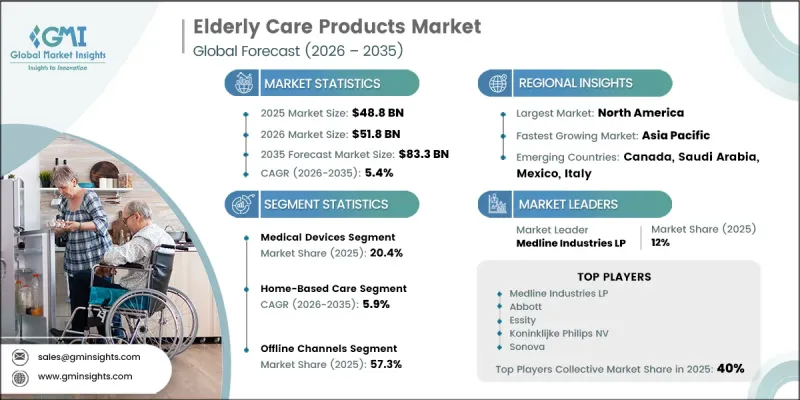
시장 성장을 주도하고 있는 것은 세계 인구 구조의 큰 변화입니다. 65세 이상의 고령 인구는 다른 연령층보다 빠른 속도로 계속 증가하고 있습니다. 이러한 장기적인 추세에 따라 이동 지원 솔루션, 건강 모니터링 기기, 영양 보충제, 개인 위생 용품 등 다양한 노인 돌봄 용품에 대한 지속적인 수요가 발생하고 있습니다. 고령자 돌봄 제품 시장에 영향을 미치는 큰 변화 중 하나는 시설 돌봄보다 재택 돌봄을 선호하는 경향이 강해지고 있다는 점입니다. 집에서 노후를 보내기로 선택하는 고령자가 늘어남에 따라, 각 제조업체들은 재택치료 환경의 변화하는 수요에 대응하기 위해 제품 라인업을 조정하고 있습니다. 동시에, 환자 수와 입소율이 지속적으로 개선되고 있는 만큼, 의료시설 및 장기 요양 사업자들의 조달 활동도 활발해지고 있습니다. 이러한 변화로 인해 업계 전반에 걸쳐 수요 패턴에 차이가 나타나고 있습니다. 재택 돌봄 이용자는 편의성, 사용 편의성, 휴대성을 중시하는 반면, 전문 돌봄 제공업체는 내구성, 신뢰성, 비용 효율성을 중시합니다. 또한, 고령화에 따라 만성 질환 유병률이 증가하고 있어, 장기적인 질환 관리를 지원하는 제품에 대한 수요가 가속화되고 있으며, 선진국과 신흥국의 의료 시장 모두에서 큰 성장 기회가 창출되고 있습니다.
| 시장 범위 | |
|---|---|
| 개시 연도 | 2025년 |
| 예측 기간 | 2026-2035년 |
| 개시 연도 시장 규모 | 488억 달러 |
| 예측액 | 833억 달러 |
| CAGR | 5.4% |
2025년에는 의료기기가 시장 점유율의 20.4%를 차지했습니다. 고령화가 진행됨에 따라 지속적인 건강 모니터링, 질병 관리 및 지원형 헬스케어 솔루션에 대한 수요가 증가함에 따라, 의료기기에 대한 수요도 계속해서 늘어나고 있습니다. 이러한 성장은 노화에 따른 건강 문제 발생률 증가와, 장기적인 건강 문제를 선제적으로 관리할 수 있는 제품에 대한 수요와 밀접한 관련이 있습니다. 의료 제공업체와 소비자가 예방 의료 및 원격 건강 모니터링을 더욱 중요하게 여기게 됨에 따라, 예측 기간 동안 의료기기 도입은 지속적으로 확대될 것으로 예측됩니다.
재택 간호 부문은 2025년에 39.6%의 점유율을 차지했습니다. 자립적인 생활이나 재택 노후를 바라는 경향이 강해짐에 따라, 주거 환경에서 사용하기 위한 다양한 노인 돌봄 용품에 대한 수요가 증가하고 있습니다. 소비자들은 가정 환경에서의 안전성, 이동성, 건강 관리, 쾌적성, 그리고 전반적인 삶의 질을 향상시키는 솔루션을 점점 더 많이 찾고 있습니다. 재택치료 서비스, 디지털 헬스 기술, 그리고 소비자 직접 판매 채널의 확대가 이 부문의 성장을 더욱 뒷받침하고 있습니다. 의료 제도가 시설 밖에서 비용 대비 효과가 높은 돌봄 서비스 제공을 계속해서 중시하는 가운데, 재택 돌봄 제품에 대한 수요는 계속해서 견조할 것으로 예측됩니다.
유럽의 노인 돌봄 용품 시장은 2025년에 25.3%의 시장 점유율을 차지했으며, 2035년까지 연평균 성장률(CAGR) 5%로 성장할 것으로 전망됩니다. 이 지역은 고령 인구가 많고, 확립된 의료 제도를 갖추고 있으며, 고령자용 제품 및 서비스 이용을 촉진하는 지원적인 공공 정책의 혜택을 받고 있습니다. 평균 수명의 연장과 의료비 증가는 유럽 각국에서 시장의 확장에 지속적으로 기여하고 있습니다. 또한, 고령자의 건강 유지, 예방 의료, 자립적인 생활을 영위하기 위한 솔루션에 대한 인식이 높아지면서 지역 전체에서 해당 제품의 도입이 촉진되고 있습니다. 이러한 요인들로 인해 재택 및 시설 돌봄 환경 모두에서 다양한 노인 돌봄 용품에 대한 안정적인 수요가 지속적으로 뒷받침되고 있습니다.
자주 묻는 질문
목차
제1장 조사 방법과 범위
제2장 주요 요약
제3장 업계 인사이트
제4장 경쟁 구도
제5장 시장 추산 및 예측 : 제품 유형별, 2022년-2035년
제6장 시장 추산 및 예측 : 케어 유형별, 2022년-2035년
제7장 시장 추산 및 예측 : 최종 용도별, 2022년-2035년
제8장 시장 추산 및 예측 : 유통 채널별, 2022년-2035년
제9장 시장 추산 및 예측 : 지역별, 2022년-2035년
제10장 기업 개요
LSH 26.07.14The Global Elderly Care Products Market was valued at USD 48.8 billion in 2025 and is estimated to grow at a CAGR of 5.4% to reach USD 83.3 billion by 2035.
Market growth is driven by a significant global demographic transition, as the population aged 65 years and older continues to increase at a faster pace than other age groups. This long-term trend is creating sustained demand across a broad range of elderly care products, including mobility support solutions, health monitoring equipment, nutritional products, and personal care items. A major transformation influencing the Elderly Care Products Market is the growing preference for home-based care over institutional care settings. As more seniors choose to age in place, manufacturers are adapting product portfolios to address the changing requirements of home healthcare environments. At the same time, healthcare facilities and long-term care providers are increasing procurement activities as patient volumes and occupancy rates continue to improve. This shift is creating differentiated demand patterns across the industry, with home-care users prioritizing convenience, ease of use, and portability, while professional care providers focus on durability, reliability, and cost efficiency. In addition, the increasing prevalence of chronic health conditions among aging populations is accelerating demand for products that support long-term disease management, creating substantial growth opportunities across both developed and emerging healthcare markets.
| Market Scope | |
|---|---|
| Start Year | 2025 |
| Forecast Year | 2026-2035 |
| Start Value | $48.8 Billion |
| Forecast Value | $83.3 Billion |
| CAGR | 5.4% |
Medical devices accounted for 20.4% share in 2025. Demand for medical devices continues to rise as aging populations require ongoing health monitoring, disease management, and supportive healthcare solutions. Growth is closely associated with the increasing incidence of age-related health conditions and the need for products that enable proactive management of long-term medical concerns. As healthcare providers and consumers place greater emphasis on preventive care and remote health monitoring, the adoption of medical devices is expected to continue expanding throughout the forecast period.
The home-based care segment held a 39.6% share in 2025. The increasing preference for independent living and aging at home is driving demand for a diverse range of elderly care products designed for residential use. Consumers are increasingly seeking solutions that improve safety, mobility, health management, comfort, and overall quality of life within home environments. The expansion of home healthcare services, digital health technologies, and direct-to-consumer distribution channels is further supporting segment growth. As healthcare systems continue to emphasize cost-effective care delivery outside institutional settings, demand for home-based care products is expected to remain strong.
Europe Elderly Care Products Market accounted for 25.3% share in 2025 and is forecast to grow at a CAGR of 5% through 2035. The region benefits from a large aging population, well-established healthcare systems, and supportive public policies that encourage access to elderly care products and services. Rising life expectancy and increasing healthcare expenditures continue to contribute to market expansion across European countries. In addition, growing awareness of senior wellness, preventive healthcare, and independent living solutions is driving product adoption throughout the region. These factors continue to support steady demand for a wide range of elderly care products across both home and professional care settings.
Major companies operating in the Elderly Care Products Market include Medtronic, Abbott, Koninklijke Philips NV, Baxter International, Kimberly-Clark Corporation, Essity, Medline Industries LP, OMRON Corp, ResMed Inc., Sonova, Drive DeVilbiss Healthcare, Sunrise Medical, Pride Mobility, Bruno Independent Living Aids, and Golden Technologies. Companies operating in the Elderly Care Products Market are implementing a variety of strategies to strengthen their competitive position and expand market presence. Product innovation remains a primary focus, with manufacturers investing in advanced healthcare technologies, connected monitoring solutions, user-friendly designs, and enhanced product functionality. Many companies are broadening their product portfolios to address the evolving needs of aging populations and support independent living. Strategic partnerships with healthcare providers, distributors, and home healthcare organizations are helping businesses improve market access and customer reach. Investments in research and development, digital health integration, and smart healthcare solutions are further enhancing product value.
Table of Contents
Chapter 1 Methodology and Scope
- 1.1 Market scope and definition
- 1.2 Research design
- 1.2.1 Research approach
- 1.2.2 Data collection methods
- 1.3 Data mining sources
- 1.3.1 Global
- 1.3.2 Regional/Country
- 1.4 Base estimates and calculations
- 1.4.1 Base year calculation
- 1.4.2 Key trends for market estimation
- 1.5 Primary research and validation
- 1.5.1 Primary sources
- 1.6 Forecast model
- 1.7 Research assumptions and limitations
Chapter 2 Executive Summary
- 2.1 Industry 360° synopsis
- 2.2 Key market trends
- 2.2.1 Regional
- 2.2.2 Product type
- 2.2.3 Care type
- 2.2.4 End use
- 2.2.5 Distribution channel
Chapter 3 Industry Insights
- 3.1 Industry ecosystem analysis
- 3.1.1 Supplier landscape
- 3.1.2 Profit margin
- 3.1.3 Value addition at each stage
- 3.1.4 Factor affecting the value chain
- 3.2 Industry impact forces
- 3.2.1 Growth drivers
- 3.2.1.1 Increasing aging population
- 3.2.1.2 Growing need for in-home & institutional care
- 3.2.1.3 Rising chronic diseases in senior citizens
- 3.2.2 Industry pitfalls & challenges
- 3.2.2.1 High cost of advanced assistive devices
- 3.2.2.2 Technological adoption barriers
- 3.2.3 Opportunities
- 3.2.3.1 Technological integration in assistive devices
- 3.2.3.2 Home-based healthcare solutions
- 3.2.1 Growth drivers
- 3.3 Growth potential analysis
- 3.4 Regulatory framework
- 3.4.1 North America (FDA - medical device classifications & OTC pathways)
- 3.4.2 Europe (EU MDR, CE marking & notified body requirements)
- 3.4.3 Asia Pacific (PMDA, CDSCO, TGA & key country regulations)
- 3.4.4 Global reimbursement policies & coverage landscape
- 3.5 Pricing analysis (driven by primary research)
- 3.5.1 Historical price trend analysis (2022-2025)
- 3.5.2 Pricing strategy by player type (premium / value / cost-plus)
- 3.6 Trade data analysis (driven by paid database)
- 3.6.1 Import/export volume & value trends
- 3.6.2 Key trade corridors & tariff impact
- 3.7 Impact of AI & generative AI on the market
- 3.7.1 AI-driven disruption of existing business models
- 3.7.2 GenAI use cases & adoption roadmap by segment
- 3.7.3 Risks, limitations & regulatory considerations
- 3.8 Treatment infrastructure & clinical adoption landscape (driven by primary research)
- 3.8.1 Facility & treatment center distribution by region
- 3.8.2 Adoption readiness by care setting & payer type
Chapter 4 Competitive Landscape, 2025
- 4.1 Introduction
- 4.2 Company market share analysis
- 4.2.1 By region
- 4.2.1.1 North America
- 4.2.1.2 Europe
- 4.2.1.3 Asia Pacific
- 4.2.1.4 Latin America
- 4.2.1.5 Middle East and Africa
- 4.2.1 By region
- 4.3 Company matrix analysis
- 4.4 Competitive analysis of major market players
- 4.5 Competitive positioning matrix
- 4.6 Key developments
- 4.6.1 Mergers & acquisitions
- 4.6.2 Partnerships & collaborations
- 4.6.3 New product launches
- 4.6.4 Expansion plans
Chapter 5 Market Estimates and Forecast, By Product Type, 2022 - 2035 (USD Billion) (Thousand Units)
- 5.1 Key trends
- 5.2 Mobility products
- 5.2.1 Wheelchairs (manual & powered)
- 5.2.2 Walkers & rollators
- 5.2.3 Mobility scooters
- 5.2.4 Canes & crutches
- 5.2.5 Stair lifts & hoists
- 5.3 Bathroom safety products
- 5.3.1 Grab bars & handrails
- 5.3.2 Shower chairs & bath seats
- 5.3.3 Commode chairs
- 5.3.4 Toilet seat raisers & accessories
- 5.4 Comfort care products
- 5.4.1 Adjustable beds & pressure-relief mattresses
- 5.4.2 Heating pads & therapeutic wraps
- 5.4.3 Fall protection pads & bed rails
- 5.4.4 Riser recliner chairs & assistive furniture
- 5.5 Medical devices
- 5.5.1 Hearing aids & assistive listening devices
- 5.5.2 Blood pressure & cardiac monitoring devices
- 5.5.3 Blood glucose monitors
- 5.5.4 Pulse oximeters & respiratory aids
- 5.5.5 Remote patient monitoring (RPM) systems
- 5.6 Incontinence products
- 5.6.1 Incontinence pads & liners
- 5.6.2 Absorbent underwear & adult diapers
- 5.6.3 Underpads & bed protectors
- 5.6.4 External catheters & urinary sheaths
- 5.7 Nutritional supplements
- 5.7.1 Multi-vitamin & mineral combinations
- 5.7.2 Protein & meal replacement supplements
- 5.7.3 Dietary fiber & digestive health products
- 5.7.4 Food thickeners & dysphagia management products
- 5.8 Daily living aids & others
- 5.8.1 Adaptive kitchen & eating utensils
- 5.8.2 Dressing & grooming aids
- 5.8.3 Vision & communication aids
- 5.8.4 Smart home safety & emergency alert devices
Chapter 6 Market Estimates and Forecast, By Care Type, 2022 - 2035 (USD Billion) (Thousand Units)
- 6.1 Key trends
- 6.2 Home care & independent living support
- 6.3 Chronic disease management
- 6.4 Post-acute rehabilitation care
- 6.5 Palliative & end-of-life care
- 6.6 Preventive health management
Chapter 7 Market Estimates and Forecast, By End Use, 2022 - 2035 (USD Billion) (Thousand Units)
- 7.1 Key trends
- 7.2 Home-based care
- 7.3 Hospitals & clinics
- 7.4 Nursing homes & skilled nursing facilities
- 7.5 Assisted living & continuing care retirement communities (CCRCS)
- 7.6 Adult day care & rehabilitation centers
Chapter 8 Market Estimates and Forecast, By Distribution Channel, 2022 - 2035 (USD Billion) (Thousand Units)
- 8.1 Key trends
- 8.2 Offline
- 8.2.1 Pharmacies & medical supply stores
- 8.2.2 Specialty durable medical equipment (DME) retailers
- 8.2.3 Hospital & institutional procurement
- 8.3 Online
- 8.3.1 E-commerce websites
- 8.3.2 Brand websites
Chapter 9 Market Estimates and Forecast, By Region, 2022 - 2035 (USD Billion) (Thousand Units)
- 9.1 Key trends
- 9.2 North America
- 9.2.1 U.S.
- 9.2.2 Canada
- 9.3 Europe
- 9.3.1 Germany
- 9.3.2 UK
- 9.3.3 France
- 9.3.4 Italy
- 9.3.5 Spain
- 9.4 Asia Pacific
- 9.4.1 China
- 9.4.2 Japan
- 9.4.3 India
- 9.4.4 Australia
- 9.4.5 South Korea
- 9.5 Latin America
- 9.5.1 Brazil
- 9.5.2 Mexico
- 9.5.3 Argentina
- 9.6 Middle East and Africa
- 9.6.1 South Africa
- 9.6.2 Saudi Arabia
- 9.6.3 UAE
Chapter 10 Company Profiles
- 10.1 Abbott
- 10.2 Baxter international
- 10.3 Bruno Independent Living Aids
- 10.4 Drive DeVilbiss healthcare
- 10.5 Essity
- 10.6 Golden technologies
- 10.7 Kimberly-Clark Corporation
- 10.8 Koninklijke Philips NV
- 10.9 Medline Industries LP
- 10.10 Medtronic
- 10.11 OMRON Corp
- 10.12 Pride mobility
- 10.13 ResMed Inc
- 10.14 Sonova
- 10.15 Sunrise Medical