

|
시장보고서
상품코드
2083319
분산형 임상시험 시장 기회, 성장 촉진요인, 업계 동향 분석 및 예측(2026-2035년)Decentralized Clinical Trials Market Opportunity, Growth Drivers, Industry Trend Analysis, and Forecast 2026 - 2035 |
||||||

세계의 분산형 임상시험 시장은 2025년에 80억 달러 규모에 달하고, 2035년까지 CAGR 13.7%로 성장하여 284억 달러에 달할 것으로 추정됩니다.
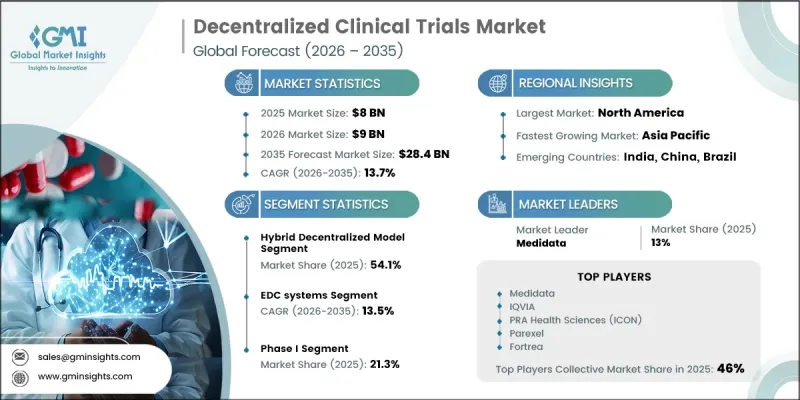
시장의 성장은 규제 당국의 수용 확대, 디지털 헬스 기술의 지속적인 발전, 그리고 보다 효율적이고 비용 효율적이며 다양한 임상시험 설계를 요구하는 후원사들의 수요 증가에 힘입어 이루어지고 있습니다. 원격의료 플랫폼, 전자 환자 보고 결과(ePRO) 솔루션, 원격 모니터링 기술 및 디지털 데이터 수집 도구의 활용 가능성이 높아짐에 따라, 분산형 임상시험의 실행 가능성이 크게 향상되었습니다. 규제 당국이 환자의 접근성, 참여, 다양성을 더욱 중시하게 됨에 따라, 제약 회사와 연구 기관들은 임상시험 체계에 분산형 기능을 도입하는 경향이 강해지고 있습니다. 원격 시험 관리는 기존 연구 시설 운영에 따르는 부담을 줄여주는 동시에, 참가자의 편의성과 지속률을 높여줍니다. 이러한 장점은 여러 지역에 걸쳐 있는 대규모 환자 집단을 대상으로 하는 대규모 연구에서 특히 유용하며, 분산형 접근 방식을 통해 업무 효율화, 비용 절감 및 연구 일정 단축이 가능해집니다.
| 시장 범위 | |
|---|---|
| 시작 연도 | 2025년 |
| 예측 기간 | 2026-2035년 |
| 개시 금액 | 80억 달러 |
| 예측 금액 | 284억 달러 |
| CAGR | 13.7% |
하이브리드형 분산 모델 부문은 2025년에 54.1%의 점유율을 차지했으며, 2035년까지 연평균 성장률(CAGR) 13.7%로 성장할 것으로 전망됩니다. 이 모델은 원격 환자 참여 기능과 필수적인 대면 임상 평가를 결합하고 있기 때문에 수많은 중기 및 후기 임상시험에서 선호되는 시험 설계로 부상해 왔습니다. 필요한 시설에서의 활동을 유지하면서 엄선된 분산형 요소를 통합함으로써, 주최 측은 참가자의 편의성과 규제 및 운영상의 요건 간의 균형을 맞출 수 있습니다. 이러한 하이브리드 접근 방식을 통해 조직은 중요한 임상 절차 및 데이터 수집 활동에 필요한 감독을 유지하면서, 피험자 모집을 개선하고, 참여 유지율을 높이며, 임상시험의 효율성을 향상시킬 수 있습니다.
1상 임상시험 부문은 2025년에 21.3%의 시장 점유율을 차지했으며, 2035년까지 연평균 성장률(CAGR) 13.6%로 성장할 것으로 전망됩니다. 이 단계에서 분산형 조사 기법의 채택은 초기 단계의 임상 연구에 수반되는 집중적인 모니터링, 안전성 평가 및 상세한 데이터 수집 요건으로 인해 여전히 보다 선별적인 성격을 띠고 있습니다. 이 단계의 많은 임상시험에서는 피험자의 안전을 확보하고 시험용 의약품에 대한 정확한 평가를 수행하기 위해 여전히 직접적인 임상 감독과 통제된 환경이 요구됩니다. 그렇긴 하지만, 원격 모니터링 기술과 디지털 헬스 플랫폼의 지속적인 발전으로 인해 초기 단계의 연구 프로그램에 분산형 요소를 더 폭넓게 도입할 기회가 생기고 있습니다.
북미의 분산형 임상시험 시장은 2025년에 44.2%의 점유율을 차지했으며, 2035년까지 연평균 성장률(CAGR) 13.8%로 성장할 것으로 전망됩니다. 이 지역은 선진적인 헬스케어 인프라, 견고한 임상 연구 생태계, 디지털 헬스 기술의 광범위한 도입, 그리고 유리한 규제 환경 덕분에 분산형 임상 연구의 주요 시장으로 자리매김하고 있습니다. 미국은 활발한 임상시험 활동, 꾸준한 기술 도입, 그리고 분산형 연구 솔루션에 주력하는 주요 업계 관계자들의 존재에 힘입어 계속해서 지역 매출에서 가장 큰 비중을 차지하고 있습니다.
자주 묻는 질문
목차
제1장 조사 방법과 범위
제2장 주요 요약
제3장 업계 인사이트
제4장 경쟁 구도
제5장 시장 추정 및 예측 : 분산화 모델별, 2022-2035년
제6장 시장 추정 및 예측 : 기술별, 2022-2035년
제7장 시장 추정 및 예측 : 치료 분야별, 2022-2035년
제8장 시장 추정 및 예측 : 조사 단계별, 2022-2035년
제9장 시장 추정 및 예측 : 지역별, 2022-2035년
제10장 기업 개요
KSM 26.07.16The Global Decentralized Clinical Trials Market was valued at USD 8 billion in 2025 and is estimated to grow at a CAGR of 13.7% to reach USD 28.4 billion by 2035.
Market growth is driven by greater regulatory acceptance, continuous advancements in digital health technologies, and increasing demand from sponsors for more efficient, cost-effective, and diverse clinical trial designs. The growing availability of telehealth platforms, electronic patient-reported outcome solutions, remote monitoring technologies, and digital data collection tools has significantly improved the feasibility of decentralized trial execution. As regulatory agencies place greater emphasis on patient accessibility, engagement, and diversity, pharmaceutical companies and research organizations are increasingly incorporating decentralized capabilities into their study frameworks. Remote trial management reduces operational burdens associated with traditional research sites while improving participant convenience and retention. These advantages are particularly valuable in large-scale studies that involve extensive patient populations across multiple geographic locations, where decentralized approaches can streamline operations, reduce costs, and accelerate study timelines.
| Market Scope | |
|---|---|
| Start Year | 2025 |
| Forecast Year | 2026-2035 |
| Start Value | $8 Billion |
| Forecast Value | $28.4 Billion |
| CAGR | 13.7% |
The hybrid decentralized model segment accounted for 54.1% share in 2025 and is expected to grow at a CAGR of 13.7% through 2035. This model has emerged as the preferred trial design across numerous mid-stage and late-stage clinical studies because it combines remote patient engagement capabilities with essential in-person clinical assessments. By integrating selected decentralized elements while maintaining necessary site-based activities, sponsors can balance participant convenience with regulatory and operational requirements. The hybrid approach enables organizations to improve patient recruitment, increase retention rates, and enhance study efficiency while preserving the oversight needed for critical clinical procedures and data collection activities.
Phase I studies segment held a 21.3% share in 2025 and is projected to grow at a CAGR of 13.6% through 2035. Adoption of decentralized methodologies within this phase remains more selective due to the intensive monitoring, safety assessments, and detailed data collection requirements associated with early-stage clinical research. Many studies at this stage continue to require direct clinical supervision and controlled environments to ensure participant safety and accurate evaluation of investigational therapies. Nevertheless, ongoing advancements in remote monitoring technologies and digital health platforms are creating opportunities for broader implementation of decentralized components within early-phase research programs.
North America Decentralized Clinical Trials Market captured a 44.2% share in 2025 and is anticipated to grow at a CAGR of 13.8% through 2035. The region remains the leading market for decentralized clinical research due to its advanced healthcare infrastructure, strong clinical research ecosystem, widespread adoption of digital health technologies, and favorable regulatory environment. The United States continues to account for the largest share of regional revenue, supported by significant clinical trial activity, robust technology deployment, and the presence of major industry participants focused on decentralized research solutions.
Key companies operating in the global decentralized clinical trials market include Curebase, Florence Healthcare, OpenClinica, Trialize, Reify Health, Signant Health, Clinical Research IO, Sanguine Bio, Medable, Propharma, Parexel, Medidata, IQVIA, ClinOne, Fortrea, Veeva Systems, ClinTex, Sano Genetics, Covance, Bio-Optronics, Mahalo Health, Science 37, PRA Health Sciences (ICON), and PPD (Thermo Fisher Scientific). Companies operating in the decentralized clinical trials market are focusing on technology innovation, strategic collaborations, and service expansion to strengthen their market position. Leading organizations are investing in advanced digital platforms that support remote patient monitoring, virtual site management, electronic data capture, and real-time analytics. Partnerships with pharmaceutical companies, contract research organizations, healthcare providers, and technology firms are helping market participants expand their service capabilities and geographic reach. Businesses are also enhancing interoperability, cybersecurity, and patient engagement tools to improve trial efficiency and participant experiences. In addition, companies are expanding cloud-based solutions, artificial intelligence capabilities, and data integration platforms to streamline clinical operations.
Table of Contents
Chapter 1 Methodology & Scope
- 1.1 Research approach
- 1.2 Quality commitments
- 1.2.1 GMI AI policy & data integrity commitment
- 1.2.1.1 Source consistency protocol
- 1.2.1 GMI AI policy & data integrity commitment
- 1.3 Research trail & confidence scoring
- 1.3.1 Research trail components
- 1.3.2 Scoring components
- 1.4 Data collection
- 1.4.1 Partial list of primary sources
- 1.5 Data mining sources
- 1.5.1 Paid sources
- 1.5.1.1 Sources, by region
- 1.5.1 Paid sources
- 1.6 Base estimates and calculations
- 1.6.1 Base year calculation for any one approach
- 1.7 Market estimates & forecasts parameters
- 1.8 Forecast model
- 1.8.1 Quantified market impact analysis
- 1.8.1.1 Mathematical impact of growth parameters on forecast
- 1.8.1 Quantified market impact analysis
- 1.9 Research transparency addendum
- 1.9.1 Source attribution framework
- 1.9.2 Quality assurance metrics
- 1.9.3 Our commitment to trust
Chapter 2 Executive Summary
- 2.1 Industry 360° synopsis
- 2.1.1 Business trends
- 2.1.2 Decentralization model trends
- 2.1.3 Technology trends
- 2.1.4 Therapeutic area trends
- 2.1.5 Study phase trends
- 2.1.6 Regional trends
- 2.2 CXO perspectives: Strategic imperatives
Chapter 3 Industry Insights
- 3.1 Industry ecosystem analysis
- 3.2 Industry impact forces
- 3.2.1 Growth drivers
- 3.2.1.1 Technological advancement in digital health
- 3.2.1.2 Cost efficiency and accelerated timelines
- 3.2.1.3 Regulatory support and framework development
- 3.2.1.4 Improved patient accessibility and diversity
- 3.2.2 Industry pitfalls and challenges
- 3.2.2.1 Data integrity and standardization
- 3.2.2.2 Regulatory complexity and regional inconsistencies
- 3.2.3 Market opportunities
- 3.2.3.1 Integration of AI and wearables
- 3.2.3.2 Expansion into underserved and emerging markets
- 3.2.1 Growth drivers
- 3.3 Growth potential analysis
- 3.4 Regulatory landscape (Driven by primary research)
- 3.4.1 North America
- 3.4.2 Europe
- 3.4.3 Asia Pacific
- 3.4.4 Latin America
- 3.4.5 MEA
- 3.5 Technology landscape
- 3.5.1 Current technological trends
- 3.5.2 Emerging technologies
- 3.6 Operational architecture of hybrid trial designs
- 3.7 Future market trends
- 3.8 Data capture and technology integration
- 3.8.1 Standardizing Electronic patient-reported outcomes (ePRO) within central clinical data repositories
- 3.8.2 Device interoperability: Technical integration of wearable sensors and digital health technologies (DHTs)
- 3.8.3 Technical strategies for preserving data integrity, managing device variance, and mitigating missing data
- 3.9 Porter's analysis
- 3.10 PESTEL analysis
- 3.11 Impact of AI and Generative AI on the market (Driven by primary research)
Chapter 4 Competitive Landscape, 2025
- 4.1 Introduction
- 4.2 Company market share analysis
- 4.2.1 North America
- 4.2.2 Europe
- 4.2.3 Asia Pacific
- 4.3 Company matrix analysis
- 4.4 Competitive analysis of major market players
- 4.5 Competitive positioning matrix
- 4.6 Key developments
- 4.6.1 Merger and acquisition
- 4.6.2 Partnership and collaboration
- 4.6.3 New product launches
- 4.6.4 Expansion plans
Chapter 5 Market Estimates and Forecast, By Decentralization Model, 2022 - 2035 (USD Million)
- 5.1 Key trends
- 5.2 Hybrid
- 5.3 Fully
- 5.4 Site-based decentralized model
Chapter 6 Market Estimates and Forecast, By Technology, 2022 - 2035 (USD Million)
- 6.1 Key trends
- 6.2 Telemedicine platforms
- 6.3 Wearable devices
- 6.4 Mobile health applications
- 6.5 Electronic data capture (EDC) systems
- 6.6 Electronic patient-reported outcomes (ePRO)
- 6.7 Other technologies
Chapter 7 Market Estimates and Forecast, By Therapeutic Area, 2022 - 2035 (USD Million)
- 7.1 Key trends
- 7.2 Oncology
- 7.3 Cardiology
- 7.4 Neurology
- 7.5 Infectious diseases
- 7.6 Respiratory disorders
- 7.7 Other chronic conditions
Chapter 8 Market Estimates and Forecast, By Study Phase, 2022 - 2035 (USD Million)
- 8.1 Key trends
- 8.2 Phase I
- 8.3 Phase II
- 8.4 Phase III
- 8.5 Phase IV
Chapter 9 Market Estimates and Forecast, By Region, 2022 - 2035 (USD Million)
- 9.1 Key trends
- 9.2 North America
- 9.2.1 U.S.
- 9.2.2 Canada
- 9.3 Europe
- 9.3.1 Germany
- 9.3.2 France
- 9.3.3 UK
- 9.3.4 Netherlands
- 9.3.5 Spain
- 9.3.6 Italy
- 9.4 Asia Pacific
- 9.4.1 China
- 9.4.2 Japan
- 9.4.3 South Korea
- 9.4.4 India
- 9.4.5 Australia
- 9.5 Latin America
- 9.5.1 Brazil
- 9.5.2 Argentina
- 9.5.3 Mexico
- 9.6 Middle East & Africa
- 9.6.1 Saudi Arabia
- 9.6.2 UAE
- 9.6.3 South Africa
Chapter 10 Company Profiles
- 10.1 Bio-Optronics
- 10.2 Clinical Research IO
- 10.3 ClinOne
- 10.4 ClinTex
- 10.5 Covance
- 10.6 Curebase
- 10.7 Florence Healthcare
- 10.8 Fortrea
- 10.9 IQVIA
- 10.10 Mahalo Health
- 10.11 Medable
- 10.12 Medidata
- 10.13 OpenClinica
- 10.14 Parexel
- 10.15 PPD (Thermo Fisher Scientific)
- 10.16 PRA Health Sciences (ICON)
- 10.17 Propharma
- 10.18 Reify Health
- 10.19 Sanguine Bio
- 10.20 Sano Genetics
- 10.21 Science 37
- 10.22 Signant Health
- 10.23 Trialize
- 10.24 Veeva Systems


