
|
시장보고서
상품코드
2083346
과수원용 트랙터 시장 기회, 성장요인, 업계 동향 분석 및 예측(2026-2035년)Orchard Tractor Market Opportunity, Growth Drivers, Industry Trend Analysis, and Forecast 2026 - 2035 |
||||||

세계의 과수원용 트랙터 시장은 2025년에 44억 달러 규모로 평가되었고, CAGR 5.1%로 성장하여 2035년까지 73억 달러에 이를 것으로 예측됩니다.
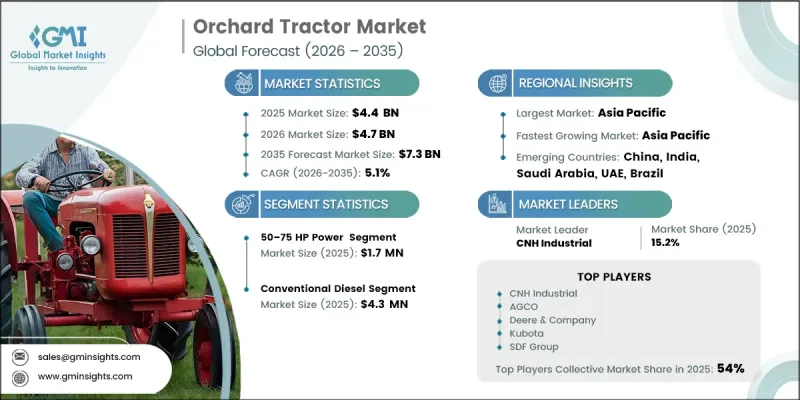
이러한 성장은 기존 과수원 경영자들의 지속적인 장비 교체 수요, 특수 작물 생산에 대한 투자 확대, 그리고 농업 발전이 진행 중인 지역에서의 기계화 농업 솔루션 도입 확대에 힘입어 이루어지고 있습니다. 이 시장은 선진국에서의 교체 수요 주도형 구매와 신흥 원예 시장에서 처음으로 이루어지는 기계화라는 두 가지 주요 수요 동향의 혜택을 받고 있습니다. 이러한 조합이 예측 기간 동안 안정적인 성장의 기반을 마련하고 있습니다. 또한, 전기 및 하이브리드 동력 시스템을 비롯한 첨단 트랙터 기술로의 전환과 정밀 농업 기능의 도입으로 인해 과수원용 트랙터의 가치 향상 가능성이 높아지고 있습니다. 이러한 기술 발전 덕분에 제조업체들은 효율성, 자동화 및 운영 성능이 향상된 고부가가치 장비를 시장에 출시할 수 있게 되었습니다. 또한, 배터리 구동형 및 디젤·전기 하이브리드 모델의 채택 확대도 기존 디젤 구동형에 비해 평균 판매 가격 상승에 기여하고 있으며, 장기적인 시장 확대를 뒷받침하고 있습니다.
| 시장 범위 | |
|---|---|
| 개시 연도 | 2025년 |
| 예측 기간 | 2026-2035년 |
| 초기 시장 규모 | 44억 달러 |
| 예측액 | 73억 달러 |
| CAGR | 5.1% |
50-75 HP 부문은 39%의 시장 점유율을 차지했으며, 2025년에는 17억 달러의 매출을 올렸습니다. 이 트랙터들은 전문적인 재배 환경에 필요한 컴팩트한 크기를 유지하면서도 주요 농업 활동에 충분한 출력을 제공하기 때문에 상업적인 과수원 경영에서 선호되는 선택지가 되고 있습니다. 살포 작업, 경작 활동, 과수원 유지 관리에 활용할 수 있어 폭넓은 용도에 적합합니다. 이 부문의 성장률은 시장 전체 평균을 소폭 상회하고 있으며, 이는 첨단 기술의 통합, 정밀 농업 기능, 그리고 향후 전동화로의 전환에 대비한 중출력 트랙터 솔루션에 대한 제조업체들의 관심이 높아지고 있기 때문입니다.
디젤 구동 과수원용 트랙터 부문은 2025년에 43억 달러 시장 규모를 기록하며 시장 점유율의 97%를 차지했습니다. 이러한 확고한 입지는 디젤 기술의 높은 에너지 효율, 잘 구축된 정비 인프라, 그리고 주요 농업 지역에서의 광범위한 연료 공급에 힘입어 유지되고 있습니다. 그러나 전기 및 하이브리드 트랙터 기술의 상업적 도입이 확대됨에 따라, 이 부문의 현재 시장 점유율은 점차 감소할 것으로 예측됩니다. 디젤 플랫폼에 대한 절대적인 수요는 견조한 추세를 보일 것으로 예상되지만, 대체 파워트레인 솔루션의 입수 가능성이 높아짐에 따라 예측 기간 동안 시장 구성 전반에 영향을 미칠 것으로 보입니다.
북미의 과수원용 트랙터 시장은 2025년에 13억 달러 규모로 30%의 점유율을 차지했으며, 2035년까지 연평균 성장률(CAGR) 5.1%로 성장할 것으로 전망됩니다. 이 지역 시장은 선진적인 과수원 경영과 효율적인 농업 기계에 대한 지속적인 수요에 힘입어 견고하게 뒷받침되고 있습니다. 미국에서는 농기계 수요가 주요 특산 작물 생산 지역에 집중되어 있으며, 이러한 지역에서는 상업 농가들이 대규모 과수원 관리를 위해 신뢰할 수 있는 트랙터를 필요로 하고 있습니다. 주요 제조업체들은 광범위한 딜러 네트워크, 자금 조달 솔루션, 그리고 전문적인 농업 경영을 위해 설계된 제품 포트폴리오를 통해 확고한 시장 지위를 유지하고 있습니다.
자주 묻는 질문
목차
제1장 조사 방법과 범위
제2장 주요 요약
제3장 업계 인사이트
제4장 경쟁 구도
제5장 시장 추산 및 예측 : 전력 카테고리별, 2022년-2035년
제6장 시장 추산 및 예측 : 파워트레인 유형별, 2022년-2035년
제7장 시장 추산 및 예측 : 용도별, 2022년-2035년
제8장 시장 추산 및 예측 : 구동 방식별, 2022년-2035년
제9장 시장 추산 및 예측 : 유통 채널별, 2022년-2035년
제10장 시장 추산 및 예측 : 지역별, 2022년-2035년
제11장 기업 개요
LSH 26.07.14The Global Orchard Tractors Market was valued at USD 4.4 billion in 2025 and is estimated to grow at a CAGR of 5.1% to reach USD 7.3 billion by 2035.
Growth is supported by continuous equipment replacement demand from established orchard operators, rising investments in specialty crop production, and increasing adoption of mechanized farming solutions in developing agricultural regions. The market is benefiting from two major demand trends: replacement-driven purchases in developed economies and first-time mechanization among emerging horticulture markets. This combination is creating a stable growth foundation throughout the forecast period. In addition, the transition toward advanced tractor technologies, including electric and hybrid power systems, along with precision farming features, is increasing the value potential of orchard tractors. These technology upgrades are enabling manufacturers to introduce higher-value equipment with improved efficiency, automation, and operational performance. The growing adoption of battery-powered and diesel-electric hybrid models is also contributing to higher average selling prices compared with traditional diesel-powered alternatives, supporting long-term market expansion.
| Market Scope | |
|---|---|
| Start Year | 2025 |
| Forecast Year | 2026-2035 |
| Start Value | $4.4 Billion |
| Forecast Value | $7.3 Billion |
| CAGR | 5.1% |
The 50-75 HP segment held a 39% share, generating USD 1.7 billion in 2025. These tractors have become a preferred choice for commercial orchard operations because they provide sufficient power for essential agricultural activities while maintaining the compact dimensions required for specialized crop environments. Their ability to support spraying operations, cultivation activities, and orchard maintenance makes them suitable for a wide range of applications. The segment's growth rate is slightly higher than the overall market average, driven by increased manufacturer focus on mid-power tractor solutions that support advanced technology integration, precision agriculture features, and future electrification upgrades.
The diesel-powered orchard tractors segment generated USD 4.3 billion, representing 97% share in 2025. This strong position is supported by diesel technology's high energy efficiency, established maintenance infrastructure, and widespread fuel availability across major agricultural regions. However, this segment's current leadership is expected to gradually decline in percentage terms as electric and hybrid tractor technologies gain wider commercial adoption. Although diesel platforms are expected to maintain strong absolute demand, the increasing availability of alternative powertrain solutions will influence the overall market composition during the forecast period.
North America Orchard Tractors Market accounted for 30% share, capturing USD 1.3 billion in 2025, and is expected to grow at a CAGR of 5.1% through 2035. The regional market is strongly supported by advanced orchard farming operations and continued demand for efficient agricultural machinery. In the United States, equipment demand is concentrated in major specialty crop-producing areas, where commercial growers require reliable tractors for large-scale orchard management. Leading manufacturers maintain strong market positions through extensive dealer networks, financing solutions, and product portfolios designed for professional agricultural operations.
Major players operating in the global orchard tractors market are Kubota, AGCO, Deere & Company, Yanmar, CNH Industrial, CLAAS, SDF Group, Mahindra & Mahindra Ltd., Daedong Corporation, International Tractors, LS Mtron, TAFE, TYM Corporation, YTO Group Corporation, Agovor, Captain Tractors, Changfa Agricultural Equipment, Ferrari Costruzioni Meccaniche, Goldoni S, Kukje Machinery, and Ztractor. Companies operating in the orchard tractors market are strengthening their competitive position through product innovation, technology development, regional expansion, and customer-focused solutions. Manufacturers are investing in advanced powertrain technologies, precision agriculture systems, improved tractor efficiency, and operator-friendly features to meet changing farming requirements. Businesses are also expanding dealership networks, enhancing after-sales services, and developing customized equipment solutions for different orchard applications. Strategic partnerships, investments in sustainable technologies, and the introduction of electric and hybrid tractor models are helping companies improve brand presence and capture emerging market opportunities.
Table of Contents
Chapter 1 Methodology and scope
- 1.1 Research approach
- 1.2 Quality Commitments
- 1.2.1 GMI AI policy & data integrity commitment
- 1.2.1.1 Source consistency protocol
- 1.2.1 GMI AI policy & data integrity commitment
- 1.3 Research Trail & Confidence Scoring
- 1.3.1 Research Trail Components
- 1.3.2 Scoring Components
- 1.4 Data Collection
- 1.4.1 Partial list of primary sources
- 1.5 Data mining sources
- 1.5.1 Paid sources
- 1.5.1.1 Sources, by region
- 1.5.1 Paid sources
- 1.6 Base estimates and calculations
- 1.6.1 Base year calculation for any one approach
- 1.7 Forecast model
- 1.7.1 Quantified market impact analysis
- 1.7.1.1 Mathematical impact of growth parameters on forecast
- 1.7.1 Quantified market impact analysis
- 1.8 Research transparency addendum
- 1.8.1 Source attribution framework
- 1.8.2 Quality assurance metrics
- 1.8.3 Our commitment to trust
Chapter 2 Executive summary
- 2.1 Industry 360° synopsis
- 2.2 Key market trends
- 2.2.1 Regional
- 2.2.2 Power category
- 2.2.3 Powertrain type
- 2.2.4 Application
- 2.2.5 Drive type
- 2.2.6 Distribution channel
Chapter 3 Industry insights
- 3.1 Industry ecosystem analysis
- 3.1.1 Supplier landscape
- 3.1.1.1 Critical input materials
- 3.1.1.2 Tier 1 and tier 2 component supplier landscape
- 3.1.1.3 Manufacturing and assembly hub distribution by region
- 3.1.1.4 Supply chain risks
- 3.1.2 Profit margin
- 3.1.3 Value addition at each stage
- 3.1.4 Factor affecting the value chain
- 3.1.5 Disruptions
- 3.1.1 Supplier landscape
- 3.2 Industry impact forces
- 3.3 Growth drivers
- 3.4 Industry pitfalls & challenges
- 3.5 Opportunities
- 3.6 Growth potential analysis
- 3.7 Price trends
- 3.8 Historical price trend analysis
- 3.9 Pricing strategy by player type
- 3.10 Regulatory framework
- 3.10.1 Global Regulatory Framework - Emission Standards, Safety Norms, CE Marking Requirements
- 3.10.2 European Union - EU Stage V Emission Norms and Impact on Orchard Tractor Adoption
- 3.10.3 Compliance Timeline and Non-Compliant Fleet Replacement Implications
- 3.10.4 Stage V Impact on OEM Engine Sourcing and Product Development Lead Times
- 3.10.5 Key European Country Regulatory Profiles
- 3.10.6 Italy - Agricultural Machinery Safety Regulations and Subsidy Schemes
- 3.10.7 Spain - PERTE Agro and Agricultural Mechanization Support Framework
- 3.10.8 France - Farm Modernization Aid and Environmental Compliance Requirements
- 3.10.9 Germany - Agricultural Equipment Standards (BG RCI) and Emission Rules
- 3.10.10 United Kingdom - Post-Brexit Machinery Regulations and Stage V Alignment
- 3.10.11 North America - EPA Tier 4 Final and CARB Off-Road Emission Standards
- 3.10.12 Asia Pacific - Country-Specific Emission and Safety Certification Frameworks
- 3.11 Porter's five forces analysis
- 3.12 PESTEL analysis
- 3.13 Trade Data Analysis (Based on Paid Database) (HS Code: 8701)
- 3.13.1 Import/export volume & value trends
- 3.13.2 Key trade corridors & tariff impact
- 3.14 Impact of AI & generative AI on the market
- 3.14.1 AI-driven disruption of traditional business models
- 3.14.2 GenAI use cases & adoption roadmap by customer segment
- 3.14.3 Risks, limitations & regulatory considerations
- 3.15 Future market trends
- 3.16 Technology and innovation landscape
- 3.16.1 Current technological trends
- 3.16.2 Emerging technologies
Chapter 4 Competitive landscape, 2025
- 4.1 Introduction
- 4.2 Company market share analysis
- 4.2.1 North America
- 4.2.2 Europe
- 4.2.3 Asia Pacific
- 4.2.4 Latin America
- 4.2.5 MEA
- 4.3 Company matrix analysis
- 4.4 Competitive analysis of major market players
- 4.5 Competitive positioning matrix
- 4.6 Key developments
- 4.6.1 Mergers & acquisitions
- 4.6.2 Partnerships & collaborations
- 4.6.3 New product launches
- 4.6.4 Expansion plans
Chapter 5 Market Estimates & Forecast, By Power Category, 2022 - 2035 ($Billion, Thousand Units)
- 5.1 Key trends
- 5.2 Below 50 HP
- 5.3 50-75 HP
- 5.4 75-100 HP
- 5.5 Above 100 HP
Chapter 6 Market Estimates & Forecast, By Powertrain Type, 2022 - 2035 ($Billion, Thousand Units)
- 6.1 Key trends
- 6.2 Conventional diesel
- 6.3 Electric (battery electric)
- 6.4 Hybrid (diesel-electric)
Chapter 7 Market Estimates & Forecast, By Application, 2022 - 2035 ($Billion, Thousand Units)
- 7.1 Key trends
- 7.2 Pome and stone fruit orchards
- 7.3 Vineyards and wine estates
- 7.4 Citrus orchards
- 7.5 Nut orchards
- 7.6 Olive groves
- 7.7 Other (soft fruits, tropical orchards etc.)
Chapter 8 Market Estimates & Forecast, By Drive Type, 2022 - 2035 ($Billion, Thousand Units)
- 8.1 Key trends
- 8.2 2WD (two-wheel drive)
- 8.3 4WD (four-wheel drive / MFWD)
Chapter 9 Market Estimates & Forecast, By Distribution Channel, 2022 - 2035 ($Billion, Thousand Units)
- 9.1 Key trends
- 9.2 Direct sales
- 9.3 Indirect sales
Chapter 10 Market Estimates & Forecast, By Region, 2022 - 2035 ($Billion, Thousand Units)
- 10.1 Key trends
- 10.2 North America
- 10.2.1 U.S.
- 10.2.2 Canada
- 10.3 Europe
- 10.3.1 Germany
- 10.3.2 UK
- 10.3.3 France
- 10.3.4 Spain
- 10.3.5 Italy
- 10.3.6 Netherlands
- 10.4 Asia Pacific
- 10.4.1 China
- 10.4.2 Japan
- 10.4.3 India
- 10.4.4 Australia
- 10.4.5 South Korea
- 10.5 Latin America
- 10.5.1 Brazil
- 10.5.2 Mexico
- 10.5.3 Argentina
- 10.6 MEA
- 10.6.1 South Africa
- 10.6.2 Saudi Arabia
- 10.6.3 UAE
Chapter 11 Company Profiles
- 11.1 Global Key Players
- 11.1.1 AGCO
- 11.1.2 CLAAS
- 11.1.3 CNH Industrial
- 11.1.4 Deere & Company
- 11.1.5 Kubota
- 11.1.6 SDF Group
- 11.1.7 Yanmar
- 11.2 Regional Players
- 11.2.1 Daedong Corporation
- 11.2.2 International Tractors
- 11.2.3 LS Mtron
- 11.2.4 Mahindra & Mahindra Ltd.
- 11.2.5 TAFE
- 11.2.6 TYM Corporation
- 11.2.7 YTO Group Corporation
- 11.3 Emerging/Niche Specialists
- 11.3.1 Agovor
- 11.3.2 Captain Tractors
- 11.3.3 Changfa Agricultural Equipment
- 11.3.4 Ferrari Costruzioni Meccaniche
- 11.3.5 Goldoni S.p.A.
- 11.3.6 Kukje Machinery
- 11.3.7 Ztractor