
|
시장보고서
상품코드
2083361
타워 크레인 시장 기회, 성장 촉진요인, 업계 동향 분석 및 예측(2026-2035년)Tower Crane Market Opportunity, Growth Drivers, Industry Trend Analysis, and Forecast 2026 - 2035 |
||||||

세계의 타워 크레인 시장은 2025년에 52억 달러 규모에 달하고, CAGR 5.6%로 성장하여 2035년까지 89억 달러에 달할 것으로 추정됩니다.
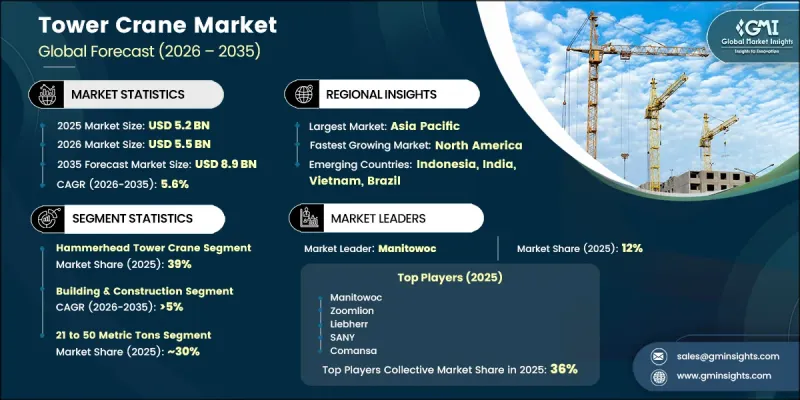
급속한 도시 개발, 인프라 확충, 건설 활동의 활성화로 인해 첨단 리프팅 장비에 대한 수요가 지속적으로 발생하고 있어, 해당 시장은 꾸준한 성장을 이루고 있습니다. 인구 밀도 증가와 도시 지역의 토지 공급 제한으로 인해 고층 건축 프로젝트가 활성화되면서, 대규모이며 장기간에 걸친 건설 활동을 뒷받침할 수 있는 타워 크레인의 수요가 증가하고 있습니다. 주택 단지, 상업 시설, 교통 인프라, 공공 시설의 개발이 활발해짐에 따라 크레인 제조사와 렌탈 서비스 사업자에게 안정적인 사업 기회가 생겨나고 있습니다. 각 지역 정부는 인프라 현대화를 위한 투자를 확대하고 있으며, 이는 효율적인 건설기계에 대한 수요를 더욱 부추기고 있습니다. 이와 동시에, 건설사에서는 설비 투자 축소, 유지보수 관리 부담 경감, 그리고 업무 유연성 제고를 위해 임대 방식의 도입이 점점 더 확대되고 있습니다. 또한, 크레인 임대 서비스는 건설업체들이 설비 소유나 자금 조달과 관련된 문제에 직면하기 쉬운 개발도상국에서의 시장 확대도 뒷받침하고 있습니다. 이러한 요인들에 더해, 진행 중인 도시화와 인프라 개발이 맞물려 전 세계 타워 크레인 업계의 지속적인 성장을 뒷받침할 것으로 예상됩니다.
| 시장 범위 | |
|---|---|
| 시작 연도 | 2025년 |
| 예측 기간 | 2026-2035년 |
| 개시 금액 | 52억 달러 |
| 예측 금액 | 89억 달러 |
| CAGR | 5.6% |
교통 시스템, 도시 현대화 프로젝트, 공공사업 확대 등을 포함하는 대규모 인프라 개발 프로그램 덕분에 각 지역에서 타워 크레인에 대한 꾸준한 수요가 유지되고 있습니다. 건설 활동에 대한 투자가 증가함에 따라, 효율적인 리프팅 능력이 필요한 복잡한 프로젝트에 장비를 도입하는 움직임이 활발해지고 있습니다. 정부 주도의 인프라 정비 정책과 장기적인 개발 프로그램은 건설사 및 임대 업체의 장비 수요 유지에 기여하고 있습니다. 또한, 크레인 임대 솔루션에 대한 수요가 증가함에 따라, 도급업체들이 막대한 초기 투자 없이도 첨단 장비를 이용할 수 있게 됨으로써 업계의 양상이 변화하고 있습니다. 렌탈 모델은 특히 자금 조달의 제약으로 인해 대형 장비 보유가 여전히 어려운 시장에서, 기업이 장비 관리의 부담을 줄이고 유지 관리 비용을 최소화하며 프로젝트의 유연성을 높이는 데 기여하고 있습니다.
해머헤드형 타워 크레인 부문은 2025년에 39%의 시장 점유율을 차지했으며, 2026년부터 2035년까지 연평균 성장률(CAGR) 4.5%로 성장할 것으로 전망됩니다. 도시화의 진전과 고층 건물 건설 증가가 이 부문의 성장을 뒷받침하고 있습니다. 이는 개발업체가 강력한 리프팅 성능과 넓은 작업 범위를 갖춘 크레인이 필요하기 때문입니다. 해머헤드형 타워 크레인은 혹독한 리프팅 작업을 효율적으로 수행할 수 있기 때문에 대형이고 무거운 건설자재를 다루는 프로젝트에서 널리 선호되고 있습니다. 프로젝트의 신속한 수행을 지원하고 복잡한 건설 요건을 충족할 수 있는 그 역량이 주요 인프라 및 건축 개발 프로젝트 전반에 걸쳐 수요를 지속적으로 견인하고 있습니다.
건축·건설 부문은 2025년에 51%의 점유율을 차지했으며, 2026년부터 2035년까지 연평균 성장률(CAGR) 5%로 성장할 것으로 전망됩니다. 이 부문은 주택 및 상업 건설 활동의 증가에 힘입어 강력한 성장이 예상됩니다. 주택 개발 사업과 도시 인프라 정비 계획의 확대가 타워 크레인 설비 수요에 크게 기여하고 있습니다. 신흥국에서의 건설 활동 확대는 개발업자들이 도시 지역의 주택 공급 능력과 현대적인 인프라 네트워크 확충에 주력하고 있기 때문에 시장 성장을 더욱 뒷받침하고 있습니다. 대규모 건설 프로젝트가 증가함에 따라, 타워 크레인은 현대 건축 작업에서 여전히 없어서는 안 될 존재로 자리 잡고 있습니다.
아시아태평양의 타워 크레인 시장은 45%의 점유율을 차지했으며, 2025년에는 23억 달러의 시장 규모를 기록했습니다. 주요 경제권에서의 활발한 건설 활동, 도시 확장, 인프라 투자가 해당 지역의 시장 성장을 뒷받침하고 있습니다. 중국은 막대한 설치 대수에 힘입어 세계 최대 규모의 타워 크레인 시장 중 하나가 되었습니다. 그러나 부동산 부문의 상황 변화와 건설 투자 패턴의 변화가 신규 설비 도입 속도에 영향을 미치고 있습니다. 이러한 변화에도 불구하고, 지속적인 인프라 개발과 도시 현대화 노력 덕분에 해당 지역 전체에서 타워 크레인 솔루션에 대한 수요는 계속해서 유지되고 있습니다.
세계 타워 크레인 업계에서 사업을 전개하는 주요 기업으로는 XCMG, Manitowoc, Liebherr, Zoomlion, Yongmao, SANY, Comansa 등이 있습니다. 타워 크레인 시장에서 사업을 전개하는 각 기업은 경쟁력을 강화하기 위해 제품 혁신, 사업 지역 확대, 기술 개발에 주력하고 있습니다. 각 제조사는 리프팅 효율, 안전성, 자동화 및 운영 신뢰성을 향상시키는 첨단 크레인 설계에 투자하고 있습니다. 많은 기업들이 고객 접근성을 높이고 건설 회사와의 장기적인 관계를 강화하기 위해 임대 및 서비스 네트워크 확장을 추진하고 있습니다. 전략적 파트너십, 지역 내 생산 거점 확대, 디지털 감시 솔루션에 대한 투자는 각 기업이 장비 성능과 고객 지원을 향상시키는 데 기여하고 있습니다. 또한 각사는 진화하는 건설 요건에 대응하기 위해 에너지 효율이 뛰어나고 기술적으로 선진적인 타워 크레인의 개발에도 힘쓰고 있습니다.
자주 묻는 질문
목차
제1장 조사 방법
제2장 주요 요약
제3장 업계 인사이트
제4장 경쟁 구도
제5장 시장 추정 및 예측 : 기기별, 2022-2035년
제6장 시장 추정 및 예측 : 적재 능력별, 2022-2035년
제7장 시장 추정 및 예측 : 용도별, 2022-2035년
제8장 시장 추정 및 예측 : 최종 용도별, 2022-2035년
제9장 시장 추정 및 예측 : 디자인별, 2022-2035년
제10장 시장 추정 및 예측 : 지역별, 2022-2035년
제11장 기업 개요
KSM 26.07.20The Global Tower Crane Market was valued at USD 5.2 billion in 2025 and is estimated to grow at a CAGR of 5.6% to reach USD 8.9 billion by 2035.
The market is experiencing steady growth as rapid urban development, infrastructure expansion, and increasing construction activities continue to create demand for advanced lifting equipment. Growing population density and limited availability of urban land are encouraging vertical construction projects, increasing the requirement for tower cranes capable of supporting large-scale and long-duration building activities. The rising development of residential complexes, commercial structures, transportation infrastructure, and public facilities is generating consistent opportunities for crane manufacturers and rental service providers. Governments across several regions are increasing investments in infrastructure modernization, which is further strengthening demand for efficient construction machinery. At the same time, construction companies are increasingly adopting rental-based equipment models to reduce capital expenditure, lower maintenance responsibilities, and improve operational flexibility. Crane rental services are also supporting market expansion in developing economies where contractors may face challenges related to equipment ownership and financing. These factors, combined with ongoing urbanization and infrastructure development, are expected to support the continued growth of the global tower crane industry.
| Market Scope | |
|---|---|
| Start Year | 2025 |
| Forecast Year | 2026-2035 |
| Start Value | $5.2 Billion |
| Forecast Value | $8.9 Billion |
| CAGR | 5.6% |
Large-scale infrastructure development programs involving transportation systems, urban modernization projects, and public utility expansion are maintaining a strong demand for tower cranes across different regions. Increased investments in construction activities are encouraging equipment deployment for complex projects that require efficient lifting capabilities. Government-backed infrastructure initiatives and long-term development programs are helping sustain equipment demand among construction companies and rental operators. The growing preference for crane rental solutions is also reshaping the industry by allowing contractors to access advanced equipment without making significant upfront investments. Rental models help companies reduce fleet management challenges, minimize maintenance costs, and improve project flexibility, particularly in markets where ownership of large equipment fleets remains difficult due to financing limitations.
The hammerhead tower crane segment accounted for 39% share in 2025 and is expected to grow at a CAGR of 4.5% from 2026 to 2035. Increasing urbanization and the rising construction of high-rise structures are supporting segment growth as developers require cranes with strong lifting performance and extended working reach. Hammerhead tower cranes are widely preferred for projects involving large and heavy construction components due to their ability to manage demanding lifting operations efficiently. Their capability to support faster project execution and handle complex construction requirements continues to drive demand across major infrastructure and building developments.
The building and construction segment represented 51% share in 2025 and is anticipated to grow at a CAGR of 5% between 2026 and 2035. This segment is expected to witness strong expansion due to increasing residential and commercial construction activities. Rising housing development initiatives and urban infrastructure programs are contributing significantly to demand for tower crane equipment. Growing construction activity in emerging economies is further supporting market growth as developers focus on expanding urban housing capacity and modern infrastructure networks. The increasing number of large-scale construction projects continues to make tower cranes an essential part of modern building operations.
Asia Pacific Tower Crane Market held a 45% share, generating USD 2.3 billion in 2025. Strong construction activity, urban expansion, and infrastructure investment across major economies are supporting regional market growth. China represents one of the largest tower crane markets globally, supported by a significant installed equipment base. However, changes in property sector conditions and evolving construction investment patterns have influenced the pace of new equipment additions. Despite these changes, ongoing infrastructure development and urban modernization efforts continue to maintain demand for tower crane solutions across the region.
The leading companies operating in the global tower crane industry include XCMG, Manitowoc, Liebherr, Zoomlion, Yongmao, SANY, and Comansa. Companies operating in the tower crane market are focusing on product innovation, geographic expansion, and technology development to strengthen their competitive position. Manufacturers are investing in advanced crane designs that improve lifting efficiency, safety, automation, and operational reliability. Many companies are expanding their rental and service networks to increase customer accessibility and strengthen long-term relationships with construction firms. Strategic partnerships, regional manufacturing expansion, and investment in digital monitoring solutions are helping businesses improve equipment performance and customer support. Companies are also developing energy-efficient and technologically advanced tower cranes to meet evolving construction requirements.
Table of Contents
Chapter 1 Methodology
- 1.1 Research approach
- 1.2 Quality Commitments
- 1.2.1 GMI AI policy & data integrity commitment
- 1.2.1.1 Source consistency protocol
- 1.2.1 GMI AI policy & data integrity commitment
- 1.3 Research Trail & Confidence Scoring
- 1.3.1 Research Trail Components
- 1.3.2 Scoring Components
- 1.4 Data Collection
- 1.4.1 Partial list of primary sources
- 1.5 Data mining sources
- 1.5.1 Paid sources
- 1.5.2 Sources, by region
- 1.6 Base estimates and calculations
- 1.6.1 Base year calculation
- 1.7 Forecast model
- 1.7.1 Quantified market impact analysis
- 1.7.1.1 Mathematical impact of growth parameters on forecast
- 1.7.1 Quantified market impact analysis
- 1.8 Research transparency addendum
- 1.8.1 Source attribution framework
- 1.8.2 Quality assurance metrics
- 1.8.3 Our commitment to trust
Chapter 2 Executive Summary
- 2.1 Industry 360° synopsis, 2022 - 2035
- 2.2 Key market trends
- 2.2.1 Regional
- 2.2.2 Equipment
- 2.2.3 Lifting Capacity
- 2.2.4 Application
- 2.2.5 End Use
- 2.2.6 Design
- 2.3 TAM Analysis, 2026-2035
- 2.4 CXO perspectives: Strategic imperatives
Chapter 3 Industry Insights
- 3.1 Industry ecosystem analysis
- 3.1.1 Supplier landscape
- 3.1.2 Profit margin analysis
- 3.1.3 Cost structure
- 3.1.4 Value addition at each stage
- 3.1.5 Factor affecting the value chain
- 3.1.6 Disruptions
- 3.2 Industry impact forces
- 3.2.1 Growth drivers
- 3.2.1.1 Rapid urbanization and super-tall construction boom in emerging economies
- 3.2.1.2 Government infrastructure stimulus programs
- 3.2.1.3 Growing shift to rental model among construction contractors
- 3.2.1.4 Rising adoption of telematics, IoT, and remote operation technologies
- 3.2.1.5 Electrification mandates and zero-emission construction site regulations
- 3.2.2 Industry pitfalls and challenges
- 3.2.2.1 Steel price volatility and raw material supply chain disruptions
- 3.2.2.2 Skilled operator shortage and ageing workforce
- 3.2.2.3 High capital expenditure for procurement, setup, and operation
- 3.2.2.4 Stricter EU/OSHA safety compliance costs and certification requirements
- 3.2.3 Market opportunities
- 3.2.3.1 Wind energy infrastructure expansion creating specialized crane demand
- 3.2.3.2 Smart city and mega infrastructure projects in Asia Pacific and MEA
- 3.2.3.3 Fleet modernization and retrofit demand among rental companies
- 3.2.3.4 Growing demand for self-erecting cranes in modular and prefab construction
- 3.2.1 Growth drivers
- 3.3 Growth potential analysis
- 3.4 Technology and innovation landscape
- 3.4.1 Current technological trends
- 3.4.2 Emerging technologies
- 3.5 Price analysis (Driven by Primary Research)
- 3.5.1 Historical Price Trend Analysis
- 3.5.2 Pricing Strategy by Player Type (Premium / Value / Cost-plus)
- 3.6 Regulatory landscape
- 3.6.1 North America
- 3.6.1.1 Environmental Protection Agency (EPA)
- 3.6.1.2 Occupational Safety and Health Administration (OSHA)
- 3.6.1.3 U.S. Department of Transportation (DOT)
- 3.6.1.4 American National Standards Institute (ANSI)
- 3.6.1.5 Canadian Standards Association (CSA)
- 3.6.2 Europe
- 3.6.2.1 EU Machinery Regulation
- 3.6.2.2 CE Marking Compliance
- 3.6.2.3 EN 14439 - Safety of Tower Cranes
- 3.6.2.4 REACH (Registration, Evaluation, Authorisation and Restriction of Chemicals)
- 3.6.2.5 National Lifting Equipment and Construction Safety Regulations
- 3.6.3 Asia Pacific
- 3.6.3.1 China Compulsory Certification (CCC)
- 3.6.3.2 GB Standards for Cranes and Lifting Equipment (China)
- 3.6.3.3 Indian Central Electricity Authority (CEA) and Building & Other Construction Workers (BOCW) Regulations
- 3.6.3.4 Japanese Industrial Standards (JIS) for Cranes
- 3.6.3.5 Australian Standards AS 2550 and AS 1418 for Cranes
- 3.6.4 Latin America
- 3.6.4.1 Brazilian National Institute of Metrology (INMETRO)
- 3.6.4.2 Brazilian Regulatory Standard NR-12
- 3.6.4.3 Mexican Official Standards (NOM) for Construction Equipment Safety
- 3.6.4.4 Regional Import and Equipment Certification Requirements
- 3.6.5 Middle East & Africa
- 3.6.5.1 GCC Standardization Organization (GSO) Construction Equipment Regulations
- 3.6.5.2 Saudi Standards, Metrology and Quality Organization (SASO)
- 3.6.5.3 South African National Standards (SANS) for Cranes
- 3.6.5.4 National Occupational Health and Construction Safety Regulations
- 3.6.1 North America
- 3.7 Trade data analysis (Driven by Paid Research)
- 3.7.1 Import/export volume & value trends
- 3.7.2 Key trade corridors & tariff impact
- 3.8 Impact of AI & generative AI on the market
- 3.8.1 AI-driven disruption of existing business models
- 3.8.2 GenAI use cases & adoption roadmap by segment
- 3.8.3 Risks, limitations & regulatory considerations
- 3.9 Capacity & production landscape (Driven by Primary Research)
- 3.9.1 Installed capacity by region & key producer
- 3.9.2 Capacity utilization rates & expansion pipelines
- 3.10 Porter's analysis
- 3.11 PESTEL analysis
- 3.12 Cost breakdown analysis
- 3.13 Patent analysis (Driven by Primary Research)
- 3.14 Sustainability and environmental aspects
- 3.14.1 Sustainable practices
- 3.14.2 Waste reduction strategies
- 3.14.3 Energy efficiency in production
- 3.14.4 Eco-friendly Initiatives
- 3.14.5 Carbon footprint considerations
- 3.15 Forecast assumptions & scenario analysis (Driven by Primary Research)
- 3.15.1 Base Case - key macro & industry variables driving CAGR
- 3.15.2 Optimistic Scenarios - Favorable macro and industry tailwinds
- 3.15.3 Pessimistic Scenario - Macroeconomic slowdown or industry headwinds
Chapter 4 Competitive Landscape, 2025
- 4.1 Introduction
- 4.2 Company market share analysis
- 4.2.1 North America
- 4.2.2 Europe
- 4.2.3 Asia Pacific
- 4.2.4 LATAM
- 4.2.5 MEA
- 4.3 Competitive analysis of major market players
- 4.4 Competitive positioning matrix
- 4.5 Key developments
- 4.5.1 Mergers & acquisitions
- 4.5.2 Partnerships & collaborations
- 4.5.3 New Product Launches
- 4.5.4 Expansion Plans and funding
- 4.6 Company tier benchmarking
- 4.6.1 Tier classification criteria & qualifying thresholds
- 4.6.2 Tier positioning matrix by revenue, geography & innovation
Chapter 5 Market Estimates & Forecast, By Equipment, 2022 - 2035 ($Mn, Units)
- 5.1 Key trends
- 5.2 Flat top
- 5.3 Hammerhead
- 5.4 Luffing jib
- 5.5 Self-erecting
Chapter 6 Market Estimates & Forecast, By Lifting Capacity, 2022 - 2035 ($Mn, Units)
- 6.1 Key trends
- 6.2 Below 5 Metric Tons
- 6.3 6 to 20 Metric Tons
- 6.4 21 to 50 Metric Tons
- 6.5 51 to 80 Metric Tons
- 6.6 Above 80 Metric Tons
Chapter 7 Market Estimates & Forecast, By Application, 2022 - 2035 ($Mn, Units)
- 7.1 Key trends
- 7.2 Building & Construction
- 7.3 Infrastructure
- 7.4 Energy
- 7.5 Mining & Excavation
- 7.6 Others
Chapter 8 Market Estimates & Forecast, By End Use, 2022 - 2035 ($Mn, Units)
- 8.1 Key trends
- 8.2 Construction Companies
- 8.3 Real Estate Developers
- 8.4 Government & Municipal Bodies
- 8.5 Industrial Enterprises
- 8.6 Crane Rental Companies
Chapter 9 Market Estimates & Forecast, By Design, 2022 - 2035 ($Mn, Units)
- 9.1 Key trends
- 9.2 Top slewing crane
- 9.3 Bottom slewing crane
Chapter 10 Market Estimates & Forecast, By Region, 2022 - 2035 ($Mn, Units)
- 10.1 Key trends
- 10.2 North America
- 10.2.1 US
- 10.2.2 Canada
- 10.3 Europe
- 10.3.1 UK
- 10.3.2 Germany
- 10.3.3 France
- 10.3.4 Italy
- 10.3.5 Spain
- 10.3.6 Russia
- 10.3.7 Nordics
- 10.4 Asia Pacific
- 10.4.1 China
- 10.4.2 India
- 10.4.3 Japan
- 10.4.4 South Korea
- 10.4.5 Southeast Asia
- 10.4.5.1 Indonesia
- 10.4.5.2 Malaysia
- 10.4.5.3 Singapore
- 10.4.5.4 Thailand
- 10.4.5.5 Vietnam
- 10.4.6 ANZ
- 10.5 Latin America
- 10.5.1 Brazil
- 10.5.2 Argentina
- 10.5.3 Mexico
- 10.6 MEA
- 10.6.1 UAE
- 10.6.2 Saudi Arabia
- 10.6.3 South Africa
Chapter 11 Company Profiles
- 11.1 Global Players
- 11.1.1 ACE
- 11.1.2 Comansa
- 11.1.3 Favelle Favco
- 11.1.4 JASO
- 11.1.5 Liebherr
- 11.1.6 Manitowoc (Potain)
- 11.1.7 SANY
- 11.1.8 WOLFFKRAN
- 11.1.9 XCMG
- 11.1.10 Yongmao
- 11.1.11 Zoomlion
- 11.2 Regional Players
- 11.2.1 ENG Cranes
- 11.2.2 FM Gru
- 11.2.3 Hyundai Everdigm
- 11.2.4 Raimondi Cranes
- 11.2.5 Saez Cranes
- 11.2.6 SCM
- 11.3 Emerging Players
- 11.3.1 Fangyuan
- 11.3.2 Huba Construction Machinery
- 11.3.3 Shandong Dahan