
|
시장보고서
상품코드
2083363
페인팅 로봇 시장 기회, 성장요인, 업계 동향 분석 및 예측(2026-2035년)Painting Robot Market Opportunity, Growth Drivers, Industry Trend Analysis, and Forecast 2026 - 2035 |
||||||

세계의 페인팅 로봇 시장은 2025년에 32억 달러로 평가되었고, CAGR 8.1%로 성장하여 2035년까지 70억 달러에 달할 것으로 추정되고 있습니다.
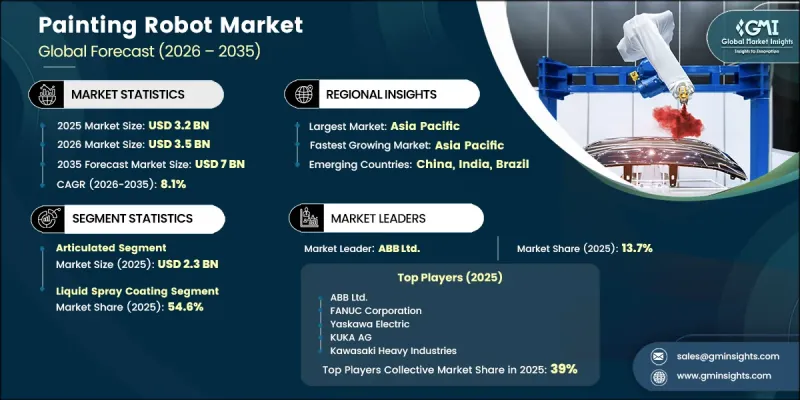
산업용 자동화 도입 확대, 고품질 표면 마감에 대한 수요 증가, 그리고 생산 효율 향상 필요성이 전 세계 도장 로봇 시장의 성장을 주도하고 있습니다. 다양한 업종의 제조업체들은 더 높은 균일성 확보, 자재 낭비 절감, 작업장 안전성 향상, 그리고 더 높은 생산 기준 유지를 위해 로봇을 활용한 도장 솔루션으로의 전환을 가속화하고 있습니다. 기업들이 복잡한 마감 요건을 충족하면서도 운영 비용을 최적화할 수 있는 신뢰성 높은 솔루션을 모색하는 가운데, 자동 도장 시스템은 현대 제조 업무에서 없어서는 안 될 요소로 자리 잡고 있습니다. 자동차 제조는 여전히 중요한 응용 분야이지만, 도장 로봇은 그 유연성, 정밀도, 그리고 대규모 생산에 대응할 수 있는 능력 덕분에 다양한 산업 분야에서 널리 받아들여지고 있습니다. 로봇 기술의 발전, 프로그래밍 능력의 향상, 그리고 스마트 제조에 대한 관심 증대가 시장 확대를 더욱 가속화하고 있습니다. 효율적인 생산 공정과 지속 가능한 제조 관행에 대한 관심이 높아짐에 따라, 전 세계 시장에서 도장 로봇 도입 기회가 앞으로도 계속해서 발생할 것으로 예측됩니다.
| 시장 범위 | |
|---|---|
| 개시 연도 | 2025년 |
| 예측 기간 | 2026-2035년 |
| 초기 시장 규모 | 32억 달러 |
| 예측액 | 70억 달러 |
| CAGR | 8.1% |
2025년, 다관절 로봇 부문은 23억 달러 시장 규모를 기록하며 도장 로봇 시장에서 가장 큰 점유율을 차지했습니다. 이 로봇들은 뛰어난 유연성과 고도의 동작 능력, 그리고 복잡한 표면에서도 정밀한 도장 작업을 수행할 수 있는 능력 덕분에 계속해서 시장을 선도하고 있습니다. 다축 로봇 암 구조 덕분에 부드럽고 정밀한 동작이 가능해지며, 제조업체는 형태나 디자인이 서로 다른 제품에 대해서도 일관된 마감 품질을 실현할 수 있습니다. 높은 재현성, 작업 효율, 적응성을 모두 갖추고 있어, 관절식 로봇은 정밀하고 신뢰성 높은 표면 처리가 요구되는 산업용도장 분야에서 선호되는 선택지가 되고 있습니다.
2025년에는 액체 스프레이 도장 부문이 54.6%의 점유율을 차지했습니다. 이 부문이 주도적인 위치를 유지하고 있는 이유는 액체 스프레이 기술이 다용도성, 균일한 도포, 그리고 다양한 소재와의 호환성을 갖추고 있기 때문입니다. 로봇식 액체 분사 시스템은 기존의 도장 방식에 비해 도포량 제어, 마감 품질 향상 및 오버스프레이 감소를 실현합니다. 다양한 생산 요구 사항을 충족할 수 있는 그 능력 덕분에, 효율적이고 일관된 마감 솔루션을 추구하는 업계에서 도입이 확대되고 있습니다.
2025년, 미국의 도장 로봇 시장은 82%의 점유율을 차지하며 5억 5,870만 달러 시장 규모를 기록했습니다. 북미는 선진적인 제조 생태계, 산업 자동화의 적극적인 도입, 그리고 생산 현대화를 위한 지속적인 투자를 바탕으로 여전히 중요한 시장으로 자리매김하고 있습니다. 제조업체들이 효율성 향상, 제품 품질 유지, 그리고 끊임없이 변화하는 작업 환경 및 환경 요건 준수를 위해 도장 공정의 자동화를 추진하고 있는 만큼, 미국은 여전히 주요 기여국으로 남아 있습니다. 이 지역의 확고한 산업 기반과 스마트 제조 기술의 도입 확대가 시장의 성장을 지속적으로 뒷받침하고 있습니다.
자주 묻는 질문
목차
제1장 조사 방법
제2장 주요 요약
제3장 업계 인사이트
제4장 경쟁 구도
제5장 시장 추산 및 예측 : 로봇 유형별, 2022년-2035년
제6장 시장 추산 및 예측 : 코팅 프로세스별, 2022년-2035년
제7장 시장 추산 및 예측 : 최종사용자 산업별, 2022년-2035년
제8장 시장 추산 및 예측 : 유통 채널별, 2022년-2035년
제9장 시장 추산 및 예측 : 지역별, 2022년-2035년
제10장 기업 개요
LSH 26.07.14The Global Painting Robot Market was valued at USD 3.2 billion in 2025 and is estimated to grow at a CAGR of 8.1% to reach USD 7 billion by 2035.
The increasing adoption of industrial automation, rising demand for high-quality surface finishing, and the need for improved production efficiency are driving the growth of the painting robot market worldwide. Manufacturers across multiple industries are increasingly shifting toward robotic painting solutions to achieve greater consistency, reduce material wastage, improve workplace safety, and maintain higher production standards. Automated painting systems are becoming an essential part of modern manufacturing operations as companies seek reliable solutions that can handle complex finishing requirements while optimizing operational costs. Although automotive manufacturing remains a significant application area, painting robots are gaining wider acceptance across diverse industrial sectors due to their flexibility, precision, and ability to support large-scale production. Advancements in robotic technologies, improved programming capabilities, and increasing focus on smart manufacturing are further accelerating market expansion. The growing emphasis on efficient production processes and sustainable manufacturing practices is expected to create continued opportunities for painting robot adoption across global markets.
| Market Scope | |
|---|---|
| Start Year | 2025 |
| Forecast Year | 2026-2035 |
| Start Value | $3.2 Billion |
| Forecast Value | $7 Billion |
| CAGR | 8.1% |
The articulated robot segment generated USD 2.3 billion in 2025, representing the largest share of the painting robot market. These robots continue to dominate due to their high flexibility, advanced movement capabilities, and ability to perform precise coating operations across complex surfaces. Their multi-axis robotic arm structure enables smooth and accurate motion, allowing manufacturers to achieve consistent finishing quality on products with varying shapes and designs. The combination of strong repeatability, operational efficiency, and adaptability makes articulated robots a preferred choice for industrial painting applications requiring detailed and reliable surface treatment.
The liquid spray coating segment accounted for 54.6% share in 2025. This segment maintains its leading position because liquid spray technology offers versatility, uniform application, and compatibility with a wide range of materials. Robotic liquid spray systems provide controlled coating distribution, improved finish quality, and reduced overspray compared with conventional painting methods. Their ability to support different production requirements has increased adoption among industries seeking efficient and consistent finishing solutions.
U.S. Painting Robot Market accounted for 82% share generating USD 558.7 million in 2025. North America continues to represent a significant market due to its advanced manufacturing ecosystem, strong industrial automation adoption, and continuous investments in production modernization. The United States remains the key contributor as manufacturers upgrade automated painting operations to improve efficiency, maintain product quality, and comply with evolving workplace and environmental requirements. The region's established industrial base and increasing adoption of smart manufacturing technologies continue to support market growth.
Major companies operating in the global painting robot market include ABB Ltd., FANUC Corporation, KUKA AG, Yaskawa Electric Corporation, Kawasaki Heavy Industries Ltd., Durr AG, Staubli International AG, Comau S.p.A., HD Hyundai Robotics, Sames, Cefla Finishing, EFORT Intelligent Robot Co., Ltd., Nachi-Fujikoshi Corporation, Gaiotto Automation S.p.A., CMA Robotics S.p.A., Lesta Srl, B+M Surface Systems GmbH, Trinity Industrial Corporation, Epistolio S.r.l., Huayan Robotics, and Venjakob Maschinenbau GmbH & Co. KG. Companies operating in the painting robot market are strengthening their competitive position by focusing on technological innovation, automation advancements, and expansion of robotic product portfolios. Manufacturers are investing in research and development to improve robot accuracy, flexibility, energy efficiency, and integration with digital manufacturing platforms. Strategic collaborations with industrial manufacturers and investments in global service networks are helping companies expand their customer base. Businesses are also developing customized robotic painting solutions designed for specific application requirements while enhancing software capabilities for easier operation and monitoring.
Table of Contents
Chapter 1 Methodology
- 1.1 Research approach
- 1.2 Quality Commitments
- 1.2.1 GMI AI policy & data integrity commitment
- 1.2.1.1 Source consistency protocol
- 1.2.1 GMI AI policy & data integrity commitment
- 1.3 Research Trail & Confidence Scoring
- 1.3.1 Research Trail Components
- 1.3.2 Scoring Components
- 1.4 Data Collection
- 1.4.1 Partial list of primary sources
- 1.5 Data mining sources
- 1.5.1 Paid sources
- 1.5.1.1 Sources, by region
- 1.5.1 Paid sources
- 1.6 Base estimates and calculations
- 1.6.1 Base year calculation for any one approach
- 1.7 Forecast model
- 1.7.1 Quantified market impact analysis
- 1.7.1.1 Mathematical impact of growth parameters on forecast
- 1.7.1 Quantified market impact analysis
- 1.8 Research transparency addendum
- 1.8.1 Source attribution framework
- 1.8.2 Quality assurance metrics
- 1.8.3 Our commitment to trust
Chapter 2 Executive Summary
- 2.1 Industry snapshot
- 2.2 Business trends
- 2.3 Robot type trends
- 2.4 Coating process trends
- 2.5 End user industry trends
- 2.6 Distribution channel trends
- 2.7 Regional trends
Chapter 3 Industry Insights
- 3.1 Industry ecosystem and value chain analysis
- 3.1.1 Upstream: raw materials, actuators & sensor suppliers
- 3.1.2 Midstream: robot OEMs, system integrators & paint booth manufacturers
- 3.1.3 Downstream: end-user industries & aftermarket service providers
- 3.1.4 Ecosystem interdependencies & critical bottlenecks
- 3.2 Industry impact forces
- 3.2.1 Market Driver
- 3.2.2 Market challenges/pitfalls
- 3.2.3 Market opportunities
- 3.3 Growth potential analysis
- 3.4 Industry ecosystem analysis
- 3.5 Regulatory framework
- 3.5.1 VOC emission standards - EU VOC solvents directive, EPA NESHAP (USA)
- 3.5.2 Explosion protection compliance - ATEX 2G/3G, FM Global (IEC 60079)
- 3.5.3 Human-robot collaboration safety standards - ISO 10218, ISO/TS 15066
- 3.5.4 EU machinery regulation (EU) 2023/1230 - impact on paint robot procurement
- 3.5.5 OSHA PELs for isocyanates & hexavalent chromium - driving automation substitution
- 3.5.6 REACH restrictions on chromium-based pigments & F-gas regulation (Europe)
- 3.6 Pricing analysis (driven by primary research)
- 3.6.1 Historical price trend analysis (2022-2024) (driven by primary research)
- 3.6.2 Pricing strategy by player type (premium / value / cost-plus) (driven by primary research)
- 3.6.3 Price differential - articulated vs. cartesian vs. SCARA vs. cobot variants
- 3.6.4 Total cost of ownership (TCO) analysis - capital, integration & maintenance
- 3.7 Technology and innovation landscape
- 3.7.1 Spray atomization technology evolution (rotary, airless, electrostatic HVLP)
- 3.7.2 Multi-axis kinematic advancements (5-axis to 7-axis articulated systems)
- 3.7.3 Vision-guided & adaptive path control technologies
- 3.7.4 Digital twin integration for paint process simulation
- 3.7.5 EV-specific paint cell technology (battery housing & panel finishing)
- 3.8 Porter's Analysis
- 3.9 PESTEL Analysis
- 3.10 Trade data analysis (driven by primary research)
- 3.10.1 Import/export volume & value trends - HS code 8479/8428
- 3.10.2 Key trade corridors & tariff impact
- 3.11 Impact of AI and generative AI on the market
- 3.11.1 AI-driven disruption of existing paint process business models
- 3.11.2 GenAI use cases & adoption roadmap - offline path programming, defect detection, predictive maintenance
- 3.11.3 Risks, limitations & regulatory considerations for AI-enabled painting systems
- 3.12 Capacity and production landscape (driven by primary research)
- 3.12.1 Installed capacity by region & key robot OEM producer (driven by primary research)
- 3.12.2 Capacity utilization rates & expansion pipelines (driven by primary research)
Chapter 4 Competitive Landscape, 2025
- 4.1 Introduction
- 4.2 Company market share analysis
- 4.2.1 North America
- 4.2.2 Europe
- 4.2.3 APAC
- 4.2.4 LATAM
- 4.2.5 MEA
- 4.3 Company matrix analysis
- 4.4 Competitive analysis of major market players
- 4.5 Competitive positioning matrix
- 4.6 Key developments
- 4.6.1 Mergers & acquisitions
- 4.6.2 Partnerships & collaborations
- 4.6.3 New product launches
- 4.6.4 Expansion plans
Chapter 5 Market Estimates and Forecast, By Robot Type, 2022 - 2035 ($ Billion) (Thousand Units)
- 5.1 Key trends
- 5.2 Articulated Robots
- 5.3 Cartesian / Gantry Robots
- 5.4 SCARA Robots
- 5.5 Others
Chapter 6 Market Estimates and Forecast, By Coating Process, 2022 - 2035 ($ Billion) (Thousand Units)
- 6.1 Key trends
- 6.2 Liquid Spray Coating
- 6.2.1 Primer Application
- 6.2.2 Basecoat Application
- 6.2.3 Clearcoat & Decorative Coating
- 6.3 Powder Coating
- 6.4 Sealing & Dispensing
- 6.5 E-Coat / Electrocoating
- 6.6 Others
Chapter 7 Market Estimates and Forecast, By End-User Industry, 2022 - 2035 ($ Billion) (Thousand Units)
- 7.1 Key trends
- 7.2 Automotive & Transportation
- 7.3 Aerospace & Defense
- 7.4 Electronics & Electrical Equipment
- 7.5 Furniture & Wood Industry
- 7.6 General Industrial Equipment & Machinery
- 7.7 Construction & Infrastructure
- 7.8 Others
Chapter 8 Market Estimates and Forecast, By Distribution Channel, 2022 - 2035 ($ Billion) (Thousand Units)
- 8.1 Key trends
- 8.2 Direct sales
- 8.3 Indirect sales
Chapter 9 Market Estimates and Forecast, By Region, 2022 - 2035 ($ Billion) (Thousand Units)
- 9.1 Key trends
- 9.2 North America
- 9.2.1 US
- 9.2.2 Canada
- 9.3 Europe
- 9.3.1 Germany
- 9.3.2 UK
- 9.3.3 France
- 9.3.4 Italy
- 9.3.5 Spain
- 9.4 Asia Pacific
- 9.4.1 China
- 9.4.2 India
- 9.4.3 Japan
- 9.4.4 Australia
- 9.4.5 South Korea
- 9.5 Latin America
- 9.5.1 Brazil
- 9.5.2 Mexico
- 9.5.3 Argentina
- 9.6 Middle East and Africa
- 9.6.1 South Africa
- 9.6.2 Saudi Arabia
- 9.6.3 UAE
Chapter 10 Company Profiles
- 10.1 Top Global Players
- 10.1.1 ABB Ltd.
- 10.1.2 FANUC Corporation
- 10.1.3 KUKA AG
- 10.1.4 Yaskawa Electric Corporation
- 10.1.5 Kawasaki Heavy Industries Ltd.
- 10.1.6 Durr AG
- 10.1.7 Staubli International AG
- 10.2 Regional Players
- 10.2.1 Comau S.p.A.
- 10.2.2 HD Hyundai Robotics
- 10.2.3 Sames
- 10.2.4 Cefla Finishing
- 10.2.5 EFORT Intelligent Robot Co., Ltd.
- 10.2.6 Nachi-Fujikoshi Corporation
- 10.2.7 Gaiotto Automation S.p.A.
- 10.3 Niche & Specialist Players
- 10.3.1 CMA Robotics S.p.A.
- 10.3.2 Lesta Srl
- 10.3.3 B+M Surface Systems GmbH
- 10.3.4 Trinity Industrial Corporation
- 10.3.5 Epistolio S.r.l.
- 10.3.6 Huayan Robotics
- 10.3.7 Venjakob Maschinenbau GmbH & Co. KG