

|
시장보고서
상품코드
2155278
비전 유도형 페인팅 로봇 : 시장 점유율 분석, 업계 동향과 통계, 성장 예측(2026-2031년)Vision-Guided Painting Robots - Market Share Analysis, Industry Trends & Statistics, Growth Forecasts (2026 - 2031) |
||||||
 Mordor Intelligence
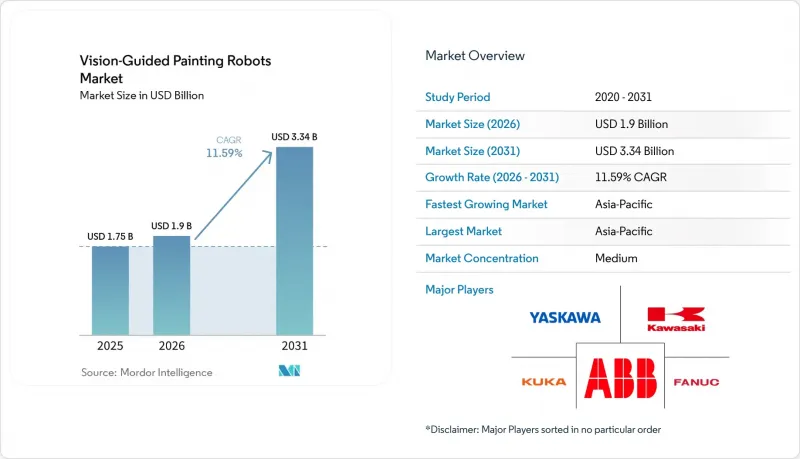
에 따르면 비전 유도형 페인팅 로봇 시장 규모는 2025년에 17억 5,000만 달러로 평가되며, 2026년 19억 1,000만 달러에서 확대하며, 2031년까지 33억 1,000만 달러에 달할 것으로 예측됩니다.
예측 기간(2026-2031년) 동안 연평균 성장률(CAGR)은 11.62%에 달할 것으로 전망됩니다.
글로벌 비전 유도형 도장 로봇 시장의 동향 및 인사이트
대량 생산 분야의 자동화 진전
대량 생산에서는 여러 교대 근무나 생산 일정에 걸쳐 안정적인 도장 사이클이 요구됩니다. 특히 도장 마감에 편차가 발생할 경우, 재작업, 자재 손실, 예정된 생산량 지연과 같은 비용이 발생할 가능성이 있기 때문입니다. 국제로봇연맹(IFR) 보고서에 따르면 2024년 전 세계 산업용 로봇 도입 대수는 54만 2,000대로, 이는 역대 두 번째로 높은 연간 총대수였습니다. 아시아는 이 도입 대수의 74%를 차지했으며, 가동 대수는 466만 4,000대에 달했습니다. 이는 로봇 응용 장비 공급업체를 지원하는 기존 산업 인프라의 규모를 여실히 보여줍니다. 2024년 전 세계 도입 대수에서 전자 분야가 24%, 자동차 분야가 23%를 차지했으며, 이로 인해 도장 로봇이 기존에 연관되던 분야를 넘어 자동 도장 설비의 기반이 확대되고 있습니다. ABB는 2025년, 아우디 FAW의 창춘 전기자동차 공장에 47대의 도장 로봇과 AI가 탑재된 ‘Digital Painting Suite’를 도입했습니다. 새로운 공장이 비전, 분석, 다축 장치 및 협업형 공정 제어를 하나의 통합 생산 시스템으로 구성할 경우, 비전 유도형 도장 로봇 시장은 그 혜택을 누리게 될 것입니다.
일관된 도장 품질과 오버스프레이 감소
고급 자동차 및 전자기기 제조업체들은 눈에 띄게 복잡한 표면에서 일관된 도장 품질을 요구합니다. 이러한 표면에서는 마감의 미세한 편차조차도 합격률에 영향을 미치며, 작업자에게 불필요한 추가 작업을 강요하게 됩니다. ABB에 따르면 이 회사의 ‘PixelPaint’ 시스템은 3D 비전 가이드 기능을 갖춘 1,000개의 노즐 헤드를 채택하여 오버스프레이 제로 상태에서 100%의 도료 전이율을 실현하고 있습니다. 이 시스템은 2025년에 메르세데스-벤츠의 진델핑겐 공장, 스텔란티스의 멜피 공장, 그리고 마힌드라 앤 마힌드라의 전기자동차 제조 시설에 도입되었습니다. 이러한 도입을 통해 마스킹 작업 없이도 생산 라인에서 투톤 마감을 적용할 수 있게 되었으며, 고급 마감 공정에서 수작업 단계가 제거되었습니다. ABB의 보고에 따르면 마힌드라 앤 마힌드라 시설에서는 RB1000i-S 아토마이저를 탑재한 IRB 5500 시리즈 로봇 42대가 가동을 시작했습니다. 비전 유도형 도장 로봇 시장은 별도의 도장 공정을 추가하지 않고도 생산 속도를 유지하면서 마감 품질, 도료 절약, 제품 맞춤화를 실현해야 하는 분야에서 확대되고 있습니다.
높은 설비 투자 및 통합 비용
완전한 비전 유도형 도장 셀을 구축하려면 로봇, 도포 장치, 안전 장비, 제어 시스템 및 시운전에 드는 비용이 필요합니다. 생산량이 적고 수주가 불안정한 중소규모 제조업체의 경우, 이러한 비용을 정당화하기가 더욱 어려워집니다. 또한 기존 시설에서는 여러 세대에 걸쳐 공급업체에서 제작한 컨베이어, 오븐, 검사 장비가 사용되고 있는 경우가 있습니다. 이러한 다양성으로 인해 새로운 로봇 셀을 생산 라인로 연결하는 데 필요한 작업이 증가합니다. 비전 유도형 도장 로봇 시장에서는 구매자가 설비 업그레이드와 자본 예산을 조율해야 하는 경우, 구매가 연기될 가능성이 있습니다. 저비용 턴키형 셀로 인해 도입 장벽은 낮아질 수 있지만, 구매자는 여전히 현장 서비스 지원과 장기적인 유지보수 체계를 중요하게 여깁니다.
부문 분석
2025년, 관절형 로봇은 비전 유도형 도장 로봇 시장에서 62.33%의 점유율을 차지했습니다. 이 로봇의 6축 및 7축 구성은 도어의 오목한 부분, 차체 하부 패널, 엔진룸 표면 및 접근이 제한된 기타 영역에 필요한 도달 거리와 손목 움직임을 제공합니다. 이러한 확고한 입지는 대량 생산을 수행하는 자동차 생산 라인에서 안정적이고 재현성이 높은 동작에 대한 요구도 반영하고 있습니다. Durr사는 2026년 5월, 메인 축에서 어플리케이터의 중심을 200mm 이상 어긋나게 배치한 비대칭 프로세스 암을 특징으로 하는 ‘EcoRP4’를 발표했습니다. 이 구조를 통해 기존 설계로는 확실하게 처리할 수 없었던 도어의 오목한 부분이나 차량 내부 영역에 대한 접근성이 개선됩니다. 이 장비는 바닥 설치, 타워 설치, 선형 레일 설치에 대응하며, 플랜트 설계자는 신규 및 기존 생산 라인에 따라 적합한 옵션을 선택할 수 있습니다. 또한 관절식 플랫폼을 통해 통합 도장 공장의 레이아웃 내에서 여러 어플리케이터 구성을 지원하는 것도 가능합니다.
협동 로봇 시장은 2031년까지 연평균 성장률(CAGR) 15.67%로 확대될 것으로 예측됩니다. 힘 감지 설계 덕분에 적절한 작업이라면 전용 보호 울타리 없이도 기존의 수동 도장 부스에서 도입이 가능합니다. 파낙(FANUC)은 2025년 3월 리옹에서 개최된 ‘Global Industrie’에서 CRX-10iA/L Paint를 발표했습니다. Hirebotics사는 2026년 6월, 금속 가공업체를 대상으로 이 하드웨어와 자사의 노코드형 ‘Beacon’ 플랫폼을 결합했습니다. 비전 기능을 통합한 방폭형 코봇은 자동화를 실현하는 데 필요한 최소 생산량을 낮출 수 있습니다. 데카르트형 및 갠트리형 로봇은 대형 항공우주 부품이나 건설용 부품 분야에서 여전히 중요한 역할을 수행하고 있는 반면, SCARA 로봇은 소형이고 고속인 전자기기 용도에 대응하고 있습니다. ISO 10218-1 및 ISO/TS 15066 안전 규격은 협업 작업 셀의 사양을 정립하는 지침으로서 계속해서 중요한 역할을 수행하고 있습니다.
2025년, 비전 유도형 도장 로봇 시장에서 2D 비전 시스템은 52.67%의 점유율을 차지했습니다. 이러한 선도적인 위상은 저비용, 고속 처리, 그리고 평평하거나 거의 평평한 자동차 표면에 대한 적합성을 반영합니다. 이미 도입된 많은 생산 라인은 확립된 기준 형상과 안정적인 부품 배치를 전제로 설계되었으므로 2D 카메라가 채택되고 있습니다. 이러한 시스템은 반사율이 높은 금속 표면이나 젖은 금속 표면, 겹쳐진 투명 층, 곡면 패널 위의 곡선 모서리를 감지하는 데 어려움을 겪을 수 있습니다. 제조업체들이 더욱 다양한 차량 및 제품 디자인을 도입함에 따라 이러한 제한 사항은 더욱 중요한 과제로 대두되고 있습니다. 3D 비전 시스템은 멀티모달 시스템과 같은 막대한 추가 비용 없이, 깊이 정보가 필요한 부분에서 구조화된 표면 매핑을 제공합니다. 따라서 이러한 시스템은 기본 카메라와 통합형 센서 퓨전 시스템의 중간에 위치하는 유용한 대안이 되고 있습니다.
멀티모달 비전은 2031년까지 연평균 성장률(CAGR) 16.89%로 확대될 것으로 예측됩니다. 이는 2D 카메라 데이터, 구조화된 빛을 이용한 깊이 감지, 그리고 AI 기반 장면 해석을 단일 지각 시스템으로 통합한 것입니다. 이러한 구성을 통해 프로그래밍된 기준 형상에만 의존하지 않고도, 작업물의 모델이나 스프레이 경로를 실시간으로 생성할 수 있습니다. IEEE IROS 2025 연구에 따르면 콘트라스트형 멀티모달 융합은 색상에 민감한 로봇 조작의 정확도 측면에서 단독 2D 시스템을 능가하는 성능을 보였습니다. ABB는 마힌드라 앤 마힌드라의 전기자동차 제조 시설에 42대의 IRB 5500 로봇에 3D 비전 시스템을 도입했습니다. 이 기능은 로트 규모가 커서 대규모 수동 프로그래밍이 현실적으로 어려운 항공우주, 선박 및 특수 생산 분야에서 중요합니다. 또한 작업자 주변의 안전 요건 역시 협업 셀에 다층 센싱을 도입하는 데 기여하는 요인이 됩니다.
지역별 분석
2025년, 아시아태평양은 비전 유도형 도장 로봇 시장의 37.51%를 차지할 것으로 예상되며, 2031년까지 연평균 성장률(CAGR) 14.11%로 성장할 것으로 전망됩니다. 중국에서는 2024년에 29만 5,000대의 산업용 로봇이 도입되었으며, 이는 전 세계 도입 대수의 54%에 해당합니다. 2024년, 중국 로봇 시장의 57%를 국내 제조업체가 차지하고 있으며, 이는 10년 전의 28%에서 크게 증가한 수치입니다. 인도에서는 2024년에 사상 최대인 9,100대의 산업용 로봇이 도입되어 전년 대비 7% 증가했습니다. 수요의 45%를 자동차 산업이 차지하고 있습니다. 스즈키는 2025년, 고사이 도장 공장에 120대의 로봇을 도입하여 자동화율이 50%를 넘었고, 직접 노동력이 30% 감소했다고 보고했습니다.
북미 시장은 미국 및 멕시코의 자동차 생산에 더해, 전자기기 및 방위용 부품의 국내 복귀(리쇼어링)에 힘입고 있습니다. 미국에서는 2024년에 3만 4,200대의 로봇 도입을 기록했습니다. Hirebotics사는 2026년 6월, 다품종 소량 생산을 하는 금속 가공업체를 대상으로 노코드(No-Code)를 지원하는 방폭형 코봇 도장 솔루션을 출시했습니다. 유럽에서는 2024년에 8만 5,000대의 로봇 도입이 기록되어 전년 대비 8% 감소했습니다. 한편, 독일에서는 2만 6,982대의 도입이 기록되어 5% 감소했습니다. Durr사는 2026년 6월, 폭스바겐 오토 유럽(Volkswagen Auto Europe)과 계약을 체결하고, 포르투갈 팔메라에 높은 이송 효율을 자랑하는 아토마이저와 3개 시설에서 공유되는 DXQ SCADA 환경을 갖춘, CO₂ 효율이 뛰어난 도장 공장을 건설하게 되었습니다. 유럽에서는 ATEX 및 산업 배출 규제 요건으로 인해 인증된 시스템에 대한 수요가 여전히 유지되고 있습니다.
남미는 브라질의 자동차 산업 기반과 아르헨티나의 금속 가공 부문을 중심으로 여전히 초기 단계의 비즈니스 기회로 남아 있습니다. 자금 조달 접근성과 시스템 통합 역량이 이 지역에서의 도입에 있으며, 주요 제약 요인으로 작용하고 있습니다. 중동은 첨단 도장 자동화의 그린필드 시장으로 발전하고 있습니다. Durr사는 2026년 1월, 사우디아라비아의 킹 압둘라 경제 도시(KAEC)에 위치한 CEER를 위해 자사의 모듈식 도장 라인 컨셉을 도입했습니다. Durr사는 이 지역에서의 서비스 지속성을 확보하기 위해 2024년 가을 제다에 ‘Durr Systems Arabia LLC’를 설립했습니다. 아프리카는 여전히 초기 단계에 있지만, 남아프리카의 자동차 산업 클러스터가 주요 수요 기반을 형성하고 있으며, 인증된 시스템은 걸프 지역 프로젝트 명세서에 명시된 요구 사항을 충족하고 있습니다.
기타 혜택:
- 엑셀 형식의 시장 예측(ME) 시트
- 3개월간의 애널리스트 지원
자주 묻는 질문
목차
제1장 서론
- 조사 전제조건과 시장 정의
- 조사 범위
제2장 조사 방법
제3장 개요
제4장 시장 구도
- 시장 개요
- 시장 성장 촉진요인
- 시장 성장 억제요인
- 거시경제 요인이 시장에 미치는 영향
- 업계 밸류체인 분석
- 규제 상황
- 기술 전망
- Porter's Five Forces 분석
제5장 시장 규모와 성장 예측
- 로봇 유형별
- 비전 기술별
- 기능별
- 페인트/코팅 공정별
- 용도별
- 최종사용자 산업별
- 지역별
- 북미
- 미국
- 캐나다
- 멕시코
- 남미
- 브라질
- 아르헨티나
- 기타 남미 국가
- 유럽
- 독일
- 영국
- 프랑스
- 이탈리아
- 스페인
- 기타 유럽 국가
- 아시아태평양
- 중국
- 일본
- 인도
- 한국
- ASEAN
- 기타 아시아태평양 국가
- 중동 및 아프리카
- 중동
- 사우디아라비아
- 아랍에미리트
- 기타 중동 국가
- 아프리카
- 남아프리카공화국
- 나이지리아
- 기타 아프리카 국가
- 중동
- 북미
제6장 경쟁 구도
- 시장 집중도
- 전략적 동향
- 시장 점유율 분석
- 기업 개요
- ABB Ltd.
- FANUC CORPORATION
- YASKAWA ELECTRIC CORPORATION
- KUKA AG
- Kawasaki Heavy Industries, Ltd.
- Durr AG
- CMA Robotics S.p.A.
- Staubli International AG
- Epistolio S.r.l.
- Krautzberger GmbH
- Gaiotto Automation S.p.A.
- Comau S.p.A.
- Seiko Epson Corporation
- Omron Corporation
- Nachi-Fujikoshi Corporation
- Teradyne, Inc.
- Siasun Robot and Automation Co., Ltd.
- Mitsubishi Electric Corporation
- Denso Corporation
- Rockwell Automation, Inc.
- Bosch Rexroth AG
- Techman Robot, Inc.
제7장 시장 기회와 향후 전망
KSA 26.10.28According to Mordor Intelligence, the vision-guided painting robots market size was valued at USD 1.75 billion in 2025 and estimated to expand from USD 1.91 billion in 2026 to reach USD 3.31 billion by 2031, at a CAGR of 11.62% during the forecast period (2026-2031).
Global Vision-Guided Painting Robots Market Trends and Insights
Increasing Automation in High-Volume Manufacturing
High-volume manufacturing requires stable coating cycles across multiple shifts and production days, especially where the cost of an inconsistent finish can include rework, material loss, and disruption to scheduled output. The International Federation of Robotics reported 542,000 industrial robot installations worldwide in 2024, the second-highest annual total recorded. Asia accounted for 74% of those installations, and the operating stock reached 4,664,000 units, underscoring the scale of the installed industrial base that supports suppliers of robotic application equipment. Electronics accounted for 24% of global installations in 2024, while automotive accounted for 23%, which broadens the base for automated coating equipment beyond the sector historically associated with paint robots. ABB installed 47 paint robots and its AI-enabled Digital Painting Suite at Audi FAW's Changchun electric vehicle plant in 2025. The Vision-guided painting robots market benefits when new factories specify vision, analytics, multi-axis equipment, and coordinated process control as one integrated production system.
Consistent Coating Quality and Lower Overspray
Premium vehicle and electronics producers require consistent coatings on visible and complex surfaces, where even small variations in the finish can affect acceptance rates and create additional work for operators. ABB stated that its PixelPaint system uses a 1,000-nozzle head with 3D vision guidance and achieves 100% paint-to-surface transfer with zero overspray. The system was deployed at Mercedes-Benz's Sindelfingen plant, Stellantis' Melfi plant, and Mahindra and Mahindra's electric vehicle facility in 2025. These deployments allow dual-tone finishes to be applied in line without masking work, which removes a manual step from premium-finish programs. ABB reported that 42 IRB 5500-family robots began operating at Mahindra and Mahindra's facility with RB1000i-S atomizers. The Vision-guided painting robots market gains where finishing quality, paint savings, and product personalization must be delivered at production speed without adding a separate coating pass.
High Capital and Integration Costs
A complete vision-guided painting cell requires spending on robots, application equipment, safety hardware, controls, and commissioning. The cost is more difficult to justify for small and mid-sized manufacturers with low volumes or uneven orders. Existing facilities can also use conveyors, ovens, and inspection equipment from several generations of suppliers. That diversity increases the work needed to connect a new robotic cell to the production line. The Vision-guided painting robots market may see delayed purchases when buyers need to align capital budgets with facility upgrades. Lower-cost turnkey cells may widen access, but buyers still weigh local service support and long-term maintenance capability.
Other drivers and restraints analyzed in the detailed report include:
- Electric Vehicle and Battery Manufacturing Expansion
- Stricter Worker Safety and VOC Requirements
- Shortage of Robotics and Paint-Process Programming Skills
For complete list of drivers and restraints, kindly check the Table Of Contents.
Segment Analysis
Articulated robots held 62.33% of the Vision-guided painting robots market share in 2025. Their six-axis and seven-axis configurations provide the reach and wrist movement needed for door recesses, underbody panels, engine-bay surfaces, and other areas with restricted access. Their established position also reflects the need for stable, repeatable motion on high-volume automotive lines. Durr presented the EcoRP4 in May 2026, featuring an asymmetric process arm that shifts the applicator center by more than 200 mm from the main axis. This geometry improves access to door rebates and interior zones that earlier designs could not reliably serve. The unit supports floor, tower, and linear-rail mounting, which gives plant designers options for new and existing lines. Articulated platforms can also support multiple applicator configurations within an integrated paint-shop layout.
Collaborative robots are projected to expand at a 15.67% CAGR through 2031. Their force-sensing design can support deployment in existing manual paint booths without dedicated guarding for suitable tasks. FANUC introduced the CRX-10iA/L Paint at Global Industrie in Lyon during March 2025. Hirebotics paired this hardware with its no-code Beacon platform for metal fabricators in June 2026. Explosion-proof cobots with integrated vision can lower the minimum production volume needed to support automation. Cartesian and gantry robots remain relevant for oversized aerospace and construction components, while SCARA robots support compact, high-speed electronics applications. ISO 10218-1 and ISO/TS 15066 safety frameworks continue to guide specifications for collaborative work cells.
2D vision systems held 52.67% share of the Vision-guided painting robots market in 2025. Their leading position reflects lower cost, fast processing, and suitability for flat or near-flat automotive surfaces. Many installed production lines use 2D cameras because they were designed around established reference geometry and stable part presentation. These systems can have difficulty with reflective, wet metal surfaces, overlapping transparent layers, and curved-edge detection on contoured panels. Such limits become more relevant as manufacturers introduce more varied vehicle and product designs. 3D vision systems provide structured surface mapping where depth information is needed without the full overhead of a multimodal system. They therefore occupy a useful middle position between baseline cameras and integrated sensor-fusion systems.
Multimodal vision is projected to expand at a 16.89% CAGR through 2031. It combines 2D camera data, structured-light depth sensing, and AI-based scene interpretation into a single perception system. This arrangement can create real-time workpiece models and spray paths without relying solely on programmed reference geometry. An IEEE IROS 2025 study found that contrastive multimodal fusion outperformed standalone 2D systems for color-sensitive robotic manipulation accuracy. ABB used 3D vision systems across 42 IRB 5500 robots at Mahindra and Mahindra's electric vehicle facility. This capability is relevant for aerospace, marine, and specialized production, where batch sizes can make extensive manual programming impractical. Safety requirements near personnel can also encourage multi-layer sensing in collaborative cells.
Complete Report Scope:
- By Robot Type
- Articulated Robots
- Collaborative Robots
- Cartesian / Gantry Robots
- SCARA Robots
- Other Robot Types
- By Vision Technology
- 2D Vision Systems
- 3D Vision Systems
- Multimodal Vision Systems
- By Function
- Part and Surface Detection and Localization
- 3D Surface Mapping and Profiling
- Adaptive Paint-Path Generation
- Real-Time Path / Trajectory Correction
- Spray Distance and Angle Optimization
- Paint Coverage / Thickness Feedback
- Other Functions
- By Paint / Coating Process
- Liquid Spray Painting
- Powder Coating
- Electrostatic Painting / Coating
- Sealant and Adhesive Application
- Specialty / Decorative Coating
- By Application
- Interior Surface Painting
- Exterior Surface Painting
- Complex-Geometry / Contoured Surface Painting
- Small-Part / Precision Painting
- Large-Component Painting
- Other Applications
- By End-User Industry
- Automotive and Electric Vehicles
- Aerospace and Defense
- Industrial Machinery and Metal Fabrication
- Electrical and Electronics
- Consumer Appliances
- Furniture and Wood Products
- Construction Equipment and Infrastructure
- Marine and Shipbuilding
- Other End-User Industries
- By Geography
- North America
- United States
- Canada
- Mexico
- South America
- Brazil
- Argentina
- Rest of South America
- Europe
- Germany
- United Kingdom
- France
- Italy
- Spain
- Rest of Europe
- Asia-Pacific
- China
- Japan
- India
- South Korea
- ASEAN
- Rest of Asia-Pacific
- Middle East and Africa
- Middle East
- Saudi Arabia
- United Arab Emirates
- Rest of the Middle East
- Africa
- South Africa
- Nigeria
- Rest of Africa
- Middle East
- North America
Geography Analysis
Asia-Pacific accounted for 37.51% of the Vision-guided painting robots market in 2025 and is projected to grow at a 14.11% CAGR through 2031. China recorded 295,000 industrial robot installations in 2024, equal to 54% of global deployments. Domestic manufacturers held 57% of China's robot market in 2024, compared with 28% a decade earlier. India installed a record 9,100 industrial robots in 2024, up 7%, with automotive accounting for 45% of demand. Suzuki deployed 120 robots at its Kosai paint facility in 2025 and reported more than 50% automation with a 30% reduction in direct labor.
North America is supported by automotive production in the United States and Mexico, as well as by the reshoring of electronics and defense components. The United States recorded 34,200 robot installations in 2024. Hirebotics launched a no-code, explosion-proof cobot painting solution in June 2026 for high-mix, low-volume metal fabricators. Europe recorded 85,000 robot installations in 2024, down 8%, while Germany recorded 26,982 installations, down 5%. Durr contracted with Volkswagen Autoeuropa in June 2026 to build a CO2-efficient paint shop in Palmela, Portugal, with high-transfer-efficiency atomizers and a shared DXQ SCADA environment across 3 facilities. Europe retains demand for certified systems due to ATEX and industrial emissions requirements.
South America remains an early-stage opportunity anchored by Brazil's automotive base and Argentina's metal fabrication sector. Access to financing and integration skills remain key limitations to adoption in this region. The Middle East is developing as a greenfield location for advanced paint automation. Durr installed its modular paint-shop concept for CEER at King Abdullah Economic City in Saudi Arabia in January 2026. Durr had established Durr Systems Arabia LLC in Jeddah in the autumn of 2024 to support regional service continuity. Africa remains at an earlier stage, with South Africa's automotive clusters providing the main demand base and certified systems meeting requirements referenced in Gulf project specifications.
- ABB Ltd.
- FANUC CORPORATION
- YASKAWA ELECTRIC CORPORATION
- KUKA AG
- Kawasaki Heavy Industries, Ltd.
- Durr AG
- CMA Robotics S.p.A.
- Staubli International AG
- Epistolio S.r.l.
- Krautzberger GmbH
- Gaiotto Automation S.p.A.
- Comau S.p.A.
- Seiko Epson Corporation
- Omron Corporation
- Nachi-Fujikoshi Corporation
- Teradyne, Inc.
- Siasun Robot and Automation Co., Ltd.
- Mitsubishi Electric Corporation
- Denso Corporation
- Rockwell Automation, Inc.
- Bosch Rexroth AG
- Techman Robot, Inc.
Additional Benefits:
- The market estimate (ME) sheet in Excel format
- 3 months of analyst support
TABLE OF CONTENTS
1 INTRODUCTION
- 1.1 Study Assumptions and Market Definition
- 1.2 Scope of the Study
2 RESEARCH METHODOLOGY
3 EXECUTIVE SUMMARY
4 MARKET LANDSCAPE
- 4.1 Market Overview
- 4.2 Market Drivers
- 4.2.1 Increasing Automation in High-Volume Manufacturing
- 4.2.2 Rising Demand for Consistent Coating Quality and Reduced Overspray
- 4.2.3 Expansion of Electric Vehicle and Battery Manufacturing
- 4.2.4 Stricter Worker-Safety and VOC-Emission Requirements
- 4.2.5 Vision-Based Adaptive Spraying for Complex Geometries
- 4.2.6 Lower-Cost Robotic Cells for Small and Mid-Sized Manufacturers
- 4.3 Market Restraints
- 4.3.1 High Capital and Integration Costs
- 4.3.2 Shortage of Robotics and Paint-Process Programming Skills
- 4.3.3 Vision-System Reliability Under Paint Booth Contamination
- 4.3.4 Limited Training Data for Novel Parts and Low-Volume Production
- 4.4 Impact of Macroeconomic Factors on the Market
- 4.5 Industry Value Chain Analysis
- 4.6 Regulatory Landscape
- 4.7 Technological Outlook
- 4.8 Porter's Five Forces Analysis
- 4.8.1 Bargaining Power of Suppliers
- 4.8.2 Bargaining Power of Buyers
- 4.8.3 Threat of New Entrants
- 4.8.4 Threat of Substitutes
- 4.8.5 Competitive Rivalry
5 MARKET SIZE AND GROWTH FORECASTS (VALUE)
- 5.1 By Robot Type
- 5.1.1 Articulated Robots
- 5.1.2 Collaborative Robots
- 5.1.3 Cartesian / Gantry Robots
- 5.1.4 SCARA Robots
- 5.1.5 Other Robot Types
- 5.2 By Vision Technology
- 5.2.1 2D Vision Systems
- 5.2.2 3D Vision Systems
- 5.2.3 Multimodal Vision Systems
- 5.3 By Function
- 5.3.1 Part and Surface Detection and Localization
- 5.3.2 3D Surface Mapping and Profiling
- 5.3.3 Adaptive Paint-Path Generation
- 5.3.4 Real-Time Path / Trajectory Correction
- 5.3.5 Spray Distance and Angle Optimization
- 5.3.6 Paint Coverage / Thickness Feedback
- 5.3.7 Other Functions
- 5.4 By Paint / Coating Process
- 5.4.1 Liquid Spray Painting
- 5.4.2 Powder Coating
- 5.4.3 Electrostatic Painting / Coating
- 5.4.4 Sealant and Adhesive Application
- 5.4.5 Specialty / Decorative Coating
- 5.5 By Application
- 5.5.1 Interior Surface Painting
- 5.5.2 Exterior Surface Painting
- 5.5.3 Complex-Geometry / Contoured Surface Painting
- 5.5.4 Small-Part / Precision Painting
- 5.5.5 Large-Component Painting
- 5.5.6 Other Applications
- 5.6 By End-User Industry
- 5.6.1 Automotive and Electric Vehicles
- 5.6.2 Aerospace and Defense
- 5.6.3 Industrial Machinery and Metal Fabrication
- 5.6.4 Electrical and Electronics
- 5.6.5 Consumer Appliances
- 5.6.6 Furniture and Wood Products
- 5.6.7 Construction Equipment and Infrastructure
- 5.6.8 Marine and Shipbuilding
- 5.6.9 Other End-User Industries
- 5.7 By Geography
- 5.7.1 North America
- 5.7.1.1 United States
- 5.7.1.2 Canada
- 5.7.1.3 Mexico
- 5.7.2 South America
- 5.7.2.1 Brazil
- 5.7.2.2 Argentina
- 5.7.2.3 Rest of South America
- 5.7.3 Europe
- 5.7.3.1 Germany
- 5.7.3.2 United Kingdom
- 5.7.3.3 France
- 5.7.3.4 Italy
- 5.7.3.5 Spain
- 5.7.3.6 Rest of Europe
- 5.7.4 Asia-Pacific
- 5.7.4.1 China
- 5.7.4.2 Japan
- 5.7.4.3 India
- 5.7.4.4 South Korea
- 5.7.4.5 ASEAN
- 5.7.4.6 Rest of Asia-Pacific
- 5.7.5 Middle East and Africa
- 5.7.5.1 Middle East
- 5.7.5.1.1 Saudi Arabia
- 5.7.5.1.2 United Arab Emirates
- 5.7.5.1.3 Rest of the Middle East
- 5.7.5.2 Africa
- 5.7.5.2.1 South Africa
- 5.7.5.2.2 Nigeria
- 5.7.5.2.3 Rest of Africa
- 5.7.5.1 Middle East
- 5.7.1 North America
6 COMPETITIVE LANDSCAPE
- 6.1 Market Concentration
- 6.2 Strategic Moves
- 6.3 Market Share Analysis
- 6.4 Company Profiles (includes Global Level Overview, Market Level Overview, Core Segments, Financials as available, Strategic Information, Market Rank/Share, Products and Services, Recent Developments)
- 6.4.1 ABB Ltd.
- 6.4.2 FANUC CORPORATION
- 6.4.3 YASKAWA ELECTRIC CORPORATION
- 6.4.4 KUKA AG
- 6.4.5 Kawasaki Heavy Industries, Ltd.
- 6.4.6 Durr AG
- 6.4.7 CMA Robotics S.p.A.
- 6.4.8 Staubli International AG
- 6.4.9 Epistolio S.r.l.
- 6.4.10 Krautzberger GmbH
- 6.4.11 Gaiotto Automation S.p.A.
- 6.4.12 Comau S.p.A.
- 6.4.13 Seiko Epson Corporation
- 6.4.14 Omron Corporation
- 6.4.15 Nachi-Fujikoshi Corporation
- 6.4.16 Teradyne, Inc.
- 6.4.17 Siasun Robot and Automation Co., Ltd.
- 6.4.18 Mitsubishi Electric Corporation
- 6.4.19 Denso Corporation
- 6.4.20 Rockwell Automation, Inc.
- 6.4.21 Bosch Rexroth AG
- 6.4.22 Techman Robot, Inc.
7 MARKET OPPORTUNITIES AND FUTURE OUTLOOK
- 7.1 White-Space and Unmet-Need Assessment


