

|
시장보고서
상품코드
2101540
분산형 에너지 자원 시장 기회, 성장 촉진요인, 업계 동향 분석 및 예측(2026-2035년)Distributed Energy Resources (DER) Market Opportunity, Growth Drivers, Industry Trend Analysis, and Forecast 2026 - 2035 |
||||||

세계의 분산형 에너지 자원 시장은 2025년에 3,120억 달러 규모에 달하고, CAGR 12.4%로 성장하여 2035년까지 1조 달러에 달할 것으로 추정됩니다.
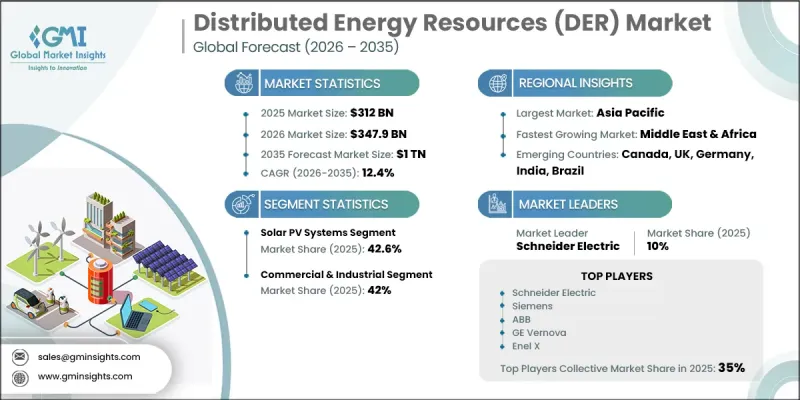
시장의 성장은 주거, 상업, 공공사업 부문에서의 분산형 에너지 자산의 급속한 도입에 의해 주도되고 있습니다. 지역 밀착형 발전, 에너지 저장 및 유연한 수요 관리 솔루션에 대한 투자 증가가 전 세계 전력망을 지속적으로 변화시키고 있습니다. 분산형 에너지 자원 시장의 장기적인 성장은 전력망의 탈탄소화를 촉진하는 정책 조치, 재생에너지 기술 관련 비용의 감소, 그리고 분산형 에너지 시스템에 대한 전기자동차 통합이 진행되고 있는 점에 힘입고 있습니다. 또한, 분산형 자산을 조정할 수 있는 소프트웨어 플랫폼의 중요성이 높아짐에 따라 시장은 물리적 인프라를 넘어 진화하고 있습니다. 전력 수요 증가, 송전망 신뢰성에 대한 중요성 부각, 그리고 지능형 에너지 관리 솔루션의 보급 확대에 힘입어 이 분야 전반에 대한 투자는 지속적으로 강화되고 있습니다. 더욱이 전기자동차 충전 인프라의 확장은 배전망에 가해지는 부하를 증가시키고 있으며, 지역 밀착형 에너지 저장 시스템과 첨단 수요 관리 솔루션의 보다 광범위한 도입을 촉진하고 있습니다. 전력 회사, 기업, 소비자가 에너지 효율, 복원력, 지속가능성을 지속적으로 우선시함에 따라, 전 세계 분산형 에너지 자원 시장은 예측 기간 동안 강력한 장기 성장을 유지할 것으로 전망됩니다.
| 시장 범위 | |
|---|---|
| 시작 연도 | 2025년 |
| 예측 기간 | 2026-2035년 |
| 초기 시장 규모 | 3,120억 달러 |
| 예측액 | 1조 달러 |
| CAGR | 12.4% |
분산형 에너지 자원 시장은 디지털 플랫폼이 전체 투자에서 더 큰 비중을 차지하게 됨에 따라 소프트웨어 주도형 에너지 관리로 점차 전환되고 있습니다. 첨단 자원 관리 시스템과 가상 에너지 조정 플랫폼은 분산형 에너지 자산의 운영 및 최적화를 향상시키는 동시에 전력 계통의 유연성 향상을 지원하고 있습니다. 동시에, 전기자동차의 보급이 지속적으로 확대됨에 따라 전력 수요 패턴이 재편되고 있으며, 전력 계통의 성능을 향상시키고 전력 소비를 보다 효과적으로 균형 있게 조정하기 위해 지역 밀착형 에너지 저장 및 유연한 수요 관리 솔루션의 도입이 촉진되고 있습니다.
2025년에는 태양광발전 시스템 부문이 시장 점유율의 42.6%를 차지했습니다. 이러한 선도적 지위는 분산형 에너지 용도 전반에 걸친 태양광발전 기술의 높은 상업적 성숙도와 대규모 보급을 반영합니다. 예상되는 성장률은 비교적 완만하지만, 이는 수요 둔화라기보다는 이미 높은 시장 침투율을 달성했음을 주로 반영한 것이며, 여러 최종 용도 부문에서 도입이 지속될 것으로 예상됩니다.
상업·산업(C&I) 부문은 2025년에 42%의 점유율을 차지했으며, 2026년부터 2035년까지 연평균 성장률(CAGR) 13%로 성장할 것으로 예측됩니다. 이 부문의 성장은 운영 효율성 향상, 에너지 비용 절감, 장기적인 지속가능성 목표 달성을 지원하는 분산형 에너지 시스템에 대한 투자 확대에 힘입고 있습니다. 각 조직은 부지 내 에너지 소비를 최적화하고, 에너지 복원력을 강화하며, 피크 시간대의 전력 수요를 줄이고, 유연한 에너지 관리 프로그램 참여를 촉진하기 위해 분산형 에너지 자원을 지속적으로 도입하고 있으며, 이로 인해 상업·산업 부문은 시장에서 가장 큰 최종 용도 부문이 되었습니다.
북미의 분산형 에너지 자원 시장은 2025년에 22%의 점유율을 차지했으며, 2035년까지 연평균 성장률(CAGR) 10.5%를 기록할 것으로 전망됩니다. 이 지역의 성장은 우호적인 정책 조치, 분산형 에너지 인프라에 대한 투자 확대, 그리고 재생에너지 및 에너지 저장 기술의 도입 확대에 의해 지속적으로 뒷받침되고 있습니다. 미국은 여전히 최대의 지역 시장으로, 분산형 에너지 프로젝트의 경제적 매력을 지속적으로 높이는 동시에, 상업·산업 분야에서의 도입 확대를 촉진하는 장기적인 투자 인센티브의 혜택을 받고 있습니다.
자주 묻는 질문
목차
제1장 조사 방법과 범위
제2장 주요 요약
제3장 업계 인사이트
제4장 경쟁 구도
제5장 시장 규모 및 예측 : 자원별, 2022-2035년
제6장 시장 규모 및 예측 : 그리드 연결 방식별, 2022-2035년
제7장 시장 규모 및 예측 : 최종사용별, 2022-2035년
제8장 시장 규모 및 예측 : 지역별, 2022-2035년
제9장 기업 개요
KSM 26.08.04The Global Distributed Energy Resources Market was valued at USD 312 billion in 2025 and is estimated to grow at a CAGR of 12.4% to reach USD 1 trillion by 2035.
Market growth is driven by the rapid deployment of distributed energy assets across residential, commercial, and utility sectors. Increasing investments in localized power generation, energy storage, and flexible demand management solutions continue to transform electricity networks worldwide. Long-term expansion of the distributed energy resources market is supported by policy initiatives promoting grid decarbonization, declining costs associated with renewable energy technologies, and the growing integration of electric vehicles into decentralized energy systems. The market is also evolving beyond physical infrastructure as software platforms capable of coordinating distributed assets become increasingly important. Growing electricity demand, rising emphasis on grid reliability, and greater adoption of intelligent energy management solutions continue to strengthen investment across the sector. In addition, the expansion of electric vehicle charging infrastructure is increasing pressure on distribution networks, encouraging broader deployment of localized energy storage systems and advanced demand management solutions. As utilities, businesses, and consumers continue to prioritize energy efficiency, resilience, and sustainability, the global distributed energy resources market is expected to maintain strong long-term growth throughout the forecast period.
| Market Scope | |
|---|---|
| Start Year | 2025 |
| Forecast Year | 2026-2035 |
| Start Value | $312 Billion |
| Forecast Value | $1 Trillion |
| CAGR | 12.4% |
The distributed energy resources market is increasingly shifting toward software-driven energy management as digital platforms become a larger component of overall investment. Advanced resource management systems and virtual energy coordination platforms are improving the operation and optimization of distributed energy assets while supporting greater grid flexibility. At the same time, the continued growth of electric vehicle adoption is reshaping electricity demand patterns, encouraging greater deployment of localized energy storage and flexible demand management solutions to improve grid performance and balance electricity consumption more effectively.
The solar PV systems segment accounted for 42.6% share in 2025. Its leading position reflects the widespread commercial maturity and large-scale adoption of solar photovoltaic technology across distributed energy applications. Although the projected growth rate is comparatively moderate, it primarily reflects the high level of market penetration already achieved rather than slowing demand, with continued deployment expected across multiple end-use sectors.
The commercial and industrial (C&I) segment represented 42% share in 2025 and is forecast to grow at a CAGR of 13% during 2026-2035. Growth within this segment is supported by increasing investments in decentralized energy systems that improve operational efficiency, reduce energy costs, and support long-term sustainability objectives. Organizations continue to adopt distributed energy resources to optimize on-site energy consumption, strengthen energy resilience, lower peak electricity demand, and improve participation in flexible energy management programs, making the commercial and industrial sector the largest end-use segment in the market.
North America Distributed Energy Resources Market accounted for 22% share in 2025 and is expected to register a CAGR of 10.5% through 2035. Regional growth continues to be supported by favorable policy initiatives, increasing investments in decentralized energy infrastructure, and expanding deployment of renewable energy and energy storage technologies. The United States remains the largest regional market, benefiting from long-term investment incentives that continue to improve the financial attractiveness of distributed energy projects while encouraging greater adoption across commercial and industrial applications.
Major companies operating in the global distributed energy resources (DER) market include ABB, AutoGrid Systems, Delta Electronics, Eaton, Enel X, EnergyHub, Enphase Energy, Exide Technologies, GE Vernova, Generac Holdings, and Hitachi Energy. Companies operating in the distributed energy resources (DER) market are strengthening their market position by expanding digital energy management capabilities, investing in advanced software platforms, and enhancing integrated energy solutions. Market participants continue to prioritize innovation in distributed energy management, localized power generation, and energy storage technologies to address evolving customer requirements. Strategic collaborations, technology partnerships, and portfolio diversification remain important approaches for expanding market reach and improving service capabilities. Companies are also investing in intelligent grid technologies, scalable energy management platforms, and operational efficiency to improve system performance and customer value.
Table of Contents
Chapter 1 Methodology & Scope
- 1.1 Research approach
- 1.2 Quality commitments
- 1.2.1 GMI AI policy & data integrity commitment
- 1.2.1.1 Source consistency protocol
- 1.2.1 GMI AI policy & data integrity commitment
- 1.3 Research trail & confidence scoring
- 1.3.1 Research trail components
- 1.3.2 Scoring components
- 1.4 Data collection
- 1.4.1 Partial list of primary sources
- 1.5 Data mining sources
- 1.5.1 Paid sources
- 1.5.1.1 Sources, by region
- 1.5.1 Paid sources
- 1.6 Base estimates and calculations
- 1.6.1 Base year calculation for any one approach
- 1.7 Market estimates & forecasts parameters
- 1.8 Forecast model
- 1.8.1 Quantified market impact analysis
- 1.8.1.1 Mathematical impact of growth parameters on forecast
- 1.8.1 Quantified market impact analysis
- 1.9 Research transparency addendum
- 1.9.1 Source attribution framework
- 1.9.2 Quality assurance metrics
- 1.9.3 Our commitment to trust
- 1.10 Market definitions
Chapter 2 Executive Summary
- 2.1 Industry synopsis, 2022 - 2035
- 2.1.1 Business trends
- 2.1.2 Resource trends
- 2.1.3 Grid connectivity trends
- 2.1.4 End use trends
- 2.1.5 Regional trends
Chapter 3 Industry Insights
- 3.1 Industry ecosystem analysis
- 3.1.1 Component manufacturers & technology providers
- 3.1.2 System integrators & project developers
- 3.1.3 Software & platform layer
- 3.1.4 Grid operators, utilities & aggregators
- 3.1.5 End users
- 3.2 Regulatory landscape
- 3.3 Industry impact forces
- 3.3.1 Growth drivers
- 3.3.1.1 Increasing grid resilience imperatives & energy security concerns
- 3.3.1.2 Declining levelized cost of solar PV & battery storage
- 3.3.1.3 Rising EV adoption
- 3.3.2 Industry pitfalls and challenges
- 3.3.2.1 Financing barriers and cybersecurity vulnerabilities
- 3.3.1 Growth drivers
- 3.4 Growth potential analysis
- 3.5 Porter's analysis
- 3.5.1 Bargaining power of suppliers
- 3.5.2 Bargaining power of buyers
- 3.5.3 Threat of new entrants
- 3.5.4 Threat of substitute
- 3.5.5 Intensity of competitive rivalry
- 3.6 PESTEL analysis
- 3.6.1 Political factors
- 3.6.2 Economic factors
- 3.6.3 Social factors
- 3.6.4 Technological factors
- 3.6.5 Environmental factors
- 3.6.6 Legal factors
- 3.7 Impact of AI and generative AI on the market (Driven by primary research)
- 3.7.1 AI-driven disruption of utility business
- 3.7.2 GenAI use cases & adoption roadmap
- 3.7.3 Risks, limitations & regulatory considerations
- 3.8 Infrastructure & deployment landscape (Driven by Primary Research)
- 3.8.1 Deployment penetration
- 3.8.2 Scalability constraints & infrastructure investment trends
Chapter 4 Competitive Landscape, 2026
- 4.1 Introduction
- 4.2 Company market share analysis, by region, 2025
- 4.2.1 North America
- 4.2.2 Europe
- 4.2.3 Asia Pacific
- 4.2.4 Middle East & Africa
- 4.2.5 Latin America
- 4.3 Competitive analysis of major market players
- 4.4 Competitive positioning matrix
- 4.5 Key developments
- 4.5.1 Mergers & acquisitions
- 4.5.2 Partnerships & collaborations
- 4.5.3 New product launches
- 4.5.4 Expansion plans and funding
- 4.6 Company tier benchmarking
- 4.6.1 Tier classification criteria & qualifying thresholds
- 4.6.2 Tier positioning matrix by revenue, geography & innovation
Chapter 5 Market Size and Forecast, By Resource, 2022 - 2035 (USD Million)
- 5.1 Key trends
- 5.2 Solar PV systems
- 5.3 Distributed wind energy systems
- 5.4 BESS
- 5.5 CHP/Cogeneration
- 5.6 EV charging infrastructure
- 5.7 Backup & standby generators
- 5.8 Others
Chapter 6 Market Size and Forecast, By Grid connectivity, 2022 - 2035 (USD Million)
- 6.1 Key trends
- 6.2 Grid-Connected - Behind-the-Meter (BTM)
- 6.3 Grid-Connected - Front-of-Meter (FTM)
- 6.4 Off grid
Chapter 7 Market Size and Forecast, By End use, 2022 - 2035 (USD Million)
- 7.1 Key trends
- 7.2 Residential
- 7.3 Commercial & industrial
- 7.4 Utility & grid operators
- 7.5 Government & municipal
Chapter 8 Market Size and Forecast, By Region, 2022 - 2035 (USD Million)
- 8.1 Key trends
- 8.2 North America
- 8.2.1 U.S.
- 8.2.2 Canada
- 8.2.3 Mexico
- 8.3 Europe
- 8.3.1 Germany
- 8.3.2 UK
- 8.3.3 France
- 8.3.4 Spain
- 8.3.5 Italy
- 8.4 Asia Pacific
- 8.4.1 China
- 8.4.2 India
- 8.4.3 Japan
- 8.4.4 South Korea
- 8.4.5 Australia
- 8.5 Middle East & Africa
- 8.5.1 Saudi Arabia
- 8.5.2 UAE
- 8.5.3 South Africa
- 8.6 Latin America
- 8.6.1 Brazil
- 8.6.2 Argentina
Chapter 9 Company Profiles
- 9.1 ABB
- 9.2 AutoGrid Systems Inc.
- 9.3 Delta Electronics
- 9.4 Eaton
- 9.5 Enel X
- 9.6 EnergyHub
- 9.7 Enphase Energy Inc.
- 9.8 Exide Technologies
- 9.9 GE Vernova
- 9.10 Generac Holdings Inc.
- 9.11 Hitachi Energy Ltd.
- 9.12 Honeywell
- 9.13 NextEra Energy Resources
- 9.14 Schneider Electric
- 9.15 Siemens
- 9.16 SolarEdge Technologies Inc.
- 9.17 Sunrun Inc.
- 9.18 Tesla
- 9.19 Virtual Peaker Inc.
- 9.20 Zunder


