
|
시장보고서
상품코드
2125378
발전 분야 비파괴 검사(NDT) : 시장 점유율 분석, 업계 동향 및 통계, 성장 예측(2026-2031년)Power Generation NDT - Market Share Analysis, Industry Trends & Statistics, Growth Forecasts (2026 - 2031) |
||||||
 Mordor Intelligence
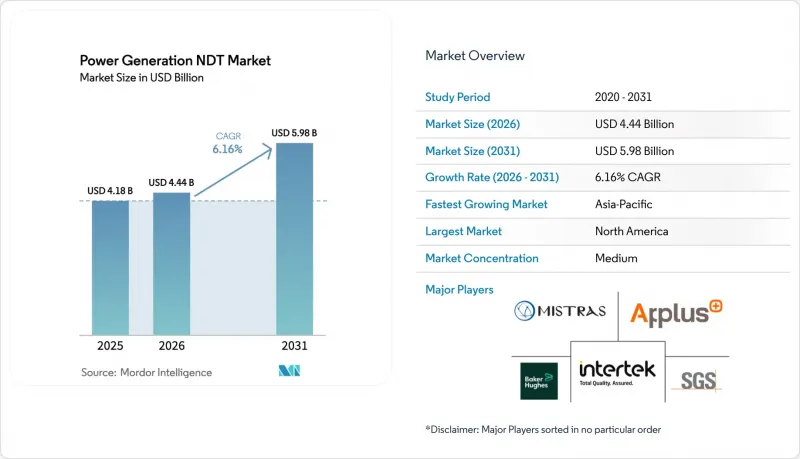
Mordor Intelligence에 의하면, 발전 분야 비파괴 검사(NDT) 시장 규모는 2025년 41억 8,000만 달러로 평가되었습니다. 2026년에는 44억 4,000만 달러로 확대되어 2026년부터 2031년에 걸쳐 CAGR 6.16%로 성장을 지속하여, 2031년까지 59억 8,000만 달러에 이를 것으로 예측됩니다.
본 보고서는 구성 요소(장비, 소프트웨어 등), 검사 방법(초음파 검사, 방사선 검사, 자분 검사 등), 기법(기존/기존 방식 및 AI 지원), 지역(북미, 남미, 유럽, 아시아태평양, 중동 및 아프리카)별로 분류되어 있습니다. 시장 예측은 금액(달러) 기준으로 제시되어 있습니다.
세계의 발전 분야 비파괴 검사(NDT) 시장 동향 및 인사이트
노후화된 화력 발전 설비가 내구 수명 종료에 따른 검사 주기를 맞이하고 있습니다.
북미 및 유럽의 발전소 소유주들은 석탄 화력 및 가스 화력 발전 설비의 가동 수명을 당초 설계보다 연장하고 있으며, 이에 따라 보일러관, 증기 헤더, 터빈 케이싱의 크리프 및 피로를 감지하기 위한 위상 배열 초음파 검사 및 컴퓨터 단층 촬영(CT)에 대한 수요가 증가하고 있습니다. 검사 빈도는 가동 마지막 해에 정점을 찍으며, 그 결과 시설당 지출이 증가하고 설비 교체가 가속화되고 있습니다. 전력 회사는 가동 중단 기간을 단축하고 재현성을 향상시키는 자동 스캐너를 도입하고 있습니다. 규제 당국의 안전 감사가 엄격해지는 가운데, 이동식 CT 기능을 갖춘 서비스 제공업체들이 긴급 출동 의뢰를 확보하고 있습니다. 발전 분야 비파괴 검사(NDT) 시장은 가동 기간이 1년 연장될 때마다 더 상세하고 빈번한 검사가 의무화됨에 따라 혜택을 보고 있습니다.
원자력 발전소 운전 연장 요건
규제 당국은 운전 허가 갱신 신청자에게 ASME XI 및 IAEA의 정기 심사 규정에 따라 압력 용기의 무결성, 증기 발생기 관의 상태, 그리고 1차 배관의 건전성을 검증할 것을 요구하고 있습니다. ENIQ 인증 절차에는 건당 50만-200만 달러의 비용이 소요되므로, 이미 검증된 기술을 보유한 기존 공급업체의 입지가 확고해지고 있습니다. 전력 회사는 가동 중단 기간에 특화된 초음파 검사, 와전류 검사 및 음향 방출 검사 캠페인에 수년에 걸친 예산을 배정하고 있으며, 이를 통해 인증된 공급업체에게는 예측 가능한 수익원이 확보되고 있습니다. 따라서 원자력 분야는 발전 분야 비파괴 검사 시장의 안정성을 유지하는 핵심 역할을 수행하며, 화석 연료 발전 분야의 지출 변동을 완화하고 있습니다. 현장 로봇 기술과 AI 기반 분석을 결합한 공급업체들은 검사 기간 단축과 총 피폭량 감소를 실현하고 있습니다.
ISO 9712/ASNT 레벨 III 인증 기술자 부족
은퇴자 급증과 엄격한 인증 일정으로 인해 25-30%의 인력 부족이 발생하고 있으며, 이는 임금 상승과 프로젝트 리드타임 장기화를 초래하고 있습니다. 규제 당국이 작업자의 초과 근무 시간을 제한하고 중요한 스캔 결과에 대해 이중 심사를 의무화하고 있기 때문에 원자력 프로젝트에서 이러한 영향이 가장 심각하게 나타나고 있습니다. 서비스 기업들은 검사원의 업무 부담을 줄이기 위해 가상현실(VR)을 활용한 교육 모듈이나 AI를 통한 예비 선별에 투자하고 있지만, 현장 배치는 여전히 부족한 베테랑 인력에 의존하고 있습니다. 전력 회사는 기술 인력을 사전에 확보하기 위해 여러 발전소를 묶은 계약을 체결하고 있으며, 이로 인해 예정에 없던 정전에 대한 대응 유연성이 저하되고 있습니다. 이러한 제약으로 인해 인력을 배치할 수 있는 동시 수행 프로젝트의 수가 제한되어, 발전 분야 비파괴 검사(NDT) 시장의 성장이 둔화되고 있습니다.
부문별 분석
위상 배열 초음파 검사 랙, 자동 스캐너, 고에너지 CT 갠트리에 대한 견조한 수요로 인해, 장비 부문은 2025년 발전 분야 비파괴 검사(NDT) 시장 점유율의 46.12%를 차지했습니다. 원자력 발전소의 면허 갱신 및 화석 연료 발전소의 수명 연장 프로젝트에서는 초음파, 와전류, 방사선 촬영 기능을 갖춘 다중 모달리티 툴킷이 필요합니다. 전력 회사들이 예측 유지보수를 도입함에 따라 소프트웨어 매출은 2031년까지 연평균 성장률(CAGR) 7.01%로 증가하고 있으며, 하드웨어를 능가하는 속도로 성장하고 있지만 여전히 하드웨어를 기반으로 하고 있습니다. 클라우드 호스팅형 분석 플랫폼은 구독을 통해 검사 데이터를 수익화하여 공급업체의 수익 구조를 혁신하고 있습니다.
결합제, 침투 탐상제, 방사선 촬영 필름 등의 소모품은 고객을 OEM 생태계에 묶어두는 지속적인 수익원이 되고 있습니다. 복잡한 규격 및 인증 제도로 인해 발전소 운영자는 사내 직원에 의한 유지 관리보다 외부 위탁을 선택할 수밖에 없기 때문에 서비스는 여전히 중요한 부분을 차지하고 있습니다. 인력 부족이 심화됨에 따라 발전 분야 비파괴 검사(NDT) 서비스 시장 규모는 꾸준히 확대될 것으로 예측됩니다. 장비 임대와 장기 서비스 계약을 세트로 제공하는 공급업체는 두 자릿수의 계약 갱신율을 달성하고 있습니다. 내부수익률(IRR) 모델에서는 하드웨어 감가상각비에 더해 데이터 분석의 평생 이용료도 고려되게 되어, 가격 결정 메커니즘이 정교해지고 있습니다.
지역별 분석
북미는 2025년 발전 분야 비파괴 검사(NDT) 시장 매출의 38.22%를 차지했으며, 이는 미국 내 90기 이상의 원자로 운전 허가 갱신과 석탄 화력 발전소의 수명 종료 검사 미처리 건들에 힘입은 결과입니다. 캐나다의 CANDU 원자로 개보수 및 멕시코의 송전망 현대화 프로젝트가 추가적인 성장 동력을 제공합니다. 명확하게 정의된 규제 체계 덕분에 장비 인증이 용이해졌으며, 또한 탄탄한 서비스 공급망을 통해 제한된 가동 중단 기간 내에 여러 팀이 동시에 작업을 수행할 수 있게 되었습니다.
아시아태평양은 중국의 원자로 건설, 인도의 석탄 화력 발전소 현대화, 그리고 동남아시아의 재생에너지 목표에 힘입어 2031년까지 연평균 성장률(CAGR) 6.74%를 기록하며 가장 빠르게 성장하는 지역입니다. 현지 OEM 기업들은 페이즈 어레이 생산을 확대하여 리드 타임을 단축하고 도입 비용을 절감하고 있습니다. 지역 정부는 AI 기반 검사 시스템에 대해 세액 공제를 제공하여 디지털 기술 도입을 가속화하고 있습니다. 중국과 싱가포르의 교육 기관에서는 ISO 9712 대응 능력을 확충하고 있어, 기술자 부족 현상은 점차 해소되고 있습니다.
유럽에서는 초음파, 방사선 투과, 와전류 등 각 기법을 포함한 정기적인 안전 심사를 의무화하는 ENSREG의 엄격한 원자력 지침에 힘입어 꾸준한 성장을 유지하고 있습니다. 독일의 원자력 발전소 단계적 폐지 과정에서도 여전히 철저한 폐지 조치를 위한 검사가 요구되고 있는 반면, 프랑스 원자력 발전소의 가동 기간 연장은 ENIQ 인증 절차에 달려 있습니다. 북해 전역에서 해상 풍력 발전이 확대됨에 따라 복합재 블레이드에 대한 전문적인 검사 수요가 발생하고 있습니다. 조화로운 EN ISO 표준은 국경을 초월한 서비스 계약을 촉진하고 있으며, 이로 인해 유럽은 광범위한 발전 분야 비파괴 검사(NDT) 시장 중에서 경쟁력이 있으면서도 진입하기 쉬운 시장이 되었습니다.
기타 혜택 :
- 엑셀 형식 시장 예측(ME) 시트
- 3개월간의 애널리스트 지원
자주 묻는 질문
목차
제1장 서론
제2장 조사 방법
제3장 주요 요약
제4장 시장 구도
제5장 시장 규모 및 성장 예측
제6장 경쟁 구도
제7장 시장 기회 및 향후 전망
KTH 26.09.14According to Mordor Intelligence, the power generation NDT market size is expected to grow from USD 4.18 billion in 2025 to USD 4.44 billion in 2026 and is forecast to reach USD 5.98 billion by 2031 at 6.16% CAGR over 2026-2031.
This report is Segmented by Component (Equipment, Software, and More), Testing Method (Ultrasonic Testing, Radiographic Testing, Magnetic Particle Testing, and More), Technique (Traditional/Conventional and AI-Enabled), and Geography (North America, South America, Europe, Asia Pacific, Middle East, and Africa). The Market Forecasts are Provided in Terms of Value (USD).
Global Power Generation NDT Market Trends and Insights
Aging Thermal-Fossil Power Fleet Reaching End-of-Life Inspection Cycles
Plant owners in North America and Europe are extending the lives of coal and gas units beyond their original design, which amplifies demand for phased-array ultrasonics and computed tomography to detect creep and fatigue in boiler tubes, steam headers, and turbine casings. Inspection intensity peaks during the final operating years, resulting in increased per-facility spending and accelerated equipment replacement. Utilities are opting for automated scanners that reduce outage durations and improve repeatability. Service providers with mobile CT capabilities are winning short-notice call-outs as regulators tighten safety audits. The power generation NDT market benefits because each incremental year of operation mandates deeper and more frequent examinations.
Nuclear Life-Extension Mandates
Regulators require license-renewal applicants to verify the integrity of their vessels, the condition of their steam generator tubes, and the health of their primary piping under ASME XI and IAEA periodic review rules. ENIQ-qualified procedures cost USD 0.5-2 million each, which entrenches incumbent vendors that already possess validated techniques. Utilities allocate multiyear budgets for outage-specific ultrasonic, eddy-current, and acoustic-emission campaigns, sustaining a predictable revenue stream for certified suppliers. The nuclear segment, therefore, acts as a stability anchor for the power generation NDT market, cushioning cyclical swings in fossil-fired spending. Vendors that combine field robotics with AI-aided interpretation are shortening inspection windows and lowering collective radiation exposure.
Shortage of Certified ISO 9712 / ASNT Level III Technicians
A retiree wave and stringent certification timelines have created a 25-30% talent gap that inflates wages and extends project lead times. Nuclear projects feel the pinch most acutely because regulators cap crew overtime and mandate dual review of critical scans. Service companies are investing in virtual-reality training modules and AI-driven preliminary screening to ease interpreter workloads, yet field deployment still hinges on scarce senior personnel. Utilities are bundling multi-plant contracts to reserve technician rosters in advance, reducing flexibility for unscheduled outages. This constraint tempers growth in the power generation NDT market by limiting the volume of simultaneous campaigns that can be staffed.
Other drivers and restraints analyzed in the detailed report include:
- Predictive-Maintenance Programs Integrating Digital Twins
- Renewables Boom Driving Blade-Composite NDT Protocols
- High Capex for Phased-Array, Automated and CT Systems
For complete list of drivers and restraints, kindly check the Table Of Contents.
Segment Analysis
Equipment captured 46.12% of the 2025 power generation NDT market share thanks to strong demand for phased-array ultrasonic racks, automated scanners, and high-energy CT gantries. Nuclear license renewals and fossil-plant life-extension projects require multi-modality toolkits that include ultrasonic, eddy-current, and radiographic capabilities. As utilities adopt predictive maintenance, software revenues are climbing at a 7.01% CAGR through 2031, outpacing hardware but still building on a hardware foundation. Cloud-hosted analytics platforms monetize inspection data via subscription, reshaping vendor economics.
Consumables such as couplants, penetrants, and radiographic films deliver recurring revenue that locks customers into OEM ecosystems. Services remain a vital layer because complex codes and qualification regimes push plant operators to outsource rather than maintain in-house crews. The power generation NDT market size for services is projected to swell steadily as personnel shortages intensify. Vendors that bundle equipment leasing with long-term service contracts are achieving double-digit renewal rates. Internal rate-of-return models now weigh lifetime data analytics fees alongside hardware depreciation, refining price-discovery mechanisms.
Complete Report Scope:
- By Component
- Equipment
- Software
- Services
- Consumables
- By Testing Method
- Ultrasonic Testing
- Radiographic Testing
- Magnetic Particle Testing
- Liquid Penetrant Testing
- Visual Inspection Testing
- Eddy-Current Testing
- Acoustic Emission Testing
- Thermography / Infrared Testing
- Computed Tomography Testing
- By Technique
- Traditional / Conventional
- AI-enabled
- By Geography
- North America
- United States
- Canada
- Mexico
- South America
- Brazil
- Argentina
- Rest of South America
- Europe
- Germany
- United Kingdom
- France
- Italy
- Spain
- Rest of Europe
- Asia-Pacific
- China
- Japan
- India
- South Korea
- South-East Asia
- Rest of Asia-Pacific
- Middle East
- Saudi Arabia
- United Arab Emirates
- Turkey
- Rest of Middle East
- Africa
- South Africa
- Nigeria
- Rest of Africa
- North America
Geography Analysis
North America accounted for 38.22% of 2025 revenue in the power generation NDT market, driven by over 90 U.S. reactor license renewals and a backlog of coal-plant end-of-life inspections. Canada's CANDU refurbishments and Mexico's grid-modernization projects add further momentum. Well-defined regulatory frameworks ease equipment qualification, while deep service supply chains enable multi-crew deployments during condensed outage windows.
The Asia-Pacific region is the fastest-growing region, with a 6.74% CAGR to 2031, driven by Chinese reactor buildouts, Indian coal fleet modernization, and Southeast Asian renewable energy targets. Local OEMs are scaling phased-array production, compressing lead times and lowering acquisition costs. Regional governments offer tax credits for AI-enabled inspection systems, accelerating digital adoption. Training academies in China and Singapore are expanding ISO 9712 capacity, gradually narrowing the technician gap.
Europe maintains steady growth, underpinned by stringent nuclear directives from ENSREG that require periodic safety reviews encompassing ultrasonic, radiographic, and eddy-current methods. Germany's nuclear phase-out still needs intensive decommissioning scans, while France's fleet life-extension hinges on ENIQ-qualified procedures. Offshore wind expansion across the North Sea is spawning specialized composite-blade inspection demand. Harmonized EN ISO standards encourage cross-border service contracts, making Europe a competitive yet accessible arena within the wider power generation NDT market.
- Baker Hughes Company
- Mistras Group Inc.
- SGS S.A.
- Intertek Group plc
- Applus Services S.A.
- Bureau Veritas S.A.
- Olympus Corporation (Evident)
- Eddyfi Technologies
- TEAM Inc.
- Acuren Group Inc.
- TUV Rheinland AG
- DEKRA SE
- Element Materials Technology
- Zetec Inc.
- Sonatest Ltd.
- Screening Eagle Technologies AG
- YXLON International GmbH
- Karl Deutsch Pruf- und Messgeratebau GmbH
- Cygnus Instruments Ltd.
- NOVO Test Ltd.
- Sonotron NDT
- Vibra-tion NDT Services Pvt. Ltd.
- Industrial Inspection and Analysis Inc.
- Premier NDT Services Inc.
- Ether NDE Ltd.
- Toshiba Energy Systems and Solutions Corp.
- Buffalo Inspection Services
Additional Benefits:
- The market estimate (ME) sheet in Excel format
- 3 months of analyst support
TABLE OF CONTENTS
1 INTRODUCTION
- 1.1 Study Assumptions and Market Definition
- 1.2 Scope of the Study
2 RESEARCH METHODOLOGY
3 EXECUTIVE SUMMARY
4 MARKET LANDSCAPE
- 4.1 Market Overview
- 4.2 Market Drivers
- 4.2.1 Ageing thermal-fossil power fleet reaching end-of-life inspection cycles
- 4.2.2 Nuclear life-extension mandates (ASME XI, IAEA periodic safety review)
- 4.2.3 Predictive-maintenance programs integrating digital twins and NDT data lakes
- 4.2.4 Renewables boom driving blade-composite NDT protocols for on-shore/off-shore wind
- 4.2.5 Laser-ultrasonic adoption enabling in-service, non-contact boiler inspection
- 4.2.6 Tariff-driven regionalization of sensor supply chains improving local availability
- 4.3 Market Restraints
- 4.3.1 Shortage of certified ISO 9712 / ASNT Level III power-sector technicians
- 4.3.2 High capex for phased-array, automated and CT systems
- 4.3.3 Data-overload bottlenecks for high-resolution inspection files
- 4.3.4 Trade-tariff shocks on specialty piezo / opto components
- 4.4 Industry Value Chain Analysis
- 4.5 Impact of Macroeconomic Factors
- 4.6 Regulatory Landscape
- 4.7 Technological Outlook
- 4.8 Porter's Five Forces Analysis
- 4.8.1 Bargaining Power of Suppliers
- 4.8.2 Bargaining Power of Buyers
- 4.8.3 Threat of New Entrants
- 4.8.4 Threat of Substitutes
- 4.8.5 Intensity Competitive Rivalry
5 MARKET SIZE AND GROWTH FORECASTS (VALUE)
- 5.1 By Component
- 5.1.1 Equipment
- 5.1.2 Software
- 5.1.3 Services
- 5.1.4 Consumables
- 5.2 By Testing Method
- 5.2.1 Ultrasonic Testing
- 5.2.2 Radiographic Testing
- 5.2.3 Magnetic Particle Testing
- 5.2.4 Liquid Penetrant Testing
- 5.2.5 Visual Inspection Testing
- 5.2.6 Eddy-Current Testing
- 5.2.7 Acoustic Emission Testing
- 5.2.8 Thermography / Infrared Testing
- 5.2.9 Computed Tomography Testing
- 5.3 By Technique
- 5.3.1 Traditional / Conventional
- 5.3.2 AI-enabled
- 5.4 By Geography
- 5.4.1 North America
- 5.4.1.1 United States
- 5.4.1.2 Canada
- 5.4.1.3 Mexico
- 5.4.2 South America
- 5.4.2.1 Brazil
- 5.4.2.2 Argentina
- 5.4.2.3 Rest of South America
- 5.4.3 Europe
- 5.4.3.1 Germany
- 5.4.3.2 United Kingdom
- 5.4.3.3 France
- 5.4.3.4 Italy
- 5.4.3.5 Spain
- 5.4.3.6 Rest of Europe
- 5.4.4 Asia-Pacific
- 5.4.4.1 China
- 5.4.4.2 Japan
- 5.4.4.3 India
- 5.4.4.4 South Korea
- 5.4.4.5 South-East Asia
- 5.4.4.6 Rest of Asia-Pacific
- 5.4.5 Middle East
- 5.4.5.1 Saudi Arabia
- 5.4.5.2 United Arab Emirates
- 5.4.5.3 Turkey
- 5.4.5.4 Rest of Middle East
- 5.4.6 Africa
- 5.4.6.1 South Africa
- 5.4.6.2 Nigeria
- 5.4.6.3 Rest of Africa
- 5.4.1 North America
6 COMPETITIVE LANDSCAPE
- 6.1 Market Concentration
- 6.2 Strategic Moves
- 6.3 Market Share Analysis
- 6.4 Company Profiles (includes Global level overview, Market level overview, Core segments, Financials as available, Strategic information, Market rank/share, Products and services, Recent developments)
- 6.4.1 Baker Hughes Company
- 6.4.2 Mistras Group Inc.
- 6.4.3 SGS S.A.
- 6.4.4 Intertek Group plc
- 6.4.5 Applus Services S.A.
- 6.4.6 Bureau Veritas S.A.
- 6.4.7 Olympus Corporation (Evident)
- 6.4.8 Eddyfi Technologies
- 6.4.9 TEAM Inc.
- 6.4.10 Acuren Group Inc.
- 6.4.11 TUV Rheinland AG
- 6.4.12 DEKRA SE
- 6.4.13 Element Materials Technology
- 6.4.14 Zetec Inc.
- 6.4.15 Sonatest Ltd.
- 6.4.16 Screening Eagle Technologies AG
- 6.4.17 YXLON International GmbH
- 6.4.18 Karl Deutsch Pruf- und Messgeratebau GmbH
- 6.4.19 Cygnus Instruments Ltd.
- 6.4.20 NOVO Test Ltd.
- 6.4.21 Sonotron NDT
- 6.4.22 Vibra-tion NDT Services Pvt. Ltd.
- 6.4.23 Industrial Inspection and Analysis Inc.
- 6.4.24 Premier NDT Services Inc.
- 6.4.25 Ether NDE Ltd.
- 6.4.26 Toshiba Energy Systems and Solutions Corp.
- 6.4.27 Buffalo Inspection Services
7 MARKET OPPORTUNITIES AND FUTURE OUTLOOK
- 7.1 White-space and Unmet-need Assessment