|
시장보고서
상품코드
2101548
PFAS 프리 식품 포장 시장 기회, 성장요인, 업계 동향 분석 및 예측(2026-2035년)PFAS-Free Food Packaging Market Opportunity, Growth Drivers, Industry Trend Analysis, and Forecast 2026 - 2035 |
||||||

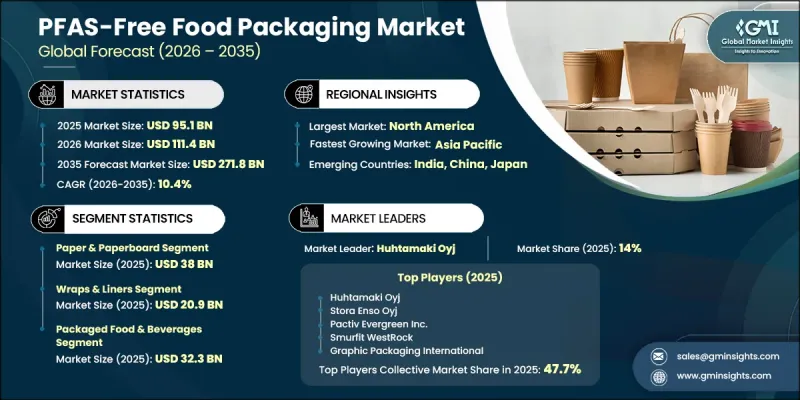
세계의 PFAS 프리 식품 포장 시장은 2025년에 951억 달러 규모에 달하며, 2035년까지 CAGR 10.4%로 성장하며, 2,718억 달러에 달할 것으로 추정되고 있습니다.
PFAS 프리 식품 포장이란 기존에 유지나 습기, 기타 외부 요인에 대한 내성을 높이기 위해 포장재에 배합되어 온 퍼플루오로알킬 물질 및 폴리플루오로알킬 물질(PFAS)을 사용하지 않고 제조된 포장재를 말합니다. PFAS가 포함되지 않은 대체재로 전환하는 것은 장기간 환경에 잔류하는 것으로 알려진 물질을 배제하면서도 동등한 기능적 성능을 발휘하는 보다 안전한 포장재에 대한 업계의 노력이 강화되고 있음을 반영합니다. 이러한 포장 솔루션은 식품으로의 화학 물질 이동 위험을 줄이는 동시에 환경에 미치는 영향을 최소화함으로써, 지속가능성 노력과 식품 안전성 목표 모두를 지원합니다. 각 제조사는 제품 보호 및 포장 성능을 유지하면서 불소 화합물 사용을 피할 수 있는 혁신적인 차단 기술과 재생 가능 소재 솔루션을 점점 더 많이 활용하고 있습니다. 잔류성이 높은 화학 물질과 관련된 환경 및 건강 문제에 대한 인식이 높아짐에 따라 포장 밸류체인 전반에 걸친 기업이 더 안전한 소재를 선택하도록 촉진되고 있습니다. 소비자의 기대치 상승, 지속가능성 노력의 진화, 그리고 규제 당국의 관심 강화로 인해 전 세계 식품 포장 분야에서 PFAS가 포함되지 않은 식품 포장의 도입이 계속해서 가속화되고 있습니다.
| 시장 범위 | |
|---|---|
| 시작연도 | 2025년 |
| 예측 기간 | 2026-2035년 |
| 개시 금액 | 951억 달러 |
| 예측액 | 2,718억 달러 |
| CAGR | 10.4% |
2025년, 종이 및 판지 부문 시장 규모는 380억 달러에 달했습니다. 이 부문의 선도적인 지위는 뛰어난 재활용성, 지속가능한 배리어 기술과의 폭넓은 호환성, 그리고 친환경 포장재에 대한 수요 증가에 힘입어 유지되고 있습니다. 성형 섬유 및 펄프 기반 포장 솔루션은 신뢰할 수 있는 구조적 성능을 제공할 뿐만 아니라 퇴비화 가능한 포장 요건도 충족하므로 계속해서 성장세를 보이고 있습니다. 동시에, 바이오플라스틱 및 바이오 기반 폴리머는 효과적인 내습성과 신뢰할 수 있는 밀봉 성능을 갖추고 있으며, 재생 가능한 원료로의 산업 전환을 촉진하는 유연한 포장 소재로서 그 중요성이 점점 더 커지고 있습니다.
식품 및 음료 부문 시장 규모는 2025년에 323억 달러에 달했습니다. 식품 안전에 대한 관심 증가, 규제 준수의 엄격화, 그리고 기업의 지속가능성 노력에 힘입어 이 부문 전반에서 PFAS가 포함되지 않은 포장재로 전환하는 움직임이 지속적으로 추진되고 있습니다. 각 제조사는 환경 목표를 지원하면서도 제품 품질을 유지하기 위해 코팅지, 섬유 기반 포장재 및 바이오플라스틱 솔루션의 채택을 확대하고 있습니다. 외식업계 사업자들도 변화하는 규제 요건과 더 안전한 식품 접촉 재료를 요구하는 소비자의 수요 증가에 맞춰 포장 전략을 조정하는 과정에서 PFAS 프리 포장재의 사용을 확대하고 있습니다.
북미의 PFAS 무함유 식품 포장 시장은 2025년에 285억 달러 규모에 달했습니다. 이 지역에서는 규제 감독이 더욱 엄격해지고, 지속가능한 포장에 대한 소비자의 인식이 지속적으로 높아지는 가운데, PFAS 무함유 포장 솔루션의 채택이 계속해서 증가하고 있습니다. 식품 소매업체와 외식 기업은 규제 준수와 장기적인 지속가능성 목표를 모두 지원하는 포장재로 전환을 꾸준히 추진하고 있습니다. 지속적인 정책 발전과 기업의 지속가능성 노력에 힘입어, 다양한 식품 포장 용도에서 섬유 기반 포장재와 PFAS가 없는 코팅 기술의 도입이 더욱 가속화되고 있습니다.
자주 묻는 질문
목차
제1장 조사 방법과 범위
제2장 개요
제3장 업계 인사이트
제4장 경쟁 구도
제5장 시장 추산·예측 : 소재 유형별, 2022-2035년
제6장 시장 추산·예측 : 포장 유형별, 2022-2035년
제7장 시장 추산·예측 : 최종 사용별, 2022-2035년
제8장 시장 추산·예측 : 지역별, 2022-2035년
제9장 기업 개요
KSA 26.07.31The Global PFAS-Free Food Packaging Market was valued at USD 95.1 billion in 2025 and is estimated to grow at a CAGR of 10.4% to reach USD 271.8 billion by 2035.
PFAS-free food packaging refers to packaging materials manufactured without per- and polyfluoroalkyl substances, which have traditionally been incorporated into packaging to enhance resistance against grease, moisture, and other external elements. The transition toward PFAS-free alternatives reflects the industry's growing commitment to safer packaging materials that deliver comparable functional performance while eliminating substances known for their long-term environmental persistence. These packaging solutions support both sustainability initiatives and food safety objectives by reducing the potential for chemical migration into food while minimizing environmental impact. Manufacturers are increasingly utilizing innovative barrier technologies and renewable material solutions that avoid fluorinated compounds while maintaining product protection and packaging performance. Growing awareness of the environmental and health concerns associated with persistent chemicals is encouraging businesses throughout the packaging value chain to adopt safer material choices. Rising consumer expectations, evolving sustainability commitments, and stronger regulatory focus continue to accelerate the adoption of PFAS-free food packaging across global food packaging applications.
| Market Scope | |
|---|---|
| Start Year | 2025 |
| Forecast Year | 2026-2035 |
| Start Value | $95.1 Billion |
| Forecast Value | $271.8 Billion |
| CAGR | 10.4% |
The paper and paperboard segment accounted for USD 38 billion in 2025. Their leading position is supported by strong recyclability, broad compatibility with sustainable barrier technologies, and increasing demand for environmentally responsible packaging materials. Molded fiber and pulp-based packaging solutions continue gaining momentum because they provide dependable structural performance while supporting compostable packaging requirements. At the same time, bioplastics and bio-based polymers are becoming increasingly important as flexible packaging materials that offer effective moisture resistance, reliable sealing performance, and support the industry's transition toward renewable raw materials.
The packaged food and beverages segment reached USD 32.3 billion in 2025. Growing emphasis on food safety, stricter regulatory compliance, and corporate sustainability initiatives continue driving the transition toward PFAS-free packaging materials across this segment. Manufacturers are increasingly adopting coated paper, fiber-based packaging, and bioplastic solutions to maintain product quality while supporting environmental objectives. Food service providers are also expanding the use of PFAS-free packaging materials as they align packaging strategies with changing regulatory requirements and increasing consumer demand for safer food-contact materials.
North America PFAS-Free Food Packaging Market captured USD 28.5 billion in 2025. The region continues to witness rising adoption of PFAS-free packaging solutions as regulatory oversight becomes more rigorous and consumer awareness regarding sustainable packaging continues to increase. Food retailers and food service companies are steadily transitioning toward packaging materials that support both regulatory compliance and long-term sustainability objectives. Continued policy developments and corporate sustainability commitments are further accelerating the adoption of fiber-based packaging materials and PFAS-free coating technologies across a broad range of food packaging applications.
Major companies operating in the Global PFAS-free food packaging market include Huhtamaki Oyj, Stora Enso Oyj, Pactiv Evergreen Inc., Smurfit WestRock, Graphic Packaging International, Sealed Air Corporation, Berry Global Group (Amcor merger pending), Vegware Ltd., Sabert Corporation, Solenis LLC, Good Start Packaging, and Transcend Packaging. Companies participating in the PFAS-free food packaging market are strengthening their competitive position by expanding sustainable product portfolios and investing in advanced barrier technologies that eliminate the use of PFAS while maintaining packaging performance. Manufacturers continue to increase research and development activities to introduce innovative materials that meet evolving food safety regulations and sustainability goals. Many companies are enhancing production capabilities, improving material sourcing strategies, and optimizing manufacturing efficiency to support rising global demand. Strategic partnerships across the packaging value chain help accelerate product development and expand market reach.
Table of Contents
Chapter 1 Methodology & Scope
- 1.1 Market scope and definition
- 1.2 Research design
- 1.2.1 Research approach
- 1.2.2 Data collection methods
- 1.3 Data mining sources
- 1.3.1 Global
- 1.3.2 Regional/Country
- 1.4 Base estimates and calculations
- 1.4.1 Base year calculation
- 1.4.2 Key trends for market estimation
- 1.5 Primary research and validation
- 1.5.1 Primary sources
- 1.6 Forecast model
- 1.7 Research assumptions and limitations
Chapter 2 Executive Summary
- 2.1 Industry 360° synopsis
- 2.2 Key market trends
- 2.2.1 Material type
- 2.2.2 Packaging type
- 2.2.3 End Use
- 2.2.4 Regional
- 2.3 TAM Analysis, 2026-2035
- 2.4 CXO perspectives: Strategic imperatives
- 2.5 Future outlook and strategic recommendations
Chapter 3 Industry Insights
- 3.1 Industry ecosystem analysis
- 3.1.1 Supplier landscape
- 3.1.2 Profit margin
- 3.1.3 Value addition at each stage
- 3.1.4 Factor affecting the value chain
- 3.1.5 Disruptions
- 3.2 Industry impact forces
- 3.2.1 Growth drivers
- 3.2.1.1 Rising demand for safer food packaging
- 3.2.1.2 Increasing regulatory restrictions on PFAS use
- 3.2.1.3 Growing consumer awareness on sustainability
- 3.2.2 Industry pitfalls and challenges
- 3.2.2.1 Development of biodegradable barrier coatings
- 3.2.2.2 Expansion in foodservice and retail applications
- 3.2.3 Market opportunities
- 3.2.3.1 Higher production costs compared alternatives
- 3.2.3.2 Performance limitations in grease resistance applications
- 3.2.1 Growth drivers
- 3.3 Growth potential analysis
- 3.4 Regulatory landscape
- 3.4.1 North America
- 3.4.2 Europe
- 3.4.3 Asia Pacific
- 3.4.4 Latin America
- 3.4.5 Middle East & Africa
- 3.5 Porter's analysis
- 3.6 PESTEL analysis
- 3.7 Technology and innovation landscape
- 3.7.1 Current technological trends
- 3.7.2 Emerging technologies
- 3.8 Price trends
- 3.8.1 By region
- 3.8.2 By material type
- 3.9 Future market trends
- 3.10 Patent landscape
- 3.11 Trade statistics (HS code)
- 3.11.1 Major importing countries
- 3.11.2 Major exporting countries
- 3.12 Sustainability and environmental aspects
- 3.12.1 Sustainable practices
- 3.12.2 Waste reduction strategies
- 3.12.3 Energy efficiency in production
- 3.12.4 Eco-friendly initiatives
- 3.13 Carbon footprint consideration
Chapter 4 Competitive Landscape, 2025
- 4.1 Introduction
- 4.2 Company market share analysis
- 4.2.1 By region
- 4.2.1.1 North America
- 4.2.1.2 Europe
- 4.2.1.3 Asia Pacific
- 4.2.1.4 LATAM
- 4.2.1.5 MEA
- 4.2.1 By region
- 4.3 Company matrix analysis
- 4.4 Competitive analysis of major market players
- 4.5 Competitive positioning matrix
- 4.6 Key developments
- 4.6.1 Mergers & acquisitions
- 4.6.2 Partnerships & collaborations
- 4.6.3 New product launches
- 4.6.4 Expansion plans
Chapter 5 Market Estimates and Forecast, By Material type, 2022-2035 (USD Million) (Kilo Tons)
- 5.1 Key trends
- 5.2 Paper & paperboard
- 5.3 Molded fiber / pulp
- 5.4 Bioplastics & bio-derived polymers
- 5.5 Cellulose films
- 5.6 Aluminum & metal-based
- 5.7 Others
Chapter 6 Market Estimates and Forecast, By Packaging type, 2022-2035 (USD Million) (Kilo Tons)
- 6.1 Key trends
- 6.2 Wraps & liners
- 6.3 Clamshells & hinged containers
- 6.4 Plates, bowls & trays
- 6.5 Cups & lids
- 6.6 Bags & pouches
- 6.7 Others
Chapter 7 Market Estimates and Forecast, By End Use, 2022-2035 (USD Million) (Kilo Tons)
- 7.1 Key trends
- 7.2 Packaged food & beverages
- 7.3 QSR & fast food
- 7.4 Retail & convenience stores
- 7.5 Bakery & confectionery
- 7.6 Others
Chapter 8 Market Estimates and Forecast, By Region, 2022-2035 (USD Million) (Kilo Tons)
- 8.1 Key trends
- 8.2 North America
- 8.2.1 U.S.
- 8.2.2 Canada
- 8.3 Europe
- 8.3.1 Germany
- 8.3.2 UK
- 8.3.3 France
- 8.3.4 Spain
- 8.3.5 Italy
- 8.3.6 Rest of Europe
- 8.4 Asia Pacific
- 8.4.1 China
- 8.4.2 India
- 8.4.3 Japan
- 8.4.4 Australia
- 8.4.5 South Korea
- 8.4.6 Rest of Asia Pacific
- 8.5 Latin America
- 8.5.1 Brazil
- 8.5.2 Mexico
- 8.5.3 Argentina
- 8.5.4 Rest of Latin America
- 8.6 Middle East and Africa
- 8.6.1 Saudi Arabia
- 8.6.2 South Africa
- 8.6.3 UAE
- 8.6.4 Rest of Middle East and Africa
Chapter 9 Company Profiles
- 9.1 Huhtamaki Oyj
- 9.2 Stora Enso Oyj
- 9.3 Pactiv Evergreen Inc.
- 9.4 Smurfit WestRock
- 9.5 Graphic Packaging International
- 9.6 Sealed Air Corporation
- 9.7 Berry Global Group (Amcor merger pending)
- 9.8 Vegware Ltd.
- 9.9 Sabert Corporation
- 9.10 Solenis LLC
- 9.11 Good Start Packaging
- 9.12 Transcend Packaging