

|
시장보고서
상품코드
2101562
산업 시설 해체 시장 기회, 성장 촉진요인, 업계 동향 분석 및 예측(2026-2035년)Industrial Decommissioning Market Opportunity, Growth Drivers, Industry Trend Analysis, and Forecast 2026 - 2035 |
||||||

세계의 산업 시설 해체 시장은 2025년에 161억 달러 규모에 달하고, CAGR 7.2%로 성장하여 2035년까지 324억 달러에 달할 것으로 추정됩니다.
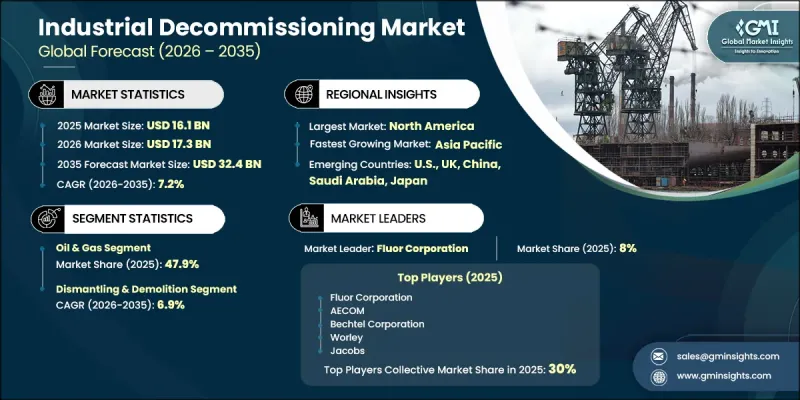
시장 성장을 견인하고 있는 요인은 석유·가스, 발전, 화학 처리 산업에서 노후화된 산업 인프라의 해체가 진행되고 있다는 점입니다. 이러한 산업에서는 시설의 가동 수명이 막바지에 다다르고 있습니다. 환경 규정 준수 요건의 강화와 규제 감독의 강화로 인해 사업자들은 장기적인 환경 책임을 최소화하면서 체계적인 해체 조치를 시행하도록 촉구받고 있습니다. 에너지 전환 이니셔티브에 대한 투자 확대 또한 부지 복원 및 재개발 기회를 창출하여 종합적인 해체 솔루션에 대한 수요를 높이고 있습니다. 동시에, 기존 산업 시설의 용도 변경은 토지 이용을 최적화하고 향후 인프라 개발을 지원하기 위한 중요한 전략으로 자리 잡고 있습니다. 유지 관리 비용 상승, 보험료 증가, 자산 건전성 평가의 엄격화로 인해 각 조직은 자산 폐기 관련 의사결정을 가속화할 수밖에 없는 상황입니다. 또한 기업들은 해체 조치를 일회성 운영 비용으로 취급하기보다는 장기적인 자산 수명주기 계획에 통합하는 경향이 강해지고 있습니다. 이러한 계획적인 해체 조치 프로그램으로의 전환에 따라 선진국과 개발도상국을 막론하고 엔지니어링, 컨설팅, 해체, 환경 복원, 프로젝트 관리 분야의 각 서비스 제공업체에게 비즈니스 기회가 확대되고 있습니다.
| 시장 범위 | |
|---|---|
| 시작 연도 | 2025년 |
| 예측 기간 | 2026-2035년 |
| 초기 시장 규모 | 161억 달러 |
| 예측액 | 324억 달러 |
| CAGR | 7.2% |
석유·가스 부문은 2025년에 47.9%의 점유율을 차지했으며, 2035년까지 연평균 성장률(CAGR) 6.8%로 성장할 것으로 전망됩니다. 이 부문이 계속해서 주도적인 위치를 유지하고 있는 배경에는 체계적인 해체 조치 및 부지 복원이 필요한 노후화된 업스트림·미드스티림·다운스트림 인프라의 방대한 도입 실적이 있습니다. 시설 폐쇄 및 자산 건전성을 규정하는 규제상의 의무는 여전히 해체 활동의 주요 촉진요인으로 작용하고 있으며, 이로 인해 상품 가격 변동과 관계없이 수요는 비교적 안정적인 상태를 유지하고 있습니다. 산업 사업자들이 환경 및 운영상의 규정 준수 기준을 충족하면서 노후화된 시설의 해체를 지속함에 따라, 석유·가스 부문의 전문적인 해체 서비스에 대한 수요는 예측 기간 동안 견조한 추세를 보일 것으로 전망됩니다.
해체·철거 부문은 2025년에 27.5%의 점유율을 차지했으며, 2026년부터 2035년까지 연평균 성장률(CAGR) 6.9%로 성장할 것으로 전망됩니다. 이 부문은 다양한 산업 분야에서 산업용 구조물, 생산 설비, 처리 유닛 및 지원 인프라를 안전하게 철거하는 작업을 수반하기 때문에 산업 시설의 해체 및 폐쇄 조치의 기초 단계로서 계속해서 중요한 역할을 수행하고 있습니다. 폐기 조치 도급업체는 환경을 배려하고 적용되는 업계 규정을 준수하면서 복잡한 해체 작업을 관리하기 위해 첨단 중장비, 다방면에 걸친 경험이 풍부한 인력, 그리고 엄격한 안전 프로토콜이 필요합니다. 철거 작업에 수반되는 기술적 복잡성으로 인해 산업 시설 철거 및 해체 시장 내 전문 서비스 제공업체의 중요성은 계속해서 높아지고 있습니다.
2025년, 북미의 산업 시설 철거 및 해체 시장은 34.9%의 점유율을 차지했습니다. 이 지역은 여러 최종 이용 산업 분야에서 해체가 필요한 노후화된 산업 자산이 다수 존재하기 때문에 선도적인 위치를 유지하고 있습니다. 미국은 주요 산업 부문 전반에 걸쳐 지속적인 폐기 조치가 이루어지고 있으며, 환경 규제 준수, 인프라 현대화, 산업 부지 재개발에 대한 투자가 지속되고 있는 점을 배경으로, 계속해서 지역 수요의 주요 견인차 역할을 하고 있습니다.
자주 묻는 질문
목차
제1장 조사 방법과 범위
제2장 주요 요약
제3장 업계 인사이트
제4장 경쟁 구도
제5장 시장 규모 및 예측 : 최종사용별, 2022-2035년
제6장 시장 규모 및 예측 : 서비스별, 2022-2035년
제7장 시장 규모 및 예측 : 방법별, 2022-2035년
제8장 시장 규모 및 예측 : 자산 유형별, 2022-2035년
제9장 시장 규모 및 예측 : 프로젝트 규모별, 2022-2035년
제10장 시장 규모 및 예측 : 지역별, 2022-2035년
제11장 기업 개요
KSM 26.08.04The Global Industrial Decommissioning Market was valued at USD 16.1 billion in 2025 and is estimated to grow at a CAGR of 7.2% to reach USD 32.4 billion by 2035.
Market growth is supported by the increasing retirement of aging industrial infrastructure across the oil & gas, power generation, and chemical processing industries, where facilities are approaching the end of their operational lifespan. Rising environmental compliance requirements and stricter regulatory oversight are encouraging operators to undertake structured decommissioning activities while minimizing long-term environmental liabilities. Growing investments in energy transition initiatives are also creating opportunities for site restoration and redevelopment, increasing demand for comprehensive decommissioning solutions. At the same time, the repurposing of existing industrial facilities is becoming an important strategy for optimizing land utilization and supporting future infrastructure development. Higher maintenance costs, rising insurance expenses, and more rigorous asset integrity evaluations are prompting organizations to accelerate decisions regarding asset retirement. In addition, businesses are increasingly incorporating decommissioning into long-term asset lifecycle planning rather than treating it as a one-time operational expense. This shift toward planned decommissioning programs is expanding opportunities for engineering, consulting, dismantling, environmental remediation, and project management service providers across developed and developing economies.
| Market Scope | |
|---|---|
| Start Year | 2025 |
| Forecast Year | 2026-2035 |
| Start Value | $16.1 Billion |
| Forecast Value | $32.4 Billion |
| CAGR | 7.2% |
The oil & gas segment accounted for 47.9% share in 2025 and is projected to grow at a CAGR of 6.8% through 2035. The continued dominance of this segment is supported by the large installed base of aging upstream, midstream, and downstream infrastructure requiring systematic retirement and site restoration. Regulatory obligations governing facility closure and asset integrity remain the primary drivers of decommissioning activity, allowing demand to remain comparatively stable regardless of fluctuations in commodity prices. As industrial operators continue to retire aging facilities while meeting environmental and operational compliance standards, demand for specialized decommissioning services within the oil & gas sector is expected to remain strong throughout the forecast period.
The dismantling and demolition segment 27.5% share in 2025 and is expected to grow at a CAGR of 6.9% from 2026 to 2035. This segment continues to serve as a fundamental stage of industrial decommissioning projects because it involves the safe removal of industrial structures, production equipment, processing units, and supporting infrastructure across multiple industries. Decommissioning contractors require advanced heavy equipment, experienced multidisciplinary workforces, and strict safety protocols to manage complex demolition activities while addressing environmental considerations and maintaining compliance with applicable industry regulations. The technical complexity associated with dismantling operations continues to reinforce the importance of specialized service providers within the industrial decommissioning market.
North America Industrial Decommissioning Market held a 34.9% share in 2025. The region maintains its leadership due to the substantial number of aging industrial assets requiring retirement across multiple end-use industries. The United States remains the primary contributor to regional demand, supported by ongoing decommissioning activities across major industrial sectors and continued investments in environmental compliance, infrastructure modernization, and industrial site redevelopment.
Key companies operating in the global industrial decommissioning market include AECOM, AF Gruppen, Aker Solutions, Amentum Services, AtkinsRealis, Babcock International Group, Baker Hughes Company, Bechtel Corporation, CLEAN HARBORS, Enviri Corporation, Fluor Corporation, Halliburton, Jacobs, KBR, Ramboll, REMONDIS, SLB, Stantec, TechnipFMC, Tetra Tech, Tradebe Environmental Services, Veolia, Wood, and Worley. Companies operating in the industrial decommissioning market are strengthening their market position by expanding their end-to-end service capabilities and investing in advanced engineering expertise. Many providers focus on delivering integrated solutions that combine project planning, dismantling, waste management, environmental remediation, and site restoration to improve operational efficiency for clients.
Table of Contents
Chapter 1 Methodology & Scope
- 1.1 Research approach
- 1.2 Quality commitments
- 1.2.1 GMI AI policy & data integrity commitment
- 1.2.1.1 Source consistency protocol
- 1.2.1 GMI AI policy & data integrity commitment
- 1.3 Research trail & confidence scoring
- 1.3.1 Research trail components
- 1.3.2 Scoring components
- 1.4 Data collection
- 1.4.1 Partial list of primary sources
- 1.5 Data mining sources
- 1.5.1 Paid sources
- 1.5.1.1 Sources, by region
- 1.5.1 Paid sources
- 1.6 Base estimates and calculations
- 1.6.1 Base year calculation for any one approach
- 1.7 Market estimates & forecasts parameters
- 1.8 Forecast model
- 1.8.1 Quantified market impact analysis
- 1.8.1.1 Mathematical impact of growth parameters on forecast
- 1.8.1 Quantified market impact analysis
- 1.9 Research transparency addendum
- 1.9.1 Source attribution framework
- 1.9.2 Quality assurance metrics
- 1.9.3 Our commitment to trust
- 1.10 Market definitions
Chapter 2 Executive Summary
- 2.1 Industry synopsis, 2022 - 2035
- 2.1.1 Business trends
- 2.1.2 End use trends
- 2.1.3 Service trends
- 2.1.4 Method trends
- 2.1.5 Asset type trends
- 2.1.6 Project size trends
- 2.1.7 Regional trends
Chapter 3 Industry Insights
- 3.1 Industry ecosystem analysis
- 3.1.1 Raw material availability & sourcing analysis
- 3.1.2 Manufacturing capacity assessment
- 3.1.3 Supply chain resilience & risk factors
- 3.1.4 Distribution network analysis
- 3.2 Industry impact forces
- 3.2.1 Growth drivers
- 3.2.2 Industry pitfalls & challenges
- 3.3 Regulatory landscape
- 3.4 Growth potential analysis
- 3.5 Porter's analysis
- 3.5.1 Bargaining power of suppliers
- 3.5.2 Bargaining power of buyers
- 3.5.3 Threat of new entrants
- 3.5.4 Threat of substitutes
- 3.6 PESTEL analysis
- 3.6.1 Political factors
- 3.6.2 Economic factors
- 3.6.3 Social factors
- 3.6.4 Technological factors
- 3.6.5 Legal factors
- 3.6.6 Environmental factors
- 3.7 Cost structure analysis of industrial decommissioning
- 3.8 Emerging decommissioning opportunities & industry transformation
- 3.9 Smart decommissioning technologies, automation & digital asset management
- 3.10 Expansion opportunities across aging industrial infrastructure & high-growth regions
- 3.11 Capital investments, strategic developments & long-term market outlook
- 3.12 Impact of AI & Generative AI on the market (Driven by Primary Research)
- 3.12.1 AI-Driven production optimization (Driven by Primary Research)
- 3.12.2 Predictive maintenance & fault detection (Driven by Primary Research)
Chapter 4 Competitive Landscape, 2026
- 4.1 Introduction
- 4.2 Company market share analysis, by region, 2025
- 4.2.1 North America
- 4.2.2 Europe
- 4.2.3 Asia Pacific
- 4.2.4 Middle East & Africa
- 4.2.5 Latin America
- 4.3 Competitive analysis of major market players
- 4.4 Competitive positioning matrix
- 4.5 Key developments
- 4.5.1 Mergers & acquisitions
- 4.5.2 Partnerships & collaborations
- 4.5.3 New product launches
- 4.5.4 Expansion plans & funding
- 4.6 Company tier benchmarking
- 4.6.1 Tier classification criteria & qualifying thresholds
- 4.6.2 Tier positioning matrix by revenue, geography & innovation
Chapter 5 Market Size and Forecast, By End Use, 2022 - 2035 (USD Million)
- 5.1 Key trends
- 5.2 Oil & gas
- 5.3 Power generation
- 5.4 Chemical & petrochemical
- 5.5 Mining & metals
- 5.6 Manufacturing
- 5.7 Marine & shipbuilding
- 5.8 Aerospace & defense
- 5.9 Others
Chapter 6 Market Size and Forecast, By Service, 2022 - 2035 (USD Million)
- 6.1 Key trends
- 6.2 Project planning & regulatory compliance
- 6.3 Engineering & consulting services
- 6.4 Asset retirement & shutdown management
- 6.5 Decontamination services
- 6.6 Dismantling & demolition
- 6.7 Waste management & disposal
- 6.8 Site remediation & environmental restoration
- 6.9 Material recovery & recycling
Chapter 7 Market Size and Forecast, By Method, 2022 - 2035 (USD Million)
- 7.1 Key trends
- 7.2 Full removal
- 7.3 Partial removal
- 7.4 Mothballing/ care & maintenance
- 7.5 Asset repurpose & redevelopment
- 7.6 In-situ decommissioning
Chapter 8 Market Size and Forecast, By Asset Type, 2022 - 2035 (USD Million)
- 8.1 Key trends
- 8.2 Buildings & structures
- 8.3 Process equipment
- 8.4 Pipelines & storage tanks
- 8.5 Boilers & pressure vessels
- 8.6 Electrical & control systems
- 8.7 Utility infrastructure
- 8.8 Offshore platforms
- 8.9 Heavy industrial machinery
Chapter 9 Market Size and Forecast, By Project Size, 2022 - 2035 (USD Million)
- 9.1 Key trends
- 9.2 Small-scale
- 9.3 Medium-scale
- 9.4 Large-scale
- 9.5 Mega-scale
Chapter 10 Market Size and Forecast, By Region, 2022 - 2035 (USD Million)
- 10.1 Key trends
- 10.2 North America
- 10.2.1 U.S.
- 10.2.2 Canada
- 10.2.3 Mexico
- 10.3 Europe
- 10.3.1 UK
- 10.3.2 Germany
- 10.3.3 France
- 10.3.4 Italy
- 10.3.5 Spain
- 10.3.6 Netherlands
- 10.3.7 Norway
- 10.3.8 Denmark
- 10.3.9 Poland
- 10.3.10 Sweden
- 10.4 Asia Pacific
- 10.4.1 China
- 10.4.2 Japan
- 10.4.3 India
- 10.4.4 South Korea
- 10.4.5 Australia
- 10.4.6 New Zealand
- 10.4.7 Indonesia
- 10.4.8 Malaysia
- 10.4.9 Thailand
- 10.5 Middle East & Africa
- 10.5.1 Saudi Arabia
- 10.5.2 UAE
- 10.5.3 Qatar
- 10.5.4 Kuwait
- 10.5.5 Oman
- 10.6 Latin America
- 10.6.1 Brazil
- 10.6.2 Argentina
- 10.6.3 Chile
Chapter 11 Company Profiles
- 11.1 AECOM
- 11.2 AF Gruppen
- 11.3 Aker Solutions
- 11.4 Amentum Services
- 11.5 AtkinsRealis
- 11.6 Babcock International Group
- 11.7 Baker Hughes Company
- 11.8 Bechtel Corporation
- 11.9 CLEAN HARBORS
- 11.10 Enviri Corporation
- 11.11 Fluor Corporation
- 11.12 Halliburton
- 11.13 Jacobs
- 11.14 KBR
- 11.15 Ramboll
- 11.16 REMONDIS
- 11.17 SLB
- 11.18 Stantec
- 11.19 TechnipFMC
- 11.20 Tetra Tech
- 11.21 Tradebe Environmental Services
- 11.22 Veolia
- 11.23 Wood
- 11.24 Worley


