

|
시장보고서
상품코드
2101644
원전 해체 서비스 시장 기회, 성장 촉진요인, 업계 동향 분석 및 예측(2026-2035년)Nuclear Decommissioning Service Market Opportunity, Growth Drivers, Industry Trend Analysis, and Forecast 2026 - 2035 |
||||||

세계의 원전 해체 서비스 시장은 2025년에 99억 달러 규모에 달하고, CAGR 6.8%로 성장하여 2035년까지 194억 달러에 달할 것으로 추정됩니다.
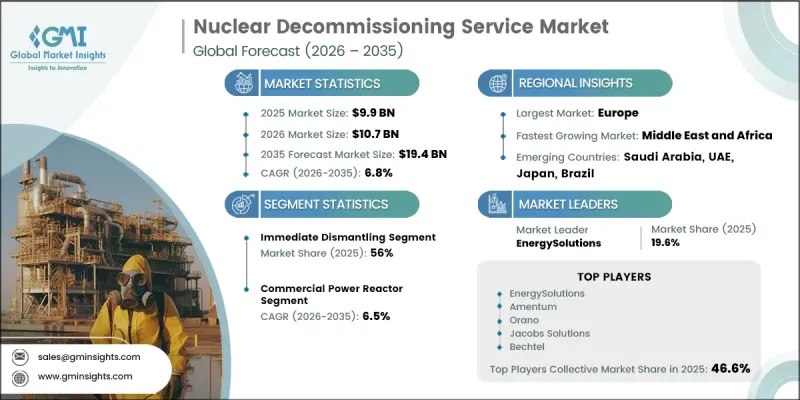
시장 성장을 주도하는 요인은 운전 수명이 막바지에 접어든 원자력 시설의 증가이며, 이로 인해 전 세계적으로 의무화된 해체 프로젝트의 장기적인 파이프라인이 형성되고 있습니다. 노후화된 원자로들이 영구적으로 폐쇄됨에 따라 전문적인 해체, 방사성 폐기물 관리, 부지 복원 및 환경 복구 서비스에 대한 수요는 계속해서 증가하고 있습니다. 발전소 가동 중단 및 해체 작업 중에 발생하는 방사성 폐기물 재고가 증가하고 있는 점도 종합적인 해체 솔루션에 대한 투자를 더욱 촉진하고 있습니다. 프로젝트 수행을 지속하기 위해서는 정부의 자금 지원과 장기적인 재정적 약속이 여전히 필수적인 반면, 규제 요건의 변화에 따라 고도로 전문화된 서비스 제공업체에 대한 수요는 계속해서 증가하고 있습니다. 또한, 해체 과정 전반에 걸쳐 시설의 안전한 폐쇄, 환경 보호 및 효율적인 프로젝트 관리가 점점 더 중요시되고 있는 점도 시장에 긍정적인 요인으로 작용하고 있습니다. 오염 제거 기술, 폐기물 처리 능력 및 프로젝트 계획 분야의 지속적인 발전으로 업무 효율이 향상될 뿐만 아니라, 엄격한 안전 기준 준수도 뒷받침되고 있습니다. 폐기 조치의 확대와 장기적인 규제 의무에 힘입어, 전 세계 원자력 시설 폐기 조치 서비스 시장은 예측 기간 동안 꾸준한 성장을 이룰 것으로 전망됩니다.
| 시장 범위 | |
|---|---|
| 시작 연도 | 2025년 |
| 예측 기간 | 2026-2035년 |
| 시작 시점 시장 규모 | 99억 달러 |
| 예측액 | 194억 달러 |
| CAGR | 6.8% |
즉시 해체 부문은 2025년에 56%의 점유율을 차지했으며, 2035년까지 연평균 성장률(CAGR) 6.8%로 성장할 것으로 전망됩니다. 이 접근 방식은 시설의 영구 폐쇄 직후 해체 작업을 시작하는 데 중점을 두고 있으며, 이를 통해 정해진 기간 내에 향후 재개발을 위한 진전을 이룰 수 있습니다. 이 전략은 장기적인 유지 관리 책임 경감, 지속적인 운영 비용 절감, 부지 복원 가속화에 기여할 뿐만 아니라 효율적인 프로젝트 수행을 지원하기 때문에 계속해서 지지를 얻고 있습니다.
2025년 시점에서 상업용 원자력발전소 부문은 70%의 점유율을 차지했습니다. 이 부문이 주도적인 위치를 차지하고 있는 것은 상업용 원자로의 해체에 수반되는 광범위한 범위, 기술적 복잡성 및 장기간에 걸친 프로젝트 기간을 반영한 결과입니다. 이러한 프로젝트에는 종합적인 엔지니어링 전문 지식, 전문적인 폐기물 관리 역량, 규제 준수 및 고도의 프로젝트 관리 서비스가 필요하며, 이는 시장 수요의 가장 큰 원천이 되고 있습니다.
북미 원전 해체 서비스 시장은 2025년에 26.6%의 점유율을 차지했으며, 2035년까지 연평균 성장률(CAGR) 15.1%를 기록할 것으로 전망됩니다. 미국은 다수의 진행 중인 해체 프로젝트와 장기적인 자금 조달의 가시성 및 체계적인 프로젝트 감독을 제공하는 확립된 규제 체제에 힘입어 계속해서 주요 지역 시장으로 자리매김하고 있습니다. 원자로의 안전한 해체, 방사성 폐기물 관리 및 환경 복원에 대한 지속적인 투자로 인해, 이 지역 전체에서 전문적인 해체 서비스에 대한 견고한 수요가 유지될 것으로 예상됩니다.
자주 묻는 질문
목차
제1장 조사 방법과 범위
제2장 주요 요약
제3장 업계 인사이트
제4장 경쟁 구도
제5장 시장 규모 및 예측 : 전략별, 2022-2035년
제6장 시장 규모 및 예측 : 용도별, 2022-2035년
제7장 시장 규모 및 예측 : 서비스별, 2022-2035년
제8장 시장 규모 및 예측 : 리액터 유형별, 2022-2035년
제9장 시장 규모 및 예측 : 용량별, 2022-2035년
제10장 시장 규모 및 예측 : 지역별, 2022-2035년
제11장 기업 개요
KSM 26.08.05The Global Nuclear Decommissioning Service Market was valued at USD 9.9 billion in 2025 and is estimated to grow at a CAGR of 6.8% to reach USD 19.4 billion by 2035.
Market growth is driven by the increasing number of nuclear facilities approaching the end of their operational lifespan, creating a long-term pipeline of mandatory decommissioning projects worldwide. As aging reactor fleets are permanently retired, demand for specialized dismantling, radioactive waste management, site restoration, and environmental remediation services continues to increase. Rising inventories of radioactive waste generated during plant shutdown and dismantling activities are further supporting investment in comprehensive decommissioning solutions. Government funding and long-term financial commitments remain essential to sustaining project execution, while evolving regulatory requirements continue to strengthen demand for highly specialized service providers. The market is also benefiting from growing emphasis on safe facility closure, environmental protection, and efficient project management throughout the decommissioning process. Continuous advancements in decontamination technologies, waste handling capabilities, and project planning are improving operational efficiency while supporting compliance with stringent safety standards. Supported by expanding retirement programs and long-term regulatory obligations, the global nuclear decommissioning service market is expected to witness steady growth throughout the forecast period.
| Market Scope | |
|---|---|
| Start Year | 2025 |
| Forecast Year | 2026-2035 |
| Start Value | $9.9 Billion |
| Forecast Value | $19.4 Billion |
| CAGR | 6.8% |
The immediate dismantling segment accounted for 56% share in 2025 and is expected to grow at a CAGR of 6.8% through 2035. This approach focuses on initiating dismantling activities shortly after permanent facility closure, allowing sites to progress toward future redevelopment within a defined timeframe. The strategy continues to gain preference because it helps reduce long-term maintenance responsibilities, lowers ongoing operational costs, and accelerates site restoration while supporting efficient project execution.
The commercial power reactors segment held 70% share in 2025. Its leadership reflects the extensive scope, technical complexity, and long project duration associated with commercial reactor decommissioning. These projects require comprehensive engineering expertise, specialized waste management capabilities, regulatory compliance, and advanced project management services, making them the largest source of market demand.
North America Nuclear Decommissioning Service Market accounted for 26.6% share in 2025 and is anticipated to register a CAGR of 15.1% through 2035. The United States remains the primary regional market, supported by a substantial number of active decommissioning projects and a well-established regulatory framework that provides long-term funding visibility and structured project oversight. Continued investment in safe reactor retirement, radioactive waste management, and environmental restoration is expected to sustain strong demand for specialized decommissioning services across the region.
Major companies operating in the global nuclear decommissioning service market include AECOM, Altrad Group, Amentum, Ansaldo Nucleare, AtkinsRealis, Babcock International, Bechtel, Enercon Services Inc., EnergySolutions, Fluor Corporation, Holtec International, Jacobs Solutions, KDC Veolia, NorthStar Group Services, Nuclear Decommissioning Authority, Orano, Sogin S.p.A., Studsvik, TRC Companies, and Westinghouse Electric. Companies operating in the nuclear decommissioning service market are strengthening their competitive position through investments in advanced dismantling technologies, radioactive waste management capabilities, and specialized engineering expertise. Market participants are expanding service portfolios to deliver integrated decommissioning solutions covering planning, decontamination, dismantling, waste processing, transportation, and site restoration. Strategic partnerships, acquisitions, and long-term government contracts are helping companies broaden their project pipelines and enhance geographic presence. Businesses are also investing in digital project management tools, robotics, remote handling technologies, and workforce training to improve operational efficiency while maintaining strict safety standards.
Table of Contents
Chapter 1 Methodology & Scope
- 1.1 Research design
- 1.2 Quality commitment
- 1.2.1 GMI AI policy & data integrity commitment
- 1.2.1.1 Source consistency protocol
- 1.2.1 GMI AI policy & data integrity commitment
- 1.3 Research Trail & Confidence Scoring
- 1.3.1 Research Trail Components
- 1.3.2 Scoring Components
- 1.4 Data Collection
- 1.4.1 Partial list of primary sources
- 1.5 Data mining sources
- 1.5.1 Paid sources
- 1.5.1.1 Sources, by region
- 1.5.1 Paid sources
- 1.6 Base estimates and calculations
- 1.6.1 Base year calculation for any one approach
- 1.7 Forecast model
- 1.8 Research transparency addendum
- 1.8.1 Source attribution framework
- 1.8.2 Quality assurance metrics
- 1.8.3 Our commitment to trust
- 1.9 Market definitions
Chapter 2 Executive Summary
- 2.1 Industry synopsis, 2022 - 2035
- 2.2 Business trends
- 2.3 Strategy trends
- 2.4 Application trends
- 2.5 Service trends
- 2.6 Reactor type trends
- 2.7 Capacity trends
- 2.8 Region trends
Chapter 3 Industry Insights
- 3.1 Industry ecosystem
- 3.2 Regulatory landscape
- 3.2.1 North America
- 3.2.2 Europe
- 3.2.3 Asia Pacific
- 3.2.4 Middle East & Africa
- 3.2.5 Latin America
- 3.3 Industry impact forces
- 3.3.1 Growth drivers
- 3.3.2 Industry pitfalls & challenges
- 3.4 Growth potential analysis
- 3.5 Porter's analysis
- 3.5.1 Bargaining power of suppliers
- 3.5.2 Bargaining power of buyers
- 3.5.3 Threat of new entrants
- 3.5.4 Threat of substitutes
- 3.6 PESTEL analysis
- 3.6.1 Political factors
- 3.6.2 Economic factors
- 3.6.3 Social factors
- 3.6.4 Technological factors
- 3.6.5 Legal factors
- 3.6.6 Environmental factors
- 3.7 Impact of AI & generative AI on the market
- 3.7.1 Predictive maintenance & fault detection
- 3.7.2 Grid optimization & load forecasting
- 3.7.3 Digital twin simulation & testing
- 3.7.4 Risks, limitations & regulatory considerations
- 3.8 Emerging opportunities & trends
- 3.8.1 Digitalization & IoT integration
- 3.8.2 Emerging market penetration
- 3.9 Overall investment scenario and future outlook
Chapter 4 Competitive landscape, 2026
- 4.1 Introduction
- 4.2 Company market share analysis, by region, 2025
- 4.2.1 North America
- 4.2.2 Europe
- 4.2.3 Asia Pacific
- 4.2.4 Middle East & Africa
- 4.2.5 Latin America
- 4.3 Competitive analysis of major market players
- 4.4 Competitive positioning matrix
- 4.5 Key developments
- 4.5.1 Mergers & acquisitions
- 4.5.2 Partnerships & collaborations
- 4.5.3 New product launches
- 4.5.4 Expansion plans & funding
- 4.6 Company tier benchmarking
- 4.6.1 Tier classification criteria & qualifying thresholds
- 4.6.2 Tier positioning matrix by revenue, geography & innovation
Chapter 5 Market Size and Forecast, By Strategy, 2022 - 2035 (USD Billion)
- 5.1 Key trends
- 5.2 Immediate dismantling
- 5.3 Safe enclosure/deferred
- 5.4 Entombment
Chapter 6 Market Size and Forecast, By Application, 2022 - 2035 (USD Billion)
- 6.1 Key trends
- 6.2 Commercial power reactor
- 6.3 Prototype power reactor
- 6.4 Research reactor
Chapter 7 Market Size and Forecast, By Service, 2022 - 2035 (USD Billion)
- 7.1 Key trends
- 7.2 Site characterization & planning
- 7.3 Decontamination services
- 7.4 Waste management & disposal
- 7.5 Dismantling & demolition
- 7.6 Robotics & remote technology
- 7.7 Site remediation & restoration
- 7.8 Regulatory & project management
- 7.9 Others
Chapter 8 Market Size and Forecast, By Reactor type, 2022 - 2035 (USD Billion)
- 8.1 Key trends
- 8.2 PWR
- 8.3 BWR
- 8.4 Gas-cooled
- 8.5 PHWR
- 8.6 Others
Chapter 9 Market Size and Forecast, By Capacity, 2022 - 2035 (USD Billion)
- 9.1 Key trends
- 9.2 <100 MW
- 9.3 101-500 MW
- 9.4 501-1,000 MW
- 9.5 >1,000 MW
Chapter 10 Market Size and Forecast, By Region, 2022 - 2035 (USD Billion)
- 10.1 Key trends
- 10.2 North America
- 10.2.1 U.S.
- 10.2.2 Canada
- 10.3 Europe
- 10.3.1 UK
- 10.3.2 Germany
- 10.3.3 France
- 10.3.4 Sweden
- 10.3.5 Spain
- 10.3.6 Belgium
- 10.4 Asia Pacific
- 10.4.1 China
- 10.4.2 Japan
- 10.4.3 India
- 10.4.4 South Korea
- 10.5 Middle East & Africa
- 10.5.1 Saudi Arabia
- 10.5.2 UAE
- 10.6 Latin America
- 10.6.1 Brazil
- 10.6.2 Argentina
Chapter 11 Company Profiles
- 11.1 AECOM
- 11.2 Altrad Group
- 11.3 Amentum
- 11.4 Ansaldo Nucleare
- 11.5 AtkinsRealis
- 11.6 Babcock International
- 11.7 Bechtel
- 11.8 Enercon Services Inc.
- 11.9 EnergySolutions
- 11.10 Fluor Corporation
- 11.11 Holtec International
- 11.12 Jacobs Solutions
- 11.13 KDC Veolia
- 11.14 NorthStar Group Services
- 11.15 Nuclear Decommissioning
- 11.16 Orano
- 11.17 Sogin S.p.A.
- 11.18 Studsvik
- 11.19 TRC Companies
- 11.20 Westinghouse Electric


