

|
시장보고서
상품코드
2101564
복합재제 타입 IV 및 V 수소 탱크 시장 기회, 성장요인, 업계 동향 분석 및 예측(2026-2035년)Composite Type IV and V Hydrogen Tanks Market Opportunity, Growth Drivers, Industry Trend Analysis, and Forecast 2026 - 2035 |
||||||

세계의 복합재제 타입 IV 및 V 수소 탱크 시장은 2025년에 11억 달러 규모에 달하며, 2035년까지 CAGR 20.90%로 성장하며, 77억 달러에 달할 것으로 추정되고 있습니다.
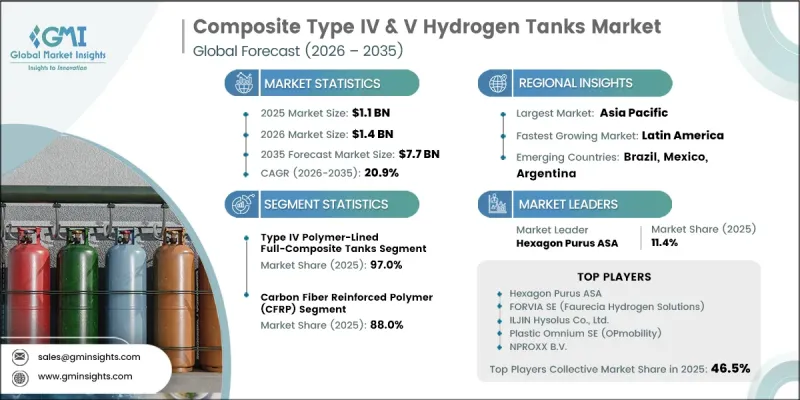
시장 확대는 수소 모빌리티가 개발 단계의 노력에서 상용화 프로그램으로 전환되고 있는 데 힘입고 있으며, 특히 경량이며 대용량의 저장 솔루션이 필요한 운송 분야에서 두드러집니다. 대형 연료전지 모빌리티에 대한 수요 증가, 수소 인프라 구축의 진전, 그리고 복합재료 기술의 발전이 타입 IV 및 타입 V 수소 탱크에 큰 비즈니스 기회를 창출하고 있습니다. 이러한 탱크는 경량 구조 덕분에 기존 금속 탱크에 비해 효율이 향상되어 그 중요성이 커지고 있습니다. 주행 거리 연장, 차량 중량 경감, 저장 성능 향상에 대한 수요가 높아짐에 따라 수소를 동력원으로 하는 전체 운송 플랫폼에서의 채택이 가속화되고 있습니다. 수소 경제가 지속적으로 성숙해감에 따라 각 제조사들은 미래 모빌리티 시스템에서 높아지는 요구 사항을 충족하기 위해 첨단 복합재료 설계, 확장 가능한 생산 능력, 그리고 재료 기술 향상에 주력하고 있습니다.
| 시장 범위 | |
|---|---|
| 시작연도 | 2025년 |
| 예측 기간 | 2026-2035년 |
| 초기 시장 규모 | 11억 달러 |
| 예측액 | 77억 달러 |
| CAGR | 20.9% |
타입 IV 폴리머 라이닝이 적용된 풀 복합재 수소 탱크 부문은 2025년에 97%의 점유율을 차지하며, 2026-2035년 연평균 성장률(CAGR) 18.1%로 성장할 것으로 전망됩니다. 이 부문은 기존 탱크 설계에 비해 경량화, 고압 저장 능력 및 효율 향상을 실현할 수 있으며, 압도적인 입지를 유지하고 있습니다. 인증 기준, 제조 공정 및 공급망 개발의 진전이 타입 IV 탱크 기술의 상업적 보급을 지원하고 있습니다. 복합재료, 라이너 제조, 와인딩 장비 및 관련 부품을 다루는 전문 공급업체의 증가로 대규모 생산의 실현 가능성이 높아지고 있습니다.
탄소섬유 강화 플라스틱(CFRP) 부문은 2025년에 88%의 점유율을 차지하고 있으며, 2035년까지 연평균 성장률(CAGR) 20.1%로 성장할 것으로 예측됩니다. CFRP는 높은 강도 대 중량비와 고압 수소 저장 용도에 대응할 수 있는 능력 덕분에 여전히 선호되는 보강 재료로 자리 잡고 있습니다. 이 소재는 첨단 타입 IV 및 타입 V 수소 탱크 시스템에 필요한 구조적 성능을 제공하므로, 경량 저장 솔루션 개발에 있으며, 필수적인 구성 요소로 자리 잡고 있습니다. 섬유 제조 분야의 지속적인 혁신과 비용 최적화를 통해 수소 모빌리티 용도 전반에 걸친 CFRP의 채택이 더욱 촉진될 것으로 예상됩니다.
북미의 복합재제 타입 IV 및 V 수소 탱크 시장은 2025년에 17.2%의 점유율을 차지하며 연평균 성장률(CAGR) 20.7%로 성장할 것으로 추정됩니다. 이 지역의 성장은 수소 인프라에 대한 투자 확대, 청정 운송을 지원하는 노력, 그리고 연료전지차 기술에 대한 수요 증가에 의해 주도되고 있습니다. 정부의 자금 지원 프로그램 및 인프라 구축 노력에 힘입어 수소 충전 네트워크의 확장이 촉진되고, 수소를 동력원으로 하는 운송 수단의 상용화가 지원되고 있습니다. 제로 배출 모빌리티 솔루션에 대한 투자 증가로 인해 이 지역의 첨단 복합재료 수소 저장 시스템에 대한 수요가 더욱 높아질 것으로 예상됩니다.
자주 묻는 질문
목차
제1장 조사 방법과 범위
제2장 개요
제3장 업계 인사이트
제4장 경쟁 구도
제5장 시장 추산·예측 : 탱크 타입별, 2022-2035년
제6장 시장 추산·예측 : 섬유 보강 재료별, 2022-2035년
제7장 시장 추산·예측 : 압력 레이팅별, 2022-2035년
제8장 시장 추산·예측 : 용도별, 2022-2035년
제9장 시장 추산·예측 : 지역별, 2022-2035년
제10장 기업 개요
KSA 26.07.31The Global Composite Type IV & V Hydrogen Tanks Market was valued at USD 1.1 billion in 2025 and is estimated to grow at a CAGR of 20.90% to reach USD 7.7 billion by 2035.
Market expansion is supported by the transition of hydrogen mobility from development-stage initiatives into commercial deployment programs, particularly across transportation applications requiring lightweight and high-capacity storage solutions. Rising demand for heavy-duty fuel-cell mobility, growing hydrogen infrastructure development, and advancements in composite material technologies are creating strong opportunities for Type IV and Type V hydrogen tanks. These tanks are gaining importance because their lightweight construction provides improved efficiency compared with conventional metal-based alternatives. The increasing need for higher driving range, reduced vehicle weight, and improved storage performance is accelerating adoption across hydrogen-powered transportation platforms. As the hydrogen economy continues to mature, manufacturers are focusing on advanced composite designs, scalable production capabilities, and improved material technologies to meet the growing requirements of future mobility systems.
| Market Scope | |
|---|---|
| Start Year | 2025 |
| Forecast Year | 2026-2035 |
| Start Value | $1.1 Billion |
| Forecast Value | $7.7 Billion |
| CAGR | 20.9% |
Type IV polymer-lined full-composite hydrogen tanks segment accounted for 97% share in 2025 and is expected to grow at a CAGR of 18.1% during 2026-2035. The segment maintains a dominant position due to its ability to deliver lightweight performance, high-pressure storage capability, and improved efficiency compared with traditional tank designs. Advancements in qualification standards, manufacturing processes, and supply chain development are supporting wider commercial adoption of Type IV tank technologies. The increasing availability of specialized suppliers across composite materials, liner production, winding equipment, and related components is strengthening the feasibility of large-scale manufacturing.
The carbon fiber reinforced polymer (CFRP) segment held 88% share in 2025 and is projected to grow at a CAGR of 20.1% through 2035. CFRP remains the preferred reinforcement material because of its high strength-to-weight ratio and ability to support high-pressure hydrogen storage applications. The material provides the structural performance required for advanced Type IV and Type V hydrogen tank systems, making it a critical component in the development of lightweight storage solutions. Continued innovation in fiber manufacturing and cost optimization is expected to further support CFRP adoption across hydrogen mobility applications.
North America Composite Type IV & V Hydrogen Tanks Market held 17.2% share in 2025 and is estimated to grow at a CAGR of 20.7%. Growth in the region is being driven by increasing investment in hydrogen infrastructure, supportive clean transportation initiatives, and expanding demand for fuel-cell vehicle technologies. Government funding programs and infrastructure development efforts are encouraging the deployment of hydrogen refueling networks and supporting the commercialization of hydrogen-powered transportation. Rising investment in zero-emission mobility solutions is expected to strengthen regional demand for advanced composite hydrogen storage systems.
Major companies operating in the global composite Type IV & V hydrogen tanks industry include Hexagon Purus ASA, FORVIA SE (Faurecia Hydrogen Solutions), ILJIN Hysolus Co., Ltd., Plastic Omnium SE (OPmobility), NPROXX B.V., Worthington Enterprises, Inc., Luxfer Holdings PLC, and Faber Industrie S.p.A. Companies operating in the composite Type IV & V hydrogen tanks market are strengthening their competitive position through investments in advanced composite technologies, manufacturing expansion, and strategic partnerships across the hydrogen value chain. Market participants are focusing on improving production efficiency, reducing manufacturing costs, and enhancing tank performance to support large-scale adoption. Businesses are also investing in research and development programs to improve lightweight designs, durability, and safety characteristics. Expanding production facilities, strengthening supplier networks, and developing customized solutions for different mobility applications are helping companies increase market reach.
Table of Contents
Chapter 1 Methodology & Scope
- 1.1 Market scope and definition
- 1.2 Research design
- 1.2.1 Research approach
- 1.2.2 Data collection methods
- 1.3 Data mining sources
- 1.3.1 Global
- 1.3.2 Regional/Country
- 1.4 Base estimates and calculations
- 1.4.1 Base year calculation
- 1.4.2 Key trends for market estimation
- 1.5 Primary research and validation
- 1.5.1 Primary sources
- 1.6 Forecast model
- 1.7 Research assumptions and limitations
Chapter 2 Executive Summary
- 2.1 Industry 360° synopsis
- 2.2 Key market trends
- 2.2.1 Tank Type
- 2.2.2 Fiber Reinforcement Material
- 2.2.3 Pressure Rating
- 2.2.4 Application
- 2.2.5 Regional
- 2.3 TAM Analysis, 2026-2035
- 2.4 CXO perspectives: Strategic imperatives
- 2.5 Future outlook and strategic recommendations
Chapter 3 Industry Insights
- 3.1 Industry ecosystem analysis
- 3.1.1 Supplier landscape
- 3.1.2 Profit margin
- 3.1.3 Value addition at each stage
- 3.1.4 Factor affecting the value chain
- 3.1.5 Disruptions
- 3.2 Industry impact forces
- 3.2.1 Growth drivers
- 3.2.1.1 Rising adoption of hydrogen mobility
- 3.2.1.2 Growing investments in hydrogen infrastructure
- 3.2.1.3 Demand for lightweight storage solutions
- 3.2.2 Industry pitfalls and challenges
- 3.2.2.1 High manufacturing and material costs
- 3.2.2.2 Limited hydrogen refueling availability
- 3.2.3 Market opportunities
- 3.2.3.1 Expansion of green hydrogen projects
- 3.2.3.2 Increasing industrial hydrogen utilization
- 3.2.3.3 Advancements in composite material technologies
- 3.2.1 Growth drivers
- 3.3 Growth potential analysis
- 3.4 Regulatory landscape
- 3.4.1 North America
- 3.4.2 Europe
- 3.4.3 Asia Pacific
- 3.4.4 Latin America
- 3.4.5 Middle East & Africa
- 3.5 Porter's analysis
- 3.6 PESTEL analysis
- 3.7 Technology and innovation landscape
- 3.7.1 Current technological trends
- 3.7.2 Emerging technologies
- 3.8 Price trends
- 3.8.1 By region
- 3.8.2 By Tank Type
- 3.9 Future market trends
- 3.10 Patent landscape
- 3.11 Trade statistics (HS code)
- 3.11.1 Major importing countries
- 3.11.2 Major exporting countries
- 3.12 Sustainability and environmental aspects
- 3.12.1 Sustainable practices
- 3.12.2 Waste reduction strategies
- 3.12.3 Energy efficiency in production
- 3.12.4 Eco-friendly initiatives
- 3.13 Carbon footprint consideration
Chapter 4 Competitive Landscape, 2025
- 4.1 Introduction
- 4.2 Company market share analysis
- 4.2.1 By region
- 4.2.1.1 North America
- 4.2.1.2 Europe
- 4.2.1.3 Asia Pacific
- 4.2.1.4 LATAM
- 4.2.1.5 MEA
- 4.2.1 By region
- 4.3 Company matrix analysis
- 4.4 Competitive analysis of major market players
- 4.5 Competitive positioning matrix
- 4.6 Key developments
- 4.6.1 Mergers & acquisitions
- 4.6.2 Partnerships & collaborations
- 4.6.3 New product launches
- 4.6.4 Expansion plans
Chapter 5 Market Estimates and Forecast, By Tank Type, 2022-2035 (USD Million) (Kilo Tons)
- 5.1 Key trends
- 5.2 Type IV - Polymer-Lined Full Composite
- 5.3 Type V - Linerless Full Composite
Chapter 6 Market Estimates and Forecast, By Fiber Reinforcement Material, 2022-2035 (USD Million) (Kilo Tons)
- 6.1 Key trends
- 6.2 Carbon Fiber Reinforced Polymer (CFRP)
- 6.3 Glass Fiber Reinforced Polymer (GFRP)
- 6.4 Hybrid Fiber Composite (Carbon + Glass)
Chapter 7 Market Estimates and Forecast, By Pressure Rating, 2022-2035 (USD Million) (Kilo Tons)
- 7.1 Key trends
- 7.2 350 bar
- 7.3 700 bar
- 7.4 Above 700 bar
Chapter 8 Market Estimates and Forecast, By Application, 2022-2035 (USD Million) (Kilo Tons)
- 8.1 Key trends
- 8.2 Automotive - Passenger Cars & Light Commercial Vehicles
- 8.3 Heavy-Duty Vehicles & Commercial Transport
- 8.4 Hydrogen Refueling Stations (HRS)
- 8.5 Stationary Energy Storage
- 8.6 Marine
- 8.7 Aerospace & Aviation
- 8.8 Rail
- 8.9 Others
Chapter 9 Market Estimates and Forecast, By Region, 2022-2035 (USD Million) (Kilo Tons)
- 9.1 Key trends
- 9.2 North America
- 9.2.1 U.S.
- 9.2.2 Canada
- 9.3 Europe
- 9.3.1 Germany
- 9.3.2 UK
- 9.3.3 France
- 9.3.4 Spain
- 9.3.5 Italy
- 9.3.6 Rest of Europe
- 9.4 Asia Pacific
- 9.4.1 China
- 9.4.2 India
- 9.4.3 Japan
- 9.4.4 Australia
- 9.4.5 South Korea
- 9.4.6 Rest of Asia Pacific
- 9.5 Latin America
- 9.5.1 Brazil
- 9.5.2 Mexico
- 9.5.3 Argentina
- 9.5.4 Rest of Latin America
- 9.6 Middle East and Africa
- 9.6.1 Saudi Arabia
- 9.6.2 South Africa
- 9.6.3 UAE
- 9.6.4 Rest of Middle East and Africa
Chapter 10 Company Profiles
- 10.1 Hexagon Purus ASA
- 10.2 FORVIA SE (Faurecia Hydrogen Solutions)
- 10.3 ILJIN Hysolus Co., Ltd.
- 10.4 Plastic Omnium SE (OPmobility)
- 10.5 NPROXX B.V.
- 10.6 Worthington Enterprises, Inc.
- 10.7 Luxfer Holdings PLC
- 10.8 Faber Industrie S.p.A.
- 10.9 Jiangsu Guofu Hydrogen Energy Equipment
- 10.10 Toyota Motor Corporation
- 10.11 Infinite Composites Technologies, Inc.
- 10.12 Quantum Fuel Systems LLC


