

|
시장보고서
상품코드
2101567
RNA 간섭(RNAi) 작물 살포제 시장 : 시장 기회, 성장 촉진요인, 업계 동향 분석 및 예측(2026-2035년)RNA Interference (RNAi) Crop Sprays Market Opportunity, Growth Drivers, Industry Trend Analysis, and Forecast 2026 - 2035 |
||||||

세계의 RNA 간섭(RNAi) 작물 살포제 시장은 2025년에 2억 4,800만 달러 규모에 달하고, 2035년까지 CAGR 28.3%로 성장하여 29억 달러에 달할 것으로 예측됩니다.
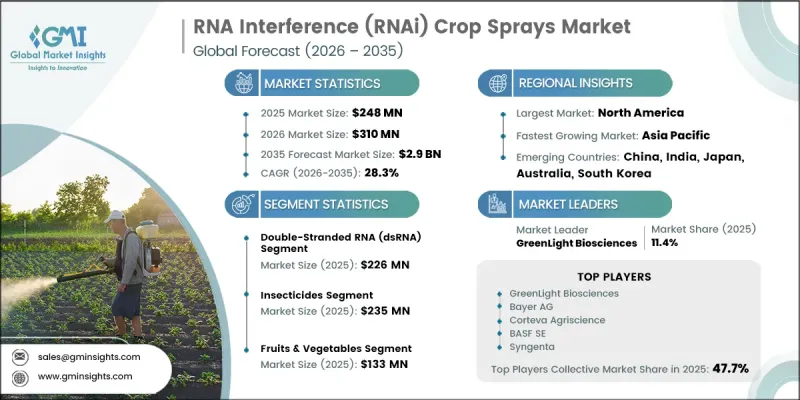
농업이 기존의 화학 농약에 대한 의존도를 줄이면서 해충과 질병을 표적으로 한 관리가 가능한 정밀 작물 보호 기술로 점점 더 전환됨에 따라, RNA 간섭(RNAi) 농약·살포제 시장은 성장세를 보이고 있습니다. RNAi 작물용 살포제는 이중가닥 RNA(dsRNA) 분자를 이용하여 성장, 번식 또는 생존에 필수적인 유전자를 억제하는 자연적인 생물학적 과정을 활성화함으로써 특정 해충, 병원체 또는 잡초의 유전자 발현을 조절합니다. 기존의 작물 보호 제품과 달리, 이러한 솔루션은 유익한 생물이나 주변 환경에 미치는 영향을 최소화하면서 표적 생물에게 선택적으로 작용하도록 설계되었습니다. 기존의 엽면 살포 방식으로 시용되면, RNA 분자는 처리된 식물과 접촉한 후 표적 생물에 흡수되어 그 세포 내에서 유전자 침묵이 시작됩니다. 농업 생산자들이 생태계에 미치는 영향을 줄이면서 작물 보호를 향상시키는 지속가능하고 환경 친화적인 솔루션을 추구하는 가운데, 이 매우 정밀한 생물학적 메커니즘이 더 광범위한 채택을 뒷받침하고 있습니다. RNA 전달 기술의 지속적인 혁신과 정밀 농업에 대한 이해가 깊어짐에 따라, 전 세계 RNA 간섭(RNAi) 농약 및 스프레이 시장의 성장이 더욱 가속화될 것으로 예상됩니다.
| 시장 범위 | |
|---|---|
| 시작 연도 | 2025년 |
| 예측 기간 | 2026-2035년 |
| 초기 시장 규모 | 2억 4,800만 달러 |
| 예측액 | 29억 달러 |
| CAGR | 28.3% |
이중가닥 RNA(dsRNA) 부문은 2025년에 2억 2,600만 달러의 매출을 기록했습니다. 이 시장에서는 유전자 침묵 작용을 효과적으로 발휘할 수 있다는 점에서, 계속해서 dsRNA 및 소간섭 RNA(siRNA) 기술이 주축을 이루고 있습니다. 이중가닥 RNA는 그 폭넓은 적용성과 여러 표적 생물에 걸친 우수한 생물학적 성능 덕분에 여전히 주요 기술로서의 지위를 유지하고 있습니다. 한편, 더 높은 표적 정확도가 요구되는 용도에서는 siRNA가 주목받고 있으며, 또한 장기적인 유전자 억제를 실현하기 위해 설계된 제어된 전달 시스템에서는 shRNA에 대한 관심도 점차 높아지고 있습니다.
2025년, 과일·채소 부문의 시장 규모는 1억 3,300만 달러를 기록했습니다. 작물의 품질 유지와 해충 피해 최소화가 최우선 과제인 고부가가치 원예 작물 분야에서 RNAi 기술의 도입은 여전히 가장 활발하게 이루어지고 있습니다. 엄격한 품질 요건과 효과적인 해충 관리의 필요성으로 인해, 과일·채소 생산 전반에 걸쳐 표적화된 생물학적 작물 보호에 대한 수요는 계속해서 증가하고 있습니다. 한편, 곡물·곡류 분야에서는 대규모 재배 지역에 적합하고 확장성이 있으며 경제적으로 실현 가능한 작물 보호 솔루션을 찾는 생산자가 늘어남에 따라 RNAi 기술의 도입이 점차 확대되고 있습니다.
북미의 RNA 간섭(RNAi) 작물 살포제 시장은 2025년 1억 5,800만 달러에서 2035년까지 6억 1,400만 달러로 확대될 것으로 예측되며, 이는 예측 기간 동안 해당 지역에서 강력한 성장이 예상됨을 반영합니다. 이러한 시장 확대는 농업 생명공학에 대한 지속적인 투자, 활발한 연구 활동, 그리고 지속가능한 농업 기법의 보급에 힘입고 있습니다. 생명공학 기업과 농업 생산자 간의 협력을 통해 상품화 노력이 진행되고 있을 뿐만 아니라, 정밀 작물 보호 기술에 대한 관심이 높아지면서 지역 전체의 시장 확산을 뒷받침하고 있습니다.
자주 묻는 질문
목차
제1장 조사 방법과 범위
제2장 주요 요약
제3장 업계 인사이트
제4장 경쟁 구도
제5장 시장 추정 및 예측 : RNA 기술별, 2022-2035년
제6장 시장 추정 및 예측 : 대상 해충별, 2022-2035년
제7장 시장 추정 및 예측 : 작물 유형별, 2022-2035년
제8장 시장 추정 및 예측 : 지역별, 2022-2035년
제9장 기업 개요
KSM 26.08.04The Global RNA Interference (RNAi) Crop Sprays Market was valued at USD 248 million in 2025 and is estimated to grow at a CAGR of 28.3% to reach USD 2.9 billion by 2035.
The RNA interference (RNAi) crop sprays market is gaining momentum as agriculture increasingly shifts toward precision crop protection technologies that offer targeted pest and disease management while reducing reliance on conventional chemical pesticides. RNAi crop sprays utilize double-stranded RNA (dsRNA) molecules to regulate gene expression in specific pests, pathogens, or weeds by activating a natural biological process that suppresses essential genes responsible for growth, reproduction, or survival. Unlike traditional crop protection products, these solutions are designed to selectively affect target organisms while minimizing the impact on beneficial species and the surrounding environment. Applied through conventional foliar spraying methods, the RNA molecules are absorbed by target organisms after contact with treated plants, initiating gene silencing within their cells. This highly precise biological mechanism is supporting broader adoption as agricultural producers seek sustainable, environmentally responsible solutions that improve crop protection while reducing ecological impact. Continuous innovation in RNA delivery technologies and growing acceptance of precision agriculture are expected to further accelerate expansion of the global RNA interference (RNAi) crop sprays market.
| Market Scope | |
|---|---|
| Start Year | 2025 |
| Forecast Year | 2026-2035 |
| Start Value | $248 Million |
| Forecast Value | $2.9 Billion |
| CAGR | 28.3% |
The double-stranded RNA (dsRNA) segment generated USD 226 million in 2025. The market continues to focus primarily on dsRNA and small interfering RNA (siRNA) technologies because of their effectiveness in delivering gene-silencing activity. Double-stranded RNA remains the leading technology due to its broad applicability and strong biological performance across multiple target organisms. At the same time, small interfering RNA is gaining attention for applications requiring greater targeting precision, while short hairpin RNA (shRNA) is gradually attracting interest for controlled delivery systems designed to achieve extended gene suppression.
The fruits and vegetables segment accounted for USD 133 million in 2025. Adoption remains strongest within high-value horticultural crops where maintaining crop quality and minimizing pest damage are critical priorities. Demand for targeted biological crop protection continues to rise across fruit and vegetable production because of stringent quality requirements and the need for effective pest management. Meanwhile, cereals and grains are gradually adopting RNAi technologies as growers seek scalable and economically viable crop protection solutions suitable for large cultivation areas.
North America RNA Interference (RNAi) Crop Sprays Market is projected to increase from USD 158 million in 2025 to USD 614 million by 2035, reflecting strong regional growth throughout the forecast period. Market expansion is supported by continued investment in agricultural biotechnology, increasing research activities, and growing adoption of sustainable farming practices. Commercialization efforts continue to advance through collaboration between biotechnology companies and agricultural producers, while increasing interest in precision crop protection technologies is supporting broader market adoption across the region.
Major companies operating in the RNA interference (RNAi) crop sprays market include Bayer AG, BASF SE, Syngenta Group, Corteva Agriscience, GreenLight Biosciences, Pebble Labs, Invaio Sciences, RNAissance Ag, SenseUP Biosciences, and Agriterna. Companies operating in the RNA interference (RNAi) crop sprays market are strengthening their market position by investing heavily in research and development, advanced RNA delivery technologies, and next-generation biological crop protection solutions. Industry participants are expanding strategic collaborations with biotechnology firms, research institutions, and agricultural organizations to accelerate product development and commercialization. Companies are also focusing on improving formulation stability, delivery efficiency, and target specificity to enhance field performance and broaden application across multiple crop types. Investments in regulatory approvals, manufacturing capabilities, and global distribution networks are further supporting market expansion.
Table of Contents
Chapter 1 Methodology & Scope
- 1.1 Market scope and definition
- 1.2 Research design
- 1.2.1 Research approach
- 1.2.2 Data collection methods
- 1.3 Data mining sources
- 1.3.1 Global
- 1.3.2 Regional/Country
- 1.4 Base estimates and calculations
- 1.4.1 Base year calculation
- 1.4.2 Key trends for market estimation
- 1.5 Primary research and validation
- 1.5.1 Primary sources
- 1.6 Forecast model
- 1.7 Research assumptions and limitations
Chapter 2 Executive Summary
- 2.1 Industry 360° synopsis
- 2.2 Key market trends
- 2.2.1 RNA Technology
- 2.2.2 Target Pest
- 2.2.3 Crop Type
- 2.2.4 Regional
- 2.3 TAM Analysis, 2026-2035
- 2.4 CXO perspectives: Strategic imperatives
- 2.5 Future outlook and strategic recommendations
Chapter 3 Industry Insights
- 3.1 Industry ecosystem analysis
- 3.1.1 Supplier landscape
- 3.1.2 Profit margin
- 3.1.3 Value addition at each stage
- 3.1.4 Factor affecting the value chain
- 3.1.5 Disruptions
- 3.2 Industry impact forces
- 3.2.1 Growth drivers
- 3.2.1.1 Rising demand for sustainable pest control
- 3.2.1.2 Increasing restrictions on chemical pesticides
- 3.2.1.3 Growing focus on precision agriculture solutions
- 3.2.2 Industry pitfalls and challenges
- 3.2.2.1 Expansion in high-value crop segments
- 3.2.2.2 Advancements in RNA delivery technologies
- 3.2.3 Market opportunities
- 3.2.3.1 Stability issues under field conditions
- 3.2.3.2 High production and formulation costs
- 3.2.3.3 Regulatory uncertainties across regions
- 3.2.1 Growth drivers
- 3.3 Growth potential analysis
- 3.4 Regulatory landscape
- 3.4.1 North America
- 3.4.2 Europe
- 3.4.3 Asia Pacific
- 3.4.4 Latin America
- 3.4.5 Middle East & Africa
- 3.5 Porter's analysis
- 3.6 PESTEL analysis
- 3.7 Technology and innovation landscape
- 3.7.1 Current technological trends
- 3.7.2 Emerging technologies
- 3.8 Price trends
- 3.8.1 By region
- 3.8.2 By crop type
- 3.9 Future market trends
- 3.10 Patent landscape
- 3.11 Trade statistics (HS code)
- 3.11.1 Major importing countries
- 3.11.2 Major exporting countries
- 3.12 Sustainability and environmental aspects
- 3.12.1 Sustainable practices
- 3.12.2 Waste reduction strategies
- 3.12.3 Energy efficiency in production
- 3.12.4 Eco-friendly initiatives
- 3.13 Carbon footprint consideration
Chapter 4 Competitive Landscape, 2025
- 4.1 Introduction
- 4.2 Company market share analysis
- 4.2.1 By region
- 4.2.1.1 North America
- 4.2.1.2 Europe
- 4.2.1.3 Asia Pacific
- 4.2.1.4 LATAM
- 4.2.1.5 MEA
- 4.2.1 By region
- 4.3 Company matrix analysis
- 4.4 Competitive analysis of major market players
- 4.5 Competitive positioning matrix
- 4.6 Key developments
- 4.6.1 Mergers & acquisitions
- 4.6.2 Partnerships & collaborations
- 4.6.3 New product launches
- 4.6.4 Expansion plans
Chapter 5 Market Estimates and Forecast, By RNA Technology, 2022-2035 (USD Million) (Kilo Tons)
- 5.1 Key trends
- 5.2 dsRNA
- 5.3 siRNA
- 5.4 shRNA
- 5.5 miRNA & SIGS
- 5.6 Others
Chapter 6 Market Estimates and Forecast, By Target Pest, 2022-2035 (USD Million) (Kilo Tons)
- 6.1 Key trends
- 6.2 Insecticides
- 6.3 Fungicides
- 6.4 Herbicides
- 6.5 Virucides
Chapter 7 Market Estimates and Forecast, By Crop Type, 2022-2035 (USD Million) (Kilo Tons)
- 7.1 Key trends
- 7.2 Cereals & Grains
- 7.3 Fruits & Vegetables
- 7.4 Oilseeds & Pulses
- 7.5 Specialty & HV Crops
- 7.6 Others
Chapter 8 Market Estimates and Forecast, By Region, 2022-2035 (USD Million) (Kilo Tons)
- 8.1 Key trends
- 8.2 North America
- 8.2.1 U.S.
- 8.2.2 Canada
- 8.3 Europe
- 8.3.1 Germany
- 8.3.2 UK
- 8.3.3 France
- 8.3.4 Spain
- 8.3.5 Italy
- 8.3.6 Rest of Europe
- 8.4 Asia Pacific
- 8.4.1 China
- 8.4.2 India
- 8.4.3 Japan
- 8.4.4 Australia
- 8.4.5 South Korea
- 8.4.6 Rest of Asia Pacific
- 8.5 Latin America
- 8.5.1 Brazil
- 8.5.2 Mexico
- 8.5.3 Argentina
- 8.5.4 Rest of Latin America
- 8.6 Middle East and Africa
- 8.6.1 Saudi Arabia
- 8.6.2 South Africa
- 8.6.3 UAE
- 8.6.4 Rest of Middle East and Africa
Chapter 9 Company Profiles
- 9.1 GreenLight Biosciences
- 9.2 Bayer AG
- 9.3 Corteva Agriscience
- 9.4 BASF SE
- 9.5 Syngenta Group
- 9.6 Pebble Labs
- 9.7 Invaio Sciences
- 9.8 RNAissance Ag
- 9.9 SenseUP Biosciences
- 9.10 Agriterna


