|
시장보고서
상품코드
2101574
전기자동차용 배터리의 재활용 및 재료 회수 시장 기회, 성장요인, 업계 동향 분석 및 예측(2026-2035년)Electric Vehicle (EV) Battery Recycling and Material Recovery Market Opportunity, Growth Drivers, Industry Trend Analysis, and Forecast 2026 - 2035 |
||||||

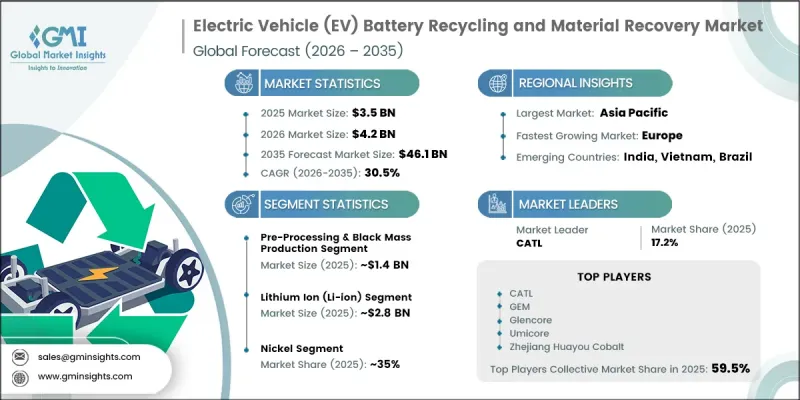
세계의 전기자동차용 배터리의 재활용 및 재료 회수 시장은 2025년에 35억 달러 규모에 달하며, 2035년까지 CAGR 30.5%로 성장하며, 461억 달러에 달할 것으로 추정되고 있습니다.
전 세계 전기자동차(EV)의 보급이 계속해서 가속화되고, 지속가능한 배터리 수명 주기 관리 솔루션에 대한 수요가 높아짐에 따라 전기자동차용 배터리 재활용 및 소재 회수 시장은 급속한 확장을 이루고 있습니다. 수명 주기가 끝나는 전기자동차 대수가 증가함에 따라 회수, 처리 및 소재 회수가 필요한 폐배터리가 대량으로 공급될 것으로 예상됩니다. 전기자동차용 배터리의 수명은 일반적으로 약 8년 12년이기 때문에 재활용 기업에게는 효율적인 회수 네트워크를 구축할 기회가 확대되고 있습니다. 배터리 핵심 소재의 공급 상황, 안보, 지속가능성에 대한 우려가 커지면서 재활용 기술 및 순환형 경제 솔루션에 대한 투자가 촉진되고 있습니다. 배터리 회수, 해체, 재활용 역량을 조기에 구축한 기업은 사용 후 배터리 공급 확대와 회수 소재에 대한 수요 증가로 인해 혜택을 볼 수 있는 위치에 있습니다. 전 세계에서 전기자동차(EV) 생산 규모가 계속 확대되는 가운데, 배터리 재활용 및 소재 회수 시스템은 지속가능한 교통 인프라의 필수 요소로 자리 잡고 있습니다.
| 시장 범위 | |
|---|---|
| 시작연도 | 2025년 |
| 예측 기간 | 2026-2035년 |
| 초기 시장 규모 | 35억 달러 |
| 예측액 | 461억 달러 |
| CAGR | 30.5% |
사용 후 전기자동차 배터리 처리량이 증가함에 따라 재활용 사업자들에게는 귀중한 자재를 회수하고 순환형 배터리 공급망 구축을 지원할 수 있는 큰 기회가 생겨나고 있습니다. 신규 채굴 원자재에 대한 의존도를 낮추려는 관심이 높아짐에 따라 첨단 재활용 인프라 및 회수 기술에 대한 투자가 촉진되고 있습니다. 사용 후 배터리의 수가 계속 증가하는 가운데, 효율적인 회수 네트워크, 처리 시설 및 소재 회수 역량을 확립한 조직은 향후 배터리 재활용 기회를 보다 확실하게 확보할 수 있을 것으로 전망됩니다.
전처리 및 블랙매스 생산 부문은 39.5%의 점유율을 차지하며, 2025년에는 14억 달러 규모의 시장을 기록했습니다. 이 부문의 주도적 위상은 재활용 경로로 유입되는 폐배터리 및 제조 폐기물의 양이 증가하고 있는 데 힘입은 것입니다. 이 단계에는 배터리 회수, 선별, 방전 관리, 해체, 파쇄 및 분리 공정이 포함되며, 이러한 공정을 통해 배터리 제조에 사용되는 귀중한 소재를 포함한 블랙매스가 생산됩니다.
리튬이온(Li-ion) 부문은 79.3%의 점유율을 차지하며, 2025년에는 28억 달러의 시장 규모에 도달할 것으로 전망됩니다. 리튬이온 배터리는 전기자동차를 비롯한 모빌리티 분야에서 널리 채택되고 있으며, 계속해서 가장 큰 배터리 카테고리로 자리매김하고 있습니다. 다양한 리튬이온 배터리의 화학 조성에는 효율적인 재활용 및 회수 공정이 필요한 귀중한 원소가 포함되어 있습니다. 전 세계 전기자동차 보급의 급속한 확대와 사용 후 관리가 필요한 리튬이온 배터리의 증가로 인해 배터리 필수 소재를 회수할 수 있는 재활용 기술에 대한 수요가 크게 증가하고 있습니다.
미국의 전기자동차용 배터리 재활용 및 소재 회수 시장은 2025년에 3억 2,080만 달러에 달했습니다. 국내 배터리 공급망을 지원하는 정부의 노력에 힘입어, 재활용 인프라 및 핵심 소재 회수 능력에 대한 투자가 지속적으로 촉진되고 있습니다. 국내 전기자동차 제조 활동의 확대와 배터리 생산 능력 증대에 따라 제조 폐기물 및 폐배터리 발생량이 증가하고 있으며, 이는 재활용 기업에게 확장 가능한 회수 사업을 운영할 수 있는 더 많은 기회를 제공하고 있습니다.
자주 묻는 질문
목차
제1장 조사 방법
제2장 개요
제3장 업계 인사이트
제4장 경쟁 구도
제5장 시장 추산·예측 : 재활용 프로세스별, 2026-2035년
제6장 시장 추산·예측 : 배터리 화학 조성별, 2026-2035년
제7장 시장 추산·예측 : 매트리얼·리커버리별, 2026-2035년
제8장 시장 추산·예측 : 배터리 유형별, 2026-2035년
제9장 시장 추산·예측 : 지역별, 2026-2035년
제10장 기업 개요
KSA 26.07.31The Global Electric Vehicle Battery Recycling and Material Recovery Market was valued at USD 3.5 billion in 2025 and is estimated to grow at a CAGR of 30.5% to reach USD 46.1 billion by 2035.
The electric vehicle battery recycling and material recovery market is experiencing rapid expansion as global EV adoption continues to accelerate and creates increasing demand for sustainable battery lifecycle management solutions. The rising number of electric vehicles reaching the end of their operational lifespan is expected to generate a significant supply of used batteries requiring collection, processing, and material recovery. EV batteries generally operate for approximately 8 to 12 years, creating a growing opportunity for recycling companies to establish efficient recovery networks. Increasing concerns regarding the availability, security, and sustainability of critical battery materials are encouraging investments in recycling technologies and circular economy solutions. Companies developing early capabilities in battery collection, dismantling, and recycling are positioned to benefit from the expanding availability of end-of-life batteries and increasing demand for recovered materials. As EV manufacturing continues to scale globally, battery recycling and material recovery systems are becoming essential components of sustainable transportation infrastructure.
| Market Scope | |
|---|---|
| Start Year | 2025 |
| Forecast Year | 2026-2035 |
| Start Value | $3.5 Billion |
| Forecast Value | $46.1 Billion |
| CAGR | 30.5% |
The growing volume of retired electric vehicle batteries is creating significant opportunities for recyclers to recover valuable materials and support the development of a circular battery supply chain. Increasing focus on reducing dependence on newly extracted raw materials is encouraging investments in advanced recycling infrastructure and recovery technologies. Organizations that establish efficient collection networks, processing facilities, and material recovery capabilities are expected to gain stronger access to future battery recycling opportunities as the number of end-of-life batteries continues to rise.
The preprocessing and black mass production segment accounted for 39.5% share, generating USD 1.4 billion in 2025. The segment's leading position is supported by the growing volume of end-of-life batteries and manufacturing waste entering recycling channels. This stage includes battery collection, sorting, discharge management, dismantling, shredding, and separation processes that produce black mass containing valuable materials used in battery manufacturing.
The lithium-ion (Li-ion) segment held 79.3% share, generating USD 2.8 billion in 2025. Lithium-ion batteries continue to represent the largest battery category due to their extensive adoption across electric mobility applications. Different lithium-ion chemistries contain valuable elements that require efficient recycling and recovery processes. The rapid expansion of EV adoption worldwide and the increasing number of lithium-ion batteries requiring end-of-life management are driving strong demand for recycling technologies capable of recovering essential battery materials.
U.S. Electric Vehicle Battery Recycling and Material Recovery Market reached USD 320.8 million in 2025. Government initiatives supporting domestic battery supply chains continue to encourage investment in recycling infrastructure and critical material recovery capabilities. Expanding electric vehicle manufacturing activities and increasing battery production capacity within the country are generating greater volumes of manufacturing waste and used batteries, creating additional opportunities for recycling companies to develop scalable recovery operations.
Key companies operating in the global electric vehicle battery recycling and material recovery market include Redwood Materials, CATL, Umicore, Ecobat, GEM, Fortum, Cylib, Zhejiang Huayou Cobalt, Glencore, and LOHUM Cleantech. Companies operating in the electric vehicle battery recycling and material recovery market are strengthening their competitive positions by expanding recycling capacity, improving material recovery technologies, and developing integrated battery lifecycle solutions. Market participants are investing in advanced processing methods to increase recovery efficiency and improve access to valuable battery materials. Strategic partnerships with automakers, battery manufacturers, and supply chain participants are helping companies secure feedstock sources and expand operational capabilities. Businesses are also focusing on regional recycling facilities, technology innovation, and closed-loop battery solutions to support sustainable material supply chains.
Table of Contents
Chapter 1 Methodology
- 1.1 Research approach
- 1.2 Quality Commitments
- 1.2.1 GMI AI policy & data integrity commitment
- 1.3 Research Trail & Confidence Scoring
- 1.3.1 Research Trail Components
- 1.3.2 Scoring Components
- 1.4 Data Collection
- 1.5 Data mining sources
- 1.5.1 Paid sources
- 1.6 Base estimates and calculations
- 1.6.1 Base year calculation
- 1.7 Forecast model
- 1.7.1 Quantified market impact analysis
- 1.8 Research transparency addendum
- 1.8.1 Source attribution framework
- 1.8.2 Quality assurance metrics
- 1.8.3 Our commitment to trust
Chapter 2 Executive Summary
- 2.1 Industry 360° synopsis
- 2.2 Key market trends
- 2.2.1 Regional
- 2.2.2 Recycling Process
- 2.2.3 Battery Chemistry
- 2.2.4 Material Recovery
- 2.2.5 Battery Source
- 2.3 TAM analysis, 2026-2035
- 2.4 CXO perspectives: Strategic imperatives
Chapter 3 Industry Insights
- 3.1 Industry ecosystem analysis
- 3.1.1 Supplier landscape
- 3.1.2 Profit margin
- 3.1.3 Cost structure
- 3.1.4 Value addition at each stage
- 3.1.5 Factor affecting the value chain
- 3.1.6 Disruptions
- 3.2 Industry impact forces
- 3.2.1 Growth drivers
- 3.2.1.1 Accelerating EV Adoption & Imminent End-of-Life Battery Wave
- 3.2.1.2 Critical Mineral Supply Security Imperatives & Domestic Content Mandates
- 3.2.1.3 Stringent Regulatory Mandates
- 3.2.1.4 Closed-Loop Battery Supply Chain Commitments by Automotive OEMs
- 3.2.2 Industry pitfalls and challenges
- 3.2.2.1 High Pre-Processing & Logistics Costs Suppressing Recycling Economics
- 3.2.2.2 Cobalt & Lithium Price Volatility Eroding Recycler Margin Predictability
- 3.2.3 Market opportunities
- 3.2.3.1 Gigafactory-Scale Recycling Facilities Driving Unit Cost Reduction
- 3.2.3.2 Black Mass as a Tradable Commodity
- 3.2.3.3 Second-Life Battery Integration Prior to Recycling Extending Revenue Lifecycle
- 3.2.1 Growth drivers
- 3.3 Technology and innovation landscape
- 3.3.1 Current technological trends
- 3.3.1.1 Pyrometallurgical smelting
- 3.3.1.2 Hydrometallurgical leaching
- 3.3.1.3 Direct recycling
- 3.3.2 Emerging technologies
- 3.3.2.1 Direct cathode regeneration at scale
- 3.3.2.2 Electrochemical recovery systems
- 3.3.1 Current technological trends
- 3.4 Growth potential analysis
- 3.5 Regulatory landscape
- 3.5.1 North America
- 3.5.1.1 U.S. Environmental Protection Agency
- 3.5.1.2 EPA Universal Waste Regulations
- 3.5.1.3 Canadian Environmental Protection Act (CEPA)
- 3.5.2 Europe
- 3.5.2.1 EU Regulation 2023/1542
- 3.5.2.2 UK Waste Batteries and Accumulators Regulations
- 3.5.3 Asia Pacific
- 3.5.3.1 Ministry of Industry and Information Technology (MIIT)
- 3.5.3.2 National Waste Policy Action Plan Australia
- 3.5.4 LATAM
- 3.5.4.1 Colombia National Electric Mobility Strategy (ENME)
- 3.5.4.2 Brazil National Solid Waste Policy
- 3.5.5 MEA
- 3.5.5.1 Saudi National Center for Waste Management (MWAN)
- 3.5.5.2 South Africa Waste Act (NEMWA)
- 3.5.1 North America
- 3.6 Porter's analysis
- 3.7 PESTEL analysis
- 3.8 Cost breakdown analysis
- 3.9 Patent analysis (Driven by Primary Research)
- 3.10 Sustainability and environmental aspects
- 3.10.1 Sustainable Practices
- 3.10.2 Waste Reduction Strategies
- 3.10.3 Energy Efficiency in Production
- 3.10.4 Eco-friendly Initiatives
- 3.10.5 Carbon Footprint Considerations
- 3.11 Impact of AI & generative AI on the market
- 3.11.1 AI-driven disruption of existing business models
- 3.11.2 GenAI use cases & adoption roadmap by segment
- 3.11.3 Risks, limitations & regulatory considerations
- 3.12 Downstream Dependency on Refining & Smelting Capacity
- 3.13 Battery Collection Efficiency & Loss Rates in the System
- 3.14 Forecast assumptions & scenario analysis (Driven by Primary Research)
- 3.14.1 Base Case - Key Macro & Industry Variables Driving CAGR
- 3.14.2 Optimistic Scenarios - Favorable macro and industry tailwinds
- 3.14.3 Pessimistic Scenario - Macroeconomic slowdown or industry headwinds
Chapter 4 Competitive Landscape, 2025
- 4.1 Introduction
- 4.2 Company market share analysis
- 4.2.1 North America
- 4.2.2 Europe
- 4.2.3 Asia Pacific
- 4.2.4 LATAM
- 4.2.5 MEA
- 4.3 Competitive analysis of major market players
- 4.4 Competitive positioning matrix
- 4.5 Key developments
- 4.5.1 Mergers & acquisitions
- 4.5.2 Partnerships & collaborations
- 4.5.3 New product launches
- 4.5.4 Expansion plans and funding
- 4.6 Company tier benchmarking
- 4.6.1 Tier classification criteria & qualifying thresholds
- 4.6.2 Tier positioning matrix by revenue, geography & innovation
Chapter 5 Market Estimates and Forecast, By Recycling Process, 2026 - 2035 ($ Mn, Metric Tons)
- 5.1 Key trends
- 5.2 Hydrometallurgical
- 5.3 Pyrometallurgical
- 5.4 Direct Recycling
- 5.5 Pre-Processing & Black Mass Production
Chapter 6 Market Estimates and Forecast, By Battery Chemistry, 2026 - 2035 ($ Mn, Metric Tons)
- 6.1 Key trends
- 6.2 Lithium-Ion (Li-ion)
- 6.2.1 NMC (Nickel Manganese Cobalt)
- 6.2.2 LFP (Lithium Iron Phosphate)
- 6.2.3 Others
- 6.3 Nickel-Metal Hydride (NiMH)
- 6.4 Lead-Acid
- 6.5 Others
Chapter 7 Market Estimates and Forecast, By Material Recovery, 2026 - 2035 ($ Mn, Metric Tons)
- 7.1 Key trends
- 7.2 Lithium
- 7.3 Cobalt
- 7.4 Nickel
- 7.5 Manganese
- 7.6 Copper
- 7.7 Others
Chapter 8 Market Estimates and Forecast, By Battery Source, 2026 - 2035 ($ Mn, Metric Tons)
- 8.1 Key trends
- 8.2 End-of-Life (EoL) EV Batteries
- 8.3 Manufacturing Scrap (Gigafactory Waste)
- 8.4 Defective & Recalled Batteries
Chapter 9 Market Estimates & Forecast, By Region, 2026 - 2035 ($ Mn, Metric Tons)
- 9.1 Key trends
- 9.2 North America
- 9.2.1 US
- 9.2.2 Canada
- 9.3 Europe
- 9.3.1 Germany
- 9.3.2 UK
- 9.3.3 France
- 9.3.4 Italy
- 9.3.5 Spain
- 9.3.6 Netherlands
- 9.3.7 Sweden
- 9.3.8 Norway
- 9.4 Asia Pacific
- 9.4.1 China
- 9.4.2 India
- 9.4.3 Japan
- 9.4.4 South Korea
- 9.4.5 Australia
- 9.4.6 Indonesia
- 9.4.7 Thailand
- 9.4.8 Vietnam
- 9.4.9 Malaysia
- 9.5 Latin America
- 9.5.1 Brazil
- 9.5.2 Mexico
- 9.5.3 Chile
- 9.5.4 Argentina
- 9.6 MEA
- 9.6.1 UAE
- 9.6.2 Saudi Arabia
- 9.6.3 South Africa
Chapter 10 Company Profiles
- 10.1 Global players
- 10.1.1 Umicore
- 10.1.2 Glencore
- 10.1.3 Redwood Materials
- 10.1.4 CATL
- 10.1.5 GEM
- 10.1.6 Ecobat
- 10.1.7 Cirba Solutions
- 10.1.8 Fortum
- 10.1.9 American Battery Technology Company (ABTC)
- 10.1.10 Veolia
- 10.2 Regional players
- 10.2.1 Accurec-Recycling
- 10.2.2 SNAM Groupe
- 10.2.3 Gravita India
- 10.2.4 SK Tes
- 10.2.5 Stena Recycling
- 10.2.6 Zhejiang Huayou Cobalt
- 10.2.7 LOHUM Cleantech
- 10.3 Emerging players
- 10.3.1 Aqua Metals
- 10.3.2 Cylib
- 10.3.3 Green Li-ion Pte. Ltd.