

|
시장보고서
상품코드
2101576
글리포세이트 합성용 삼염화인 시장 기회, 성장요인, 업계 동향 분석 및 예측(2026-2035년)Phosphorus Trichloride (PCl3) for Glyphosate Synthesis Market Opportunity, Growth Drivers, Industry Trend Analysis, and Forecast 2026 - 2035 |
||||||

세계의 글리포세이트 합성용 삼염화인 시장 규모는 2025년에 7억 2,010만 달러로 평가되고 CAGR 4.5%로 확대하며, 2035년까지 11억 달러에 달할 것으로 예측됩니다.
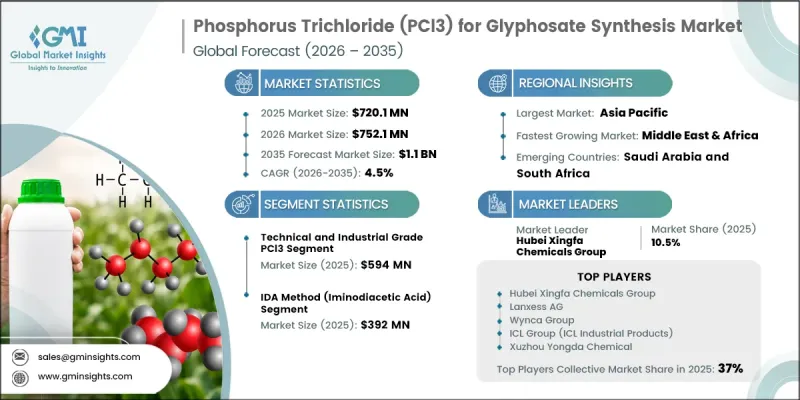
글리포세이트 합성용 삼염화인 시장은 글리포세이트 제조 공정에서 주요 중간체로서 PCl3가 수행하는 필수적인 역할 덕분에 계속해서 혜택을 받고 있습니다. 이 화합물은 유효 성분을 제조하는 데 사용되는 주요 제조 경로에서 쉽게 대체될 수 없기 때문에 수요는 전 세계 글리포세이트 생산량과 계속해서 밀접한 관련을 맺고 있습니다. 농업 활동의 확대와 현대적인 작물 생산 기법의 보급에 힘입어 제초제 소비량이 증가하면서 시장 성장을 지속적으로 견인하고 있습니다. 개발도상국에서의 경작지 확대와 작물 보호 제품 사용 증가는 글리포세이트 생산량 증가에 더욱 기여하고 있으며, 이는 PCl3 소비를 직접적으로 지원하고 있습니다. 주요 합성 경로를 통해 생산되는 글리포세이트 1톤당 중간체로 삼염화인(PCl3)이 필요하므로 시장 수요는 글리포세이트 생산량에 비례하여 계속 증가하고 있습니다. 주요 생산 지역의 안정적인 생산 능력과 농업 생산성에 대한 지속적인 투자가 맞물려, 글리포세이트 합성용 삼염화인 시장의 장기적인 성장 기회가 유지될 것으로 예상됩니다.
| 시장 범위 | |
|---|---|
| 시작연도 | 2025년 |
| 예측 기간 | 2026-2035년 |
| 개시 금액 | 7억 2,010만 달러 |
| 예측액 | 11억 달러 |
| CAGR | 4.5% |
순도 99% 이상의 테크니컬 등급 및 산업용 삼염화인 부문은 2025년에 5억 9,400만 달러의 매출을 기록했습니다. 이 등급의 제품은 주요 상업적 합성 경로를 활용하는 대규모 글리포세이트 생산 시설에서 주요 원료로 사용되고 있습니다. 구매 결정은 생산 효율과 제조 비용에 크게 좌우되며, 원자재 가격은 전반적인 조달 전략에서 계속해서 중요한 역할을 하고 있습니다.
IDA 공정 경로는 2025년에 3억 9,200만 달러의 시장 점유율을 차지했으며, 2035년까지 연평균 성장률(CAGR) 7.3%로 성장할 것으로 예상됩니다. 이 생산 경로에서는 삼염화인(P3Cl)이 인산으로 전환된 후, 글리포세이트 생산의 중요한 중간체인 PMIDA 제조에 활용됩니다. 이 공정은 염분 함량이 높은 유기 폐기물의 발생을 최소화하면서 염화암모늄을 주요 부산물로 생성하므로 점점 더 많은 지지를 얻고 있으며, 진화하는 환경 규정 준수 요건 및 제조 효율 향상에도 부합합니다.
북미의 글리포세이트 합성용 삼염화인 시장은 2025년에 6,800만 달러 규모에 달하며, 2035년까지 연평균 성장률(CAGR) 4%로 성장할 것으로 전망됩니다. 이 지역의 수요는 인 및 글리포세이트 밸류체인의 여러 단계에 걸쳐 생산을 유지하는 통합 제조 체제에 의해 지원되고 있습니다. 이러한 수직 통합형 접근 방식은 공급망의 효율성을 높이고, 원자재 확보를 강화하며, 글리포세이트의 안정적인 생산을 지원함으로써 지역 시장 전반에 걸쳐 삼염화인에 대한 안정적인 수요를 창출하고 있습니다.
자주 묻는 질문
목차
제1장 조사 방법과 범위
제2장 개요
제3장 업계 인사이트
제4장 경쟁 구도
제5장 시장 추산·예측 : PCl3 등급별, 2022-2035년
제6장 시장 추산·예측 : 합성 경로별, 2022-2035년
제7장 시장 추산·예측 : 조달 모델별, 2022-2035년
제8장 시장 추산·예측 : 지역별, 2022-2035년
제9장 기업 개요
KSA 26.07.31The Global Phosphorus Trichloride for Glyphosate Synthesis Market was valued at USD 720.1 million in 2025 and is estimated to grow at a CAGR of 4.5% to reach USD 1.1 billion by 2035.
The phosphorus trichloride for glyphosate synthesis market continues to benefit from the indispensable role of PCl3 as a key intermediate in glyphosate manufacturing processes. Demand remains closely linked to global glyphosate production, as the compound cannot be readily replaced within the primary manufacturing routes used to produce the active ingredient. Rising herbicide consumption, supported by expanding agricultural activities and the increasing adoption of modern crop production practices, continues to reinforce market growth. The expansion of cultivated farmland and greater use of crop protection products in developing economies are further contributing to higher glyphosate production volumes, directly supporting PCl3 consumption. Since every ton of glyphosate produced through the major synthesis routes requires phosphorus trichloride as an intermediate, market demand remains proportional to glyphosate output. Stable manufacturing capacity across leading production regions, combined with ongoing investments in agricultural productivity, is expected to sustain long-term growth opportunities for the phosphorus trichloride for glyphosate synthesis market.
| Market Scope | |
|---|---|
| Start Year | 2025 |
| Forecast Year | 2026-2035 |
| Start Value | $720.1 Million |
| Forecast Value | $1.1 Billion |
| CAGR | 4.5% |
The technical and industrial-grade phosphorus trichloride with an assay of at least 99% segment generated USD 594 million in 2025. This grade serves as the primary feedstock for large-scale glyphosate production facilities utilizing the major commercial synthesis routes. Purchasing decisions are largely influenced by production efficiency and manufacturing costs, with raw material pricing continuing to play a significant role in overall procurement strategies.
The IDA process route accounted for USD 392 million share in 2025 and is expected to grow at a CAGR of 7.3% through 2035. Within this production route, phosphorus trichloride is converted into phosphorous acid, which is subsequently utilized to manufacture PMIDA, an important intermediate in glyphosate production. The process is increasingly favored because it generates ammonium chloride as its primary byproduct while minimizing the generation of high-salt organic waste streams, making it well aligned with evolving environmental compliance requirements and improved manufacturing efficiency.
North America Phosphorus Trichloride for Glyphosate Synthesis Market was valued at USD 68 million in 2025 and is forecast to grow at a CAGR of 4% through 2035. Regional demand is supported by integrated manufacturing operations that maintain production across multiple stages of the phosphorus and glyphosate value chain. This vertically integrated approach enhances supply chain efficiency, strengthens raw material availability, and supports consistent production of glyphosate, creating stable demand for phosphorus trichloride throughout the regional market.
Key participants operating in the global phosphorus trichloride for glyphosate synthesis market include Wynca Group, Hubei Xingfa Chemicals Group Co., Ltd., LANXESS AG, Xuzhou Yongda Chemical Co., Ltd., and ICL Group. Companies operating in the phosphorus trichloride for glyphosate synthesis market are strengthening their competitive positions by expanding production capacity, improving manufacturing efficiency, and investing in advanced process technologies that enhance product quality while reducing operating costs. Manufacturers continue to optimize integrated supply chains to secure reliable raw material availability and improve overall production stability. Ongoing investments in research and development are supporting process improvements that increase environmental compliance and operational efficiency. Companies are also focusing on long-term supply agreements, expanding regional distribution capabilities, and strengthening relationships with glyphosate manufacturers to ensure consistent demand.
Table of Contents
Chapter 1 Methodology & Scope
- 1.1 Research approach
- 1.2 Quality Commitments
- 1.2.1 GMI AI policy & data integrity commitment
- 1.2.1.1 Source consistency protocol
- 1.2.1 GMI AI policy & data integrity commitment
- 1.3 Research Trail & Confidence Scoring
- 1.3.1 Research Trail Components
- 1.3.2 Scoring Components
- 1.4 Data Collection
- 1.4.1 Partial list of primary sources
- 1.5 Data mining sources
- 1.5.1 Paid sources
- 1.5.1.1 Sources, by region
- 1.5.1 Paid sources
- 1.6 Base estimates and calculations
- 1.6.1 Base year calculation for any one approach
- 1.7 Forecast model
- 1.7.1 Quantified market impact analysis
- 1.7.1.1 Mathematical impact of growth parameters on forecast
- 1.7.1 Quantified market impact analysis
- 1.8 Research transparency addendum
- 1.8.1 Source attribution framework
- 1.8.2 Quality assurance metrics
- 1.8.3 Our commitment to trust
Chapter 2 Executive Summary
- 2.1 Industry 360° synopsis
- 2.2 Key market trends
- 2.2.1 Regional
- 2.2.2 By PCl3 Grade
- 2.2.3 By Synthesis Route
- 2.2.4 By Sourcing Model
- 2.3 TAM Analysis, 2026 2035
- 2.4 CXO perspectives: Strategic imperatives
Chapter 3 Industry Insights
- 3.1 Industry ecosystem analysis
- 3.1.1 Supplier landscape
- 3.1.2 Profit margin
- 3.1.3 Value addition at each stage
- 3.1.4 Factor affecting the value chain
- 3.1.5 Disruptions
- 3.2 Industry impact forces
- 3.2.1 Growth drivers
- 3.2.2 Industry pitfalls and challenges
- 3.2.3 Market opportunities
- 3.3 Growth potential analysis
- 3.4 Regulatory landscape
- 3.4.1 North America
- 3.4.2 Europe
- 3.4.3 Asia Pacific
- 3.4.4 Latin America
- 3.4.5 Middle East & Africa
- 3.5 Porter's analysis
- 3.6 PESTEL analysis
- 3.7 Price trends
- 3.7.1 By region
- 3.7.2 By PCl3 Grade
- 3.8 Future market trends
- 3.9 Technology and Innovation landscape
- 3.9.1 Current technological trends
- 3.9.2 Emerging technologies
- 3.10 Patent Landscape
- 3.11 Trade statistics (HS code)
- 3.11.1 Major importing countries
- 3.11.2 Major exporting countries
- 3.12 Sustainability and environmental aspects
- 3.12.1 Sustainable practices
- 3.12.2 Waste reduction strategies
- 3.12.3 Energy efficiency in production
- 3.12.4 Eco friendly initiatives
Chapter 4 Competitive Landscape, 2025
- 4.1 Introduction
- 4.2 Company market share analysis
- 4.2.1 By region
- 4.2.1.1 North America
- 4.2.1.2 Europe
- 4.2.1.3 Asia Pacific
- 4.2.1.4 LATAM
- 4.2.1.5 MEA
- 4.2.1 By region
- 4.3 Company matrix analysis
- 4.4 Competitive analysis of major market players
- 4.5 Competitive positioning matrix
- 4.6 Key developments
- 4.6.1 Mergers & acquisitions
- 4.6.2 Partnerships & collaborations
- 4.6.3 New Product Launches
- 4.6.4 Expansion Plans
Chapter 5 Market Estimates and Forecast, By PCl3 Grade, 2022 to 2035 (USD Million) (Tons)
- 5.1 Key trends
- 5.2 Technical / Industrial Grade PCl3
- 5.3 High-Purity PCl3
Chapter 6 Market Estimates and Forecast, By Synthesis Route, 2022 to 2035 (USD Million) (Tons)
- 6.1 Key trends
- 6.2 Glycine Method (Strecker Route)
- 6.3 IDA Method (Iminodiacetic Acid)
Chapter 7 Market Estimates and Forecast, By Sourcing Model, 2022 to 2035 (USD Million) (Tons)
- 7.1 Key trends
- 7.2 Captive / Vertically Integrated Supply
- 7.3 Merchant / External Procurement
Chapter 8 Market Estimates and Forecast, By Region, 2022 to 2035 (USD Million) (Tons)
- 8.1 Key trends
- 8.2 North America
- 8.2.1 U.S.
- 8.2.2 Canada
- 8.3 Europe
- 8.3.1 Germany
- 8.3.2 UK
- 8.3.3 France
- 8.3.4 Spain
- 8.3.5 Italy
- 8.3.6 Rest of Europe
- 8.4 Asia Pacific
- 8.4.1 China
- 8.4.2 India
- 8.4.3 Japan
- 8.4.4 Australia
- 8.4.5 South Korea
- 8.4.6 Rest of Asia Pacific
- 8.5 Latin America
- 8.5.1 Brazil
- 8.5.2 Mexico
- 8.5.3 Argentina
- 8.5.4 Rest of Latin America
- 8.6 Middle East and Africa
- 8.6.1 Saudi Arabia
- 8.6.2 South Africa
- 8.6.3 UAE
- 8.6.4 Rest of Middle East and Africa
Chapter 9 Company Profiles
- 9.1 Hubei Xingfa Chemicals Group
- 9.2 Lanxess AG
- 9.3 Wynca Group
- 9.4 ICL Group (ICL Industrial Products)
- 9.5 Xuzhou Yongda Chemical
- 9.6 Anhui Shengli Pesticide & Chemistry
- 9.7 SANDHYA GROUP
- 9.8 PCC Rokita SA
- 9.9 Zyntex Ltd.


