

|
시장보고서
상품코드
2101599
소형 모듈 원자로 시장 기회, 성장요인, 업계 동향 분석 및 예측(2026-2035년)Small Modular Reactor Market Opportunity, Growth Drivers, Industry Trend Analysis, and Forecast 2026 - 2035 |
||||||

세계의 소형 모듈 원자로(SMR) 시장은 2025년에 36억 달러 규모에 달하며, CAGR 12.7%로 성장하며, 2035년까지 156억 달러에 달할 것으로 추정되고 있습니다.
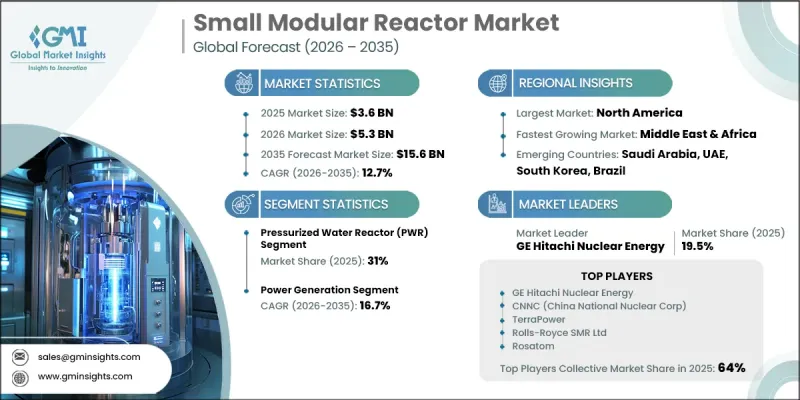
각국이 청정 전력 생산, 에너지 안보, 그리고 장기적인 탈탄소화 목표 달성을 위한 노력을 강화함에 따라 소형 모듈 원자로 시장은 놀라운 성장세를 보이고 있습니다. 디지털 인프라의 확대, 교통 수단의 전기화, 산업의 현대화에 힘입어 전력 소비량이 증가함에 따라 신뢰성이 높고 저탄소인 발전 기술에 대한 지속적인 수요가 발생하고 있습니다. 소형 모듈 원자로는 신뢰성 높은 발전과 유연한 도입, 그리고 필요한 부지 면적의 축소를 모두 갖추고 있으며, 매력적인 해결책으로 점점 더 인식되고 있습니다. 기존의 대규모 원자력 발전 시설과 달리, 이러한 원자로는 광범위한 송전 인프라의 업그레이드 필요성을 최소화하면서 지역의 에너지 수요에 더 적절하게 대응할 수 있는 소규모 용량 단위로 도입할 수 있습니다. 첨단형 원자로 개발의 지속적인 진전, 유리한 규제 체계, 그리고 정부의 지원 확대에 힘입어 전 세계적인 상용화 전망은 계속해서 개선되고 있습니다. 노후화된 기존 발전 시설의 폐지는 신뢰성 높은 베이스로드 전력 수요를 더욱 가속화하고 있으며, 소형 모듈 원자로는 미래 에너지 시스템의 핵심 구성 요소로서의 입지를 확고히 다져가고 있습니다. 이러한 구조적인 시장 촉진요인들은 장기적인 투자를 지속적으로 지원하며, 전 세계 소형 모듈 원자로 시장 전체의 성장 기회를 지속적으로 강화하고 있습니다.
| 시장 범위 | |
|---|---|
| 시작연도 | 2025년 |
| 예측 기간 | 2026-2035년 |
| 개시 금액 | 36억 달러 |
| 예측액 | 156억 달러 |
| CAGR | 12.7% |
가압수형 원자로(PWR) 부문은 2025년에 31%의 점유율을 차지하며, 2035년까지 연평균 성장률(CAGR) 16.3%를 기록할 것으로 전망됩니다. 이 부문이 주도적인 위치를 유지하고 있는 이유는 가압수형 원자로 기술이 풍부한 운전 실적, 확립된 연료 관리 기법, 검증된 안전 체계, 그리고 성숙한 엔지니어링 역량과 같은 강점을 갖추고 있기 때문입니다. 이러한 견고한 기술적 기반을 통해 개발사는 기존의 전문 지식을 소형 원자로 설계에 적용할 수 있을 뿐만 아니라, 규제 당국의 신뢰를 얻어 상용화를 가속화할 수 있게 됩니다.
발전 부문은 2025년에 80%의 점유율을 차지하고 있으며, 2026-2035년에 연평균 성장률(CAGR) 16.7%로 성장할 것으로 전망됩니다. 발전 부문은 안정적이고 조절 가능한 저탄소 전력에 대한 수요 증가를 반영하여, 신흥 소형 모듈 원자로 설계의 대부분에서 계속해서 주요 용도로 자리 잡고 있습니다. 또한 에너지 집약적 산업에서 신뢰할 수 있는 전력 공급 확보에 대한 관심이 높아짐에 따라 소형 모듈 원자로 기술에 대한 투자가 확대되고 있으며, 이는 발전 부문 전체의 장기적인 수요를 강화하고 있습니다.
북미의 소형 모듈 원자로 시장은 2025년에 47%의 점유율을 차지하며, 2035년까지 연평균 성장률(CAGR) 15.1%로 성장할 것으로 전망됩니다. 이 지역은 첨단인 원자력 규제 환경, 강력한 정부 자금 지원 정책, 민간 부문의 참여 확대, 그리고 원자로 개발 및 도입을 지원하는 확고한 상업적 파트너십을 바탕으로 계속해서 시장을 주도하고 있습니다. 청정 에너지 인프라에 대한 지속적인 투자와 우호적인 정책 지원으로 인해 예측 기간 중 북미의 주도적 지위가 유지될 것으로 전망됩니다.
자주 묻는 질문
목차
제1장 조사 방법과 범위
제2장 개요
제3장 업계 인사이트
제4장 경쟁 구도
제5장 시장 규모·예측 : 리액터 유형별, 2022-2035년
제6장 시장 규모·예측 : 용도별, 2022-2035년
제7장 시장 규모·예측 : 접속성별, 2022-2035년
제8장 시장 규모·예측 : 로케이션별, 2022-2035년
제9장 시장 규모·예측 : 용량별, 2022-2035년
제10장 시장 규모·예측 : 최종 사용별, 2022-2035년
제11장 시장 규모·예측 : 지역별, 2022-2035년
제12장 기업 개요
KSA 26.07.31The Global Small Modular Reactor Market was valued at USD 3.6 billion in 2025 and is estimated to grow at a CAGR of 12.7% to reach USD 15.6 billion by 2035.
The small modular reactor market is gaining significant momentum as countries strengthen their focus on clean electricity generation, energy security, and long-term decarbonization goals. Growing electricity consumption, driven by expanding digital infrastructure, transportation electrification, and industrial modernization, is creating sustained demand for reliable, low-carbon power generation technologies. Small modular reactors are increasingly recognized as an attractive solution because they combine dependable electricity generation with flexible deployment and reduced land requirements. Unlike conventional large-scale nuclear facilities, these reactors can be deployed in smaller capacity increments that better align with regional energy demand while minimizing the need for extensive transmission infrastructure upgrades. Ongoing progress in advanced reactor development, favorable regulatory frameworks, and increasing government support continue to improve commercialization prospects worldwide. The retirement of aging conventional power generation facilities is further accelerating demand for dependable baseload electricity, positioning small modular reactors as an important component of future energy systems. These structural market drivers continue to support long-term investment and strengthen growth opportunities across the global small modular reactor market.
| Market Scope | |
|---|---|
| Start Year | 2025 |
| Forecast Year | 2026-2035 |
| Start Value | $3.6 Billion |
| Forecast Value | $15.6 Billion |
| CAGR | 12.7% |
The pressurized water reactor (PWR) segment accounted for 31% share in 2025 and is projected to register a CAGR of 16.3% through 2035. The segment maintains its leading position because pressurized water reactor technology benefits from extensive operational experience, well-established fuel management practices, proven safety frameworks, and mature engineering capabilities. This strong technological foundation allows developers to adapt existing expertise to compact reactor designs while supporting regulatory confidence and accelerating commercial deployment.
The power generation segment held 80% share in 2025 and is anticipated to grow at a CAGR of 16.7% during 2026-2035. Electricity production continues to be the primary application for most emerging small modular reactor designs, reflecting growing demand for stable and dispatchable low-carbon power. Increasing interest from energy-intensive industries in securing reliable electricity supplies is also supporting stronger investment in small modular reactor technologies, reinforcing long-term demand across the power generation segment.
North America Small Modular Reactor Market held a 47% share in 2025 and is expected to grow at a CAGR of 15.1% through 2035. The region continues to lead the market due to its advanced nuclear regulatory environment, strong government funding initiatives, expanding private-sector participation, and well-established commercial partnerships supporting reactor development and deployment. Continued investment in clean energy infrastructure and favorable policy support are expected to sustain North America's leadership throughout the forecast period.
Major companies operating in the global small modular reactor market include NuScale Power, TerraPower, Westinghouse Electric Company, GE Hitachi Nuclear Energy, Rolls-Royce SMR Ltd, X-energy, Holtec International, Kairos Power, ARC Clean Technology, Terrestrial Energy, Moltex Energy, Oklo Inc., ThorCon Power, Seaborg Technologies, Ultra Safe Nuclear Corporation, General Atomics, EDF, Rosatom (NIKIET), CNNC (China National Nuclear Corp), and Huaneng Group. Companies operating in the small modular reactor market are strengthening their competitive position by investing heavily in advanced reactor research, technology development, and commercialization initiatives. Manufacturers continue to focus on improving reactor safety, operational efficiency, and modular construction methods to reduce project costs and accelerate deployment timelines. Strategic collaborations with governments, utilities, engineering firms, and technology partners are supporting project development and expanding commercial opportunities.
Table of Contents
Chapter 1 Methodology & Scope
- 1.1 Research design
- 1.2 Quality commitment
- 1.2.1 GMI AI policy & data integrity commitment
- 1.2.1.1 Source consistency protocol
- 1.2.1 GMI AI policy & data integrity commitment
- 1.3 Research Trail & Confidence Scoring
- 1.3.1 Research Trail Components
- 1.3.2 Scoring Components
- 1.4 Data Collection
- 1.4.1 Partial list of primary sources
- 1.5 Data mining sources
- 1.5.1 Paid sources
- 1.5.1.1 Sources, by region
- 1.5.1 Paid sources
- 1.6 Base estimates and calculations
- 1.6.1 Base year calculation for any one approach
- 1.7 Forecast model
- 1.8 Research transparency addendum
- 1.8.1 Source attribution framework
- 1.8.2 Quality assurance metrics
- 1.8.3 Our commitment to trust
- 1.9 Market definitions
Chapter 2 Executive Summary
- 2.1 Industry synopsis, 2022 - 2035
- 2.2 Business trends
- 2.3 Reactor type trends
- 2.4 Application trends
- 2.5 Connectivity trends
- 2.6 Location trends
- 2.7 Capacity trends
- 2.8 End use trends
- 2.9 Regional trends
Chapter 3 Industry Insights
- 3.1 Industry ecosystem
- 3.1.1 Raw material availability & sourcing analysis
- 3.1.2 Manufacturing capacity assessment
- 3.1.3 Supply chain resilience & risk factors
- 3.1.4 Distribution network analysis
- 3.2 Regulatory landscape
- 3.2.1 North America
- 3.2.2 Europe
- 3.2.3 Asia Pacific
- 3.2.4 Middle East & Africa
- 3.2.5 Latin America
- 3.3 Industry impact forces
- 3.3.1 Growth drivers
- 3.3.2 Industry pitfalls & challenges
- 3.4 Growth potential analysis
- 3.5 Porter's analysis
- 3.5.1 Bargaining power of suppliers
- 3.5.2 Bargaining power of buyers
- 3.5.3 Threat of new entrants
- 3.5.4 Threat of substitutes
- 3.6 PESTEL analysis
- 3.6.1 Political factors
- 3.6.2 Economic factors
- 3.6.3 Social factors
- 3.6.4 Technological factors
- 3.6.5 Legal factors
- 3.6.6 Environmental factors
- 3.7 Cost structure analysis of small modular reactor
- 3.8 Price trend analysis (Driven by Primary Research)
- 3.8.1 By capacity USD/MW (Driven by Primary Research)
- 3.8.2 Pricing strategy by player type (Premium / Value / Cost-plus) (Driven by Primary Research)
- 3.9 Production capacity & utilization (Driven by Primary Research)
- 3.9.1 Production capacity by region (Driven by Primary Research)
- 3.9.2 Utilization rates (Driven by Primary Research)
- 3.10 Impact of AI & generative AI on the market
- 3.10.1 Predictive maintenance & fault detection
- 3.10.2 Grid optimization & load forecasting
- 3.10.3 Digital twin simulation & testing
- 3.10.4 Risks, limitations & regulatory considerations
- 3.11 Emerging opportunities & trends
- 3.11.1 Digitalization & IoT integration
- 3.11.2 Emerging market penetration
- 3.12 Overall investment scenario and future outlook
Chapter 4 Competitive landscape, 2026
- 4.1 Introduction
- 4.2 Company market share analysis, by region, 2025
- 4.2.1 North America
- 4.2.2 Europe
- 4.2.3 Asia Pacific
- 4.2.4 Middle East & Africa
- 4.2.5 Latin America
- 4.3 Competitive analysis of major market players
- 4.4 Competitive positioning matrix
- 4.5 Key developments
- 4.5.1 Mergers & acquisitions
- 4.5.2 Partnerships & collaborations
- 4.5.3 New product launches
- 4.5.4 Expansion plans & funding
- 4.6 Company tier benchmarking
- 4.6.1 Tier classification criteria & qualifying thresholds
- 4.6.2 Tier positioning matrix by revenue, geography & innovation
Chapter 5 Market Size and Forecast, By Reactor type, 2022 - 2035 (USD Billion & MW)
- 5.1 Key trends
- 5.2 PWR
- 5.3 BWR
- 5.4 Fast neutron
- 5.5 HTGR
- 5.6 Molten salt / FHR
- 5.7 Others
Chapter 6 Market Size and Forecast, By Application, 2022 - 2035 (USD Billion & MW)
- 6.1 Key trends
- 6.2 Power generation
- 6.3 Industrial & process heat
- 6.4 Hydrogen production
- 6.5 Desalination & water treatment
- 6.6 Research / demonstration
Chapter 7 Market Size and Forecast, By Connectivity, 2022 - 2035 (USD Billion & MW)
- 7.1 Key trends
- 7.2 Grid-connected
- 7.3 Off-grid / remote
Chapter 8 Market Size and Forecast, By Location, 2022 - 2035 (USD Billion & MW)
- 8.1 Key trends
- 8.2 Land-based
- 8.3 Marine-based / floating
Chapter 9 Market Size and Forecast, By Capacity, 2022 - 2035 (USD Billion & MW)
- 9.1 Key trends
- 9.2 Below 50 MW
- 9.3 50-100 MW
- 9.4 101-300 MW
- 9.5 Above 300 MW
Chapter 10 Market Size and Forecast, By End use, 2022 - 2035 (USD Billion & MW)
- 10.1 Key trends
- 10.2 Utilities
- 10.3 Government / state enterprises
- 10.4 Industrial operators
- 10.5 Data centers
- 10.6 Others
Chapter 11 Market Size and Forecast, By Region, 2022 - 2035 (USD Billion & MW)
- 11.1 Key trends
- 11.2 North America
- 11.2.1 U.S.
- 11.2.2 Canada
- 11.3 Europe
- 11.3.1 UK
- 11.3.2 Poland
- 11.3.3 Romania
- 11.3.4 Russia
- 11.3.5 France
- 11.4 Asia Pacific
- 11.4.1 China
- 11.4.2 South Korea
- 11.4.3 Japan
- 11.4.4 India
- 11.5 Middle East & Africa
- 11.5.1 Saudi Arabia
- 11.5.2 UAE
- 11.5.3 South Africa
- 11.6 Latin America
- 11.6.1 Argentina
- 11.6.2 Brazil
Chapter 12 Company Profiles
- 12.1 ARC Clean Technology
- 12.2 CNNC
- 12.3 EDF
- 12.4 GE Hitachi Nuclear Energy
- 12.5 General Atomics
- 12.6 Holtec International
- 12.7 Huaneng Group
- 12.8 Kairos Power
- 12.9 Moltex Energy
- 12.10 NuScale Power
- 12.11 Oklo Inc.
- 12.12 Rolls-Royce SMR Ltd
- 12.13 Rosatom
- 12.14 Seaborg Technologies
- 12.15 TerraPower
- 12.16 Terrestrial Energy
- 12.17 ThorCon Power
- 12.18 Ultra Safe Nuclear Corporation
- 12.19 Westinghouse Electric Company
- 12.20 X-energy


